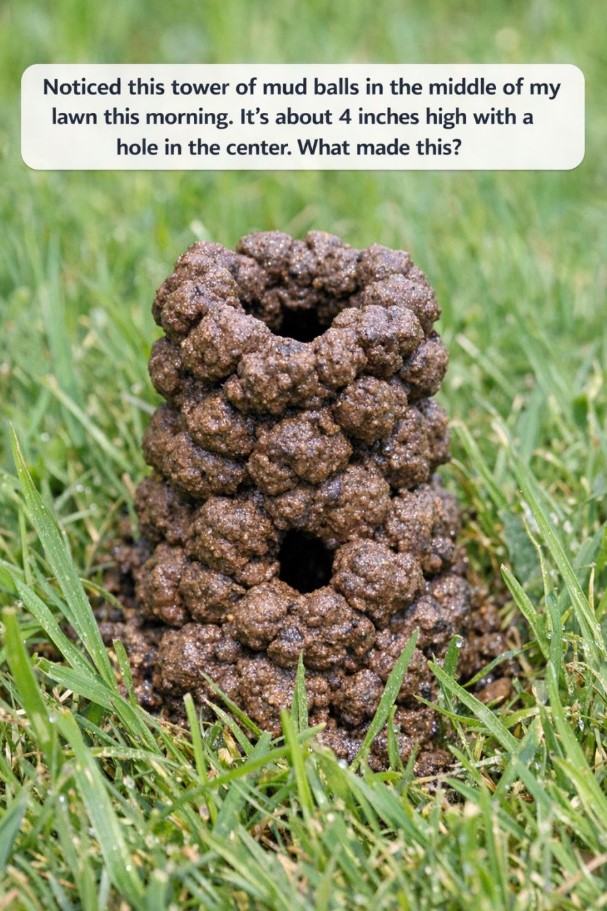
Waking up to find a strange tower of mud balls in the middle of your lawn — about four inches tall, with a hole in the center — can be surprising. Whether you’re a seasoned gardener or simply love spending time outdoors, unusual formations like this can leave you wondering what animal or natural process created it.
A structure of mud balls stacked into a small tower isn’t random. It’s typically the result of insects or other small animals behaving in ways you might not often see. By understanding animal behavior and soil activity, you can learn what likely made it, whether it’s harmless, and what it means for your yard.
This guide explains the most common possibilities, how to identify them, and whether you need to take action.
Most Likely Explanations: What Created the Mud Towers
1. Ant Hills / Fire Ant Activity
In some regions, ants — especially certain species like fire ants — create small piles of soil and mud as they build and expand nests underground. Worker ants excavate tunnels and bring soil particles above the surface, forming tiny pellets that can accumulate into a mound or tower.
Key features of ant-related soil heaps:
- Small soil pellets stacked or clustered
- A central hole (the entrance to the nest)
- Often found in lawns, pastures, or garden areas
- Soil may appear damp if ants mixed it with moisture while excavating
Fire ants and other mound-building ants are especially known for pushing soil out of underground chambers and tunnels.
2. Mud Dauber Wasp Nesting Behavior
Mud daubers are solitary wasps that build nests from mud. Unlike social wasps that create paper nests, mud daubers form tube-like or cylindrical mud structures. These can sometimes appear as stacks or towers of mud.
Signs this could be from a mud dauber:
- Smooth cylindrical mud tubes rather than loose soil pellets
- Often attached to structures like walls, fences, or rocks — but can appear on the ground if built on low surfaces
- A small hole leading into the structure where the adult wasp enters
Mud dauber nests are typically not dangerous; these wasps are not aggressive unless handled.
3. Earthworms Working the Soil
Some species of earthworms push castings (excreted soil and organic matter) to the surface. These castings can appear as small piles or balls of soil, especially in moist conditions.
What earthworm castings look like:
- Rounded, worm-cast piles
- Often scattered rather than stacked into a neat tower
- Usually soft rather than firm
Earthworm activity is usually a sign of healthy soil and is not harmful.
How to Identify Which It Is
1. Examine Texture and Shape
Take a closer look at the material:
- Loose soil pellets: Likely ant activity
- Tube-like mud with smoother surfaces: May be mud dauber nesting material
- Soft, crumbly castings: Earthworm activity
Note whether the particles look like pushed soil or shaped and smoothed mud.
2. Check for Movement
If you gently disturb the area:
- Ants may emerge quickly from the hole or nearby tunnels.
- Wasps do not usually stay near the nest and will not typically defend it like social wasps.
- Worm castings won’t have insect movement at all unless you uncover a worm.
Be cautious near ant activity; some ants can sting or bite if disturbed.
3. Consider Location and Weather
The position of the pile and recent weather conditions help narrow down the cause:
- Moist soil after rain or watering may encourage earthworm castings and ant tunneling.
- Dry, warm soil can sometimes lead to more visible ant mounds.
Patterns in your yard (e.g., multiple piles vs. a single mound) can also offer clues.
When You Need to Do Something
In most cases, a small mud tower in the lawn is not a major problem and can be left alone. However, you might want to take action if:
- You suspect fire ants and they are numerous — fire ants can sting and may require pest control measures.
- The mounds are damaging turf or interfering with lawn use.
- You see repeated mounds in the same lawn area, suggesting a large colony.
In those cases, consider consulting a local pest professional to confirm whether control measures are needed.
When You Can Leave It Alone
You can usually ignore these small soil formations when:
- The activity is limited and isolated
- No aggressive insects are present
- It’s caused by earthworms, which improve soil health
- The structure poses no hazard to people or pets
Many creatures that create these structures are part of a balanced ecosystem and do more good than harm.
Conclusion :
A small tower of mud balls in your lawn with a hole in the center is most likely the result of insects or soil-dwelling animals doing their normal activities. Ants — especially mound-building species — are a common reason, ejecting soil pellets as they expand underground tunnels. Mud dauber wasps make smooth mud tubes as nesting structures, and earthworms push castings to the surface that can look like small piles of soil.
Careful observation of texture, shape, and any insect activity can help you identify what created it. In most cases — particularly with earthworms and solitary wasps — these formations are harmless. Only in cases of aggressive ants or repeated, disruptive mounds should you consider taking action.
Understanding the behavior behind these lawn features turns mystery into clarity, helping you manage your outdoor space with confidence.