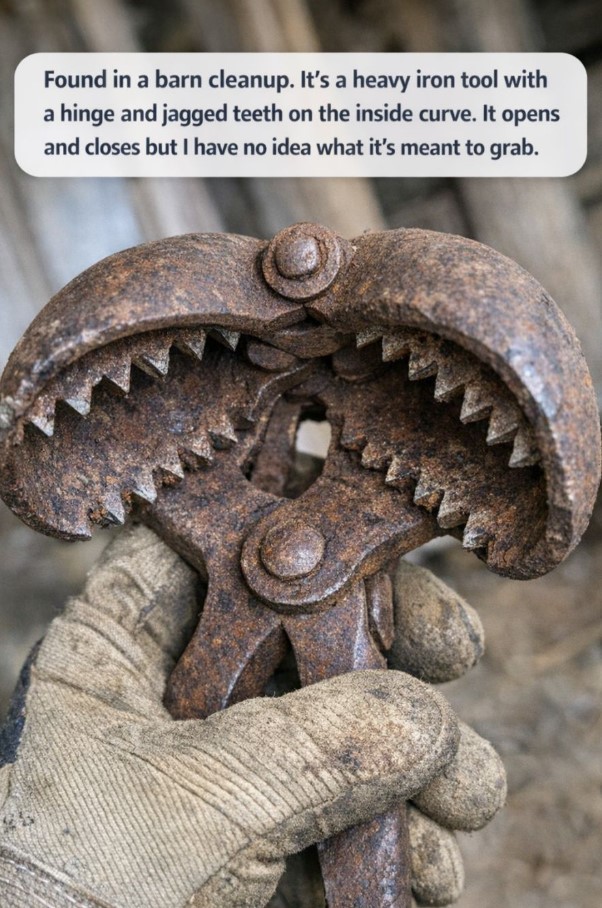
Between the dust-covered rafters, weathered wooden beams, and forgotten boxes tucked into shadowy corners, you never quite know what piece of history you’ll uncover. Sometimes it’s an old lantern. Sometimes it’s a wooden crate stamped with a company name long gone. And occasionally — it’s a strange, heavy iron tool with jagged teeth and a hinge that leaves you completely puzzled.
That’s exactly what happened during a recent barn cleanup. Among rusted hardware and relics of rural life, there sat a solid iron object with curved arms, sharp inner teeth, and a hinge mechanism that allowed it to open and close. It was heavy. Sturdy. Clearly built for serious work. But what was it meant to grab?
At first glance, it looks almost intimidating — like something designed to trap or clamp down on something solid. But the answer is far less mysterious and far more fascinating than you might expect.
A Closer Look at the Mystery Tool
The tool’s design offers clues:
- Two curved iron arms
- Jagged teeth along the inside curve
- A central hinge allowing the arms to open and close
- A loop or handle at the top
It’s clearly meant to grip something securely. The teeth are not decorative — they’re functional. The hinge mechanism suggests controlled pressure. And the heavy weight indicates it was built to handle something substantial.
After some research and comparison with antique tool collections, the answer becomes clear:
It’s an antique ice block tong.
Before Refrigerators: The Age of Ice Harvesting
To understand this tool, we need to step back to a time before modern refrigeration.
Before electric refrigerators became household staples, people relied on harvested ice to keep food fresh. During winter months, large blocks of ice were cut from frozen lakes and rivers. These blocks were then stored in insulated icehouses, packed in sawdust to preserve them through warmer seasons.
When someone needed ice, it wasn’t scooped from a freezer. It was delivered — often by horse-drawn wagon — in massive blocks that had to be handled carefully.
That’s where this heavy iron tool comes in.
How Ice Tongs Worked
Ice block tongs were specifically designed to grip large, slippery blocks of ice securely. The jagged teeth bit into the surface, while the hinge allowed the arms to clamp tighter as weight was applied.
The more weight suspended from the tool, the tighter it gripped.
This clever mechanical design meant that ice delivery workers could lift and carry heavy ice blocks without them slipping out. It was practical engineering at its finest — simple, durable, and effective.
Imagine maneuvering a 50- to 100-pound block of ice without modern gloves or machinery. These tongs were essential.
A Tool That Tells a Story
Finding one of these in a barn makes perfect sense.
Many rural homes had icehouses or relied on ice deliveries. Farmers and families would have kept tools like this for personal use or local trade. When refrigeration technology advanced in the early-to-mid 20th century, these tools were gradually retired — often stored away rather than discarded.
And there they stayed.
Hidden in barns.
Hung on nails.
Resting quietly in corners for decades.
Until someone stumbled upon them again.
Why It Feels So Mysterious Today
To modern eyes, an ice tong looks unusual. We’re accustomed to plastic coolers, automatic ice makers, and stainless steel appliances. A heavy, toothed iron clamp feels almost medieval by comparison.
Without context, it’s easy to mistake it for:
- A farming clamp
- A logging tool
- A blacksmith’s gripping device
- Or even something far more dramatic
But once you understand its purpose, it becomes a reminder of everyday life in a different era.
The Craftsmanship Behind Antique Tools
One of the most striking things about old tools like this is their durability. Cast iron construction allowed them to survive decades — even a century — with minimal deterioration beyond surface rust.
They weren’t disposable.
They weren’t plastic.
They were built to last.
And many still function perfectly today.
Collectors often seek antique ice tongs as decorative pieces, especially for farmhouse-style homes. They make striking wall décor in kitchens, workshops, or rustic interiors.
Could It Be Valuable?
While not extremely rare, antique ice tongs can have modest collectible value depending on:
- Manufacturer markings
- Condition
- Size
- Age
- Unique design features
Most commonly, they’re valued as nostalgic decorative pieces rather than high-ticket antiques. However, pieces in excellent condition or from well-known manufacturers may be worth more to collectors.
How to Identify Yours
If you find a similar tool, here are steps to confirm its identity:
- Look for manufacturer stamps or brand markings.
- Compare the shape and curvature to known ice tongs.
- Check if the teeth are designed to grip flat surfaces (like ice).
- Observe how the hinge tightens under weight.
A little research through antique tool databases or local historical societies can also help.
Why Discoveries Like This Matter
There’s something deeply meaningful about rediscovering tools like this.
They connect us to the daily routines of people who lived before us — to farmers hauling ice, to families preserving food, to a time when seasonal rhythms dictated storage and survival.
It reminds us that innovation evolves step by step.
What was once cutting-edge technology — ice harvesting and storage — has become obsolete. Yet the tools remain, quietly preserving history.
Conclusion:
What initially looks like a strange, intimidating iron device turns out to be a fascinating relic of everyday life from a bygone era.
This heavy, hinged tool with jagged teeth isn’t a trap or mysterious farm instrument — it’s an antique ice block tong, once essential for lifting and transporting large slabs of ice before refrigeration changed the world.
Discoveries like this are part of the joy of barn cleanups and estate finds. They remind us that every object has a story — and sometimes, all it takes is a little curiosity to uncover it.
So next time you find something unusual tucked away in an old building, don’t dismiss it too quickly.
It might just be a piece of history waiting to be rediscovered.