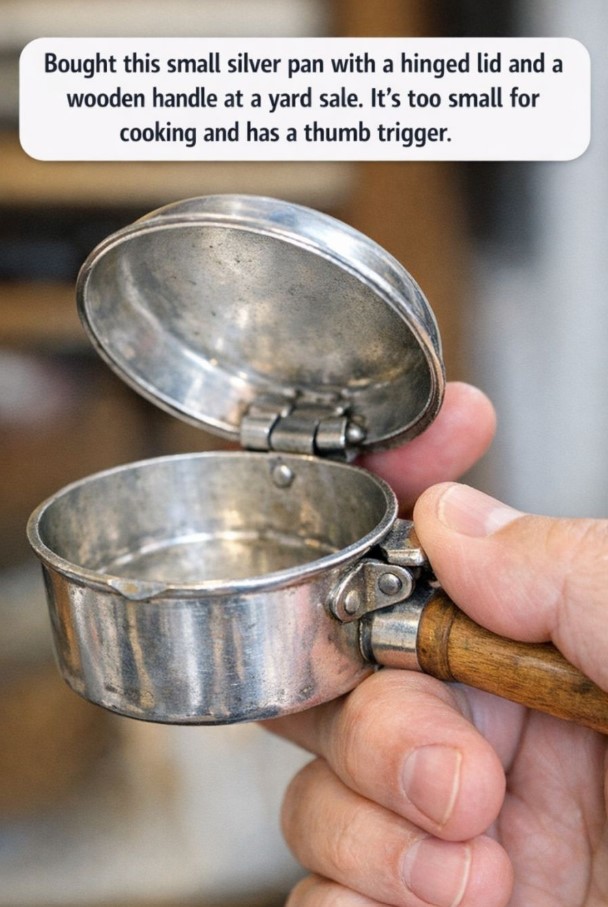
There’s something undeniably exciting about finding a mysterious object at a yard sale. You might scoop up old books, vintage dishes, tools, or even strange tools you’ve never seen before, thinking, “I wonder what this was used for!” That’s exactly what happens when someone brings home a small silver pan with a hinged lid and a wooden handle — except this one also had a thumb trigger, making it feel more like a gadget than a simple dish.
At first glance, it might seem too small to cook with, too refined to be a regular kitchen pan, and the thumb trigger only deepens the mystery: what exactly was this designed to grab, pour, or serve?
In this blog post, we’re going to take a trip through time and find out what this unusual object likely was, why it was made in this way, and how it might have been used in the past. From antique dining traditions to collectible curiosities, this little pan has a bigger story than its size suggests.
First Impressions: A Mysterious Little Pan
Imagine walking into a yard sale on a sunny weekend, sifting through tables of dishes, tools, and trinkets. Among them, something shiny catches your eye — a small metal pan, silver in color, with a hinged lid and a wooden handle. There’s a thumb trigger on the side, almost like it was meant to open the lid without touching it directly.
It feels too ornate to be just an everyday cooking pot, but too functional to be purely decorative. What was this?
Uncovering the History of Small Antique Pans
Objects like this are not unheard of — small pans with hinged lids were often crafted as serving vessels, condiment servers, or miniature cookware for specific tasks. Unlike regular saucepans used to cook entire meals, these miniature pans had specialized uses, such as:
- Serving gravy, melted butter, or sauces directly at the table
- Holding broths or consommés
- Melting small amounts of ingredients without exposing them to air
- Allowing precise pouring without lifting the entire vessel
In earlier times, households that could afford metal tableware often used finely made small pans or bowls for serving rather than cooking. These items became part of the dining ritual, especially in more formal settings.
Some of these pans were made from silver or silver‑plated metals, and their design included practical elements like hinged lids to protect contents from dust and insects while still allowing easy access.
Why the Thumb Trigger?
The thumb trigger is an interesting feature that gives this little pan a more mechanical feel. It suggests that the lid was meant to be opened one‑handedly — perhaps so the person holding the handle could serve contents without needing to set the pan down.
This type of design appears in serving equipment where:
- The contents are hot and the user shouldn’t need both hands
- Precision is important — for example, controlled pouring of sauces
- The tool is used rapidly or frequently during a meal
If you picture a formal dining table in the 19th or early 20th century, servants or hosts might serve gravy, melted butter, or even specialized sauces using a small hinged‑lid pan. The trigger allows them to open the lid while holding the vessel without needing a spoon or extra utensil.
Over time, as dining habits and kitchen technology changed, these specialized tools became less common, and kitchen gadgets consolidated into more universal cookware.
What It’s Not
Before we jump too far into historical guesses, it helps to know what this little pan almost certainly wasn’t:
- It’s unlikely to be a cooking pot meant for stove‑top use — there’s no large pan base
- It’s not a toy, even though small pans can sometimes resemble miniature play cookware
- It’s not a tool for industrial or mechanical use — the design is more culinary than mechanical
Instead, the shape, construction, and materials point toward a serving or food‑related purpose.
Similar Antique Items
Collectible silver pans or small service pieces like béarnaise pans, sauce pots, or mini stewpans often appear in antique collections. Many of these are small, elegant, and meant for tabletop serving rather than cooking large quantities. Some even include hinged lids similar to your find.
In online marketplaces and antiques listings, small silver‑plated pans with wooden handles are often described as:
- Sauce pans
- Gravy boats or miniature sauce servers
- Condiment pans
- Specialty serving vessels
These pieces may date from the late 19th to early 20th century when craftsmanship and table presentation were held in high regard, especially in middle‑class and upper‑class households.
Collectors sometimes pay attention to craftsmanship, hallmarks, and materials — silver plating and wooden handles often indicate that the piece was meant to look refined without being too heavy or expensive.
How to Tell What It Really Is
If you want to know exactly what your pan was used for, here are some practical ways to investigate:
1. Check for Markings
Look under the base or on the metal surface for maker’s marks or stamps. Antique silver‑plated tools often have markings that can identify their origin and period.
2. Compare Shapes
Look online for images of old sauce pans, condiment vessels, and serving pieces. The shape of the pan, lid, and handle can give clues about its purpose.
3. Consider the Size
If the pan is quite small — say just a few inches across — that’s a sign it was likely for sauces or small servings rather than full meal prep.
4. Ask Antique Experts
Local antique shops, historical societies, or online antiquarian forums often specialize in identifying vintage kitchen tools.
Why This Little Find Is Cool
Even if you never use this little pan for cooking, it’s fascinating for a few reasons:
- It tells a story about past dining practices — when meals were served with more formal tools.
- It reflects craftsmanship — the combination of metalwork and wood handle shows attention to both form and function.
- It’s a collectible that many people enjoy displaying, especially in kitchens styled with vintage charm.
What You Can Do With It Today
Found objects like this can be repurposed in creative ways:
- Display it as vintage décor
- Use it as a dish for serving very small amounts of sauces or relishes at dinner parties
- Turn it into a decorative container for trinkets
- Keep it as part of a collection of antique kitchen tools
Either way, it’s a conversation piece — and that’s part of the magic of yard sale finds.
Conclusion:
A small silver pan with a hinged lid and wooden handle might look like an odd kitchen gadget at first, but once you understand its likely purpose, it becomes a window into the daily rituals of dining history.
Originally, tools like this weren’t just practical — they were part of an era when serving food was an art form, and every piece on the table had a purpose. Whether it held sauce, melted butter, or another condiment, it would have played its part quietly — and now, decades later, it’s back in your hands, waiting to tell its story.
So next time you find a curious item at a yard sale, take a moment to imagine where it came from. Sometimes the tiniest objects have the richest histories.