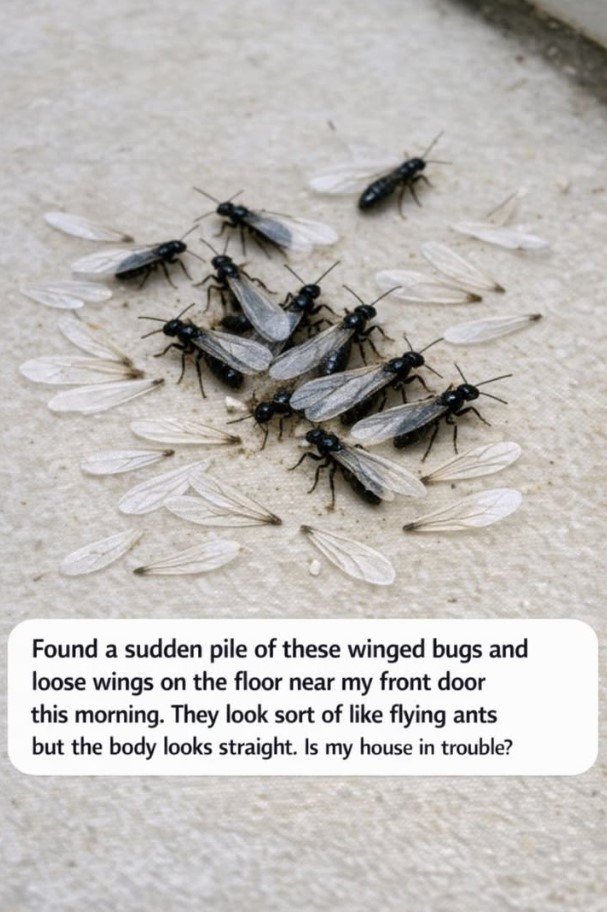
Walking up to your front door and finding a sudden pile of tiny winged insects—along with scattered loose wings on the floor—can be alarming. At first glance, they often look like flying ants, but many homeowners worry they could actually be termites.
That concern makes sense, because both flying ants and termite swarmers appear suddenly, often in large numbers, and both shed wings after landing. The difference is important: flying ants are usually more of a nuisance, while termite swarmers can signal a nearby termite colony.
One of the biggest clues is the pile of discarded wings. Experts note that termite swarmers often lose their wings quickly after landing, which is why homeowners commonly find wings near doors, windows, and light sources.
What These Winged Bugs Often Are
In many cases, they are either:
- Flying ants (reproductive ants during swarming season)
- Termite swarmers (winged termites leaving to form new colonies)
Both appear during warm, humid weather—especially after rain—and are often attracted to porch lights or indoor lighting.
This is why they often show up suddenly near front doors.
How to Tell the Difference
There are three main things to check:
1. The Wings
Termites
- Four wings of equal size
- Wings are long, pale, and fragile
- Wings fall off easily and pile up nearby
Flying Ants
- Front wings are larger than back wings
- Wings stay attached longer
Equal-sized discarded wings strongly point toward termites.
2. The Waist
Termites
- Straight, thick body
- No narrow “pinched” waist
Flying Ants
- Narrow, pinched waist like a classic ant
That pinched waist is often the fastest clue.
3. The Antennae
Termites
- Straight antennae
Flying Ants
- Bent or elbow-shaped antennae
This detail helps confirm identification if you can look closely.
Why They Show Up Near the Front Door
Swarmers are strongly attracted to light.
That means:
- Porch lights
- Entryway lamps
- Windows
- Glass doors
…often become the main place where people first notice them.
A Reddit user described seeing the same thing and another commenter explained: “The light at night typically attracts them.”
When It’s More Likely to Be Termites
It becomes more concerning if you notice:
- Large piles of loose wings
- Swarmers appearing indoors
- Mud tubes near the foundation
- Soft or damaged wood
- Repeated swarms near the same area
Southern Living notes that dead swarmers or shed wings indoors can indicate termite activity and should prompt inspection.
What You Should Do Next
If it’s outside only:
It may simply mean a nearby outdoor colony is swarming.
If it’s inside:
It’s more important to get the insects identified quickly.
Experts recommend collecting a few specimens for identification and checking for signs of wood damage rather than relying only on appearance.
Avoid spraying blindly before knowing whether they are ants or termites—the treatment is different.
Conclusion :
Finding a sudden pile of winged bugs and loose wings near your front door is often a sign of seasonal swarming—but whether it’s flying ants or termite swarmers makes a big difference.
Flying ants are usually annoying but harmless. Termite swarmers, however, may suggest a nearby colony that could eventually affect the home. The biggest clues are equal-sized wings, straight bodies, and piles of shed wings—those often point toward termites.
The good news is that one swarm does not automatically mean major damage. But it does mean it’s worth paying attention.
In the end, the loose wings are often the real message: something nearby is trying to start a new colony—and identifying which insect it is should be the first step.