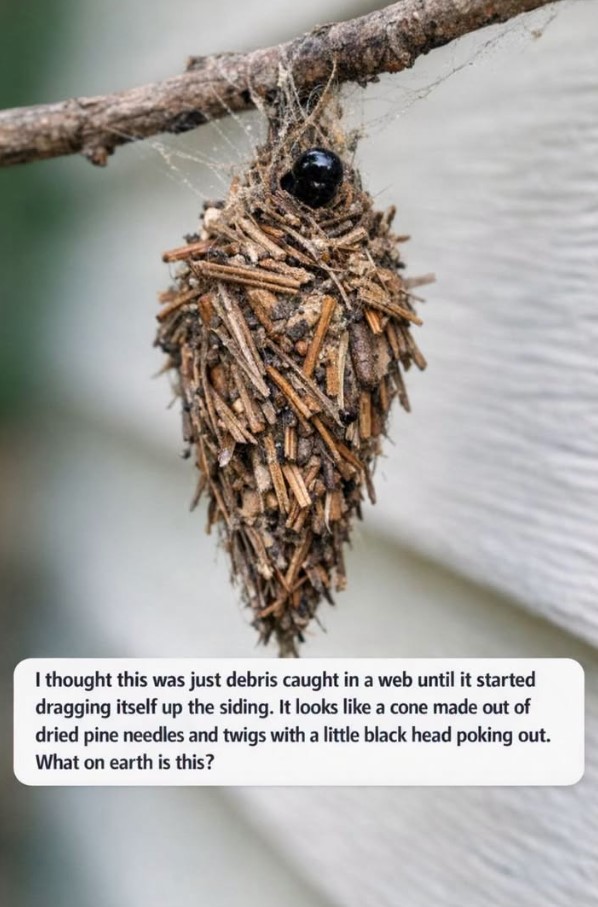
At first glance, it looks like nothing more than a tiny bundle of dried pine needles, twigs, and leaves caught in a spider web. Most people would probably brush it away without giving it a second thought. But then something unexpected happens—it begins to move. Slowly, the little cone inches its way across your home’s siding or along a nearby branch, leaving you wondering if you’re witnessing some kind of strange natural phenomenon.
If you’ve recently noticed one of these unusual cases hanging from a tree, fence, or exterior wall, you’re certainly not alone. Every year, curious homeowners and gardeners discover these mysterious little structures and immediately start asking the same question: What is this thing? Is it dangerous? Should I remove it?
The answer is both fascinating and surprisingly simple. What you’re seeing isn’t debris at all—it’s actually the portable home of an insect commonly known as the bagworm. These remarkable caterpillars are masters of camouflage, building protective cases from bits of the very plants they feed on. Their unique appearance allows them to blend almost perfectly into their surroundings, making them difficult to spot until they begin moving.
Understanding what bagworms are, how they live, and whether they pose a threat to your landscape can help you decide if action is necessary or if nature is simply putting on another incredible display.
What Exactly Is a Bagworm?
A bagworm is the larval stage of a moth belonging to the family Psychidae. Unlike most caterpillars that crawl around in plain sight, bagworms spend nearly their entire lives inside a protective case that they construct themselves.
Using silk as a foundation, the young caterpillar gathers tiny pieces of:
- Pine needles
- Small twigs
- Bark fragments
- Leaves
- Grass
- Bits of dried plant material
It carefully attaches these materials to its silk case, creating what looks like a tiny pinecone or bundle of forest debris. As the caterpillar grows, it continues adding new materials, enlarging its portable shelter throughout the season.
This clever disguise serves two important purposes:
- It hides the caterpillar from birds and predators.
- It protects its soft body from weather and environmental hazards.
Why Does It Look Like It’s Carrying a Tiny House?
Unlike many insects that leave their shelters behind, bagworms never truly abandon theirs while they’re growing.
The caterpillar keeps its body safely hidden inside the case, extending only its head and legs when it’s time to move or feed. When disturbed, it quickly pulls itself back inside, making the entire structure appear completely lifeless.
This remarkable behavior often surprises homeowners because the “bag” suddenly begins crawling across a wall, tree trunk, or shrub, creating the illusion that a pile of sticks has somehow come to life.
Where Are Bagworms Commonly Found?
Bagworms are found throughout many parts of North America and are especially common in areas with plenty of trees and ornamental shrubs.
They are frequently spotted on:
- Arborvitae
- Juniper
- Cedar
- Spruce
- Pine
- Cypress
- Boxwood
- Evergreen hedges
- Some deciduous trees
Occasionally, they’ll also attach themselves to:
- House siding
- Wooden fences
- Porch railings
- Decks
- Outdoor furniture
- Mailboxes
Their excellent camouflage often means dozens of bagworms may be present before anyone notices them.
Are Bagworms Harmful?
The answer depends largely on how many there are.
Finding one or two bagworms usually isn’t cause for alarm. Nature contains countless insects, and isolated individuals rarely cause significant damage.
However, when large populations develop, bagworms can become serious pests.
Each caterpillar feeds on plant foliage while safely hidden inside its protective case. A small infestation may remove only a few leaves or needles, but hundreds of bagworms feeding together can strip entire branches bare.
In severe cases, repeated defoliation may weaken or even kill valuable ornamental shrubs and young evergreen trees.
How Do Bagworms Damage Plants?
Bagworms chew on leaves and needles, gradually removing the plant’s ability to produce energy through photosynthesis.
Early signs of infestation include:
- Brown patches in evergreen shrubs
- Sparse foliage
- Missing needles
- Branch dieback
- Uneven plant growth
Because their cases blend in so well, many homeowners don’t realize what’s happening until visible damage has already occurred.
Regular inspection is especially important for evergreen trees, where bagworms often remain unnoticed until late summer.
Their Incredible Life Cycle
One reason bagworms are so fascinating is their unusual life cycle.
In spring, tiny caterpillars hatch from eggs that spent the winter safely inside an old bag.
Shortly after emerging, each young larva begins constructing its own protective case using silk and nearby plant material.
Throughout spring and summer, the caterpillar:
- Eats foliage
- Enlarges its case
- Moves from branch to branch
- Continues adding camouflage
By late summer or early fall, it has reached full size.
At this point, the caterpillar attaches its bag securely to a branch or other surface before transforming into an adult.
The differences between males and females are remarkable.
- Adult males become small dark moths with wings and leave their bags to search for females.
- Adult females remain wingless and never leave the protective case they built as caterpillars.
After mating, the female lays hundreds of eggs inside the same bag before dying, allowing the cycle to begin again the following spring.
How Can You Tell If It’s Really a Bagworm?
Although bagworms are excellent at blending into their surroundings, there are a few characteristics that make them easier to identify once you know what to look for.
Look for these signs:
- A cone-shaped or spindle-shaped case made from leaves, needles, or small twigs.
- A small dark or black head that occasionally emerges from one end.
- Slow movement across tree bark, siding, fences, or branches.
- The case hanging from a branch by a thin strand of silk.
- Visible feeding damage on nearby plants.
Unlike spider egg sacs or bird nests, a bagworm case is portable and moves with the insect inside.
Should You Remove It?
Whether you should remove a bagworm depends on where you find it and how many are present.
If you discover only one or two cases on a tree or shrub, removing them by hand is usually enough to prevent future problems. Simply wear gloves, gently pull the bag from the branch, and place it in a sealed bag before throwing it in the trash.
However, if dozens of bagworms are attached to the same plant, it’s a sign of a larger infestation that may require more thorough management.
The sooner you act, the easier it is to protect your trees and shrubs from extensive damage.
Natural Ways to Control Bagworms
Many gardeners prefer starting with environmentally friendly solutions before considering stronger treatments.
Hand Removal
This is often the simplest and most effective method for small infestations.
During late fall, winter, and early spring, inspect trees and shrubs carefully. Removing the bags before the eggs hatch can prevent hundreds of new caterpillars from appearing the following season.
Encourage Birds
Many bird species feed on insects and help maintain a healthy garden ecosystem.
Creating a bird-friendly yard by providing water, native plants, and nesting areas may encourage natural predators to visit your property.
Maintain Healthy Plants
Strong, healthy shrubs are generally better able to recover from minor insect feeding than stressed or neglected plants.
Proper watering, pruning, and fertilization help improve a plant’s natural resilience.
When Is Chemical Treatment Necessary?
Large infestations sometimes require insecticides, especially if valuable ornamental trees are at risk.
Products designed specifically for caterpillars are usually most effective when the larvae are still young and actively feeding. Once the bagworms mature and their protective cases become thicker, treatments become much less effective.
Always read and follow the product label carefully, paying close attention to application timing and safety precautions.
Common Myths About Bagworms
Because they look so unusual, bagworms are surrounded by plenty of misconceptions.
Myth 1: They’re Spider Nests
This is probably the most common misunderstanding. While spiders may occasionally build webs nearby, the cone-shaped structure is actually made by a caterpillar—not a spider.
Myth 2: They’re Harmful to People
Bagworms do not bite, sting, or spread diseases to humans or pets. Their primary concern is damage to ornamental plants rather than personal safety.
Myth 3: Every Moving Twig Is a Bagworm
Nature includes many insects that camouflage themselves with plant material. Although bagworms are among the best-known examples, not every moving bundle of debris belongs to the same species.
Why Nature Uses Camouflage
The bagworm is a wonderful example of how animals evolve remarkable survival strategies.
Its homemade case provides protection from:
- Birds
- Predatory insects
- Extreme weather
- Dry conditions
- Curious animals
By disguising itself as ordinary plant debris, the bagworm often goes completely unnoticed, giving it a much greater chance of surviving to adulthood.
Scientists consider camouflage one of nature’s most effective defense mechanisms, and the bagworm is among its finest examples.
Frequently Asked Questions :
Can bagworms kill trees?
Yes. A few bagworms usually cause only minor damage, but heavy infestations can severely weaken or even kill young evergreen trees after repeated feeding.
Do bagworms move?
Absolutely. The caterpillar extends its head and legs from the opening of the bag to crawl slowly across plants and other surfaces while carrying its protective case.
Are they dangerous to humans?
No. Bagworms are harmless to people and pets. They neither bite nor sting.
What time of year are they most active?
Young caterpillars typically emerge during spring. They feed throughout spring and summer before reaching maturity in late summer or early autumn.
Can I simply leave them alone?
If you find only one isolated bagworm away from valuable landscape plants, leaving it alone usually isn’t a problem. However, if you notice several on ornamental shrubs or evergreens, early removal is recommended to prevent future damage.
Conclusion :
Discovering what looks like a tiny bundle of sticks crawling across your home’s siding can certainly be surprising. At first glance, it resembles nothing more than windblown debris tangled in a spider web, but a closer look reveals one of nature’s most remarkable little architects—the bagworm. Its ability to build a portable home from twigs, leaves, and pine needles is an extraordinary example of camouflage and adaptation.
While these insects are fascinating to observe, it’s also important to recognize when they transition from harmless curiosity to potential garden pest. A single bagworm is rarely a reason for concern, but larger populations can cause significant damage to evergreen trees, shrubs, and ornamental landscaping if left unchecked. Regularly inspecting your plants, especially during the growing season, allows you to spot problems early when they’re much easier to manage.
Fortunately, keeping bagworms under control doesn’t always require complicated solutions. Hand-picking cases during the dormant season, encouraging natural predators, maintaining healthy plants, and monitoring vulnerable shrubs are often enough to prevent serious infestations. If a larger outbreak occurs, timely treatment while the caterpillars are still young can help protect valuable landscape plants.
Perhaps the greatest lesson from the bagworm is a reminder that nature is full of incredible surprises. What first appears to be an ordinary clump of dried leaves can actually be a living creature demonstrating one of the most sophisticated camouflage techniques in the insect world. By learning to recognize these unusual insects, homeowners can appreciate their remarkable biology while also making informed decisions to keep gardens healthy, attractive, and thriving throughout the year.