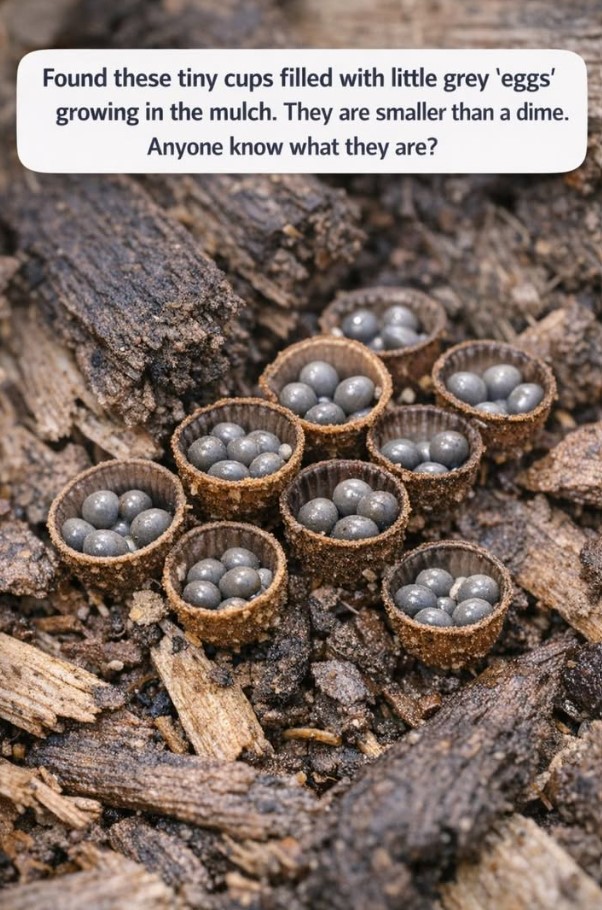
Gardening often comes with unexpected surprises. Whether you’re planting flowers, spreading fresh mulch, or simply inspecting your yard after a rainy day, it’s not uncommon to discover strange-looking organisms that seem almost too unusual to be real. One of the most fascinating finds is a cluster of tiny cup-shaped structures filled with what appear to be miniature gray eggs. At first glance, many people assume they’ve stumbled upon insect eggs or the nest of some mysterious creature.
Fortunately, the explanation is much less alarming—and far more interesting. These tiny cups are actually the fruiting bodies of a unique group of fungi known as bird’s nest fungi. Although their appearance may seem unusual, they play an important role in nature and are generally considered harmless to people, pets, and plants.
Let’s take a closer look at these remarkable fungi and discover why they often appear in gardens and landscaped areas.
What Are These Tiny Cups?
Despite looking like miniature nests filled with eggs, these structures are not created by insects or birds.
They belong to a fascinating group of fungi commonly called bird’s nest fungi, named for their striking resemblance to tiny bird nests containing eggs.
Each “egg” is actually a small spore-containing structure called a peridiole, which holds thousands of microscopic spores that help the fungus reproduce.
Their unusual appearance has made them one of the most photographed fungi found in home gardens.
Why Do They Grow in Mulch?
Bird’s nest fungi thrive in environments rich in decaying organic matter.
They are commonly found in:
- Wood mulch
- Bark chips
- Compost piles
- Rotten logs
- Decaying branches
- Leaf litter
- Forest floors
Freshly mulched flower beds provide ideal conditions because they retain moisture and contain plenty of decomposing wood for the fungi to feed on.
After periods of rain or high humidity, they often appear seemingly overnight.
Are They Really Eggs?
One of the biggest misconceptions is that the gray spheres are eggs waiting to hatch.
In reality, they are reproductive structures.
Each tiny “egg” contains fungal spores that allow the organism to spread and colonize new areas.
The resemblance to eggs is simply a coincidence created by evolution.
How Do They Spread?
Bird’s nest fungi have developed an ingenious method of reproduction.
When raindrops strike the tiny cups, the force launches the spore-filled “eggs” into the air.
Some species can propel these structures several feet away from the original cup.
The sticky outer coating helps them attach to nearby plants, twigs, or other surfaces where spores can eventually be released under suitable conditions.
It’s an impressive natural strategy that helps ensure the fungus spreads effectively.
Are They Harmful?
The good news is that bird’s nest fungi are generally harmless.
They do not:
- Damage healthy plants.
- Harm lawns.
- Attack flowers or vegetables.
- Pose a threat to pets.
- Cause structural damage to gardens.
In fact, they perform a valuable ecological service by helping break down dead wood and other organic materials.
This natural recycling process returns nutrients to the soil and supports healthy ecosystems.
Should You Remove Them?
In most cases, removal isn’t necessary.
Many gardeners simply leave them alone because they disappear naturally as conditions become drier.
However, if you’d prefer to reduce their presence, you can:
- Replace old mulch with fresh material.
- Turn or rake mulch regularly to encourage drying.
- Improve air circulation around planting beds.
- Avoid excessive watering.
- Remove heavily decayed organic matter.
These steps make the environment less favorable for fungal growth.
Why They Fascinate Nature Lovers
Bird’s nest fungi are among nature’s smallest and most remarkable organisms.
Their intricate design has fascinated scientists and photographers for decades.
Their tiny cups, perfectly rounded “eggs,” and ingenious spore-launching system demonstrate how even the smallest forms of life can develop highly specialized survival strategies.
Many people discover them only after years of gardening, making each encounter feel like uncovering a hidden natural treasure.
Other Interesting Facts
Here are a few fun facts about bird’s nest fungi:
- Most species measure less than half an inch across.
- The cups are often smaller than a dime.
- They are found on every continent except Antarctica.
- Their colors range from tan and brown to gray and black.
- They play an important role in decomposing wood and plant material.
- They are considered beneficial members of many garden ecosystems.
Their unusual appearance makes them one of the easiest fungi to recognize once you know what you’re looking for.
Appreciating Nature’s Small Wonders
Many mysterious objects we encounter outdoors turn out to have perfectly natural explanations.
Instead of being something dangerous or unusual, bird’s nest fungi remind us that nature is full of extraordinary forms that often go unnoticed because of their tiny size.
Taking time to observe these fascinating organisms can make even routine gardening feel like an opportunity for discovery.
Sometimes the most interesting wildlife isn’t found in large animals or colorful flowers—but in tiny organisms quietly performing essential work beneath our feet.
Conclusion :
Finding clusters of tiny cup-shaped structures filled with gray “eggs” in your mulch may seem mysterious at first, but they’re actually one of nature’s most fascinating fungi. Bird’s nest fungi are harmless decomposers that help recycle dead organic material, enriching the soil and supporting a healthy garden ecosystem. Their remarkable appearance and unique method of dispersing spores make them a wonderful example of the creativity and complexity found in the natural world.
Rather than viewing them as a problem, many gardeners choose to appreciate these miniature marvels as a sign that nature is actively at work breaking down organic matter. They require no treatment in most situations and typically disappear on their own as weather conditions change. If they become too numerous for your liking, simple gardening practices such as reducing excess moisture and refreshing old mulch can help limit their growth.
The next time you spot something unusual while working in your garden, resist the urge to assume the worst. A little curiosity and research can transform a puzzling discovery into a fascinating lesson about the incredible diversity of life that exists all around us. Sometimes the smallest organisms turn out to be the most captivating, reminding us that nature is filled with hidden wonders waiting to be explored.