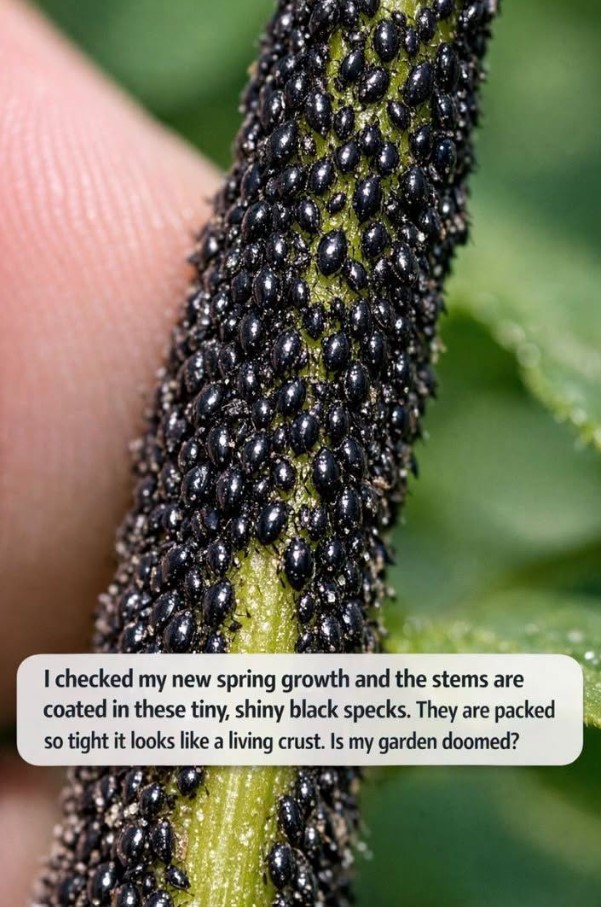
Few things are more discouraging for a gardener than stepping outside to admire fresh spring growth only to discover that the tender stems are covered with hundreds of tiny black insects. At first glance, they can look like seeds, dirt, or even mold, but a closer inspection reveals that they are alive—and multiplying quickly. It’s easy to assume the worst and wonder whether your carefully tended garden is beyond saving.
The good news is that while this sight can be alarming, your garden is almost certainly not doomed. Those tiny black specks are most likely aphids, one of the most common garden pests. They reproduce rapidly and gather in dense colonies on new shoots, but with prompt action and a little patience, they can usually be brought under control before they cause serious damage.
Here’s what these insects are, why they appear, how much harm they can do, and the safest, most effective ways to protect your plants.
What Are Those Tiny Black Specks?
The insects covering the stems are almost certainly black aphids, also called plant lice. Aphids are tiny, soft-bodied insects that feed by piercing plant tissue and sucking out nutrient-rich sap.
Unlike many garden pests that scatter when disturbed, aphids prefer to cluster together in large groups. They are especially attracted to fresh, tender growth because the sap is easier to access and contains more nutrients.
A single colony can contain hundreds or even thousands of aphids, making an infestation seem like it appeared overnight.
Why Aphids Love New Spring Growth
Spring is the perfect season for aphids because plants are producing soft, nutrient-rich shoots that are easy to feed on.
They commonly gather on:
- New stems
- Flower buds
- Young leaves
- Vegetable seedlings
- Fruit tree shoots
- Rose bushes
- Bean plants
- Peppers
- Tomatoes
- Milkweed and many ornamentals
Since many aphids reproduce without mating, one female can produce dozens of offspring in a very short period. Those offspring mature quickly and begin reproducing themselves, causing populations to explode within days.
Signs That Aphids Are Feeding
The insects themselves are the first obvious clue, but there are several other warning signs.
You may notice:
- Curled or twisted leaves
- Stunted new growth
- Yellowing foliage
- Deformed flower buds
- Sticky residue on leaves
- Increased ant activity
- Slow plant growth
If left untreated for long periods, severe infestations can weaken plants and reduce flowering or fruit production.
What Is the Sticky Substance?
One of the most noticeable signs of aphids is a shiny, sticky coating called honeydew.
Honeydew is essentially excess sugar that aphids excrete after feeding on plant sap.
Although harmless by itself, it creates additional problems because it:
- Attracts ants
- Encourages black sooty mold
- Makes leaves sticky
- Blocks sunlight when mold develops
If you notice shiny leaves beneath the aphid colony, honeydew is usually the reason.
Why Are Ants Always Nearby?
Many gardeners notice ants crawling around aphid colonies.
This isn’t a coincidence.
Ants actually protect aphids because they feed on the sugary honeydew the insects produce.
The ants:
- Defend aphids from predators
- Chase away ladybugs
- Move aphids to fresh plants
- Help maintain healthy aphid colonies
If you eliminate the aphids, the ants usually disappear as well.
Can Aphids Kill a Plant?
In most cases, no.
Healthy, established plants often recover well after an aphid infestation is controlled.
However, aphids can become dangerous when:
- Plants are already stressed
- Seedlings are very young
- Infestations are extremely heavy
- They transmit plant viruses
- Feeding continues for several weeks
The sooner you act, the less likely your plants are to suffer lasting damage.
The First Thing You Should Do
Before reaching for insecticides, simply inspect the entire plant.
Check:
- Undersides of leaves
- Stem joints
- Flower buds
- Nearby plants
Aphids spread easily, so neighboring plants may already be affected.
Wash Them Off with Water
One of the easiest and safest solutions is surprisingly simple.
Use a strong spray of water from a garden hose.
Aim directly at the colonies.
Many aphids will be knocked off and cannot easily climb back onto the plant.
Repeat every few days until their numbers drop significantly.
This method works especially well for established outdoor plants.
Try Insecticidal Soap
If water alone isn’t enough, insecticidal soap is one of the safest treatments.
It works by breaking down the insects’ protective outer coating.
To use it:
- Spray thoroughly over the insects.
- Cover stems and leaf undersides.
- Apply during cooler parts of the day.
- Repeat according to the product instructions.
Because the soap only works on insects it contacts directly, good coverage is essential.
Neem Oil Can Help
Neem oil is another popular organic treatment.
It not only kills some insects directly but also disrupts their feeding and reproductive cycle.
Use neem oil carefully:
- Apply early morning or evening.
- Avoid spraying during intense sunlight.
- Never spray open flowers while bees are actively visiting.
Invite Nature’s Helpers
Fortunately, aphids have many natural enemies.
Beneficial insects include:
- Ladybugs
- Lacewings
- Hoverfly larvae
- Parasitic wasps
These predators can consume hundreds of aphids and often bring infestations under control naturally.
Avoid broad-spectrum insecticides whenever possible, since they can also kill these helpful insects.
Remove the Worst-Affected Growth
If only a few stems are heavily infested, pruning them off may be the fastest solution.
Dispose of the cuttings in the trash rather than composting them if the infestation is severe.
Removing the largest colonies immediately reduces the population and gives the plant a chance to recover.
Prevent Future Infestations
While no garden is completely aphid-proof, a few habits can greatly reduce future outbreaks.
Helpful practices include:
- Inspect new growth regularly.
- Encourage beneficial insects.
- Avoid excessive nitrogen fertilizer, which produces extra-soft growth.
- Keep plants healthy with proper watering.
- Remove weeds that may harbor aphids.
- Space plants to improve airflow.
Frequent inspections are often the best defense, allowing you to catch small colonies before they become major infestations.
When Should You Worry?
Most aphid infestations are manageable.
However, consider stronger intervention if:
- Entire plants are covered.
- Leaves are dropping rapidly.
- New growth stops completely.
- Multiple plants become infested at once.
- Repeated treatments show little improvement.
Persistent infestations may require a combination of pruning, repeated washing, beneficial insects, and targeted treatments.
The Bottom Line
Seeing your plants covered in what looks like a living layer of tiny black insects can be shocking, especially after you’ve spent weeks nurturing fresh spring growth. Fortunately, black aphids are a common challenge rather than a sign that your garden is beyond saving. While they multiply quickly and can weaken plants if ignored, they are also among the easiest garden pests to manage when caught early.
Regular inspections, a strong spray of water, insecticidal soap, neem oil, and encouraging beneficial insects can dramatically reduce aphid populations without harming your plants or the surrounding ecosystem. Most healthy plants bounce back once the insects are removed, often producing vigorous new growth within a few weeks.
Remember that every experienced gardener encounters pests from time to time. The difference between a temporary setback and a serious problem is simply how quickly you respond. Stay observant, act promptly, and continue caring for your plants consistently. With patience and the right approach, your garden can recover beautifully, and those alarming black clusters will soon be nothing more than a learning experience on your journey to becoming a more confident gardener.