Have you ever encountered a question that looks so easy you answer it immediately, only to discover that you may have missed an important detail?
This simple cow puzzle is a perfect example.
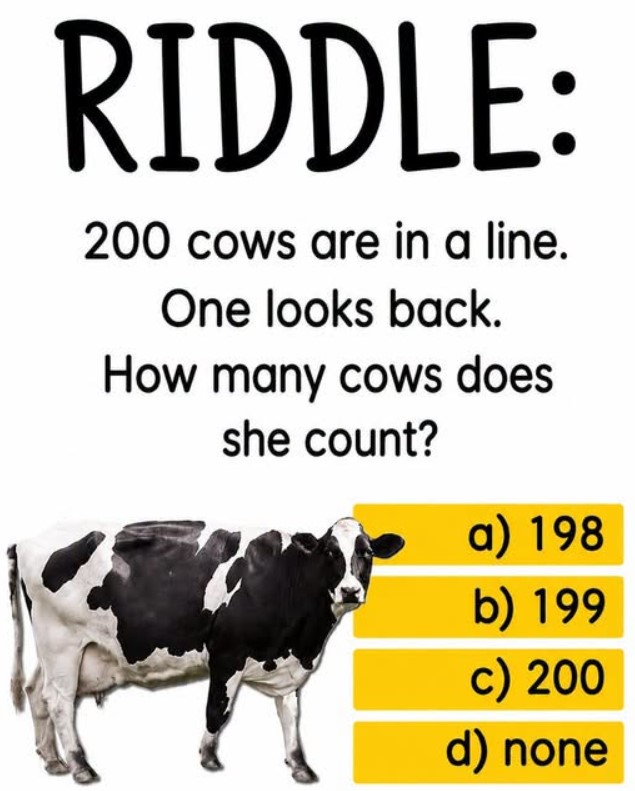
Imagine 200 cows standing in a straight line. One of the cows turns around and looks behind her. The question is:
“200 cows are in a line. One looks back. How many cows does she count?”
At first, the answer may seem obvious. Many people immediately say 199 because they imagine the cow standing at the very front of the line and looking back at all the cows behind her.
But there is a catch.
The question never tells us which cow is looking backward.
That small omission completely changes the puzzle. Depending on where the cow is standing, several different answers can be correct.
First, Read the Question Carefully
Before jumping to an answer, think about exactly what the puzzle tells us.
There are 200 cows.
They are standing in a line.
One cow looks backward.
Then we are asked how many cows she counts.
Notice what the question does not tell us. It does not say that the cow is first in line, second in line, somewhere in the middle, or at the very end.
That missing information is the key.
Our brains often fill in gaps automatically. When we hear that animals are standing in a line and one turns around, we may instinctively picture the first animal looking toward all the others.
Once we create that mental image, we may stop questioning whether the question actually gave us enough information to reach that conclusion.
This is why the puzzle is less about arithmetic and more about careful reading and logical thinking.
If the First Cow Looks Back
Let’s start with the situation most people probably imagine.
Suppose the cow at the very front of the line turns her head and looks backward.
There are 200 cows in total.
Since she is the first cow, there are 199 other cows standing behind her.
When she looks backward, she can see those 199 cows.
So in this particular situation:
Answer: 199 cows.
This is probably the answer that comes to mind first, and it is perfectly logical if we assume the cow looking backward is the first cow.
But remember—the original question never actually says that.
What If the Second Cow Turns Around?
Now let’s change the situation.
Imagine that the second cow in the line is the one who looks backward.
There is one cow standing in front of her.
Behind her are the remaining cows.
Since she is second in a line of 200, there are 198 cows behind her.
If she looks backward, she counts those 198 cows.
So now the answer becomes:
198 cows.
Nothing about the arithmetic is complicated. The important thing is simply recognizing that the cow’s position determines the answer.
This is where the puzzle starts to reveal its trick.
What If the Cow Is in the Middle?
Now imagine that the cow looking backward is somewhere in the middle of the line.
Perhaps she is the 100th cow.
There are 99 cows in front of her and 100 cows behind her.
If she looks backward, she would see the 100 cows behind her.
So the answer would be 100.
If she were the 50th cow, she would count 150 cows behind her.
If she were the 150th cow, she would count only 50 cows behind her.
The number changes depending entirely on where the cow is standing.
This demonstrates why there cannot be one definite numerical answer unless the puzzle gives us the cow’s position.
What If the Last Cow Looks Back?
Here’s another possibility.
Suppose the cow at the very end of the line is the one who turns around.
There are 199 cows standing in front of her.
But there are no cows behind her.
So when she looks backward, she sees nothing.
Her count would therefore be:
0 cows.
This may seem surprising because there are 200 cows in the line, but the question is not asking how many cows are in front of her. It asks how many she counts when she looks backward.
That distinction is extremely important.
So, What’s the Correct Answer?
The clever answer is that the puzzle does not provide enough information to determine one unique number.
If the first cow looks backward, she counts 199.
If the second cow looks backward, she counts 198.
If the cow is in the middle, the number depends on her exact position.
If the last cow looks backward, she counts 0.
The original puzzle specifically leaves the cow’s position unstated, which means multiple answers can be logically valid.
So if someone immediately answers “199,” you can ask them one simple question:
“Which cow is looking back?”
That question exposes the hidden assumption behind the common answer.
Could the Answer Be 200?
Some people might wonder whether the answer could be 200.
After all, there are 200 cows in total.
But normally, when we ask how many cows one cow counts, we are referring to the other cows she can see, not counting herself.
The cow doing the looking is already part of the group, so she would not normally count herself.
Therefore, 200 would generally not be the intended answer.
The puzzle is about the number of other cows positioned behind the cow who turns around.
Why Do So Many People Answer 199?
This is one of the most interesting parts of the riddle.
When we receive incomplete information, our brains naturally try to complete the picture.
The wording “200 cows are in a line. One looks back” encourages us to imagine a specific scene. Without realizing it, many people picture the first cow turning around and looking at the other 199.
That mental picture feels so natural that we may never stop to ask whether the question actually said the cow was first.
This happens in everyday life, too.
We regularly make assumptions based on incomplete information. Usually, those assumptions are harmless. But puzzles like this demonstrate how quickly our minds can make a decision before we have carefully examined all the possibilities.
This Is More Than a Math Puzzle
At first glance, you might think this is a simple counting exercise.
But there is barely any mathematics involved.
The real challenge is attention to wording.
You need to identify what information is actually provided and distinguish it from what your brain has assumed.
That is an important reasoning skill.
A person who carefully reads the question might notice immediately that the cow’s position is missing. Someone who rushes may simply perform a quick calculation and answer 199.
Neither person necessarily has better mathematical ability. The difference is that one person questioned the assumptions hidden inside the problem.
A Simple Way to Think About It
You can summarize the possibilities like this:
- First cow looks back: 199 cows
- Second cow looks back: 198 cows
- 100th cow looks back: 100 cows
- 150th cow looks back: 50 cows
- Last cow looks back: 0 cows
There is a clear pattern.
If the cow is number N in the line, then the number of cows behind her is:
200 − N
So the exact answer depends on her position.
That is why asking for the cow’s position is more important than doing any complicated calculation.
Try This Puzzle on Someone Else
Now that you know the trick, try asking the question to a friend or family member.
Say:
“There are 200 cows standing in a line. One cow looks back. How many cows does she count?”
Then wait for the answer.
If they immediately say 199, ask:
“How do you know she’s the first cow?”
That follow-up question is where the fun begins.
You may find that they suddenly realize the question never specified her position.
It’s a simple way to demonstrate how easily people can make assumptions when information appears straightforward.
The Bigger Lesson
The beauty of this puzzle is that it teaches a useful lesson without requiring complicated calculations.
Whenever you are faced with a question, don’t just look for the fastest answer. First ask whether you have been given all the information necessary to reach a definite conclusion.
Sometimes the most important detail is the one that was never mentioned.
In this case, that missing detail is the cow’s position.
The puzzle encourages us to slow down, challenge our first impression, and consider alternative possibilities before deciding that our initial answer must be correct.
Conclusion :
The question “200 cows are in a line. One looks back. How many cows does she count?” seems to have an obvious answer at first.
Most people instinctively choose 199, imagining that the first cow has turned around and is looking at the other 199 cows.
But the puzzle never says that she is the first cow.
She could be second, somewhere in the middle, or even the final cow in the line. If she is second, she counts 198. If she is in the middle, the number depends on her exact position. If she is at the very end, she counts 0.
So the most accurate response is not simply a number.
The real answer is: we need to know which cow is looking back.
And that is what makes this little riddle so clever. It reminds us that the easiest-looking questions can sometimes require the most careful reading.
Did you answer 199 at first, or did you catch the trick?