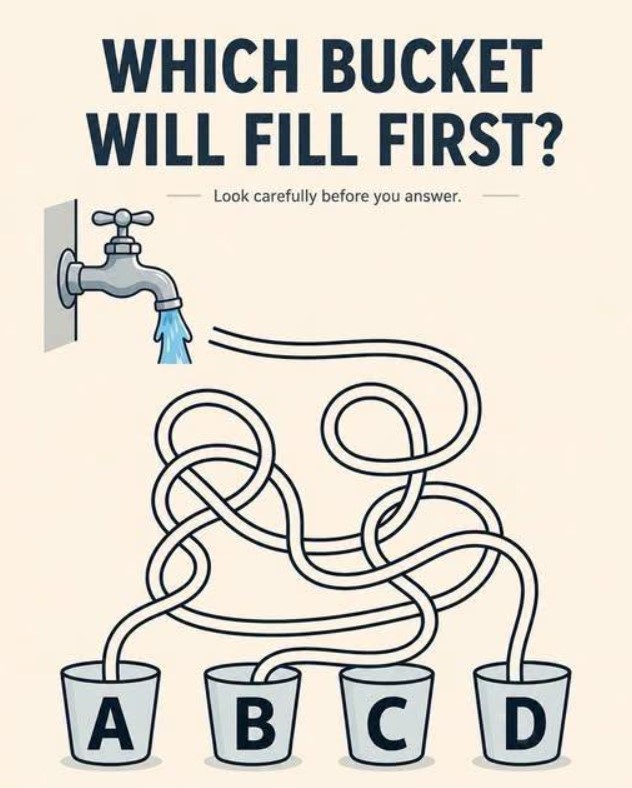
At first glance, this puzzle looks incredibly simple.
You see a series of buckets connected by pipes, with water being poured into the system. Your task is straightforward: figure out which bucket will fill up first.
But there is a catch.
Several pipes appear to provide a path for the water, and the buckets are arranged in a way that can easily make your eyes jump from one container to another. The puzzle is designed to encourage you to make a quick assumption instead of carefully examining every detail.
That is exactly why so many people get it wrong.
Before looking at the solution, give yourself a challenge: Can you determine the correct bucket in 15 seconds or less?
Take a Careful Look
The diagram contains seven buckets connected by a confusing arrangement of pipes.
Water begins entering Bucket 1 from a faucet. From there, you need to determine where the water can actually travel.
The obvious approach might be to follow every pipe toward the next bucket. However, simply seeing a pipe does not necessarily mean that water can pass through it.
Some of the connections are blocked.
That small detail completely changes the answer.
So before choosing a bucket, carefully inspect each pipe and ask yourself:
- Which pipes are actually open?
- Which connections are blocked?
- Where can the water realistically travel?
- Which bucket is positioned to receive the water first?
Don’t let the appearance of the diagram trick you.
Why This Puzzle Is So Deceptive
The biggest difficulty is that the image creates the impression that water can move through several different routes.
Your brain naturally tries to complete the paths.
When you see a pipe leading toward another bucket, you may automatically assume that the water will flow through it. But this puzzle requires you to ignore assumptions and inspect the actual connections.
This is a common feature of visual brain teasers.
They often contain information that looks important but isn’t useful, while hiding one small detail that determines the entire answer.
In this case, the blocked pipes are the key.
Start With Bucket 1
The faucet is positioned above Bucket 1, so that is where the water enters the system.
The next step is to follow the available pipe.
If you simply trace every apparent connection, you may end up thinking that the water has several possible destinations.
But look more closely.
The route toward Bucket 4 is blocked.
The connection toward Bucket 5 is also blocked.
The route toward Bucket 6 is blocked as well.
That means those apparent pathways cannot carry the water onward.
Once those obstacles are recognized, the puzzle becomes much easier.
The Water’s Actual Route
With the blocked connections removed from consideration, the water from Bucket 1 has a clear path.
It flows toward Bucket 3.
This is the crucial observation.
You don’t need to calculate complicated water pressure, flow rates, or the exact amount of water entering each container.
The puzzle is primarily about recognizing which paths are open.
There is also another visual clue that can distract you: the relative positions of the buckets.
Some containers may appear to be possible destinations because they are positioned nearby or connected visually.
But location alone doesn’t determine the result.
The water must have an unobstructed route.
The Answer: Bucket 3
So, which bucket fills first?
The correct answer is Bucket 3.
The water entering Bucket 1 follows the available open connection and reaches Bucket 3.
The pipes leading toward Buckets 4, 5, and 6 are blocked, preventing water from reaching those containers through those routes.
Therefore, Bucket 3 receives the water first and will fill before the other accessible buckets.
After that, the water can continue through the remaining open pathway toward another bucket.
Why So Many People Choose the Wrong Answer
This puzzle is a great example of how quickly our brains can make assumptions.
When people see a complicated diagram, they often try to solve it by looking at the overall shape instead of checking each individual connection.
That can lead to mistakes.
Another common error is focusing on the bucket that appears to be lowest or closest to the water source.
But being lower does not automatically mean that a bucket will fill first.
A blocked pipe can completely eliminate a seemingly obvious route.
The correct strategy is to forget about what the diagram appears to suggest and follow the water step by step.
A Simple Strategy for Solving Similar Puzzles
If you encounter another puzzle involving pipes, containers, or flowing water, try using this method.
Step 1: Find the Starting Point
First identify where the water, liquid, or other moving object enters the system.
In this puzzle, that is Bucket 1.
Step 2: Follow Only Real Connections
Don’t assume every pipe is functional.
Look for blocked, closed, or disconnected sections.
Step 3: Eliminate Impossible Routes
Once you identify a blocked pipe, remove that route from your mental map.
This immediately reduces the number of possible answers.
Step 4: Follow the Remaining Path
Continue tracing the water from one bucket to the next.
Don’t skip over any connection.
Step 5: Ignore Distractions
The puzzle may include buckets that appear important simply because of their position.
Don’t let their location influence your answer.
The water can only travel where there is an open path.
Did You Get It Right?
If you chose Bucket 3, congratulations!
You successfully noticed the blocked pipes instead of simply following the most obvious-looking route.
If you chose another bucket, don’t worry.
These puzzles are specifically designed to create confusion. Even people who are very good at logical reasoning can make a quick mistake when they don’t inspect the diagram carefully.
The important lesson is not simply knowing the answer.
It’s understanding why the answer is correct.
The Real Test Is Your Attention
Although puzzles like this are often presented as IQ tests, they are really excellent exercises in observation and attention.
The solution doesn’t require advanced mathematics.
Instead, it requires patience.
You have to resist the temptation to answer immediately and examine the information in front of you.
That’s a useful skill far beyond puzzles.
In everyday situations, we often make decisions based on what something appears to be rather than investigating the details. A small overlooked piece of information can completely change the conclusion.
This bucket puzzle demonstrates that principle in a fun and simple way.
Final Thoughts
The answer may seem obvious once it has been explained, but that is exactly what makes this type of brain teaser so entertaining.
At first, the collection of buckets and pipes creates a maze of possible routes. Your eyes naturally follow several different connections, making it difficult to determine which path the water will actually take.
But once you inspect the system carefully, the solution becomes clear.
The pipes leading to Buckets 4, 5, and 6 are blocked, eliminating those routes. The water entering Bucket 1 therefore travels through the available connection toward Bucket 3.
So the bucket that fills first is Bucket 3.
The next time you encounter a visual puzzle that seems easy, don’t rush to give the obvious answer. Take a few extra seconds, examine every connection, and look for the tiny detail that everyone else might overlook.
Sometimes the hardest part of a puzzle isn’t finding the answer.
It’s slowing down enough to notice what was right in front of you all along.