Few things can make a parent worry faster than waking up to discover that a toddler has suddenly developed a cluster of tiny red bumps.
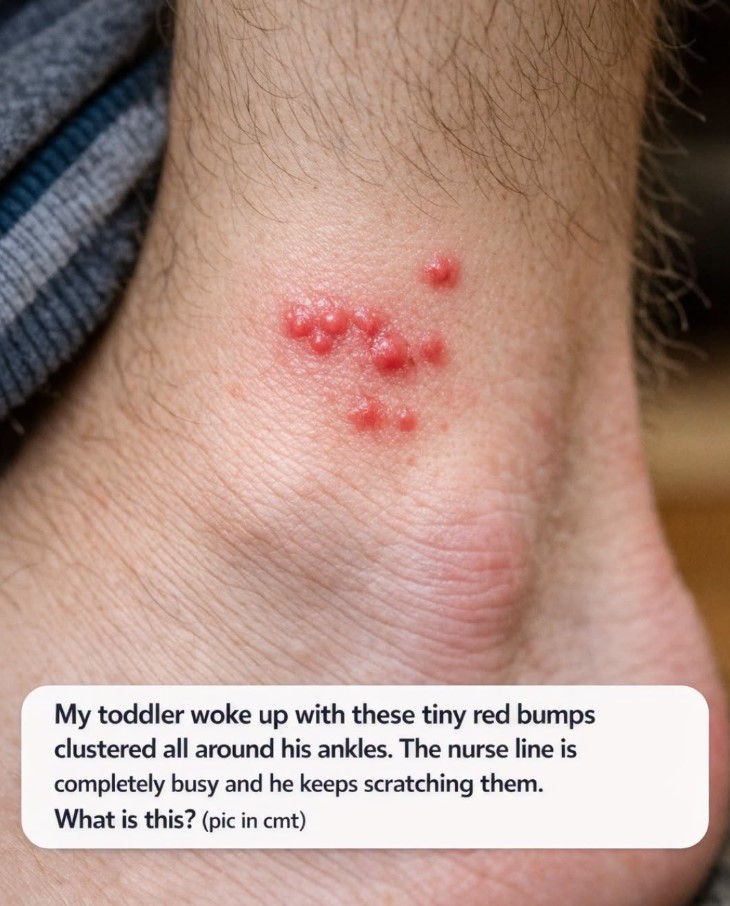
That’s exactly what happened in this situation. The child had gone to sleep normally, but by morning, several small bumps had appeared around his ankles. They were itchy enough that he couldn’t stop scratching, leaving his parent wondering what could have caused them.
When a rash appears suddenly and is concentrated around the ankles, one possibility that immediately comes to mind is insect bites—particularly flea bites. Flea bites commonly appear as small, itchy bumps in clusters on the feet, ankles, and lower legs.
But there’s an important catch: you can’t diagnose a child’s rash with certainty from a description alone. Several different insect bites and skin conditions can look similar.
So, what clues should parents look for?
Why the Ankles Are Such an Important Clue
The location of the bumps can provide an important clue.
Fleas are tiny jumping insects, and they commonly bite around the feet and ankles. Their bites can appear as multiple small, itchy bumps grouped together or arranged in a short line.
That’s why a toddler who suddenly develops several itchy bumps concentrated around the ankles may have encountered fleas somewhere in the environment.
The pattern becomes even more suggestive if there is a dog or cat in the household, because fleas commonly live on pets and can also survive in carpets, rugs, bedding, and upholstered furniture.
Still, the location alone isn’t enough to confirm the cause.
What Do Flea Bites Usually Look Like?
Flea bites are generally small, raised, and itchy.
They may appear as individual red bumps, but several bites can occur close together. Some people develop a small halo around each bite, while others experience a stronger local reaction.
On children, the itching can be particularly noticeable because scratching may make the bumps look larger and more inflamed.
A parent might notice:
- Several small bumps close together
- Red or discolored spots
- Intense itching
- Bumps concentrated around the ankles or feet
- New bumps appearing after spending time in an area where fleas may be present
Flea bites commonly affect the lower legs, feet, and ankles.
Why Would Fleas Be in the House?
Many people immediately associate fleas with pets, but having fleas doesn’t necessarily mean a home is dirty.
Fleas can enter a home in different ways.
A dog or cat can bring them indoors after spending time outside. Fleas can then survive in carpets, rugs, furniture, and pet bedding.
In some cases, people can also encounter fleas without having a pet at all. Outdoor environments can harbor fleas, and they may occasionally be carried indoors on clothing or other materials.
So if a toddler suddenly develops several itchy bites around the ankles, it’s worth looking beyond the child’s skin and considering the surrounding environment.
Check the Family Pets
If you have a dog or cat, check whether the animal has been scratching more frequently than usual.
Restlessness, frequent scratching, or visible evidence of fleas can provide an important clue.
A veterinarian can help determine whether a pet has fleas and recommend an appropriate treatment.
It’s important, however, never to use a flea-control product intended for pets on a child. Animal products can contain ingredients or concentrations that aren’t appropriate for human skin.
Look Around the Sleeping Area
If the bumps appeared overnight, inspect the child’s sleeping environment.
Check the bedding, nearby carpet, rugs, and upholstered furniture.
If pets spend time in the child’s bedroom or on nearby furniture, those areas deserve particular attention.
Frequent vacuuming can help remove fleas and their immature stages from carpets and other household surfaces. Washing bedding and pet bedding appropriately can also be part of controlling an infestation.
If you continue seeing new bites despite cleaning, professional pest-control advice may be necessary.
But It Isn’t Always Fleas
This is one of the most important points to remember.
Tiny red bumps around a toddler’s ankles don’t automatically mean flea bites.
Other insects can cause itchy bumps, including mosquitoes, bedbugs, mites, and other biting insects.
The American Academy of Pediatrics notes that flea bites can produce multiple small clustered bumps on exposed areas, while bedbug bites may also appear as itchy red bumps and sometimes occur in rows.
Skin conditions can also cause bumps and itching.
For example, eczema and contact dermatitis can produce itchy, irritated areas in children. The American Academy of Dermatology lists several childhood conditions that can produce bumps or rashes, which is why identifying the cause based only on appearance can be difficult.
Pay Attention to Other Symptoms
The child’s overall condition is just as important as the appearance of the bumps.
If the toddler is otherwise happy, alert, eating and drinking normally, and has only a few itchy bumps, the situation may be less concerning than a rash accompanied by significant illness.
Parents should pay attention to symptoms such as:
- Fever
- Increasing pain
- Significant swelling
- Blisters
- Pus or yellowish drainage
- Redness that continues spreading
- Red streaks extending from the affected area
- Unusual tiredness or behavior
- A rash spreading rapidly
Scratching can damage the skin and increase the risk of infection. If a bite becomes increasingly red, swollen, warm, painful, or starts producing drainage, medical evaluation is appropriate.
What Can You Do About the Itching?
When a toddler is constantly scratching, the immediate goal is to keep the skin comfortable and prevent further damage.
A cool, damp compress can provide temporary relief.
Keep the child’s fingernails short and clean, and try to discourage scratching as much as possible.
Avoid experimenting with multiple creams or medications, particularly on a very young child. Some products that are appropriate for adults aren’t necessarily suitable for toddlers.
If you’re considering an over-the-counter treatment, check the age instructions carefully and ask a pediatrician or pharmacist if you’re uncertain.
What If the Nurse Line Is Busy?
Waiting for a callback can be frustrating when your child is uncomfortable.
While you’re waiting, observe the rash carefully.
Take a clear photograph in good lighting. Note when you first noticed the bumps, where they are located, whether new ones are appearing, and how intensely your child is scratching.
Also make a note of any recent exposures.
Did your child:
- Play outside recently?
- Visit another home?
- Spend time around animals?
- Sleep somewhere different?
- Play on carpet or upholstered furniture?
- Have contact with a new detergent, soap, lotion, or clothing?
These details can help a healthcare professional understand what may be happening.
When Is It an Emergency?
Most insect bites are not medical emergencies, but serious allergic reactions can occur.
Seek emergency medical help immediately if your child develops difficulty breathing, weakness or loss of consciousness, widespread hives, or severe swelling involving areas such as the face, lips, or around the eyes.
If the child develops significant symptoms or appears seriously unwell, don’t wait for a routine nurse-line callback.
Could It Be Bedbugs Instead?
Bedbugs are another possibility parents sometimes consider when bites appear after sleeping.
Bedbug bites can cause itchy red bumps and may occur in groups or rows. Unlike fleas, however, bedbugs tend to live in cracks, furniture, mattresses, and bedding rather than primarily on pets.
If multiple people in the household are waking up with unexplained bites, examining the sleeping environment becomes especially important.
The pattern alone still cannot provide a definite diagnosis.
What About Mosquito Bites?
Mosquito bites can also produce itchy red bumps.
However, mosquito bites are often more variable in size and may appear on different exposed parts of the body. Children can sometimes develop stronger reactions than adults.
Again, the location, timing, environment, and appearance all need to be considered together.
The Most Useful Clue May Be the Environment
When trying to understand unexplained bites, don’t focus only on the child’s skin.
Look at what surrounds the child.
If there are pets, inspect them.
If there are carpets, vacuum regularly.
If the child recently played outside, consider outdoor insect exposure.
If the bumps repeatedly appear after sleeping, examine the bedding and surrounding furniture.
The environment can provide clues that aren’t visible from the rash itself.
Don’t Let the Appearance Fool You
One of the frustrating things about childhood rashes is that completely different causes can sometimes produce surprisingly similar symptoms.
A few red bumps can represent insect bites.
Itching and redness can result from irritation.
Other childhood skin conditions can also produce clusters of bumps.
That’s why it’s better to treat the description as a clue rather than a diagnosis.
The ankle location and clustered pattern make flea bites a reasonable possibility, but they don’t prove that fleas are responsible.
Final Thoughts
Waking up to discover tiny red bumps clustered around your toddler’s ankles can certainly be alarming, particularly when your child keeps scratching and you can’t immediately reach the nurse line.
The pattern described here is consistent with flea bites, which commonly appear as small, itchy clusters around the feet, ankles, and lower legs.
But that’s only one possibility.
Other insects, environmental exposures, and childhood skin conditions can produce similar-looking bumps. The safest approach is to look at the complete picture rather than relying on the location of the rash alone.
Check the child’s environment, inspect pets if you have them, keep the affected skin clean, use simple measures such as a cool compress to help with itching, and try to prevent scratching.
Most importantly, watch for signs that the situation is becoming more serious. Increasing redness, warmth, swelling, pain, drainage, fever, or a child who appears unwell should prompt medical attention. Emergency symptoms such as breathing difficulty or widespread hives require immediate help.
Sometimes those mysterious little bumps have a simple explanation.
But when the patient is a toddler, careful observation and professional medical advice are always more important than trying to diagnose the rash from a picture or article alone.