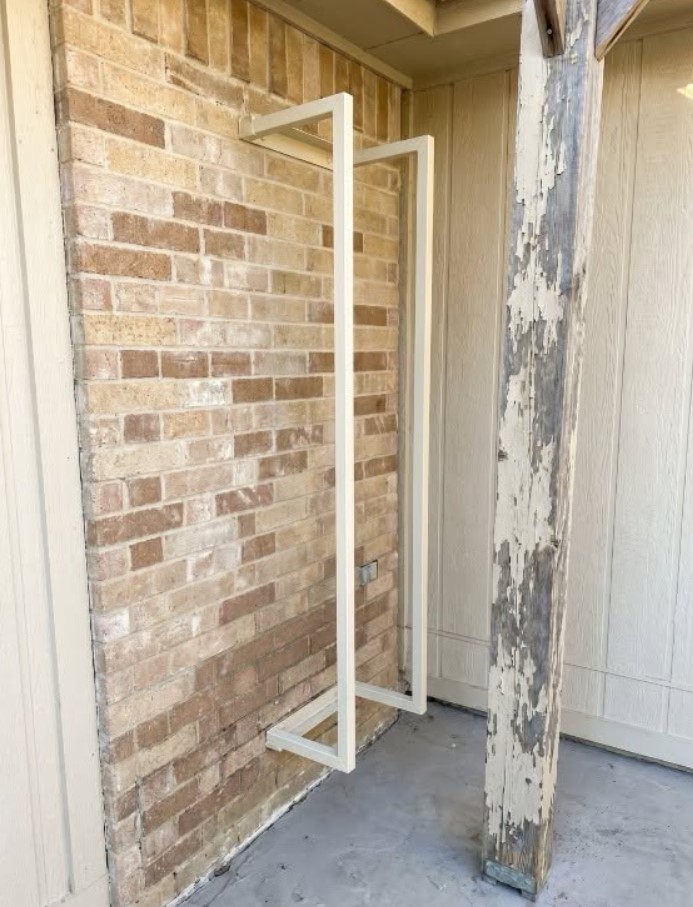
Have you ever walked past an older house and noticed a strange-looking metal frame attached to the outside wall?
At first glance, it can look like part of an old construction project. Maybe it’s a bracket, a support for some forgotten piece of equipment, or even something that was installed for a purpose that no longer exists.
But if you’ve seen one of these frames attached to the side or back of a home, there’s a good chance you’re looking at something much more familiar than you realize.
It’s a clothesline.
More specifically, the structure in the picture is a type of wall-mounted folding clothesline or outdoor drying rack. These practical frames were designed to provide a convenient place to hang freshly washed clothes while taking up very little space when they weren’t being used.
Today, many people rely almost entirely on electric or gas dryers, so an old-fashioned clothesline can seem unusual. But for generations of homeowners, drying clothes outdoors wasn’t unusual at all.
It was simply part of doing the laundry.
What Is This Metal Frame?
The structure shown in the image is a wall-mounted drying frame.
Its basic design is remarkably simple.
A sturdy metal frame is attached to the exterior wall of a house. The frame can extend outward to create space for hanging clothes, while some designs can be folded or lowered toward the wall when they aren’t needed.
Modern versions are still sold today, including folding clotheslines specifically designed for brick and concrete walls.
The goal is straightforward:
Create useful drying space without taking up valuable ground space.
That makes these systems especially practical for narrow side yards, patios, courtyards, balconies, and smaller homes.
Why Were They So Common?
Before automatic clothes dryers became a normal household appliance, families had to find other ways to dry their laundry.
The simplest solution was to hang clothes outside.
Sunlight and moving air could do the work naturally.
A basic clothesline could be stretched between two poles, attached between buildings, or mounted to a wall.
Over time, homeowners and manufacturers developed more convenient designs.
Instead of requiring a large yard with poles running across it, a folding wall-mounted frame could be installed against the house.
When laundry needed to be dried, the frame could be opened.
When the washing was finished, it could be folded away.
This made it an extremely practical solution for homes where outdoor space was limited.
A Simple Idea That Solved a Real Problem
One reason these frames became so popular is that they didn’t require complicated technology.
There was no motor.
No electricity.
No expensive appliance.
No complicated controls.
The homeowner simply washed the clothes, carried them outside, and hung them on the lines.
The sun provided warmth.
The wind provided airflow.
And gravity did the rest.
It was an inexpensive and surprisingly effective way to dry clothing.
Why Mount It on the Wall?
The wall-mounted design offered an important advantage: space efficiency.
A traditional freestanding clothesline can require a significant amount of room.
That’s perfectly fine if you have a large backyard.
But what if you live on a narrow lot?
Or have a small patio?
Or have a side passage between the house and a fence?
A wall-mounted clothesline can make much better use of that limited space.
The frame can extend outward when it’s needed and remain close to the wall when it isn’t.
Some modern folding designs are specifically marketed for courtyards and narrow outdoor areas.
Why Is It Often Attached to Brick?
Look closely at the photograph and you’ll notice that the frame is mounted directly against a brick wall.
That’s not accidental.
A clothesline loaded with wet laundry can put considerable force on its mounting points.
Wet towels, jeans, bedding, and other heavy items can weigh substantially more than they do when dry.
The frame also extends outward from the wall, creating leverage on the fixings.
For that reason, solid masonry can provide an excellent surface for mounting this type of structure when appropriate fixings are used. Modern wall-mounted clothesline guidance specifically lists brick and concrete as suitable surfaces for many models.
That explains why you may see these frames attached to brick houses.
The Clothesline Was More Than a Convenience
For many families, the clothesline wasn’t an occasional backup.
It was the primary way laundry was dried.
A typical laundry day might involve washing sheets, towels, shirts, children’s clothing, work clothes, and other household items.
Everything would then be carried outside.
Clothes would be shaken out, placed on the line, and arranged so air could circulate around them.
On a warm, breezy day, the process could be surprisingly efficient.
And there was another benefit people often remember:
the smell.
Freshly washed clothes dried outdoors often developed a distinctive clean, airy scent that many people associate with childhood, summer, and time spent at home.
The Rise of the Electric Dryer Changed Everything
As household appliances became more common, electric and gas clothes dryers gradually changed the way people handled laundry.
Instead of waiting for sunshine and favorable weather, families could put wet clothes into a machine and have them dried indoors.
That was an enormous convenience.
Rain was no longer a problem.
Cold weather was less important.
Laundry could be finished late at night or early in the morning.
And people no longer needed a large outdoor drying area.
Today, clothes dryers are extremely common in the United States. ENERGY STAR notes that about 80% of American homes have a clothes dryer.
That helps explain why an old-fashioned outdoor drying frame can look mysterious to younger homeowners.
The technology has changed, but the old hardware sometimes remains attached to the house.
Why Some People Still Prefer Air-Drying
Despite the convenience of modern dryers, outdoor drying hasn’t disappeared.
In fact, there are several reasons people continue to use clotheslines.
The biggest is energy consumption.
A clothes dryer requires energy to produce heat and move air through the machine.
Air drying, by comparison, uses the natural environment.
ENERGY STAR specifically recommends using a drying rack or hanging clothes outside when possible, noting that air-drying can save energy and may also help clothes last longer.
For families who do several loads of laundry each week, those savings can add up.
It Can Be Gentler on Clothing
Heat and repeated tumbling can contribute to wear and tear on fabrics.
Anyone who has pulled a favorite shirt from the dryer and noticed that it has become smaller, rougher, or more worn over time understands the frustration.
Air drying avoids the intense heat and mechanical tumbling of a conventional dryer.
That’s one reason some people choose to air-dry delicate garments, towels, linens, or clothing that they want to preserve for as long as possible.
It can take longer, but sometimes slower is better.
The Sun Does More Than Provide Heat
Sunlight is another useful part of outdoor drying.
A sunny day can help warm damp fabric while air movement carries moisture away.
The combination can make a simple clothesline remarkably effective.
Of course, weather conditions matter.
A humid, rainy day isn’t ideal for outdoor drying.
Neither is a completely still day with little airflow.
But on a warm, dry, breezy day, a clothesline can work beautifully.
Why These Old Frames Are Still Attached to Houses
One interesting thing about old homes is that previous owners often leave practical fixtures behind.
A house may have changed hands several times.
The original family may have used the clothesline every week.
The next family may have installed a dryer.
The following owners may have forgotten the frame was even there.
Eventually, the clothesline becomes part of the architecture.
It may remain on the wall for decades even though nobody uses it anymore.
That’s why someone moving into an older home might suddenly notice one and wonder what it was originally designed to do.
Not Every Old Metal Frame Has the Same Purpose
It’s worth mentioning that exterior metal structures can serve many different purposes.
Brackets and frames can support awnings, air-conditioning equipment, signs, plants, storage systems, or other household accessories.
So it’s always best to look at the structure carefully rather than assuming every unusual frame is a clothesline.
But the design shown here—with its rectangular folding frame attached to an exterior brick wall—is consistent with the type of wall-mounted drying rack used for laundry.
Modern examples still use a similar basic concept.
A Brilliant Example of Practical Design
There’s something satisfying about the simplicity of these old household fixtures.
They solve a problem without wasting space.
They don’t require electricity.
They don’t need complicated maintenance.
They can be opened when necessary and kept out of the way when they’re not.
In an era when many household products are filled with electronics and smart features, it’s interesting to remember that sometimes the most effective design is simply a sturdy frame and a few lines.
How to Use One Safely Today
If you discover an old clothesline frame attached to your home and want to use it, don’t immediately hang a heavy load of laundry from it.
First, inspect the structure.
Look for:
- Rust
- Cracked welds
- Bent metal
- Loose bolts
- Damaged hinges
- Deteriorated wall fixings
- Crumbling brick or mortar
- Signs that the frame is pulling away from the wall
The mounting points are particularly important.
Because the frame extends outward, a heavy load can put additional stress on the wall connections.
If the structure is very old or appears damaged, it may be better to have it inspected or replaced rather than assuming it is still safe.
The Modern Version Is Still Around
Interestingly, the basic concept hasn’t disappeared.
Modern folding clotheslines continue to be manufactured for homes today.
They come in different sizes and configurations, but the principle remains essentially the same:
attach the drying system to the wall, open it when needed, hang the laundry, and fold it away afterward.
Some modern systems are specifically designed for brick or concrete surfaces and compact outdoor areas.
In other words, what looks like an outdated invention is actually a design that has survived because it continues to solve a useful problem.
Why This Little Piece of Hardware Tells a Bigger Story
Old household fixtures can reveal a surprising amount about how people lived.
A clothesline tells us that previous generations had different routines.
Laundry required more planning.
Weather mattered.
Outdoor space mattered.
Families often repaired and reused things instead of replacing them immediately.
And household energy use looked very different.
The frame may appear insignificant today, but it represents an everyday activity that once happened in countless backyards.
A Forgotten Piece of Everyday History
Historical objects aren’t always found in museums.
Sometimes they’re attached to the side of a house.
A metal clothesline frame might seem like nothing more than an outdated piece of hardware.
But it can remind us of a time when drying laundry meant stepping outside, checking the weather, hanging clothes by hand, and bringing everything back inside when the sky began to change.
There is something charming about that simplicity.
Final Thoughts :
So, why is this on so many homes?
The answer is much simpler than it first appears.
The structure in the photograph is a wall-mounted folding clothesline or outdoor drying rack, designed to give homeowners a convenient place to hang laundry while using very little ground space. Similar folding clotheslines are still made today, particularly for brick and concrete walls, patios, courtyards, and narrow outdoor areas.
For earlier generations, a clothesline was an ordinary and essential part of household life. Before modern dryers became widespread, people relied on sunlight and fresh air to dry everything from everyday clothing to towels and bedsheets.
The design was practical because it was inexpensive, simple, durable, and didn’t require electricity.
Even today, air-drying remains a useful alternative to machine drying. ENERGY STAR recommends hanging clothes outside or using a drying rack when possible because air-drying can reduce energy use and may help clothing last longer.
So the next time you see one of these mysterious metal frames attached to an older home, don’t assume it’s some forgotten construction bracket.
It may be a small reminder of a time when laundry was done a little differently.
And perhaps the most interesting thing about it is that the idea never really disappeared.
The modern world gave us powerful washing machines and convenient dryers, but the humble clothesline still works exactly the way it always did.
Wash the clothes. Hang them up. Let nature do the rest.
Sometimes, the simplest household inventions really are the ones that stand the test of time.