His name flashed across my phone again.
I stared at the screen for several seconds without touching it.
My daughter was sleeping only a few feet away, curled beneath the borrowed blanket on my friend’s bed. Her breathing had finally become steady, but I could still see the faint red mark on her cheek whenever I looked at her.
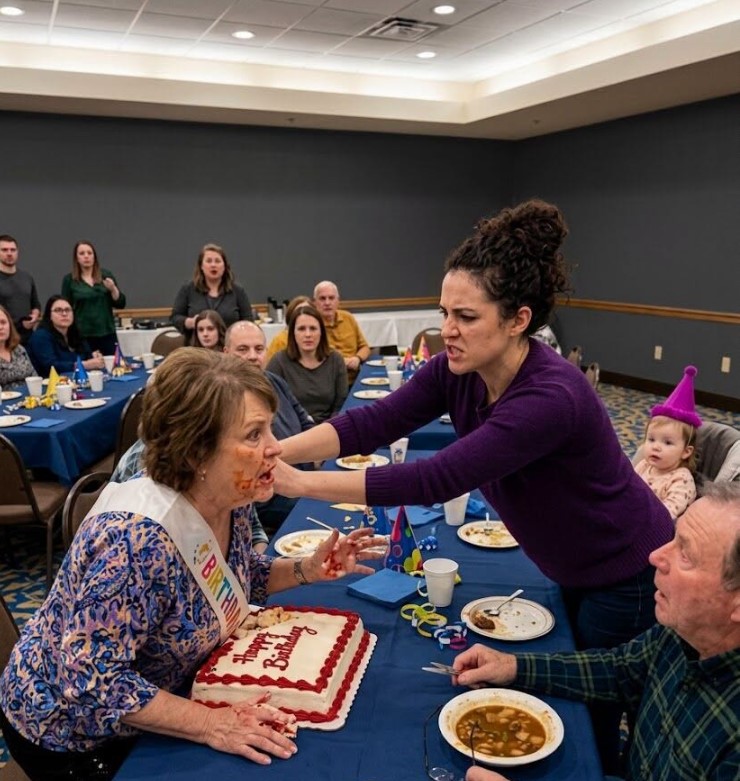
Just a few hours earlier, I had been sitting at a birthday banquet surrounded by people who called themselves family.
Now I was sitting in someone else’s apartment, wondering how I had stayed in my marriage for so long without seeing what had been happening right in front of me.
The video was still open on my phone.
I watched it again.
My mother-in-law leaning toward my daughter.
Her fingers gripping my little girl’s wrist.
Her face twisting with anger.
Then the slap.
And then my husband.
He had been sitting there the entire time.
He had seen everything.
But the sentence that kept replaying inside my head wasn’t what his mother had said.
It wasn’t even the sound of the slap.
It was his quiet voice immediately afterward.
“Mom, I told you—not in front of everyone.”
I closed my eyes.
Not in front of everyone.
Those five words suddenly seemed to explain two years of my marriage.
For so long, I had believed my husband was simply weak.
I thought he was afraid of confronting his mother.
I thought maybe he hated conflict.
I thought perhaps he loved her too much to disappoint her.
I had made excuses for him because admitting the truth would have meant admitting something much harder.
He wasn’t protecting me from his mother.
He was protecting his mother from consequences.
And there was a difference.
I looked at my sleeping daughter.
She was two years old.
Two.
She didn’t understand family politics.
She didn’t understand why adults smiled at one another while saying cruel things.
She didn’t understand why Grandma could suddenly become angry.
She only knew that someone had hurt her.
And earlier, in the parking lot, she had touched her cheek and whispered, “Grandma mad.”
As though Grandma’s anger was something she had caused.
That broke something inside me.
I had spent two years telling myself I was keeping the peace for my daughter.
But what kind of peace teaches a child to accept being mistreated?
I looked back at the phone.
The recording had removed every excuse.
There was no bad camera angle.
No confusion.
No misunderstanding.
No possibility of someone claiming my mother-in-law had accidentally struck her.
The video showed exactly what happened.
She had grabbed my daughter’s wrist.
She had insulted her.
And she had slapped her.
My husband had watched.
And when he finally spoke, his concern wasn’t that his daughter had been hurt.
His concern was that people had seen it.
I thought about all the times he had told me the same thing in different ways.
“Don’t make a scene.”
“Just ignore her.”
“She doesn’t mean it.”
“You know how Mom gets.”
“Please, for the sake of the family.”
“Can we just keep the peace?”
I used to hear those words and think he was asking me to be patient.
Now I understood what they had really done.
They had kept me quiet.
Every time his mother crossed a line, I was expected to step backward.
Every time she insulted me, I was expected to smile.
Every time she criticized our daughter, I was expected to pretend it didn’t matter.
And my husband never had to choose.
Until tonight.
Tonight, his mother had crossed a line that even I couldn’t pretend wasn’t there.
She had hit our child.
And for the first time, I had stopped trying to make everyone comfortable.
I had taken my daughter and walked away.
That decision had terrified me earlier.
Now it gave me a strange sense of calm.
A month before the birthday banquet, I had quietly started preparing for the possibility that I might have to leave.
I had copied important documents.
I had saved money from my own paychecks.
I had packed a small bag for my daughter.
At the time, I had felt guilty about doing it.
I wondered if I was being dramatic.
I wondered whether I was imagining problems that weren’t really there.
But now I realized something.
Preparing wasn’t betrayal.
Preparing meant I had finally admitted that my daughter’s safety mattered more than maintaining appearances.
I didn’t know what would happen next.
I didn’t know whether my marriage could survive.
I didn’t know what my husband would tell his family.
I didn’t know whether his mother would apologize.
But I knew one thing.
My daughter was not going back into that house tonight.
My phone vibrated again.
Another message.
I looked at my husband’s name.
For a moment, I considered ignoring him.
Then I opened it.
His message was longer this time.
He said I had humiliated his mother.
He said I had gone too far.
He said everyone at the banquet was talking.
He said I needed to come home so we could “handle this like adults.”
I stared at those words.
Handle this like adults.
I almost laughed.
Our daughter had been hit.
And somehow I was still being asked to manage everyone else’s feelings.
I typed a response.
Then deleted it.
Typed another.
Deleted that one too.
Finally, I realized I didn’t need to explain myself anymore.
The video had already explained enough.
I opened the recording one more time.
This time, I listened carefully to everything happening before the slap.
There was background noise.
People talking.
Plates moving.
Someone laughing.
Then my mother-in-law leaned toward my daughter.
My little girl was holding a piece of cake.
My mother-in-law said something too quietly for me to hear clearly.
Then my daughter pulled her hand away.
That’s when my mother-in-law grabbed her wrist.
My husband turned toward them.
He saw it.
He knew exactly what was happening.
And then came the words.
“Mom, I told you—not in front of everyone.”
I froze.
I had listened to the sentence several times, but now I noticed something else.
He didn’t sound shocked.
He didn’t sound surprised.
He sounded annoyed.
As if his mother had ignored an instruction.
As if there were rules about when she was allowed to behave that way.
As if the problem wasn’t what she had done.
The problem was that she had done it publicly.
That realization made my stomach turn.
How many times had something similar happened when I wasn’t looking?
How many times had my husband quietly warned his mother without ever actually protecting our daughter?
How many times had he told her to wait until I wasn’t around?
I suddenly understood why some of his explanations had always felt incomplete.
There had been moments when I entered a room and everyone became strangely quiet.
Moments when my mother-in-law suddenly changed the subject.
Moments when my husband acted nervous for no obvious reason.
I had always assumed I was imagining things.
Maybe I wasn’t.
Maybe there had been an entire conversation happening behind my back.
And now I had proof that at least one part of it had existed.
The video wasn’t just evidence of a slap.
It was evidence of a mindset.
My husband had known his mother could hurt our daughter.
He had known enough to warn her.
But apparently, his boundary had been visibility.
Not violence.
Visibility.
Don’t do it in front of everyone.
That was the sentence that changed everything.
I looked toward my daughter.
She shifted in her sleep.
I immediately stood and walked over to her.
I gently placed my hand on her back.
She didn’t wake.
I stood there for a long time.
I thought about the woman I had been when I first married my husband.
I had believed marriage meant building a family together.
I had believed my husband and I would protect one another.
I had believed that when we had children, our priorities would naturally change.
But somewhere along the way, I had become the person expected to absorb everything.
His mother could criticize me.
I was supposed to forgive.
She could insult our parenting.
I was supposed to stay calm.
She could make cruel comments about our daughter.
I was supposed to understand.
And when I finally objected, my husband would tell me that I was making things worse.
Tonight, I finally understood why.
Because every time I objected, someone had to admit there was a problem.
And as long as I stayed quiet, everyone else could pretend there wasn’t one.
I returned to the bed and sat beside my daughter.
My phone was still in my hand.
The new message from my husband was waiting.
I didn’t open it immediately.
Instead, I thought about the sentence I had almost sent him earlier.
“The wrong idea is that this was the first time you failed her.”
I had never sent it.
But I didn’t regret writing it.
Because it was true.
The slap hadn’t created the problem.
It had exposed it.
The birthday banquet hadn’t destroyed our family.
It had revealed what had already been broken for a long time.
And the video hadn’t created my anger.
It had removed my doubt.
For years, I had wondered whether I was being too sensitive.
Whether I expected too much.
Whether I should simply tolerate his mother’s behavior because she was family.
Now I had something I hadn’t had before.
Certainty.
The video showed what happened.
My daughter’s cheek showed what happened.
My husband’s words showed what he thought mattered.
And his messages afterward showed what still mattered to him.
Not his daughter’s pain.
Not her fear.
Not whether she was okay.
He cared about the banquet.
His mother.
The guests.
The family’s reputation.
The story everyone would tell afterward.
But I was finished protecting a story that wasn’t true.
I didn’t need to convince anyone that I was a good mother.
I didn’t need his family to understand.
I didn’t need his mother to approve of me.
My responsibility was much simpler.
Protect my daughter.
I looked at the small overnight bag sitting beside the wall.
A month ago, packing that bag had made me feel frightened.
Tonight, it made me feel prepared.
There was a difference.
I picked up my phone.
My husband’s name was still on the screen.
I finally opened his message.
It said:
“Please come home. We need to talk before this gets any worse.”
I read it twice.
Then I looked at my daughter.
She was still asleep.
Safe.
Quiet.
Away from the people who had spent years telling me that keeping the peace mattered more than setting boundaries.
I typed one sentence.
I stared at it.
Then I sent it.
“I am not bringing our daughter back until I know she is safe with you.”
I put the phone down.
For the first time that night, I didn’t feel the need to defend my decision.
I didn’t feel guilty.
I didn’t feel afraid.
I simply felt certain.
The birthday video had shown me something I had been too afraid to see.
My husband had not been hiding one terrible secret.
He had been hiding a pattern.
A pattern of silence.
A pattern of excuses.
A pattern of protecting appearances instead of protecting his child.
And once I saw it clearly, I couldn’t unsee it.
The next morning, I would make phone calls.
I would gather my documents.
I would figure out where my daughter and I would stay.
I would deal with whatever came next.
But that night, I did something much simpler.
I climbed into the bed beside my daughter.
I pulled the blanket gently around her.
And when she reached for my hand in her sleep, I held it.
She had no idea what had happened.
She didn’t know about the video.
She didn’t know about the messages.
She didn’t know that her mother had finally stopped asking other people for permission to protect her.
She only knew that she was safe.
And for that night, that was enough.
The birthday celebration had been supposed to be about family.
Instead, it became the night I finally understood what my family had been hiding from me.
The video didn’t just reveal what happened at the table.
It revealed what had been happening behind closed doors all along.
And this time, I wasn’t going to look away.