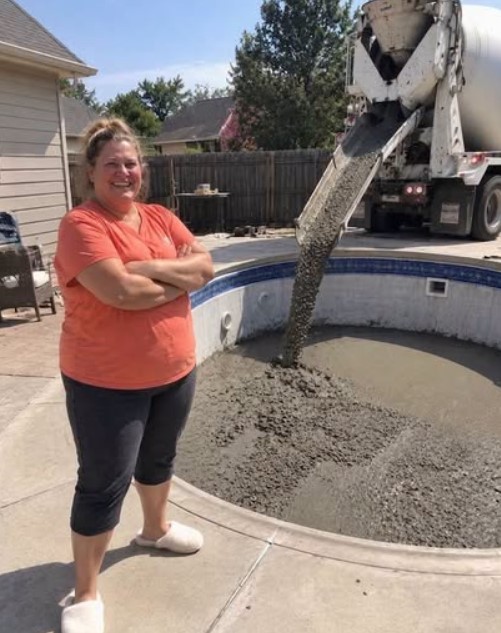
I stood there in the cold morning air, staring at the concrete truck parked beside my fence.
For a few seconds, I couldn’t move.
The sound of the rotating drum filled the entire backyard as thick gray concrete continued pouring into the pool my husband had built with his own hands.
The pool that had been his final gift to our children.
The pool that had given us countless summer afternoons together.
And now Katherine was watching it disappear beneath a layer of concrete because she claimed my children were “too loud.”
I felt my hands shaking.
But strangely, I wasn’t going to scream at her.
I wasn’t going to give her the argument she clearly wanted.
Instead, I pulled out my phone.
Katherine noticed immediately.
“What are you doing?” she demanded.
I didn’t answer.
I started recording.
I filmed the entire scene—the concrete truck, the license plate, the company logo on the door, the truck’s position inside my property, and Katherine standing there watching it happen.
Then I turned the camera toward her.
“You came onto my property without permission,” I said calmly. “And now you’re destroying my pool.”
Her expression changed.
“Don’t start making this dramatic,” she snapped.
“I’m not making anything dramatic.”
I kept the camera steady.
“You are the one who brought a construction truck onto my property and filled my pool with concrete.”
Her husband was sitting behind the wheel.
I recognized him immediately because I knew he owned a local construction company.
He looked uncomfortable.
For the first time since the truck had arrived, he seemed to realize that this wasn’t simply a disagreement between two neighbors.
This could have serious consequences.
“Katherine,” he said quietly, “maybe we should stop.”
She immediately turned toward him.
“No. Keep going.”
“But—”
“I said keep going!”
The concrete continued to pour.
I recorded everything.
Every word.
Every movement.
Every second of what they were doing.
Then I looked at the pool one last time.
The water had almost disappeared beneath the gray mixture.
My throat tightened.
I thought about Steve.
My husband had spent months building that pool.
He had worked through heat and exhaustion because he wanted our four children to have something special.
He had finished it only weeks before his illness took him.
I could still remember the day he stepped back from the finished pool, covered in dust and sweat, smiling proudly.
“You built them a whole summer,” I had told him.
He smiled.
“I built us a memory.”
That memory was now being buried.
But I refused to let Katherine destroy what it meant.
I turned around and went inside.
My four children were standing near the kitchen window.
They had watched everything.
My youngest had tears running down her cheeks.
“Mommy,” she whispered, “what happened to Daddy’s pool?”
I knelt down and pulled all four children into my arms.
I wanted to cry with them.
I wanted to tell them how unfair everything was.
Instead, I took a breath.
“Listen to me,” I said. “The pool can be rebuilt.”
“But it’s ruined,” my son said.
“I know.”
I wiped his tears.
“But your father’s memories aren’t inside that pool. They’re inside us.”
They looked at me silently.
“And nobody gets to take those away.”
I hugged them tighter.
Then I stood up.
For two years, I had tried to keep the peace.
I had apologized when I wasn’t wrong.
I had ignored Katherine’s complaints about my decorations.
I had tolerated her criticism of my garden.
I had even told my children to stay quiet when they had done nothing wrong.
I had convinced myself that avoiding conflict was the best thing for everyone.
But Katherine had mistaken my patience for weakness.
That morning, she learned the difference.
I picked up my phone and called the attorney a friend had recommended months earlier.
I had never contacted him because I had always hoped the situation with Katherine would eventually settle down.
It hadn’t.
Instead, she had crossed the biggest boundary imaginable.
She had entered my property and deliberately damaged something that belonged to my family.
When the attorney answered, I explained everything.
I told him about the previous confrontation.
I explained what had happened that morning.
Most importantly, I told him I had recorded the entire incident.
“The truck, the license plate, the company logo, everything,” I said.
“Good,” he replied. “Don’t touch anything. Preserve the scene exactly as it is.”
“I won’t.”
“And don’t confront her again. Let us handle the next steps.”
For the first time that morning, I felt a little calmer.
I wasn’t going to fight Katherine with shouting.
I was going to let the evidence speak for itself.
Later that day, the attorney arrived at my home with a surveyor and an insurance representative.
Katherine saw them almost immediately.
She came storming out of her house.
“What are all these people doing here?”
I stood on my side of the fence.
“My attorney is documenting the damage.”
Her face tightened.
“You can’t do this!”
“I didn’t do anything to you, Katherine.”
I looked toward the ruined pool.
“You did this.”
The surveyor carefully examined the property line.
He checked the fence, the gate, and the position where the truck had been parked.
After taking several measurements, he confirmed what I already knew.
The truck had crossed onto my property.
The damage had occurred entirely inside my yard.
The insurance representative documented the construction equipment and the resulting destruction.
Katherine’s confidence began disappearing.
Her husband looked increasingly nervous.
She had probably imagined that filling my pool with concrete would end the problem.
Instead, she had created evidence of exactly what she had done.
The video showed everything.
The survey confirmed where the truck had been.
The concrete itself was undeniable.
And her own words had made her intentions perfectly clear.
She had done it because she wanted “peace and quiet.”
But the law didn’t care whether she was annoyed by my children’s laughter.
It cared about property damage and unauthorized entry.
Katherine suddenly lowered her voice.
“Maybe we can work something out.”
I looked at her.
“Two days ago, I apologized to you when my children hadn’t even done anything wrong.”
She said nothing.
“I tried to be your neighbor. I tried to be respectful. I tried to avoid conflict.”
I pointed toward the pool.
“And you responded by destroying something my husband built for our children.”
Her eyes shifted away.
“You crossed a line,” I continued. “And now there are consequences.”
Her husband finally spoke.
“Katherine, we need to talk.”
She turned on him.
“Don’t start blaming me!”
But he didn’t answer.
He simply looked at the concrete-covered pool.
I could tell he was beginning to understand how serious the situation had become.
The construction company had been involved.
Company equipment had been used.
And everything had been recorded.
The insurance and legal process moved forward.
The cost of removing the concrete, repairing the pool, and restoring the backyard was calculated.
Katherine tried to argue that she had only been trying to stop excessive noise.
But that explanation didn’t erase what she had done.
My children weren’t screaming.
They weren’t damaging her property.
They weren’t even on her land.
They were swimming in their own backyard.
And no amount of complaining could justify destroying someone else’s property.
Eventually, the court ordered Katherine to cover the costs associated with restoring the pool.
Her husband also faced serious consequences connected to the use of his company’s equipment.
The situation became known around the neighborhood, and Katherine’s carefully maintained image of being the person who always demanded “order” began to fall apart.
People learned what had actually happened.
They learned that she hadn’t simply complained about noise.
She had crossed into my yard and arranged for a concrete truck to destroy my pool.
Not long afterward, Katherine and her husband decided to leave.
One afternoon, I saw a moving truck outside their house.
Boxes were being carried out.
Furniture disappeared through the front door.
Katherine never came over to say goodbye.
I didn’t expect her to.
And honestly, I didn’t need her to.
Months later, I stood beside a completely rebuilt pool.
The water was clear again.
Sunlight reflected across its surface.
My four children were swimming, laughing, and splashing just as they had before.
This time, I didn’t feel nervous when I heard them laugh.
I didn’t look toward Katherine’s house.
I didn’t wonder whether someone was watching.
I simply smiled.
For a moment, I placed my hand against the edge of the pool.
I remembered Steve.
I remembered how carefully he had built it.
How proud he had been when he finally finished.
I closed my eyes.
“I protected it,” I whispered.
“I protected what you left us.”
Behind me, my children were laughing.
The sound filled the backyard.
And this time, instead of apologizing for it, I let myself smile.
Katherine had believed that if she destroyed the pool, she could destroy the memories connected to it.
She was wrong.
She had only reminded me that protecting my family didn’t mean avoiding every conflict.
Sometimes it meant standing up when someone crossed a line.
Sometimes it meant saying no.
And sometimes it meant letting someone face the consequences of their own choices.
The pool was no longer just a swimming pool.
It was proof that something broken could be rebuilt.
And as I watched my children playing in the water their father had once dreamed they would enjoy, I finally understood something.
Peace doesn’t come from making yourself smaller so difficult people can be comfortable.
Real peace comes when you know your boundaries, protect the people you love, and refuse to let someone else’s unreasonable behavior control your life.
Steve’s last gift to our children was still there.
Not because Katherine hadn’t tried to destroy it.
But because she hadn’t succeeded.
And as the sunlight danced across the water, I heard my youngest shout,
“Mom! Come look!”
I laughed.
“I’m coming!”
Then I walked toward the pool.
This time, I didn’t hear the sound of a neighbor complaining.
I heard my children’s laughter.
And that was exactly the kind of noise Steve had built that pool for.