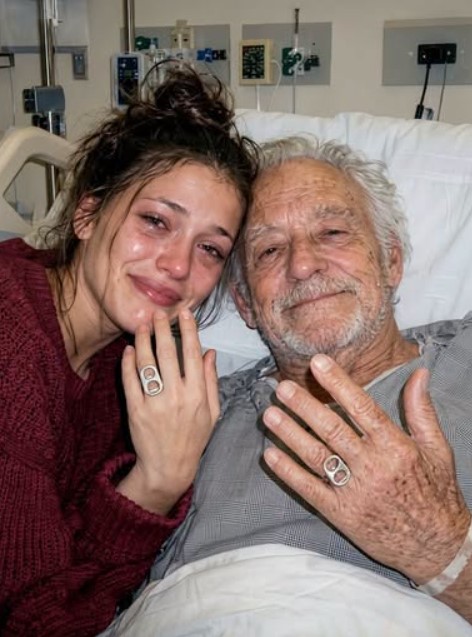
The heavy wooden door suddenly swung open.
I flinched.
A tall man in an expensive charcoal suit stepped into the hospital room, followed by a younger man carrying a leather briefcase.
The stranger didn’t look like someone who had come to mourn.
He looked like someone who had come to collect something.
His eyes moved quickly around the room.
The empty hospital bed.
The green backpack in my lap.
The red silk dress spread across my knees.
Then his gaze landed on Arthur.
“Pendelton,” he said coldly. “Where are the estate documents?”
Arthur didn’t move.
“You’re too late, Caleb.”
The man’s expression hardened.
“What did you say?”
“Your father’s estate is not going through probate the way you expected.”
Caleb stared at him.
“My father had no wife.”
Arthur slowly turned toward me.
“He did.”
Caleb finally looked at me properly.
His eyes moved from my worn sneakers to my yellow sweater, then to the soda-can pull tab still resting on my finger.
He looked confused.
Then he laughed.
It wasn’t a warm laugh.
It was disbelief mixed with contempt.
“You’re telling me this woman is my father’s wife?”
Arthur nodded.
“Nora is Julian’s lawful wife.”
Caleb’s face changed instantly.
He looked at the red dress in my lap.
For several seconds, he said nothing.
Then he stepped closer.
“Where did you get that?”
I instinctively pulled the dress toward my chest.
“Your father left it for me.”
His jaw tightened.
“That belonged to Lily.”
I looked at Arthur.
He gave me a small nod.
“Lily was Caleb’s twin sister,” he explained.
Caleb’s eyes remained fixed on the dress.
“My sister died forty-five years ago.”
“I know,” I whispered.
“You don’t know anything about her.”
His voice cracked slightly.
Then the coldness returned.
“You knew my father for one week.”
“I know.”
“And somehow, in that one week, he married you and transferred everything to you?”
“I didn’t ask him for anything.”
Caleb stepped closer.
“Of course you didn’t.”
His younger associate opened his briefcase.
“We’re prepared to challenge the validity of the marriage,” Caleb said. “My father’s condition was extremely serious. He was vulnerable. A deathbed marriage involving a hospital volunteer raises obvious questions.”
I felt my face grow hot.
“I didn’t manipulate him.”
Caleb gave me a hard stare.
“My father had millions of dollars in assets.”
“And I didn’t know that.”
“That doesn’t matter.”
“It matters to me.”
Arthur stepped between us.
“Enough.”
He removed a document from his folder.
“Julian knew exactly what he was doing. His medical evaluations were clear. He was mentally competent when he married Nora.”
Caleb glanced at the papers.
Arthur continued.
“Julian also signed a transfer deed before his death.”
Caleb’s expression changed.
“What transfer?”
Arthur placed the document on the table.
“The downtown property.”
Caleb went silent.
“That property was supposed to come to me.”
“No,” Arthur said calmly. “You assumed it would.”
Caleb picked up the document and read it.
His face became increasingly tense.
“This is impossible.”
“It isn’t.”
“He couldn’t have transferred it without telling me.”
“He didn’t need your permission.”
Caleb looked at me.
Then he looked back at Arthur.
“How much?”
I frowned.
“How much what?”
“How much did my father promise you?”
I stared at him.
“Nothing.”
“Don’t lie to me.”
“I am not lying.”
I stood up, still holding Lily’s dress.
“Your father asked me to marry him because he didn’t want to die alone. I stayed because I cared about him. I didn’t know about the property. I didn’t know about the money. I didn’t even know he had children until today.”
Caleb’s expression remained hard.
But something flickered behind his eyes.
Arthur opened Julian’s leather notebook.
“Your father left something else.”
He handed the notebook to me.
“Read the last page.”
My fingers trembled as I turned through the worn pages.
There were decades of memories inside.
Notes about fabric.
Measurements.
Business expenses.
Names of customers.
Little observations about people.
And then I reached the final page.
The handwriting was unmistakably Julian’s.
My dear Nora,
If you are reading this, then my heart has finally become quiet.
I stopped.
My eyes blurred.
I continued.
Forgive me for keeping so much from you during our short marriage. I needed to know that your kindness was real. I had watched you sit with people who had nobody. You never asked what they could give you. You simply stayed.
I pressed my hand against my mouth.
The red dress belonged to Lily. I could not save her, but I could save this one piece of her childhood.
A tear fell onto the page.
The property and the shop are yours now. Not because I want to make you rich, but because I want the place where I built my life to remain standing.
Then came the sentence that made my heart ache.
Please protect the shop. It holds more than my work. It holds the last place where I remember being a husband and a father before grief changed everything.
I looked up.
Caleb was watching me.
For the first time, he didn’t look angry.
He looked tired.
“You really didn’t know,” he said quietly.
I shook my head.
“No.”
He looked toward the red dress.
“My sister wore that on her fifth birthday.”
Arthur nodded.
“Julian made it himself.”
Caleb’s face tightened.
“What happened to her?”
Arthur answered softly.
“There was a house fire.”
Caleb looked down.
“Dad got Mom and me out,” he said. “He went back for Lily.”
His voice broke.
“He didn’t make it in time.”
I couldn’t say anything.
Caleb stared at the floor.
“After that, everything fell apart.”
I understood then that Julian hadn’t been alone because nobody had ever loved him.
He had been alone because grief had taken almost everything from him.
His marriage collapsed.
His relationship with Caleb disappeared.
And for decades, he carried the memory of a little girl in a red dress.
Caleb eventually looked at me again.
“My father hated me,” he said.
“No,” I replied gently. “I don’t think he did.”
“How could you know?”
I turned the notebook around and showed him the photograph tucked between the pages.
It showed a much younger Julian standing outside the tailor shop with a little boy sitting on his shoulders.
Caleb.
His face changed the moment he saw it.
On the back of the photograph were a few handwritten words:
My boy Caleb. My greatest hope.
Caleb took the photograph from my hands.
His fingers trembled.
For a long time, he didn’t speak.
Then he whispered,
“He kept this?”
“Apparently,” I said.
He stared at the photograph as though it were something precious he had forgotten existed.
“I thought he stopped loving me.”
Arthur spoke quietly.
“Sometimes grief makes people behave like they no longer care when they are actually drowning in it.”
Caleb closed his eyes.
A long silence filled the room.
Then he looked at me.
“What are you going to do with the property?”
“I don’t know yet.”
“You could sell it.”
“I could.”
“It’s worth a fortune.”
“I know that now.”
He looked surprised.
“But you won’t sell it?”
I looked down at Lily’s red dress.
“I don’t think I can.”
Caleb’s jaw tightened again.
“My company wanted that land.”
“I know.”
“We were planning a major development.”
I looked at him.
“And what would happen to the shop?”
“It would be demolished.”
The answer hurt more than I expected.
I remembered Julian’s final letter.
Protect the shop.
I looked back at Caleb.
“Then I won’t sell it.”
For a moment, I expected him to threaten me.
Instead, he sighed.
“My lawyers will fight you.”
“I know.”
“We’ll challenge the marriage.”
“Then we’ll deal with that.”
“You’re not afraid?”
I looked down at the soda-can pull tab on my finger.
“I’ve already watched someone I cared about die.”
I swallowed.
“I’ve already lost my mother. I’ve already spent years sitting beside strangers who were afraid of dying alone.”
Then I looked directly at Caleb.
“I don’t want to spend the rest of my life being afraid of people who have money.”
He stared at me.
Finally, he nodded once.
“I don’t think my father would have wanted you to be afraid.”
Then he turned and walked out.
Arthur remained beside me.
“You did well.”
I looked at the red dress.
“I don’t feel like I did anything.”
“You stayed.”
I looked at him.
Arthur smiled sadly.
“That was exactly why Julian chose you.”
Three weeks later, I stood outside the building that had once been Julian’s tailor shop.
The old brick structure sat between modern buildings, almost forgotten by the city around it.
Above the entrance was an old painted sign:
The Oak Tailor — J. Vance, Est. 1974.
I had never seen the place before.
Yet the moment I stepped inside, I felt as if I had entered Julian’s memory.
Old sewing machines lined the walls.
Spools of thread filled wooden shelves.
Fabric rested carefully inside glass cabinets.
There were photographs everywhere.
Julian at twenty-eight.
Julian with his wife.
Julian holding Caleb.
And, tucked into one corner, a photograph of Lily.
She was wearing a red dress.
The same dress I now kept carefully folded.
Caleb’s lawyers had tried to challenge the estate.
They had questioned the marriage.
They had questioned Julian’s decisions.
They had offered me money to sell the property.
I refused.
Not because I wanted revenge.
Because I finally understood what Julian had wanted me to protect.
The shop wasn’t just real estate.
It was the place where his life had happened.
It was where he had been a young husband.
Where he had been a father.
Where he had created beautiful things with his hands.
And where he had spent decades trying to survive his grief.
One afternoon, Caleb came back.
He walked through the front door without an entourage.
No lawyers.
No assistants.
Just him.
I was standing beside the glass display case where Lily’s red dress now rested safely.
“You turned down the offer,” he said.
“Yes.”
He looked around.
“You really intend to keep this place?”
“Yes.”
He was quiet.
Then he looked at the dress.
“My sister loved that color.”
I smiled faintly.
“Your father made it for her.”
Caleb stepped closer to the case.
For several seconds, he simply stared.
Then he reached into his pocket and pulled out the old photograph.
The picture of him as a little boy sitting on Julian’s shoulders.
“He kept this his entire life.”
“Yes.”
“I thought he forgot about us.”
“He didn’t.”
Caleb’s eyes became wet.
He quickly looked away.
Then he took a slow breath.
“My development plans can be changed.”
I looked at him.
“What?”
“The building doesn’t have to be demolished.”
I didn’t speak.
“I can move the project around it.”
“Why?”
He looked at the photograph.
“Because maybe Dad was right about one thing.”
“What?”
“Some things are worth keeping.”
He placed the photograph gently on the counter.
Then he turned toward the door.
Before leaving, he stopped.
“Keep the shop, Nora.”
The door closed behind him.
Six months later, the old tailor shop opened again.
But it wasn’t simply a clothing store anymore.
I named it the Lily Vance Memorial Textile Center.
Julian’s trust helped fund free sewing and tailoring classes for young people who couldn’t afford them.
We offered clothing workshops.
We helped teenagers prepare outfits for job interviews.
We taught basic sewing skills.
We repaired donated clothes instead of throwing them away.
And on one wall, behind glass, I placed Lily’s red dress.
It became the heart of the center.
I also turned the soda-can pull tab into a small pendant.
I wore it around my neck.
Whenever someone asked about it, I told them the truth.
“I married a stranger because he didn’t want to die alone.”
Then I would touch the little silver ring.
“But he gave me something much bigger than a marriage certificate.”
He gave me a place where grief could become something useful.
A place where forgotten people could feel welcome.
A place where Lily’s memory would never disappear.
And, unexpectedly, a place where my own grief began to heal.
I had spent years thinking that losing my mother meant I would always carry an empty space inside me.
But Julian taught me something during those seven strange days.
Sometimes grief doesn’t disappear.
Sometimes you simply find somewhere safe to put it.
I never knew Julian long enough to understand everything about him.
I never had years of marriage with him.
I never got to grow old beside him.
Our marriage lasted only one week.
But that week changed the direction of my entire life.
I had entered a hospital as a grieving daughter who wanted to make someone else’s final days less lonely.
I left it as a widow carrying a green backpack, a red dress, a notebook, and a promise.
And years later, whenever I looked at the soda-can pull tab hanging against my chest, I remembered the strange little wedding in that hospital.
No flowers.
No expensive ring.
No crowd.
Just Julian’s tired smile and his trembling hand placing a simple piece of metal around my finger.
At the time, I thought it was the saddest wedding imaginable.
Now I understand that it was one of the most meaningful moments of my life.
Because Julian hadn’t married me for a grand future.
He married me because he wanted his final days to contain companionship instead of loneliness.
And in the end, he left me with something I never expected.
Not merely money.
Not merely property.
A purpose.
A memory worth protecting.
And a reminder that sometimes the shortest relationships can leave the longest shadows.
I never forgot Julian.
I never forgot Lily.
And I never forgot the man who once told me that he simply wanted to leave this world as someone’s husband rather than as a nameless file.
He got his wish.
And somehow, after everything he left behind, so did I.