There is something wonderfully comforting about an old-fashioned pie recipe that has been passed down through generations. Long before modern desserts filled bakery shelves and recipe websites offered endless variations, home cooks created delicious treats from simple ingredients they already had in the kitchen.
New England Marlborough Pie is a beautiful example of that tradition.
This historic apple dessert is quite different from the familiar double-crust apple pie. Instead of filling a pastry shell with layers of sliced apples, sugar, and cinnamon, Marlborough Pie combines tender cooked apples with a smooth, rich custard.
The result is delicate, creamy, lightly spiced, and deeply comforting.
Apples provide the fruity foundation, while eggs and cream create the silky custard that surrounds them. Lemon juice adds brightness, cinnamon brings familiar warmth, and nutmeg gives the pie its distinctive old-fashioned character. Traditional versions may also include a small amount of sherry for additional depth.
It is the kind of dessert that feels perfectly suited to a cool autumn afternoon, a Thanksgiving table, or a quiet family dinner when you want something a little different from ordinary apple pie.
What Is Marlborough Pie?
Marlborough Pie is a traditional New England apple custard pie made by combining cooked or grated apples with eggs, cream or milk, sugar, butter, and warm spices.
Historical recipes vary considerably, but the central idea remains the same: apples are transformed into a smooth or tender filling and incorporated into a custard before being baked inside a pastry crust.
Some traditional recipes use applesauce or stewed apple puree, while others begin with grated apples that are cooked until tender.
Sherry is another ingredient that appears in many traditional versions. It gives the filling a subtle depth that makes the finished pie taste more complex without making it overwhelmingly rich.
Unlike a classic apple pie, Marlborough Pie usually has no thick layer of apple slices underneath a pastry lid.
Instead, the filling itself becomes soft, creamy, and custard-like.
That difference is what makes this forgotten New England dessert so interesting.
A Little History of Marlborough Pie
Marlborough Pie has deep roots in early American and New England cooking.
The dessert was especially associated with New England households and holiday meals, including Thanksgiving. Historical versions were often a practical way to transform cooked apples or applesauce into a richer dessert by combining them with eggs, dairy, sugar, butter, and spices.
There was never just one universal Marlborough Pie recipe.
Like many old-fashioned dishes, the recipe changed from household to household. Some cooks used more cream, while others relied on milk. Some included sherry or another flavorful liquid. The amount of sugar and the type of apples could also vary.
That flexibility was part of traditional home cooking.
Recipes were adapted according to what was available, what the family preferred, and what ingredients were in season.
The basic formula, however, remained wonderfully simple:
apples + custard + pastry = Marlborough Pie.
Why You’ll Love This Old-Fashioned Pie
There are plenty of reasons this historic dessert deserves another chance.
It’s Different From Traditional Apple Pie
If you already love apple pie but want to try something less familiar, Marlborough Pie offers a completely different texture.
There is no thick layer of cinnamon-coated apple slices.
Instead, the apples become part of a creamy custard filling.
The Filling Is Silky and Tender
The combination of eggs and cream creates a smooth custard that surrounds the apple flavor.
When baked properly, the filling should be set but still delicate rather than dry or firm.
It Has Gentle Spice
Cinnamon and nutmeg add warmth without overpowering the apples.
The spices are there to support the fruit and custard rather than dominate them.
It’s Perfect for Apple Season
This recipe is particularly appealing during autumn, when fresh apples are plentiful.
It is also an excellent way to turn cooked apples or unsweetened applesauce into something much more special.
It Makes a Beautiful Holiday Dessert
Marlborough Pie offers something different for Thanksgiving and other gatherings.
Instead of serving only the familiar pumpkin or standard apple pie, you can bring a piece of New England culinary history to the table.
What Does Marlborough Pie Taste Like?
The easiest way to imagine Marlborough Pie is to think of a combination of apple pie and baked custard.
The apples provide soft fruitiness and natural sweetness.
The eggs and cream create a smooth, rich texture.
Cinnamon adds a familiar apple-pie flavor, while nutmeg contributes a warmer, more distinctive note.
Lemon juice brightens the entire filling and keeps the dessert from tasting too heavy.
If you include dry sherry, it adds another subtle layer of flavor.
The finished pie is sweet, but it does not need to be aggressively sugary.
It is more delicate than many modern apple desserts.
And when served at room temperature or slightly chilled with a little whipped cream, it becomes an especially satisfying dessert.
Ingredients You’ll Need
For one 9-inch pie, you’ll need:
For the Crust
- 1 prepared 9-inch pie crust, homemade or store-bought
- Pie weights or dried beans for blind baking, if needed
For the Apple Custard Filling
- 2 large firm-tart apples, such as Granny Smith or Northern Spy
- 2 large firm-sweet apples, such as Pink Lady
- 3 tablespoons fresh lemon juice
- 3 tablespoons dry sherry
- 2 tablespoons salted butter
- ⅔ cup granulated sugar
- 3 large eggs
- 1 cup light cream or half-and-half
- ¼ teaspoon ground cinnamon
- ¼ teaspoon freshly grated nutmeg
- ¼ teaspoon salt
These quantities follow a traditional New England-style Marlborough Pie formula documented by Yankee Magazine/New England, with the apples cooked down before being combined with the custard.
If you prefer a shortcut, you can also use about 1 cup of unsweetened applesauce in place of the cooked apples. Other modern versions use this approach successfully.
How to Make New England Marlborough Pie
Step 1: Prepare the Pie Crust
Begin with a prepared 9-inch pie crust.
If you’re making your own crust, prepare the dough and chill it before rolling it out.
Place the crust into your pie dish and gently press it against the bottom and sides.
Trim and crimp the edges as desired.
Because the Marlborough filling is fairly moist, partially baking the crust first helps prevent the bottom from becoming soggy.
Prick the bottom of the crust several times with a fork.
Cover the crust with parchment paper or foil and fill it with pie weights or dried beans.
Bake it briefly until the pastry begins to set, then remove the weights and continue baking for a few additional minutes.
Set the crust aside while you prepare the filling. A traditional version uses a lightly blind-baked crust before adding the apple custard.
Step 2: Prepare the Apples
Peel and core the apples.
For the traditional method, grate the apples using a box grater.
Place the grated apples in a bowl and immediately add the lemon juice.
The lemon juice helps brighten the flavor and also helps prevent the apples from darkening too quickly.
Add the dry sherry and gently stir everything together.
The combination of apple, lemon, and sherry creates the flavorful foundation of the pie.
Step 3: Cook the Apple Mixture
Melt the butter in a large, heavy-bottomed skillet over medium-high heat.
Add the prepared apples along with the lemon juice and sherry.
Sprinkle in the sugar.
Stir the mixture as it heats.
Once the liquid begins to boil, reduce the heat and allow the apples to simmer.
Continue cooking until the apples become tender and much of the excess liquid has evaporated.
This usually takes around 10 minutes, depending on the apples and the amount of moisture they release.
The goal is not to completely dry out the apples.
You simply want to concentrate their flavor and soften them before they are incorporated into the custard.
Step 4: Let the Apples Cool
Remove the cooked apple mixture from the heat.
Allow it to cool for approximately 10 minutes.
This is an important step because you do not want to add very hot apples directly to the beaten eggs.
Letting the mixture cool slightly reduces the risk of prematurely cooking the eggs when everything is combined.
Step 5: Prepare the Custard
While the apples are cooling, crack the eggs into a large mixing bowl.
Whisk them gently until combined.
Add the light cream or half-and-half.
Then add the cinnamon, freshly grated nutmeg, and salt.
Whisk everything together until the mixture is smooth.
You don’t need to whip the eggs aggressively.
The goal is simply to combine the ingredients evenly.
Step 6: Combine the Apples and Custard
Slowly add the cooled apple mixture to the custard.
Stir gently until the apples are evenly distributed throughout the mixture.
At this point, you should have a fragrant filling with a creamy consistency and visible pieces or pulp of softened apple.
Taste the mixture if desired and make sure the balance of sweetness and spice suits your preference.
Step 7: Fill the Pie Crust
Place your partially baked crust on a baking sheet.
Carefully pour the apple custard filling into the crust.
Avoid filling it all the way to the very top if your pie dish is shallow.
A baking sheet underneath the pie is helpful because it catches any filling that might bubble over during baking.
Step 8: Bake the Pie
Place the pie in a preheated oven.
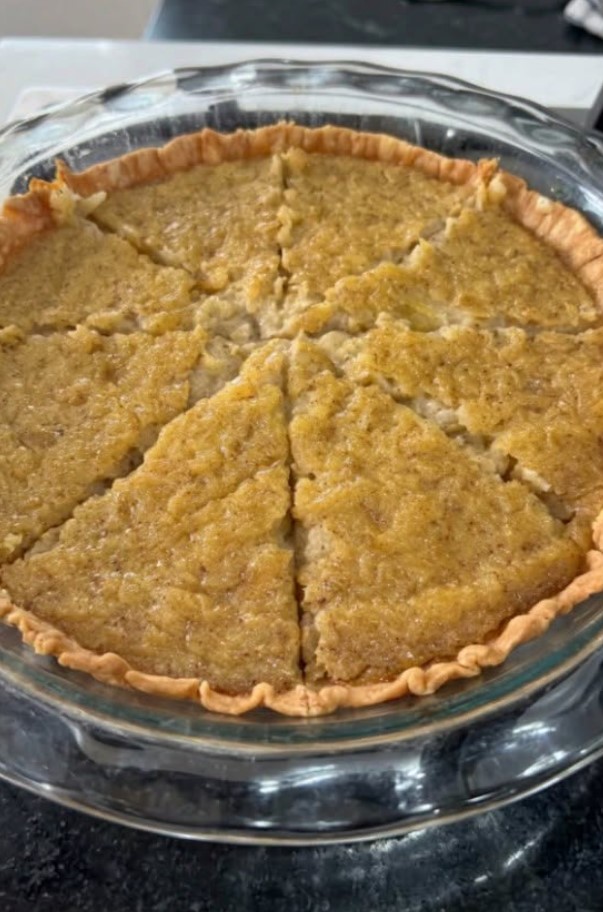
Bake until the custard has set but the top remains relatively light rather than deeply browned.
A traditional recipe using this style of filling bakes the pie at around 350°F for approximately 35 minutes after the crust has been prepared.
The exact baking time can vary depending on your oven, the depth of your pie dish, and the temperature of the filling when it goes into the oven.
The center should no longer look liquid.
However, a slight jiggle in the middle is perfectly normal for a custard pie.
Step 9: Cool Before Serving
Remove the finished pie from the oven and place it on a cooling rack.
Allow it to cool for at least 30 minutes.
This gives the custard time to finish setting.
Trying to slice it while it is extremely hot can cause the filling to appear too loose.
Marlborough Pie can be served warm, at room temperature, or chilled depending on your preference.
Tips for Making the Best Marlborough Pie
Choose Apples With Good Flavor
A mixture of tart and sweet apples gives the filling more complexity.
Firm-tart varieties such as Granny Smith or Northern Spy work well alongside sweeter apples.
You can also use other apples that hold their flavor when cooked.
Don’t Skip the Lemon Juice
The lemon juice does more than help keep the apples fresh-looking.
Its acidity balances the sweetness and helps prevent the custard from becoming too heavy.
Use Freshly Grated Nutmeg if Possible
Ground nutmeg works perfectly well, but freshly grated nutmeg has a particularly warm and fragrant flavor.
Because this recipe uses only a small amount of spice, freshness can make a noticeable difference.
Let the Apple Mixture Cool
Don’t rush this step.
If the apple mixture is extremely hot when you combine it with the eggs, it can interfere with the texture of the custard.
A short cooling period makes the process easier.
Don’t Overbake the Custard
This may be the most important tip.
A custard pie should be creamy and delicate.
Overbaking can cause the eggs to become firm and give the filling a less pleasant texture.
Remove the pie once the custard is set but still has a slight softness in the center.
Can You Use Applesauce Instead of Fresh Apples?
Yes.
Some modern versions of Marlborough Pie use unsweetened applesauce as a convenient alternative to cooking fresh apples.
About 1 cup of unsweetened applesauce can be incorporated into the filling with the other ingredients.
This shortcut is particularly useful when you already have homemade applesauce available.
However, if you want to experience the traditional process, cooking fresh apples gives you more control over their texture and flavor.
Can You Make It Without Sherry?
Yes.
Sherry appears in many traditional versions, but it is not essential to the basic structure of the pie.
If you prefer not to use it, you can leave it out or replace it with a small amount of another suitable flavoring depending on your recipe.
The apple, lemon, custard, cinnamon, and nutmeg will still provide plenty of flavor.
What to Serve With Marlborough Pie
This pie is delicious on its own, but a few simple toppings can make it even more inviting.
Whipped Cream
A spoonful of lightly sweetened whipped cream pairs beautifully with the creamy apple custard.
Vanilla Ice Cream
For a warmer, more indulgent dessert, serve a slice with a scoop of vanilla ice cream.
The contrast between cool ice cream and the softly spiced apple filling is especially pleasant.
A Dusting of Nutmeg
A very small sprinkle of freshly grated nutmeg over the top can reinforce the warm flavor already present in the filling.
Coffee or Tea
Because Marlborough Pie is relatively delicate, it pairs naturally with a cup of coffee or a warm mug of tea.
How to Store Leftover Pie
Because the filling contains eggs and dairy, leftover Marlborough Pie should be refrigerated.
Allow the pie to cool properly before covering it and placing it in the refrigerator.
Keep it covered so that it doesn’t absorb odors from other foods.
The chilled pie can be served cold or allowed to sit at room temperature briefly before serving.
If you prefer the texture slightly softer and warmer, individual slices can be gently brought toward room temperature before eating.
Why This Pie Deserves to Be Remembered
There are countless apple pie recipes available today.
Some are loaded with cinnamon.
Others contain caramel, nuts, streusel, cheddar cheese, or elaborate toppings.
Marlborough Pie takes a quieter approach.
It doesn’t try to overwhelm you with ingredients.
Instead, it combines a handful of traditional flavors and lets the apples and custard take center stage.
That simplicity is part of its appeal.
It feels like the kind of dessert that might have appeared on a family table generations ago, prepared with ingredients that were already available in the pantry.
And although it has an old-fashioned character, there is nothing outdated about the flavor.
Apple and custard remain a wonderful combination.
Final Thoughts :
New England Marlborough Pie is more than just another apple dessert.
It is a glimpse into an earlier style of American home baking, when cooks transformed simple seasonal ingredients into desserts that were both practical and elegant.
The recipe’s most distinctive feature is the way apples are combined with a rich custard rather than being layered beneath a traditional pastry crust. Historical and modern versions vary, but the familiar combination of apples, eggs, dairy, sugar, lemon, and warm spices remains at the heart of the dessert.
What makes this pie especially appealing is its balance.
The apples bring natural fruitiness.
The custard adds richness and a soft, creamy texture.
Lemon provides brightness.
Cinnamon and nutmeg bring warmth.
And a little sherry, when included, adds a subtle old-fashioned depth.
The finished dessert is elegant without being complicated.
It is also a wonderful reminder that some of the most memorable recipes don’t need dozens of ingredients or elaborate techniques. Sometimes a simple combination of seasonal fruit, a buttery pastry crust, eggs, cream, and a few carefully chosen spices is enough to create something truly special.
If you’re looking for an apple dessert that feels familiar but still offers something different, Marlborough Pie is well worth trying.
Serve it warm or at room temperature, add a spoonful of whipped cream or a scoop of vanilla ice cream, and you’ll have a dessert that connects the flavors of today’s kitchen with a much older New England tradition.
This forgotten apple custard pie may not have the same fame as classic apple or pumpkin pie, but that is part of its charm.
Once you taste that silky apple-filled custard inside a golden pastry crust, you may understand why this historic dessert remained part of New England cooking for generations—and why it deserves a place on the table again today.