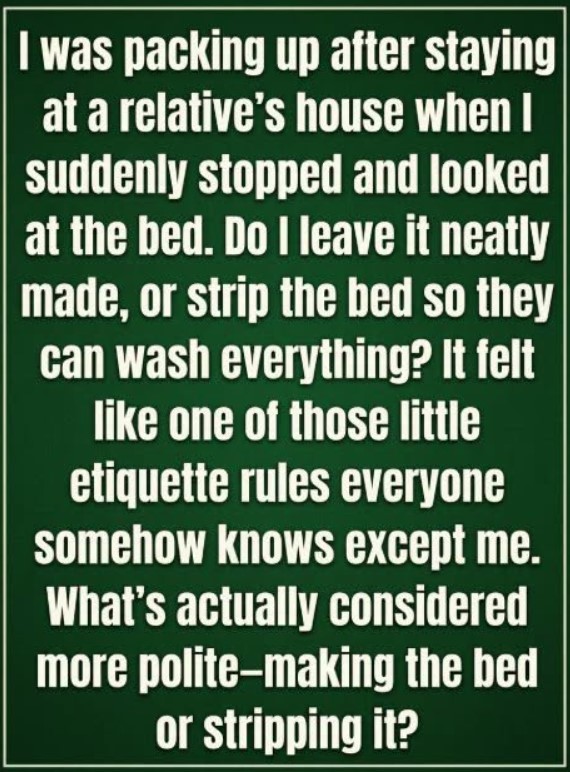
Being invited to stay in someone’s home is a wonderful gesture.
Whether you’re spending a weekend with close friends, visiting family for a few days, or staying with someone you’ve only recently gotten to know, being a houseguest usually comes with a few basic responsibilities.
You say thank you.
You try not to make a mess.
You respect the household’s routines.
And before you leave, you probably want to do something helpful to show your appreciation.
But there is one surprisingly awkward question that many guests have asked themselves while packing their bags:
What should I do with the bed?
Should you remove the sheets and leave them in a pile?
Should you put the used bedding in the laundry?
Or should you simply make the bed neatly and leave everything exactly where it was?
It seems like a tiny detail, but household etiquette can be surprisingly personal. What one host considers helpful, another might consider an unnecessary chore.
The good news is that there isn’t one universal rule.
The best choice depends on the host, the household routine, the type of visit, and whether your host has given you specific instructions.
If You’re Not Sure, Ask Your Host
The simplest solution is also the most considerate one.
If you’re staying in someone’s home and you’re unsure what they prefer, just ask.
You can say something as simple as:
“Would you like me to strip the bed before I leave, or should I just make it?”
There is nothing strange about asking.
In fact, it shows that you’re thinking about the work your host will have to do after you leave.
Some people want used sheets removed immediately because they plan to wash them.
Others prefer to handle the entire room themselves.
And some hosts would rather their guests leave everything alone.
The important thing is that you don’t assume your way of doing things is automatically the right way for someone else’s home.
When Making the Bed Is the Better Choice
If your host hasn’t given you any instructions, making the bed neatly is generally a safe and thoughtful choice.
It takes only a few minutes.
Pull the sheets into place, straighten the pillows, fold the blankets, and make the room look reasonably tidy.
When your host enters the room later, they won’t immediately be confronted with a bed that looks as though someone has just checked out of a hotel.
A made bed can also make the entire guest room look cleaner and more organized.
This can be especially appropriate when you’re staying with someone you don’t know extremely well.
If you’re visiting a friend of a friend, a distant relative, or someone hosting you for the first time, leaving the room neat is a simple way to show respect.
But Some Hosts Prefer You to Strip the Bed
There is an important exception.
Some hosts would actually prefer you to remove the bedding.
They may want to put the sheets directly into the washing machine.
They may have a particular laundry routine.
Or they may simply find it easier to know immediately which linens were used.
In those households, making the bed could actually create more work.
The host might have to pull everything apart again before washing it.
That’s why the best etiquette isn’t necessarily “always make the bed” or “always strip the bed.”
The better rule is:
Follow the host’s preference whenever you know it.
If they tell you to remove the sheets, remove them.
If they tell you to leave everything on the bed, leave it.
If they say, “Don’t worry about anything,” you can usually take them at their word.
Every Household Has Its Own Routine
One reason this question doesn’t have a universal answer is that households operate differently.
Some people wash bedding immediately after a guest leaves.
Others wait until later in the day.
Some have a specific hamper for used sheets and towels.
Others wash everything together.
Some hosts enjoy having guests help with laundry.
Others would rather their guests do nothing at all.
This is why it can be risky to assume that you are helping when you start rearranging things.
You may have good intentions, but your host may have a completely different system.
When in doubt, ask.
What If You’re Staying With Close Friends?
When you’re staying with your best friend, sibling, parent, or another close relative, things are usually much more relaxed.
You probably don’t need to behave like you’re checking out of a five-star hotel.
Your host may simply tell you:
“Don’t worry about the room. I’ll take care of it.”
In that situation, there’s no need to create a complicated departure routine.
Still, tidying up after yourself is always a thoughtful gesture.
You can straighten the bed, gather your belongings, collect your used towels, and make sure you haven’t left anything behind.
Even if your host doesn’t care about the bedding, they will probably appreciate the effort.
What If You’re Staying With Someone You Barely Know?
This situation requires a little more thought.
Maybe you’re staying with a friend’s parents.
Perhaps you’ve been invited to stay with a relative you’ve only met a few times.
Or maybe you’re visiting someone you’ve recently become friends with.
When you aren’t familiar with the household’s routines, it’s usually best to leave the room neat and orderly.
Make the bed unless you’ve been told otherwise.
Put dirty clothes into your suitcase rather than leaving them on the floor.
Gather your chargers, toiletries, books, and other belongings.
Place towels where you’ve been instructed to put them.
And take a quick look around before leaving to make sure you haven’t forgotten anything.
You don’t need to make the room look professionally cleaned.
You simply want to leave it looking cared for.
Don’t Turn the Guest Room Into a Hotel Checkout
There is another side to this issue.
Sometimes guests become so determined to be helpful that they go too far.
They strip the bed, start washing laundry, clean the bathroom, rearrange furniture, empty trash cans, and start organizing things without being asked.
That may sound helpful, but not every host wants a guest taking over their household chores.
You don’t necessarily know where everything belongs.
You might accidentally mix personal laundry with bedding.
You might use a cleaning product the host doesn’t normally use.
Or you might put something away in a place where the host can’t find it later.
Good manners aren’t about doing as much as possible.
They’re about doing what is genuinely helpful.
What About Used Towels?
The same basic principle applies to towels.
If your host has a laundry basket specifically for used towels, use it.
If they’ve asked you to leave them in the bathroom, do that.
If you’re not sure, ask.
Don’t leave damp towels crumpled on the floor.
Even if the host plans to wash them anyway, putting them somewhere appropriate makes their job easier.
And if you’ve been staying for several days, you may want to ask whether they would like you to put used towels in the laundry before you leave.
Longer Stays May Be Different
The length of your visit can also make a difference.
If you’ve stayed for one night, there may be little reason to do much more than tidy the room.
But if you’ve been there for a week or longer, you’ve probably used more bedding, towels, and household resources.
In that situation, offering to strip the bed or help with laundry can be a thoughtful gesture.
You might say:
“I’ve been here for a few days. Would you like me to strip the bed and put the sheets in the laundry?”
That gives the host a choice.
If they say yes, you know exactly what to do.
If they say no, you can simply leave everything alone.
What If the Host Has Children?
If you’re staying in a busy family home, especially one with children, the host may already have plenty of things to do.
That doesn’t mean you should take over their laundry.
But small gestures can make your departure easier for them.
Gathering your belongings, straightening the room, and putting used towels where they belong can save a few minutes.
If you’ve stayed in a child’s room or another room that has to be used by someone else immediately afterward, it may be especially helpful to ask what should happen to the bedding.
Again, communication is the easiest solution.
Don’t Forget to Check Under the Bed
Before you leave, do a quick scan of the room.
This may sound obvious, but guests frequently forget small things.
Check the nightstand.
Look behind the door.
Check the bathroom.
Look under the bed.
Check electrical outlets for chargers.
Look inside drawers if you’ve used them.
It’s surprisingly easy to leave behind socks, jewelry, phone chargers, toiletries, books, or other small belongings.
A two-minute check before you leave can save you from having to contact your host later.
What About Pets?
If your host has pets, there may be another consideration.
Perhaps a dog or cat has spent time in the guest room.
If you’ve been asked to keep the door closed, make sure it is left that way.
If the pet normally sleeps on the bed, don’t assume you should change the household routine.
The host knows how their home works.
When you’re unsure, ask.
The same principle applies to almost every part of being a considerate houseguest.
Your Relationship With the Host Matters
The closer you are to someone, the less formal the etiquette usually becomes.
You probably wouldn’t worry much about making the bed perfectly when staying at your parents’ house.
But if you’re staying with your boss’s family, a distant relative, or someone you’ve only recently met, you may want to be a little more careful.
That doesn’t mean you need to become overly formal.
It simply means you should pay attention to the household’s expectations.
A good guest notices how the home works and tries not to create unnecessary work.
The Most Important Rule: Follow Instructions
If your host gives you instructions, follow them.
This sounds obvious, but it’s worth emphasizing.
If they say:
“Just leave the bed as it is.”
Leave it.
If they say:
“Could you please strip the sheets?”
Strip them.
If they say:
“Put everything in the laundry room.”
Put it there.
If they say:
“Don’t worry about anything. I’ll handle it.”
Respect that too.
Sometimes the most considerate thing you can do is accept someone’s hospitality without trying to prove how helpful you are.
A Simple Question Can Prevent the Awkwardness
If you are still unsure, there’s one sentence that solves almost everything:
“How would you like me to leave the bed?”
That’s all you need.
It removes the guesswork.
It respects the host’s preferences.
And it shows that you’re thinking about what happens after you leave.
Most hosts will appreciate being asked.
They may laugh and say, “Oh, don’t worry about it.”
Or they may give you very specific instructions.
Either way, you know what they prefer.
The Goal Is to Leave the Room Respectfully
Ultimately, the question isn’t really about sheets.
It’s about consideration.
A thoughtful houseguest doesn’t need to perform a long list of chores.
They simply avoid leaving unnecessary work behind.
That might mean making the bed.
It might mean stripping the sheets.
It might mean gathering towels.
Or it might mean doing absolutely nothing because the host specifically asked you not to.
The best choice depends on the situation.
And that’s why there isn’t a single rule that applies to every household.
A Good Guest Also Says Thank You
There is one thing that matters even more than what you do with the bedding.
Say thank you.
If someone has opened their home to you, acknowledge the effort they’ve made.
Thank them when you arrive.
Thank them during your stay.
And thank them again when you leave.
A small note, a message afterward, or a thoughtful gesture can also be appropriate depending on your relationship.
Hospitality is personal.
So gratitude should be personal too.
Conclusion :
So, should you remove the bedding or make up the bed before leaving as a houseguest?
The answer is simple: there isn’t one rule for every situation.
If your host has specifically told you what they prefer, follow their instructions. Some hosts want guests to strip the bed so they can immediately wash the sheets, while others would rather find the bed neatly made when they return to the room.
If nobody has given you instructions, making the bed neatly is generally a safe and considerate choice.
Straighten the sheets, arrange the pillows, fold the blankets, gather your belongings, and leave the room looking tidy.
But don’t feel that you have to turn yourself into a housekeeper.
You don’t need to reorganize the room, start laundry without permission, or clean every corner of the house unless your host has asked you to.
When you’re unsure, simply ask.
“Would you like me to strip the bed, or should I leave it made?”
That one question can prevent confusion and shows your host that you’re thinking about their preferences.
In the end, good houseguest etiquette isn’t really about whether the bed is made or stripped.
It’s about respect, gratitude, and consideration.
Leave the room in a reasonable condition, follow the household’s instructions, take your belongings with you, and thank your host for opening their home to you.
Those small gestures are often what people remember long after the visit is over.