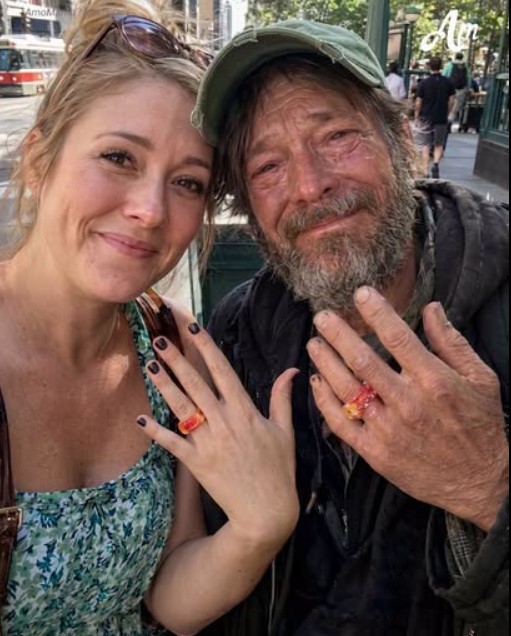
Six days after Larry’s funeral, I found his letter waiting in my mailbox.
The envelope was thick and white, and my name was written across the front in the shaky handwriting I knew so well.
I had seen that handwriting on his hospice forms.
I had watched his trembling hand struggle to complete paperwork while nurses offered to help him.
He always refused.
“My hand still works,” he would say with a faint smile. “Mostly.”
When I first saw the envelope, I actually smiled.
I assumed it was a goodbye.
That was exactly the kind of thing Larry would do. He had never been able to accept something as simple as a cup of coffee without thanking me several times.
I expected a sad letter filled with gratitude.
I expected tears.
I expected one final joke about the pigeons he hated so much.
Instead, the first sentence made my stomach tighten.
“Sarah, I need to apologize before I thank you.”
I read it again.
Then I continued.
“Nobody was going to bury me as a John Doe.”
The color seemed to disappear from the room.
I sat down on the floor.
“No,” I whispered.
Because suddenly I knew that the story I thought I understood wasn’t the whole story.
Less than a month earlier, Larry had been sitting outside my subway station with a cardboard sign resting across his knees.
The words were written in large black letters:
MARRY ME. I HAVE ONE MONTH LEFT TO LIVE.
And somehow, I had said yes.
The Man Outside the Subway Station
I had known Larry for almost two years.
Every weekday morning, I stopped at the coffee kiosk near the subway entrance.
I bought two coffees.
Mine had cream.
Larry’s was always black.
He never asked me for money.
He never demanded food.
He never complained when I was too busy to stay.
Most mornings, we talked for only a few minutes.
Sometimes we discussed the weather.
Sometimes he complained about the pigeons.
Once, he looked at my work shoes and told me they looked like they had been designed by someone who hated human feet.
I laughed so hard that morning I nearly missed my train.
Those little conversations became part of my routine.
Larry became part of my routine.
Then, one freezing Tuesday morning, everything changed.
He looked different.
His skin had a yellowish color, and his hands shook badly when I gave him his coffee.
Then I noticed the cardboard sign.
I pointed toward it.
“What is this?”
Larry looked down.
“The clinic says I probably have about a month.”
I thought I had misunderstood him.
“What?”
“Liver failure.”
The traffic around us suddenly seemed very far away.
I sat beside him on the cold pavement.
“Larry, I’m so sorry.”
He looked at me.
“Don’t make that face.”
“What face?”
“The face people make when they’re already standing at your funeral.”
Even then, he made me laugh.
But the sign wasn’t funny.
I kept staring at it.
“Why marriage?” I asked.
Larry looked down at his coffee.
“I don’t want to die belonging to nobody.”
“You don’t belong to nobody.”
“That’s a nice thing to say, Sarah.”
He looked toward the street.
“But it’s different when it’s written on a form.”
He explained that he didn’t want strangers handling everything after he died.
He wanted someone who could say his name.
Someone who could say, “He’s mine. I’ll take care of him.”
And somehow, I understood.
I was single.
Larry was dying.
And I had always been much better at solving problems than walking away from them.
So I agreed.
Eleven Minutes Changed Everything
Two days later, Larry and I went to the courthouse.
He wore a clean blue shirt someone at the shelter had given him.
I wore my navy work dress.
There were no flowers.
No guests.
No celebration.
When the clerk asked whether we had rings, Larry dramatically searched his pockets.
“Knew I forgot something.”
I laughed.
Eleven minutes later, I was legally his wife.
The whole thing felt surreal.
I kept telling myself it wasn’t really a marriage in the traditional sense.
It was simply a way of making sure Larry wouldn’t disappear without anyone there to speak for him.
But the next three weeks changed that.
I visited him at hospice every evening.
I brought him things.
Warm socks.
A blanket.
A phone charger.
Toiletries.
Anything I thought might make his final days easier.
And Larry kept telling me the same thing.
“Sit down, Sarah.”
I’d always answer:
“In a minute.”
There was always something else to do.
Another nurse to speak with.
Another form to complete.
Another problem to solve.
I didn’t realize then that Larry wasn’t asking for another thing.
He was asking for me.
Three weeks after we married, I sat beside his bed at the hospice facility.
I held his hand.
His breathing became slower.
Quieter.
And then it stopped.
Larry was gone.
I thought that was the end of our strange little story.
I was wrong.
The Letter I Never Expected
Six days after his funeral, I opened his letter.
The first sentence still stared back at me.
“Sarah, I need to apologize before I thank you.”
Then came the sentence that had made my blood run cold.
“Nobody was going to bury me as a John Doe.”
I kept reading.
“The liver failure was real. The month was real. The lie was why I asked you to marry me.”
I stopped.
My hands went cold.
I read the sentence again.
Then again.
His illness had been real.
His death had been real.
But the reason he had asked me to marry him wasn’t exactly what he’d told me.
Larry explained that his arrangements had already been made.
Hospice and the county would have handled the necessary paperwork.
He was not actually going to disappear without a name.
He had made that part sound worse because he knew something about me.
He knew I couldn’t resist a problem I believed I could solve.
“If I gave you a problem you could solve,” he wrote, “I knew you would solve it.”
I stood up so quickly that my chair scraped across the floor.
“What did you do, Larry?”
But he wasn’t there.
I couldn’t call him.
I couldn’t demand an explanation.
I couldn’t even make him sit across from me and watch my face while I confronted him.
He had left the explanation behind after he was already gone.
And the worst part was that he had understood me perfectly.
Larry Had Known Me Better Than I Thought
Larry knew that I liked fixing things.
He knew that when someone needed help, I immediately started looking for a solution.
That was how I’d treated him for two years.
If he needed socks, I bought socks.
If he needed food, I brought food.
If he needed a shelter number, I searched for one.
If he needed paperwork, I helped him.
I thought I was helping Larry.
But Larry had been watching me.
He knew exactly how I responded to problems.
And he turned his loneliness into one.
His letter continued.
“You always wanted to fix things for me. I liked that about you, even when you drove me crazy.”
Despite myself, I smiled through my tears.
Then I read the next sentence.
“I didn’t need better socks as much as you thought I did.”
A laugh escaped me.
“You’re welcome, Larry,” I whispered.
Then I read the line underneath.
“I needed you to sit down.”
That sentence broke something inside me.
Because I suddenly remembered every visit to the hospice.
Every time Larry had asked me to sit.
Every time I’d answered that I would do it in a minute.
I had been so focused on fixing things that I hadn’t realized what he actually wanted.
He didn’t need another blanket.
He didn’t need another phone charger.
He didn’t need me to solve every problem.
He wanted me to stay.
The Question Larry Never Asked
Then I reached the most painful part of the letter.
Larry had written:
“I didn’t need a wife to make my life matter, Sarah.”
I stopped reading.
Underneath it was another sentence.
“But I did want to know what it felt like, once, to have somebody choose that word with me.”
My eyes filled with tears.
I whispered into the empty room:
“Then why didn’t you just tell me?”
His answer was already waiting.
Because he had been afraid.
If he had simply asked me to marry him because he was lonely, I might have hesitated.
I might have asked questions.
I might have said no.
He couldn’t bear that possibility.
So he gave me something I understood.
A problem.
Paperwork.
A task.
Something I could fix.
“I knew if I’d told you the truth, you might still have said yes,” he wrote.
Then came the question I had been asking myself.
“So why didn’t you?”
His answer was heartbreaking.
“Because then I’d have to hear you decide whether being lonely was a good enough reason.”
I lowered the letter.
For two years, I had thought I was the one who understood Larry.
But perhaps he had understood me just as well.
Maybe even better.
I Finally Understood What He Had Given Me
I had always thought of myself as the person who gave.
I bought the coffee.
I brought the food.
I found the shelter numbers.
I made the calls.
I solved the problems.
But Larry’s letter made me look at those two years differently.
He had given me something too.
He had given me a place where I could slow down.
A place where someone didn’t need me to be perfect.
A place where I could simply sit.
I remembered our last Tuesday together.
I had brought him his usual black coffee.
“Are you staying?” he had asked.
“Five minutes.”
“Big spender.”
I had laughed.
But that day, I stayed twelve minutes.
At the time, twelve minutes seemed meaningless.
Now they felt precious.
Maybe those twelve minutes were the greatest gift I had ever given him.
Not the socks.
Not the blanket.
Not the phone charger.
Not the paperwork.
Just twelve minutes of sitting beside him.
“Don’t Turn Me Into Someone You Failed to Save”
Then I reached the final part of the letter.
Larry had written:
“Don’t turn me into one more person you failed to save.”
My fingers stopped.
Because that was exactly what I had been doing.
Since his funeral, I had been replaying everything.
What if I had noticed his illness sooner?
What if I had found better treatment?
What if I had helped him find permanent housing earlier?
What if I had done more?
I had been turning Larry into another problem I hadn’t solved.
Another person I believed I had failed.
But Larry didn’t see it that way.
His next words made me cry.
“You were not my failed rescue, Sarah.”
Then:
“You were my wife for three weeks.”
And finally:
“I liked it.”
I laughed through my tears.
“You absolute idiot,” I whispered.
That was Larry.
Even in his final letter, he found a way to make me laugh.
Back to the Place Where It All Began
After reading the letter, I folded it carefully.
But I wasn’t ready to go home.
I took the subway to Larry’s old station.
The coffee kiosk was still there.
The woman behind the counter recognized me immediately.
“Two?” she asked.
For a second, I almost answered automatically.
Then I looked toward the place where Larry had sat for nearly two years.
“Yeah,” I said quietly.
She handed me two cups.
Mine had cream.
His was black.
I carried both outside.
Then, for the first time in two years, I actually sat in Larry’s spot.
I didn’t stay for five minutes.
I didn’t check the time.
I didn’t hurry toward the office.
I just sat there.
I put his black coffee beside me and opened the letter again.
The city moved around me.
People hurried into the subway.
Cars passed.
The train rumbled underneath the pavement.
But for once, I wasn’t rushing to fix anything.
I was simply there.
Then a man with a worn backpack stopped nearby.
“Excuse me,” he said. “Is this seat taken?”
I looked at the empty space beside me.
“No.”
He sat down.
For a moment, neither of us spoke.
Then I held out my hand.
“I’m Sarah.”
He looked surprised.
“Jeremy.”
“Nice to meet you.”
I picked up the black coffee and took a sip.
It was bitter.
I made a face.
Jeremy noticed.
“Bad?”
“No,” I said.
I looked at Larry’s empty place.
“Just not mine.”
I stood and returned to the kiosk.
The woman behind the counter smiled.
“Another black?”
I shook my head.
“Actually, could you add some cream?”
She handed me the new cup.
I returned to the bench.
Larry’s letter and our marriage certificate were beside me.
For the first time since his death, I didn’t feel as though I had to rush toward the next solution.
I didn’t have to rescue anyone.
I didn’t have to fix anything.
I simply sat.
And as the city moved around me, I finally understood what Larry had been trying to teach me all along.
Sometimes helping someone doesn’t mean solving their life.
Sometimes it means listening.
Sometimes it means staying.
And sometimes, the most meaningful thing you can give another person is simply your time.
Larry had been afraid of dying alone.
He had wanted someone to choose him.
In the end, I realized that our marriage had been far more complicated than the simple arrangement I had believed it was.
He had manipulated the situation by turning his loneliness into a problem I could solve.
But he had also given me a lesson I would carry for the rest of my life.
Not every person who needs help is asking you to fix them.
Sometimes they are only asking you to sit beside them.
I looked down at the marriage certificate one last time.
For most of Larry’s life, his name had appeared beside the word Witness.
For three weeks, it appeared beside another word.
Spouse.
And somehow, that small word meant more to both of us than either of us had understood when we signed the papers.
I folded the certificate and Larry’s letter together.
Then I took another sip of my coffee.
This time, I didn’t hurry.
For the first time, I wasn’t trying to solve the moment.
I was simply living it.
And the coffee in my hands finally tasted like mine.
Conclusion :
Larry entered my life as a man sitting outside a subway station with a cup of black coffee and a cardboard sign.
I thought I was the one helping him.
I thought our marriage was simply a final act of kindness for a dying man who didn’t want to disappear without a name.
But his final letter showed me that there had been something deeper underneath it all.
Larry was lonely.
He wanted to be chosen.
He wanted someone to stay.
He was afraid that if he asked for those things directly, the answer might be no.
So he gave me a problem instead.
And because I was the kind of person who always tried to solve problems, I said yes.
His method wasn’t perfect. He should have told me the truth from the beginning.
But after his death, I finally understood something I had been missing for years.
People don’t always need us to rescue them.
They don’t always need another solution, another phone call, another form, or another plan.
Sometimes they need someone to sit down.
Sometimes they need someone to listen.
And sometimes they simply need to know that, for once, somebody has chosen to stay.
Larry only had three weeks as my husband.
But those three weeks changed the way I saw love, kindness, grief, and even myself.
I couldn’t save Larry from dying.
That was never mine to control.
But I could remember him.
I could honor what he taught me.
And I could stop turning his life into something I had failed to fix.
So I sat there outside the subway station, with his letter beside me and a cup of coffee in my hands.
For once, I wasn’t rushing anywhere.
I wasn’t solving anything.
I was simply staying.
And somehow, that was enough.