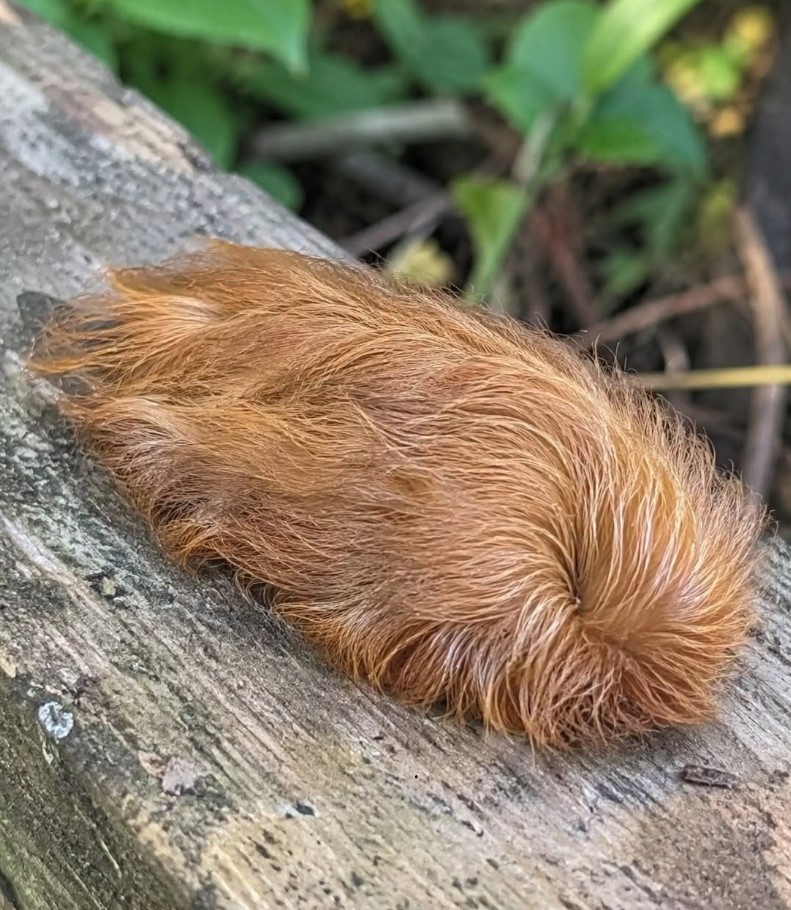
Finding a fuzzy caterpillar crawling across your garden, patio, driveway, or even the side of your house can create an interesting little mystery.
At first glance, it may look completely harmless. It is small, slow-moving, and covered in soft-looking hairs. Unlike wasps or spiders, it doesn’t appear particularly threatening.
But there’s an important reason you shouldn’t automatically pick up every fuzzy caterpillar you find.
Those hairs can mean very different things depending on the species.
Some hairy caterpillars are completely harmless to people. Others have specialized hairs or spines that can cause skin irritation, itching, burning, or a painful reaction when touched.
That’s why identifying a caterpillar based only on the fact that it looks “fuzzy” isn’t enough.
The safest approach is simple: don’t touch an unfamiliar caterpillar with your bare hands.
Instead, take a good look at its shape, color, markings, location, and behavior. If you’re still uncertain, use a reliable insect-identification resource or ask a local extension specialist.
Why Are Some Caterpillars Fuzzy?
The hairs covering a caterpillar aren’t necessarily there to make it look cute.
For many species, the hairs serve as a form of protection.
A caterpillar is vulnerable while it is growing. Birds, small mammals, insects, and other predators may try to eat it.
Hair-like structures can make a caterpillar look less appealing or more difficult to swallow.
In some species, the hairs are simply part of the insect’s body covering.
In others, however, the structures can be associated with defensive mechanisms.
This is why you shouldn’t assume that a caterpillar is safe simply because its hairs look soft.
What appears to be ordinary fuzz from a distance may have a very different purpose.
Not Every Hairy Caterpillar Is Dangerous
It’s also important not to go to the opposite extreme.
Seeing a fuzzy caterpillar doesn’t automatically mean you’re looking at a dangerous insect.
There are many caterpillar species with noticeable hairs or bristles that don’t pose a significant threat to people.
For example, some common caterpillars are simply covered with hairs as part of their normal appearance and do not have a mechanism for delivering a painful sting.
University extension resources point out that caterpillar identification depends on several characteristics, including size, body markings, and other physical features rather than simply whether the insect is hairy.
That’s why the question isn’t really:
“Is every fuzzy caterpillar dangerous?”
The better question is:
“Which caterpillar is this?”
Once the species is known, its potential risks become much easier to understand.
The Problem With Identifying Caterpillars by Appearance Alone
Caterpillars can be surprisingly difficult to identify.
Different species can have similar colors, patterns, and body shapes.
Some may even look completely different at different stages of development.
A young caterpillar may have markings that change as it grows. A species that appears mostly black at one stage may develop a different pattern later.
This makes casual identification unreliable.
Even experienced gardeners sometimes need to look closely at details such as:
- Body color
- Stripe patterns
- Spots
- Hair arrangement
- Spines
- Body shape
- Number and position of legs
- Size
- Host plant
- Geographic location
- Season
A photograph can help, but even photographs aren’t always enough for a confident identification.
What Makes Some Caterpillars Cause Skin Reactions?
Certain caterpillars have specialized structures that can irritate human skin.
Depending on the species, contact can result in symptoms such as:
- Itching
- Redness
- Burning
- Stinging
- Localized swelling
- A rash
- Small irritated spots
The reaction can vary from person to person.
One person might experience only mild irritation, while another may have a much stronger response.
This is another reason it’s better not to experiment by touching an unidentified caterpillar.
You don’t gain much from picking it up, but you could end up with an uncomfortable skin reaction.
What Should You Do If You Find One?
The easiest thing to do is leave it alone.
If it’s outside and isn’t causing a problem, there’s usually no reason to handle it.
Watch it from a safe distance.
If you’re curious about what species it is, take a photograph without touching it.
Try to capture:
- The entire caterpillar
- A close-up of the body
- The head and rear end if visible
- Its markings
- The plant or surface where you found it
The surrounding environment can also provide useful information.
A caterpillar found feeding on an oak tree may be easier to identify when that information is included with the photograph.
Don’t Pick It Up With Your Bare Hands
This is probably the most useful rule to remember.
If you don’t know what you’re looking at, don’t handle it.
Even if the caterpillar looks soft.
Even if it is sitting quietly.
Even if you’ve seen similar caterpillars before.
And especially if it has unusual hairs, tufts, spines, or bright warning colors.
You don’t need to panic.
Just avoid direct contact.
If you need to move it away from a walkway or another frequently used area, use a method that doesn’t require touching the insect directly.
What If a Caterpillar Is on Your House?
Finding a caterpillar on a wall, porch, or window doesn’t necessarily mean there’s an infestation inside your home.
Caterpillars often move around as they search for food, shelter, or an appropriate place to continue their life cycle.
Some species may wander away from the plants where they fed.
Others may be looking for a protected location before transforming into the next stage of their life cycle.
So seeing one caterpillar on your house isn’t automatically a reason to start spraying insecticide.
First, identify what you’re dealing with.
What If There Are Many Caterpillars?
A larger number of caterpillars can be a different situation.
If you suddenly notice many caterpillars feeding on the same tree or shrub, inspect the plant carefully.
Look for:
- Chewed leaves
- Bare branches
- Webbing
- Egg masses
- Groups of caterpillars
- Droppings beneath the foliage
Some caterpillar species can cause substantial feeding damage when populations become high.
Others are much less concerning and may have little effect on a healthy plant.
For example, University of Minnesota Extension notes that healthy established trees can tolerate feeding by certain tent caterpillars, although young or stressed trees may be more vulnerable.
That means the presence of caterpillars doesn’t automatically mean the plant needs immediate treatment.
Don’t Reach for Pesticides Immediately
It can be tempting to grab an insecticide the moment you see a strange caterpillar.
But that’s not always the best first step.
The insect might be harmless.
It might be a beneficial species.
It might be part of the natural ecosystem.
And you might not even know what you’re trying to eliminate.
Identification should come first.
If treatment is genuinely necessary because caterpillars are damaging a plant, choose a product appropriate for the situation and follow its label directions carefully.
Extension guidance emphasizes identifying the pest and considering the stage of the caterpillar before deciding whether treatment is necessary.
Caterpillars Are an Important Part of Nature
It’s easy to think of caterpillars only as garden pests.
But they are also an important part of many ecosystems.
Caterpillars feed on plants and, in turn, provide food for birds and other animals.
They are also part of the life cycle of moths and butterflies.
That means finding a caterpillar doesn’t necessarily mean you’ve discovered a problem.
Sometimes you’ve simply encountered an ordinary part of the local ecosystem.
In fact, many gardeners enjoy watching caterpillars develop and eventually transform into adult moths or butterflies.
Why Some Caterpillars Have Bright Colors
If you’ve ever noticed a caterpillar with unusually bright colors, you may have wondered whether the coloring is a warning.
Sometimes it can be.
Bright colors can serve as a visual signal to predators, although color alone isn’t a reliable way to determine whether a caterpillar is harmful to humans.
Some harmless species may have striking colors.
Other species may use camouflage instead.
And some insects mimic the appearance of more dangerous species as a defensive strategy.
So don’t rely on a single characteristic.
Look at the complete combination of features.
What About Very Hairy Caterpillars?
The extremely fuzzy ones are often the ones that attract the most attention.
Their appearance can range from soft and fluffy to bristly and almost spiky.
But “hairy” isn’t a scientific identification.
There are many unrelated caterpillars that can appear fuzzy.
Some have long, fine hairs.
Some have dense tufts.
Some have short bristles.
Others have obvious spines hidden among the hairs.
Without knowing the species, it is difficult to determine what those structures mean.
That’s why avoiding direct contact is the sensible approach.
What If You Accidentally Touch One?
If you accidentally brush against an unfamiliar caterpillar, don’t panic.
Move away from the insect and avoid rubbing the affected area.
If visible hairs or irritating material may have contacted your skin, gently remove any obvious material without spreading it further.
Wash the area with soap and water.
If irritation develops, monitor it.
Mild localized reactions may settle, but symptoms that are severe, rapidly worsening, widespread, or accompanied by difficulty breathing or other signs of a serious allergic reaction require prompt medical attention.
Children should receive particular attention because they may be more likely to touch unfamiliar insects out of curiosity.
Why Children Should Be Taught Not to Touch Fuzzy Caterpillars
A fuzzy caterpillar can look like something a child would naturally want to pick up.
It moves slowly.
It doesn’t make noise.
It may even look soft enough to touch.
That’s exactly why it’s worth teaching children a simple outdoor rule:
Look, but don’t touch unfamiliar insects.
They can observe the caterpillar, take a photograph, or call an adult.
This rule doesn’t need to be frightening.
The goal isn’t to make children afraid of nature.
It’s simply to encourage safe curiosity.
How to Identify an Unknown Caterpillar More Carefully
If you want to identify the caterpillar, start by documenting what you can see.
Look at the Overall Color
Is it black, brown, gray, white, yellow, green, orange, or a combination?
Look for Stripes
Does it have a stripe running down the back?
Are there stripes along the sides?
Look at the Hair Pattern
Are the hairs evenly distributed?
Are there tufts?
Are there obvious spines?
Does the body appear smooth underneath the hair?
Estimate the Size
A rough measurement can be very useful.
Don’t guess wildly.
If possible, place a ruler near the caterpillar without touching it and take a photograph.
Look at the Plant
What is it eating?
Was it on an oak, fruit tree, vegetable plant, ornamental shrub, or grass?
The host plant can provide a valuable clue.
Note Your Location
Caterpillar species vary by region.
Knowing the country, state, province, or general area can help narrow down possible identifications.
University extension identification guides, for example, organize caterpillar resources by size and habitat and provide photographs to help people compare insects.
Why a Photograph Is Better Than Picking It Up
If you’re curious, photography is one of the safest tools available.
You can get surprisingly useful information without touching the insect.
Take several photographs from different angles.
Try to capture the body clearly.
If possible, photograph the caterpillar where you found it rather than moving it.
This preserves information about its environment.
You can then compare the images with reliable identification resources.
What If It Is a Stinging Caterpillar?
Some caterpillars have defensive structures capable of causing painful or irritating reactions.
If an identification resource indicates that the species can sting or cause skin irritation, keep your distance.
Don’t handle it casually just because it isn’t moving.
If it is in a place where people are likely to touch it accidentally, consider contacting a local pest or extension professional for advice on safe removal.
The exact risk depends heavily on the species.
That is why identification is so important.
Don’t Assume Every Fuzzy Caterpillar Is a “Woolly Bear”
One common mistake is giving every fuzzy caterpillar the same familiar name.
There are several kinds of hairy caterpillars, and common names can vary by region.
A caterpillar may look somewhat similar to a familiar species without actually being the same insect.
This is another reason scientific identification can be more reliable than guessing from a nickname.
What Role Do Caterpillars Play in Their Life Cycle?
A caterpillar is not the final form of the insect.
It is the larval stage of a moth or butterfly.
During this stage, its primary job is generally to eat and grow.
As it develops, it may shed its skin several times.
Eventually, it reaches a stage where it transforms into a pupa or chrysalis, depending on the type of insect.
Later, the adult moth or butterfly emerges.
Understanding this life cycle can make a strange-looking caterpillar seem much less mysterious.
That fuzzy creature crawling across a leaf may eventually become a completely different-looking winged insect.
When Should You Be More Concerned?
A caterpillar deserves more caution when:
- You don’t know what species it is.
- It has obvious spines or unusual defensive structures.
- It is known locally to cause skin reactions.
- Someone has already developed significant irritation after contact.
- There are large numbers of caterpillars around frequently used areas.
- Children or pets are likely to handle them.
- The insects are causing significant damage to plants.
Even then, the answer isn’t necessarily “destroy them immediately.”
The first step is still identification.
Once you know what you’re dealing with, you can decide whether any action is necessary.
The Best Rule to Remember
You don’t have to become an expert entomologist every time you see a caterpillar.
You only need to remember one simple rule:
If you don’t know what it is, don’t touch it.
That’s enough.
You can enjoy looking at it.
Take a photograph.
Observe what plant it is feeding on.
Search a reliable identification guide.
Ask an expert if necessary.
There is no reason to take an unnecessary risk just because an insect looks interesting.
Final Thoughts
So, is this fuzzy caterpillar harmless, or is it dangerous?
The honest answer is that you can’t determine that simply from the fact that it is fuzzy.
Some hairy caterpillars are harmless. Others have defensive hairs, spines, or structures that can cause skin irritation or a painful reaction.
That’s why identification matters.
Instead of picking up an unfamiliar caterpillar, observe it from a safe distance. Look carefully at its color, markings, body shape, hair pattern, size, and the plant where you found it. A clear photograph can make identification much easier, and local extension services or other reliable insect-identification resources can help when you’re uncertain.
It’s also important to remember that caterpillars aren’t automatically pests. They are an important part of the life cycle of moths and butterflies and provide food for many other animals. Some can cause noticeable damage to plants when populations become large, while others have little impact on healthy vegetation.
The safest approach is therefore neither panic nor careless handling.
It’s simple curiosity with a little caution.
The next time you spot a strange fuzzy caterpillar, take a step back, grab your camera instead of your hand, and have a closer look.
That tiny creature may be completely harmless—or it may be one of the species better admired from a distance.