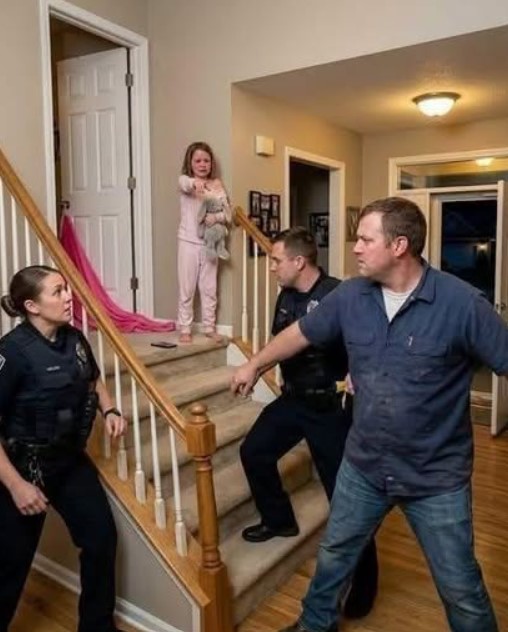
Daniel didn’t take his eyes off Thomas as he reached the landing.
Thomas shifted sideways again, placing himself between the officers and the half-open bedroom door. Down the hall, the little phone remained facedown on the carpet, its 911 connection still open.
Daniel repeated the command.
“Mr. Miller, step away from the stairs.”
Thomas didn’t obey.
Instead, he raised both hands slightly, as if he were the reasonable one in the situation.
“You’re making a mistake,” he said.
Daniel remained calm.
“We received a 911 call from this house. A child reported that she was in danger. We need to make sure she is safe.”
“She’s confused,” Thomas replied. “She wakes up from nightmares. She says strange things.”
Daniel took another step toward the bedroom.
Thomas moved again.
This time, Daniel understood that the man’s position in the hallway wasn’t accidental.
He wasn’t simply nervous.
He was trying to prevent them from entering the room Emily had pointed toward.
Downstairs, María kept her attention on Emily.
The little girl had become almost completely silent. Her stuffed rabbit was pressed tightly against her chest, one ear twisted around her fingers.
María crouched beside her.
“Stay with me, Emily.”
The girl nodded.
Then she glanced toward the stairs.
“Is he mad?”
María answered carefully.
“You don’t have to worry about him right now.”
Emily swallowed.
“He gets mad when I tell.”
María didn’t ask her to explain.
She knew there would be trained professionals whose job was to speak with Emily carefully, without forcing her to repeat frightening memories over and over.
For now, the priority was simple.
Emily needed to remain safe.
María looked toward the landing.
“Emily, is the snake you told the 911 operator about inside that room?”
The girl stared at the floor.
Then she slowly shook her head.
“No.”
María waited.
Emily’s voice was barely audible.
“Snake is what Daddy makes me call it.”
María kept her expression calm.
“What does he make you call that?”
Emily hugged the rabbit tighter.
“What he does when the door is closed.”
María immediately stopped asking questions.
She didn’t need Emily to explain more.
Not there.
Not while Thomas was still inside the house.
Upstairs, Daniel reached the bedroom door.
Thomas suddenly stepped directly into his path.
Daniel stopped him.
The movement was quick, and for a few seconds the quiet hallway became a struggle of positioning and commands.
“Step away from the door.”
Thomas resisted.
“I’m her father!”
“And she’s the child who called 911,” Daniel replied.
Thomas looked toward the phone on the floor.
His eyes stayed there for only a second.
But Daniel noticed.
So did Claire Johnson, who was still listening from the emergency line.
At 9:19 p.m., Claire added another note to the call record: officers were on scene, an adult male was obstructing access to the room identified by the child, and the original caller remained connected.
The call had not been disconnected.
Neither had the officers’ body cameras stopped recording.
That mattered.
Because Thomas was already trying to change the story.
Daniel finally moved him away from the doorway.
Then he opened the bedroom door.
There was no snake.
No cage.
No animal hiding beneath the bed.
Instead, Daniel saw an ordinary child’s bedroom that had been disturbed.
A pink blanket had been pulled partly into the hallway. The bedding was disorganized. Emily’s phone was lying facedown outside the room. Toys and other belongings were scattered around the familiar space of an eight-year-old child.
Nothing inside the room provided a simple explanation for the call.
Daniel looked carefully without touching anything unnecessarily.
Then he stepped back.
“We need medical personnel here,” he told María.
Thomas immediately began talking.
“She makes things up.”
Daniel looked at him.
Thomas continued.
“She has nightmares. She gets confused when she’s tired. Ask anyone.”
Daniel didn’t argue.
He didn’t need to.
There was already a record of what had happened.
Claire had heard Emily’s original words before police arrived.
The body cameras had recorded the officers’ arrival.
Daniel and María had personally seen Emily’s reaction to her father.
They had seen Thomas attempt to prevent them from reaching the room she had identified.
And Claire had heard a man’s voice near the phone before the officers entered the house.
Those were separate observations.
They would have to be evaluated properly.
Thomas kept speaking.
“You came into my house because a kid used the word ‘snake’?”
Daniel answered simply.
“We came because your daughter called 911.”
Thomas looked down the staircase.
Emily immediately moved behind María.
María raised one hand.
“Do not approach her.”
“I’m her father.”
“Do not approach her.”
Thomas stopped.
For the first time that night, he seemed to have no prepared answer.
A few minutes later, the medical team arrived.
María turned toward Emily.
“Do you want to walk or do you want someone to carry you?”
Emily looked at her.
“I can walk.”
“Okay.”
The girl took one step.
Then another.
She still held the stuffed rabbit.
As they reached the bottom of the stairs, Thomas called her name.
“Emily.”
The girl froze.
Her shoulders tightened.
María immediately turned toward him.
“No.”
Thomas lifted his hands.
“I just want to tell my daughter I love her.”
María looked at Emily.
“You don’t have to answer him.”
Emily didn’t.
She simply continued walking.
It was a small moment, but it was important.
For the first time that night, she made a decision without first looking at her father’s face to see how he would react.
Outside, Maplewood Drive looked completely normal.
Porch lights illuminated quiet homes.
A sprinkler clicked somewhere nearby.
The swing set behind the Miller house moved gently in the breeze.
Nothing about the neighborhood suggested that a frightened child had just called 911 from inside one of its houses.
Emily was taken somewhere she could be examined privately.
The adults around her did not demand a complete explanation.
They documented what they could observe.
They listened when she spoke.
And they arranged for trained professionals to continue the conversation in a safer environment.
Inside the house, Thomas’s behavior continued to change.
First he sounded offended.
Then cooperative.
Then angry.
Then insulted.
He insisted that nobody should believe an eight-year-old over him.
Daniel allowed the body camera to record everything.
Thomas eventually said, “Kids misunderstand things.”
Daniel asked him a simple question.
“Then why did you keep us from reaching the room she pointed to?”
Thomas opened his mouth.
For several seconds, he said nothing.
Finally, he answered, “I didn’t know what you were going to do.”
“But you knew which room she meant.”
Thomas looked away.
Daniel didn’t claim that one reaction proved everything.
He knew an investigation couldn’t be built on assumptions.
Neither could María.
The truth would have to be established through evidence, professional interviews, medical information, documentation, and whatever else investigators uncovered.
But the original 911 call was already important.
Claire had heard Emily before Thomas knew police were coming.
She had heard the girl’s voice change.
She had heard her become quieter.
She had heard footsteps.
She had heard Emily say that her father was coming back.
And she had remained on the line while officers responded.
No officer had suggested those words.
No investigator had coached Emily.
They were recorded before anyone from law enforcement had entered the house.
At 9:23 p.m., Daniel stepped away from the others and spoke into his radio.
“We have the child separated and safe.”
Claire watched the words appear in the dispatch system.
Safe.
It wasn’t the same thing as healed.
It wasn’t the same thing as the investigation being finished.
But it was the first word that night that pointed toward something better.
Thomas was detained while officers secured the scene and investigators began the next stage of the process.
He protested.
“What are you putting in her head?” he demanded.
María didn’t answer.
Emily could hear him from outside.
She looked toward the house.
María gently spoke to her.
“You didn’t cause this.”
Emily looked down at the rabbit.
“You called for help because you were scared. That was the right thing to do.”
The girl was quiet.
Then she whispered something that made María’s expression soften.
“I wasn’t supposed to call.”
María nodded.
“I know.”
“He said police would be mad at me.”
María looked directly at her.
“We’re not.”
Emily slowly lifted her eyes.
“We’re not mad at you.”
For a moment, nothing happened.
Emily didn’t suddenly smile.
She didn’t throw herself into María’s arms.
She simply relaxed her shoulders.
Only slightly.
Sometimes that is what safety looks like in the beginning.
It isn’t dramatic.
Sometimes it is just a child realizing that the person who threatened her was wrong.
Later, Emily was able to speak with professionals trained to work with children in difficult situations.
The process was handled carefully.
The adults around her understood that her words mattered, but so did the way those words were obtained.
They didn’t want her repeatedly questioned until fear or exhaustion changed her answers.
They wanted her original account preserved.
They also had the emergency call.
They had the timeline.
They had the officers’ observations.
They had the body-camera recordings.
And they had Thomas’s repeated attempts to control access to both Emily and the bedroom.
The investigation wasn’t about finding a literal snake.
There had never been an animal hiding inside the room.
The word had another meaning.
Emily had been taught to use it as a secret word for something she was afraid to describe directly.
That was why her strange statement to Claire suddenly made sense.
She hadn’t been trying to trick the dispatcher.
She had been trying to communicate using the language she knew.
For an eight-year-old, fear can make ordinary words difficult to say.
Sometimes a child doesn’t know how to describe something frightening in adult language.
Sometimes they repeat the words an adult has taught them.
And sometimes, a single unusual word is the only way they know how to ask for help.
Thomas continued denying wrongdoing as the investigation moved forward.
He insisted Emily was confused.
He criticized the officers.
He described the emergency response as an overreaction.
But the timeline remained.
At 9:15 p.m., Emily’s call reached Claire.
At 9:16, the situation was escalated as an immediate danger involving a child.
At 9:17, medical standby was requested and the recording was preserved.
Just after 9:18, Daniel and María arrived at the Miller home.
By 9:23, Daniel had reported that Emily was separated and safe.
Those minutes mattered.
They showed how quickly a quiet voice on a telephone had turned into an emergency response.
For Claire, the hardest part came afterward.
Emergency operators don’t usually get to see the whole story.
They answer the call.
They ask questions.
They send help.
Then another phone rings.
Another person needs assistance.
Before Claire closed Emily’s call from her active screen, she listened to the final sounds coming through the line.
Footsteps.
A radio transmission.
A door opening downstairs.
Then Daniel’s distant voice confirming that Emily was with the officers.
Only when the scene had been completely transferred to the responders did Claire end the connection.
For several seconds, she sat quietly at her desk.
Then another line flashed.
Claire put her headset back on.
“911, what’s your emergency?”
Her voice sounded calm.
That was part of her job.
The weeks that followed were quieter than the night itself, but they were more important.
Emily’s care moved into the systems designed to protect children after an emergency report: medical follow-up, professional interviews, documentation, and court oversight where necessary.
There was no single dramatic moment when every question was answered.
There was no instant ending.
Instead, the situation moved forward one careful step at a time.
The investigation continued.
The evidence was reviewed.
And the adults responsible for protecting Emily made sure she was no longer dependent on the person she feared to decide whether she could speak.
Thomas could no longer simply close a bedroom door and control what happened behind it.
He could no longer turn fear into a secret and expect the secret to remain hidden.
And he could no longer erase the 911 call.
That recording preserved the moment when Emily reached beyond the house.
The moment she chose to speak.
The moment someone on the other end of the line listened.
The stuffed rabbit stayed with Emily through much of that first night.
One ear was still twisted from the way she had held it.
Eventually, someone asked whether she wanted help straightening it.
Emily looked down.
Then she shook her head.
“Leave it.”
So they did.
Nobody forced her.
Nobody took it from her.
Later, when she was ready, Emily slowly loosened the rabbit’s ear herself.
It was a tiny thing.
Almost nothing compared with everything that had happened.
But tiny choices mattered.
For so long, other people had decided when she should be quiet, what words she should use, and what she was allowed to say.
Now she could make a small choice of her own.
At 1427 Maplewood Drive, a closed door had once represented the control Thomas believed he had.
But that door didn’t stay closed.
A frightened eight-year-old had found another way through it.
She had a phone.
She had a voice.
And, on the other end of that phone, there was someone willing to listen.
The word “snake” had never been about scales.
It was the secret word a frightened child had been forced to carry.
But when she finally used that word to reach 911, the secret stopped belonging only to the person who had demanded it.
The call created a record.
The record brought officers to the house.
The officers separated Emily from the person she feared.
And from there, trained professionals could begin the slower work of finding the truth and protecting her.
Sometimes courage doesn’t look like standing up to someone.
Sometimes it looks like whispering into a phone when you’re terrified someone might hear.
Sometimes it is one sentence.
One call.
One decision to keep talking.
Emily had done exactly that.
And that was enough to get someone through the door.