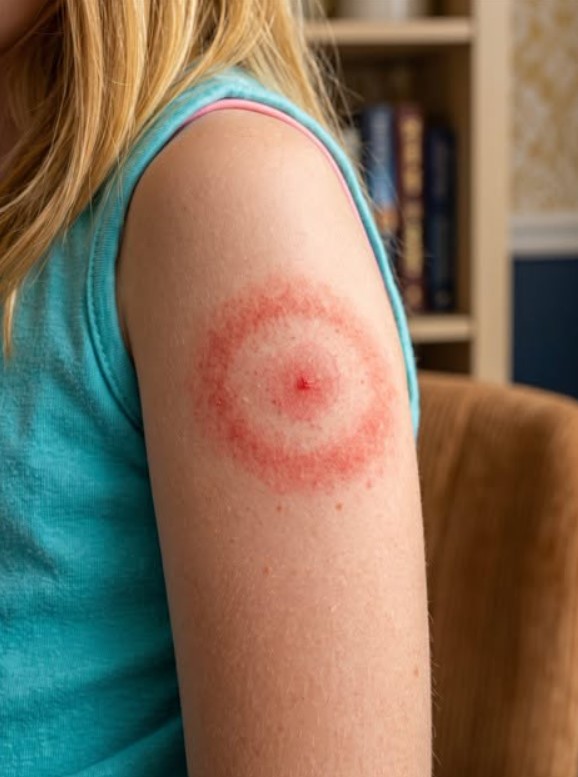
Few things make a parent look twice faster than waking up to find a strange new mark on a child’s skin. A red ring on your daughter’s arm can immediately raise questions: Is it an allergy? A bug bite? Ringworm? Something she touched? Could it be serious?
The good news is that many childhood rashes are caused by relatively common skin conditions and are not emergencies. At the same time, the appearance of a rash alone usually isn’t enough to determine exactly what caused it. Several different conditions can create circular, red, itchy, dry, or irritated patches that look surprisingly similar.
That’s why the most useful approach is to look at the entire picture: how the rash looks, whether it itches or hurts, whether it is growing, whether the center looks different from the border, whether your child has other symptoms, and whether there has been a possible exposure to something that could explain it.
One of the most familiar possibilities is ringworm, despite its misleading name. Ringworm isn’t caused by a worm at all. It is a fungal infection that commonly produces a ring-shaped rash, often with a raised or scaly edge.
But ringworm is not the only explanation.
Why Does a Rash Form a Ring?
The shape of a rash can provide a useful clue, but it isn’t a diagnosis by itself.
Some skin conditions spread outward from a particular point, naturally creating a circular or ring-like appearance. Others can become irritated around the edges while the center looks relatively normal.
Ringworm is a classic example. The CDC describes it as a red, itchy, ring-shaped rash that may have a clearer or scaly area in the center and a slightly raised border.
Other possibilities include eczema, contact dermatitis, insect reactions, and other inflammatory skin conditions. Because several rashes can resemble one another, a healthcare professional may need to examine the skin to determine what is actually happening.
This is particularly important if the rash continues to expand, keeps returning, becomes painful, develops drainage, or doesn’t improve.
Ringworm: One Common Cause of a Ring-Shaped Rash
Ringworm is one of the first things many people think about when they see a circular rash.
Despite its name, there are no worms involved. Ringworm is a fungal infection of the skin. On many areas of the body, it produces round or ring-shaped patches with a raised, sometimes scaly border.
The rash may be itchy, and the affected area can gradually become larger. Some children may develop more than one patch.
The CDC notes that symptoms of skin ringworm typically appear between about 4 and 14 days after contact with the fungi that cause the infection.
Ringworm can spread through direct contact with infected skin and through contaminated personal items. That’s one reason it is important not to share towels, clothing, or other items that come into contact with an affected area if a fungal infection is suspected.
If your child’s rash has a clearly defined, scaly or raised edge and seems to be slowly enlarging, ringworm is worth discussing with a healthcare professional.
Could It Be Eczema?
Eczema is another common reason children develop irritated skin.
Childhood eczema, particularly atopic dermatitis, can cause itchy, dry, inflamed areas of skin. It does not spread from person to person.
Unlike classic ringworm, eczema doesn’t necessarily form a perfect ring. However, patches of irritated skin can sometimes have unusual shapes and may be mistaken for other rashes.
A child’s eczema may become worse after exposure to certain triggers. These can include dry skin, sweat, fragrances, certain fabrics, detergents, and other irritants or allergens.
If your daughter’s skin is generally dry or she has had similar itchy patches before, eczema could be part of the picture.
Still, it’s better not to assume that every itchy circular rash is eczema. A healthcare professional can help distinguish eczema from fungal infections and other conditions.
Contact Dermatitis Can Also Cause a Red Patch
Another possibility is contact dermatitis.
This happens when the skin reacts to something that has touched it. Children can develop irritation or allergic reactions from a variety of everyday exposures, including some metals, fragrances, preservatives, adhesives, clothing materials, and personal-care products.
For example, if a child wears a bracelet, touches a particular plant, uses a new body product, or comes into contact with another irritating substance, redness may appear where the skin was exposed.
Contact dermatitis can be itchy and may sometimes produce bumps or blisters.
One useful clue is location. If the rash appears exactly where an object or product touched the skin, think about what was in contact with that area during the previous day or two.
What About a Bug Bite?
Insect bites can also produce circular redness.
A bite may initially look like a small red spot, but the surrounding skin can become swollen or irritated as the body’s immune system reacts.
Children may scratch bites more than adults, which can make the area look larger and more inflamed.
The appearance of a single circular mark doesn’t automatically mean there is an infection. However, if the redness continues expanding, becomes increasingly painful or warm, produces drainage, or is accompanied by fever or other concerning symptoms, the child should be evaluated.
What If There Was a Tick Exposure?
A spreading circular or expanding rash after a possible tick bite deserves particular attention.
One rash associated with early Lyme disease is called erythema migrans. The CDC notes that this rash can occur after infection with Lyme disease and that early diagnosis and appropriate antibiotic treatment are important.
It is important not to assume that every circular rash is Lyme disease. The appearance can vary, and not every person develops the classic “bull’s-eye” appearance people often associate with Lyme disease.
If your child has been in an area where ticks are present and you notice a new expanding rash after possible tick exposure, contact a healthcare professional promptly and mention the possible exposure.
Does the Center of the Rash Look Different?
One helpful thing to observe is what is happening in the middle of the ring.
With ringworm, the center can sometimes look clearer or less affected than the outer edge, while the border may be raised or scaly.
But don’t rely on this feature alone.
A photograph can also be useful. If the rash changes over several hours or days, taking a clear picture in natural light can help you document its progression and give your child’s healthcare professional something to compare.
Avoid manipulating the skin just to see what happens. Scratching or rubbing can make many rashes more irritated.
Is the Rash Itchy?
Itching is another useful clue.
Ringworm commonly causes itching. Eczema is also frequently itchy, and contact dermatitis can cause significant irritation.
If your daughter is constantly scratching the area, keep her fingernails trimmed and encourage her not to scratch. Scratching can damage the skin and increase the chance of secondary infection.
If the itching is severe or interfering with sleep, speak with her healthcare professional about appropriate treatment rather than applying multiple products at once.
What Should a Parent Do First?
If your child otherwise feels well and the rash is small, there are several sensible first steps.
Start by looking closely at the area without rubbing it.
Take a photograph so you can compare its size and appearance later.
Think about recent exposures. Did your child play outside? Wear a new bracelet? Use a new soap or lotion? Sleep somewhere different? Have contact with another child or pet with a skin problem?
Also check whether the rash is changing.
Is it getting larger?
Is it becoming more painful?
Is the border becoming scaly?
Are additional spots appearing?
Is there swelling, drainage, blistering, or crusting?
Does your child have a fever or seem unwell?
These observations can be much more useful than simply describing the rash as “red.”
Should You Put Cream on It Right Away?
It’s tempting to reach for whatever cream happens to be in the bathroom cabinet, but this isn’t always the best approach.
Different rashes require different treatments. A cream that helps one condition may not help another, and some products can change the appearance of a rash and make it harder to diagnose.
For that reason, if you’re unsure what the rash is, it is reasonable to ask a pediatrician, dermatologist, pharmacist, or another qualified healthcare professional before starting treatment.
This is especially important when the rash is spreading or when the diagnosis isn’t obvious.
When Can You Breathe a Little Easier?
A child who has a small rash but is otherwise behaving normally, eating and drinking normally, breathing comfortably, and showing no signs of serious illness is generally less concerning than a child who has a rash accompanied by significant symptoms.
Many childhood rashes are not emergencies.
The NHS notes that many rashes in babies and children are caused by conditions that are not serious.
That doesn’t mean a new rash should automatically be ignored. It simply means that seeing a strange spot doesn’t necessarily mean something dangerous is happening.
Pay attention to your child’s overall condition as well as the appearance of the skin.
When Should You Contact a Doctor?
Contact your child’s healthcare professional if:
- The rash continues to grow.
- The rash keeps returning.
- The area becomes painful or increasingly tender.
- The skin becomes warm and swollen.
- There is pus, drainage, or significant crusting.
- Your child develops a fever.
- The rash doesn’t improve or you aren’t sure what caused it.
- You suspect ringworm and need guidance on appropriate treatment.
- Your child may have been exposed to a tick and develops an expanding rash.
- The rash is spreading to multiple areas of the body.
- Your child has significant itching that is affecting sleep or daily activities.
A healthcare professional can examine the rash and determine whether additional testing or treatment is appropriate.
When Is a Rash an Emergency?
Some situations require urgent medical attention.
A rash accompanied by difficulty breathing, swelling of the lips or mouth, throat tightness, confusion, unusual unresponsiveness, a stiff neck, or significant changes in skin color can be a medical emergency.
The NHS also advises urgent emergency evaluation when a child has a rash that looks like small bruises or bleeding under the skin and does not fade when pressed with a glass, particularly when the child is unwell.
In those circumstances, don’t wait to see whether the rash disappears on its own.
A Note About Skin Color
Rashes don’t always look identical on every skin tone.
A rash that appears bright red on lighter skin may appear brown, purple, gray, or darker than the surrounding skin on darker skin. The CDC and American Academy of Dermatology both note that ringworm and eczema can have different visible appearances depending on skin tone.
Parents should therefore pay attention to changes in texture, warmth, swelling, scaling, borders, and symptoms such as itching or pain rather than relying only on the color red.
If you’re uncertain about what you’re seeing, a medical professional can provide a much more reliable assessment.
Keeping Your Child’s Skin Comfortable
While you’re waiting for medical advice, gentle skin care is generally preferable to aggressive treatment.
Avoid scrubbing the area.
Use mild, fragrance-free products if the skin is dry or irritated.
Try to prevent excessive scratching.
Keep the area clean and dry.
Don’t share towels or clothing if a fungal infection is suspected.
For children prone to eczema, dermatologists commonly recommend gentle bathing and regular use of a thick, fragrance-free moisturizer to help maintain the skin barrier.
Most importantly, don’t panic because the rash has a circular shape.
The shape provides information, but it does not provide the entire diagnosis.
The Bottom Line for Parents
Finding a strange red ring on your child’s arm can be alarming, especially when you first notice it in the morning and have no idea where it came from.
But a ring-shaped rash has many possible explanations.
It could be a fungal infection such as ringworm. It could be eczema or contact dermatitis. It could be an insect reaction. In certain circumstances, especially after possible tick exposure, another diagnosis needs to be considered.
The most useful thing you can do is avoid jumping immediately to the worst-case scenario while still paying attention to changes.
Look at the rash carefully. Take a photograph. Notice whether it is itchy, painful, scaly, warm, swollen, or expanding. Think about recent exposures and whether your child has any other symptoms.
If your daughter feels completely well and the rash is small and stable, you may have time to contact her pediatrician or another healthcare professional for advice rather than assuming it is an emergency.
If the rash is spreading, painful, associated with fever or other illness, follows a possible tick exposure, or simply worries you, professional evaluation is appropriate.
And if the rash appears alongside serious symptoms such as difficulty breathing, swelling of the mouth or throat, confusion, or a concerning non-blanching bruise-like rash, seek emergency medical care.
A mysterious circle on your child’s arm can certainly make a parent nervous. But the important thing is to look at the whole picture, not just the shape. With careful observation and appropriate medical guidance when needed, many causes of ring-shaped rashes can be identified and treated effectively.