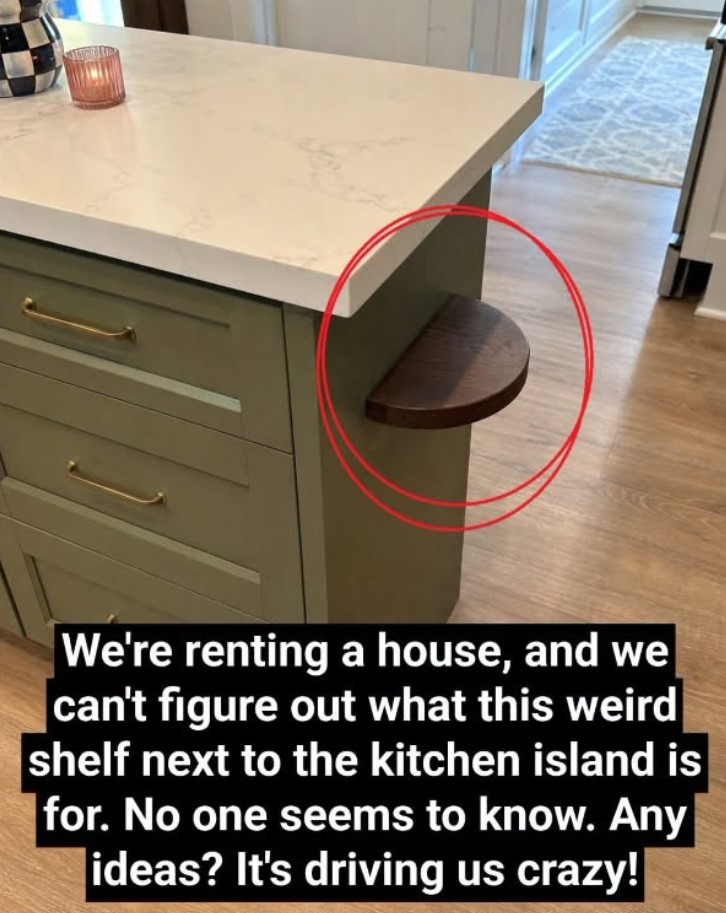
Have you ever looked at a kitchen island and noticed a small shelf built into one of its sides and wondered what it was actually supposed to be used for?
It can look a little unusual.
It may be too narrow to function like a normal countertop, too small to hold serious kitchen equipment, and certainly not large enough to replace a cabinet. Because of that, many people simply assume it is a decorative feature with no real purpose.
But that little shelf can actually be quite useful.
A small shelf built into the side or end of a kitchen island is usually designed as a light-duty storage, display, or landing area. It gives you a convenient place for small items that you want nearby without taking up valuable counter space.
Depending on the design of the island, it can hold cookbooks, a small plant, a decorative bowl, a phone, keys, a coffee mug, serving pieces, or other lightweight items.
It is less about storing a large amount of stuff and more about giving an otherwise unused part of the island a useful purpose.
What Is This Kitchen Island Shelf For?
The simplest way to think about a small kitchen island shelf is as a convenient little landing spot.
It isn’t supposed to replace the main work surface.
Instead, it gives you somewhere to put something temporarily or display something that fits naturally into the kitchen.
For example, imagine you’re cooking dinner and someone walks into the kitchen with their phone. Instead of leaving the phone on the countertop beside your cutting board, ingredients, and utensils, it could sit on the little shelf.
The same thing applies to a cup of coffee, a small bowl, a cookbook, or a decorative item.
It provides just enough extra space to make the island more functional without turning the entire side into another cabinet.
It Can Be Used as a Small Display Shelf
One of the most common purposes of an open shelf on a kitchen island is decoration.
Kitchen islands can be large and visually heavy. A solid block of cabinets can sometimes make the room feel more closed in, particularly in an open-plan kitchen.
An open shelf breaks up that solid appearance.
Instead of having a completely blank side panel, the designer can create a small open area where you can display something attractive.
A small vase, plant, ceramic bowl, cookbook, wooden cutting board, or decorative tray can make the island feel more personal.
Open shelving is often used this way because it adds visual interest while still keeping the kitchen practical.
It Can Hold Cookbooks
If you still like using printed cookbooks while preparing meals, the side of a kitchen island can be an excellent place for them.
A few favorite cookbooks can be placed on the shelf where they are easy to reach.
This is especially useful when the shelf faces the dining or living area. Instead of hiding your favorite recipe books inside a cabinet, you can keep a small collection visible.
The important thing is not to overcrowd the shelf.
A few books arranged neatly can look intentional. A large pile of books, papers, mail, and random kitchen items can quickly make the area look messy.
It Can Be a Handy Spot for a Coffee Mug
Sometimes the simplest uses are the most practical.
If you’re standing around the island in the morning with a cup of coffee, a small shelf can give you somewhere to place the mug when you need both hands free.
The same idea works during casual conversations.
Someone might be talking with you while you’re preparing breakfast, and rather than placing their drink directly beside your food-preparation area, they can use the nearby shelf.
It becomes a tiny drink ledge.
Of course, you should still consider the position of the shelf. If it sticks into a busy walkway, placing a full glass on it may not be the best idea.
It Can Be Used for Small Everyday Items
A small island shelf can also work as a temporary landing area for things that tend to end up scattered around the kitchen.
Depending on where the island is located, it might hold:
- A phone
- Keys
- Sunglasses
- A small wallet
- A recipe card
- A small tray
- A coffee cup
- A napkin holder
- A small bowl
- A decorative item
This is particularly useful when the kitchen connects directly to another part of the home.
Someone entering the kitchen might naturally put their keys or phone on the nearest available surface.
Having a designated little shelf can keep those items from taking over the main countertop.
It Can Help When You’re Entertaining
Kitchen islands are often gathering points when friends or family visit.
People naturally stand around them while talking, eating appetizers, having drinks, or watching someone prepare food.
A small shelf can provide an extra place to put lightweight serving items.
You might use it for a small plate of appetizers, napkins, a serving spoon, or a drink.
It can be especially useful when the main countertop is already covered with food.
Instead of trying to squeeze everything onto one surface, you have another small area available.
However, it should still be treated as a light-duty surface rather than a second countertop.
It Is Not Really a Storage Cabinet
There is an important distinction between an open island shelf and a cabinet.
A cabinet is designed to hold and protect larger quantities of items.
An open shelf is much more exposed.
That means it works best for things that are either attractive enough to leave on display or used frequently enough that easy access matters.
Designers often recommend mixing open and closed storage rather than turning an entire island into open shelving. Open shelves can be useful, but too much exposed storage can quickly become cluttered.
For example, you could keep a few cookbooks and serving bowls on the open shelf while storing small appliances, food containers, cleaning supplies, and miscellaneous kitchen equipment behind cabinet doors.
That gives you both accessibility and a cleaner appearance.
Why Is the Shelf Often on the End of the Island?
The short end of a kitchen island is frequently an underused area.
The main faces of the island may already contain drawers, cabinets, appliances, or seating.
But the end panel can sometimes be left completely blank.
Adding a narrow shelf turns that otherwise unused space into something functional.
It can also soften the appearance of the island.
Instead of seeing a large flat cabinet panel, you see a small architectural feature that adds depth and character.
End shelves are commonly used for cookbooks, baskets, plants, and decorative objects because they are visible from the rest of the room.
The Shelf Can Make a Large Island Feel Lighter
There is also a design reason behind these shelves.
A large kitchen island can look like a massive block in the middle of a room.
That can be particularly noticeable in an open-concept home where the kitchen, dining room, and living room share one large space.
Open shelving interrupts that visual mass.
Instead of one continuous solid surface, the eye sees an opening.
That small change can make the island feel less bulky.
This is one reason open shelving has become popular on kitchen islands. It can provide storage while also making the furniture appear lighter and more open.
Could You Store Plates and Bowls There?
Yes, if the shelf is properly sized and securely constructed.
Small stacks of plates, bowls, or serving dishes can work well on deeper open shelving.
The advantage is convenience.
You don’t need to open a cabinet every time you need something.
However, the location matters.
If the shelf is close to a walkway, you probably don’t want delicate glassware sitting where someone could easily bump into it.
A shelf on the side facing a dining area may be better suited to serving dishes or decorative ceramics than fragile everyday glasses.
What About a Small Plant?
A small plant is actually one of the easiest ways to make a kitchen island shelf look intentional.
A little herb pot or decorative plant can bring some warmth to an otherwise hard surface of stone, wood, or cabinetry.
You just need to choose something appropriate for the location.
Avoid placing a plant where water could regularly drip onto cabinetry or flooring.
And if the shelf is located in an area where people walk past frequently, choose something compact that won’t get knocked over.
A Decorative Bowl Can Work Too
A small bowl or tray is another practical option.
It can serve two purposes at once.
First, it adds decoration.
Second, it provides a designated place for small items.
For example, a shallow bowl could hold keys or other small objects when people enter the kitchen.
A decorative tray could hold a few frequently used items while keeping them visually organized.
This is much better than allowing random objects to accumulate directly on the main countertop.
What Should You Avoid Putting on the Shelf?
Because the shelf may look sturdy, people sometimes assume it can support anything.
That’s not necessarily true.
The material alone does not tell you how much weight the shelf can safely support. The way it is attached to the island is equally important.
Avoid using a small decorative shelf for:
- Sitting
- Standing
- Climbing
- Supporting your body weight
- Heavy appliances
- Large cast-iron cookware
- Very heavy serving dishes
- Large stacks of dishes
- Anything that could easily fall onto someone
If the shelf moves, feels loose, or appears damaged, it should be inspected rather than treated like a sturdy countertop.
It Is Definitely Not a Seat
This is especially important if the shelf looks like it could support a person.
A kitchen island may have seating areas, but a small side shelf isn’t automatically one of them.
A proper seating overhang is designed differently and provides enough room for someone’s legs and body.
A narrow decorative ledge doesn’t offer the same support or space.
So if you’re wondering whether that little shelf is secretly a tiny seat, the answer is generally no.
It is best treated as a light-duty surface.
It Is Not a Step for Children
The same warning applies to children.
A shelf at a convenient height can look tempting to a young child who wants to climb or reach something.
But using the shelf as a step can put excessive force on it and create a fall hazard.
If you have children in the home, it is better to keep breakable or dangerous objects away from low open shelving as well. Open shelves can make attractive items easily accessible, so placement matters.
Don’t Turn It Into a Clutter Magnet
One of the biggest problems with open shelving is that it can become a dumping ground.
At first, you might put one beautiful bowl there.
Then someone adds a phone.
Someone else leaves mail.
A pair of keys appears.
Then a charger, a receipt, a child’s toy, and a random kitchen utensil somehow join them.
Before long, the shelf that was supposed to make the kitchen look better becomes one of the messiest areas in the room.
The solution is simple: give the shelf a specific purpose.
If it’s a display shelf, keep it decorative.
If it’s for cookbooks, use it for cookbooks.
If it’s a temporary landing area, don’t let temporary items become permanent clutter.
Keep the Shelf Easy to Clean
Kitchen shelves are exposed to the environment around them.
Depending on where the island is located, they can collect dust, crumbs, cooking residue, or fingerprints.
That is another reason not to overload them.
A simple shelf with one or two items is much easier to wipe down than a crowded display.
If you are storing dishes or decorative objects, occasionally remove everything and clean the shelf underneath.
This is particularly important in kitchens because grease and dust can combine and create a sticky surface over time.
A Small Shelf Can Be Surprisingly Useful
The shelf may be small, but that doesn’t mean it is pointless.
In a well-designed kitchen, even a small amount of additional space can make a difference.
It gives you somewhere to put an item temporarily without interrupting the main work surface.
It gives you a place to display something attractive.
It can make cookbooks easier to access.
It can provide a convenient spot for serving pieces during gatherings.
And it can make the island itself look more custom.
The key is understanding its limitations.
It isn’t supposed to do everything.
It’s a small feature designed to perform a small job well.
How to Style a Kitchen Island Shelf
If your island has one of these shelves and you’re not sure what to put there, start with one simple item.
A few good choices include:
A small plant: This adds color and softness without making the shelf look crowded.
A cookbook: Choose one or two of your favorites rather than displaying your entire collection.
A decorative bowl: A simple ceramic or wooden bowl can add texture while remaining useful.
A small tray: This works well if you want to create a designated landing spot.
A serving piece: A beautiful platter or serving bowl can be both decorative and practical.
A small basket: Baskets can hide small items while keeping the shelf organized.
The goal isn’t to fill every inch.
In fact, leaving some empty space usually makes the shelf look more intentional.
Think of It as a “Pause” Spot
Perhaps the easiest way to understand this little shelf is to think of it as a pause spot.
It’s where something can sit for a moment.
Your coffee can rest there while you answer a question.
Your phone can sit there while you cook.
A serving plate can wait there while dinner is being prepared.
A cookbook can stay there while you’re following a recipe.
A small decorative object can remain there permanently.
It doesn’t need to be a major storage system to be useful.
Sometimes a small amount of thoughtfully placed space is exactly what a room needs.
Why Designers Add Details Like This
Kitchen design isn’t only about making everything as large and functional as possible.
Small architectural details can make a room feel more finished.
A curved shelf, an open cubby, a recessed niche, or a decorative end panel can give an island a custom appearance.
These details can also help connect the kitchen to the rest of the home.
For example, an open shelf facing the living room can display books or decorative objects that make the kitchen feel less like a separate workspace and more like part of the living environment.
That’s one reason open island shelving is often used on the outward-facing side rather than only on the cooking side.
So, What Is a Kitchen Island Shelf Used For?
A kitchen island shelf is generally designed for light storage, display, and convenience.
It can hold cookbooks, small serving dishes, decorative bowls, plants, baskets, mugs, phones, keys, or other lightweight objects.
It can also provide a little extra space when you’re entertaining and the main countertop is already full.
But it shouldn’t be treated like a chair, step, heavy-duty countertop, or large storage cabinet.
The best use depends on the exact design and location of the shelf, but the general idea is simple: it turns a small amount of otherwise unused space into something useful.
Conclusion :
That little shelf on the side of a kitchen island may seem like an odd design choice when you first notice it, especially if you can’t figure out what you’re supposed to do with it.
But once you understand its purpose, it makes much more sense.
It is essentially a small landing and display area designed to give the island a little extra functionality without adding another full cabinet or taking up valuable countertop space.
You can use it for a favorite cookbook, a small plant, a decorative bowl, a serving plate, a coffee mug, or even a small tray for everyday items. During a gathering, it can provide an extra spot for a drink or appetizer. In a busy kitchen, it can keep small objects from taking over the main work surface.
At the same time, it’s important not to expect too much from it. A small island shelf isn’t designed to replace a countertop or cabinet, and it shouldn’t be used for sitting, climbing, heavy appliances, or anything that places excessive weight on the structure.
The real beauty of this feature is its simplicity.
It doesn’t need to hold dozens of things to be useful. In fact, one or two carefully chosen items can make it both practical and attractive.
So the next time you see that little shelf built into the side of a kitchen island, don’t assume it’s just a strange decorative detail.
It may be one of those small design features that quietly makes a kitchen more convenient, more organized, and a little more personal.