As a parent, it is easy to dismiss a small change in your child’s skin.
A little bump here, a patch there, a different texture after summer—most of the time, these things turn out to be harmless. Teenagers can develop acne, dry skin, irritation from hair products, eczema, or other ordinary skin changes.
But sometimes the appearance and location of a skin change provide an important clue.
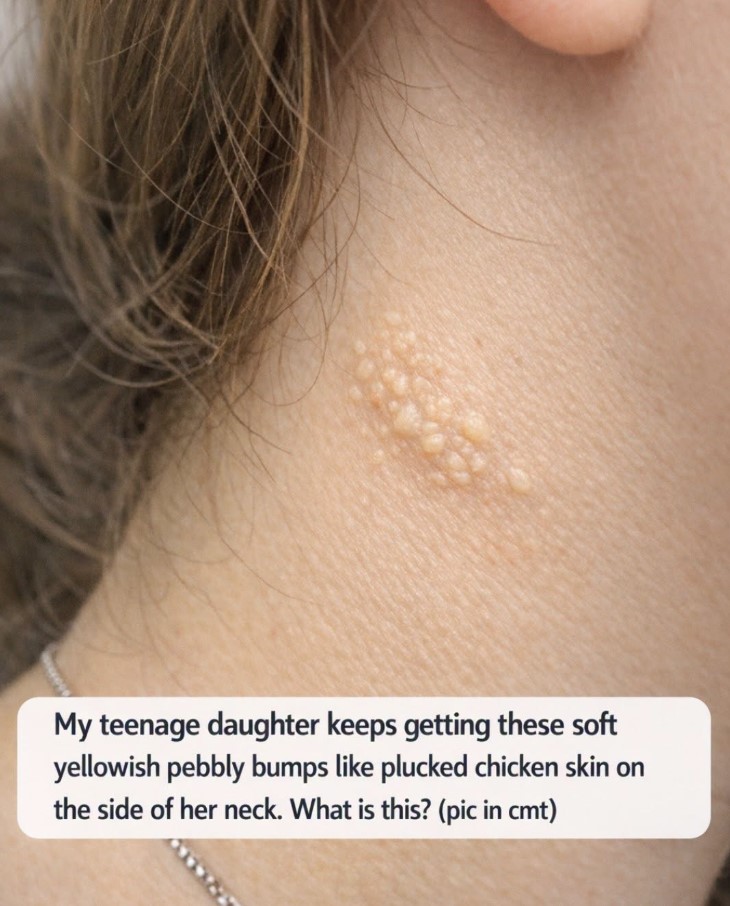
That was the situation when a mother noticed that her teenage daughter repeatedly developed tiny, soft, yellowish bumps along the side of her neck. The skin didn’t simply look dry or irritated. Instead, it had a strange pebbly or cobblestone-like texture that reminded her of what people sometimes describe as “plucked chicken skin.”
That particular description is worth paying attention to.
One condition doctors may consider when they see this pattern is pseudoxanthoma elasticum, commonly called PXE. It is an uncommon inherited disorder that affects elastic tissue in the body. The skin can be the first place where signs become noticeable, sometimes during childhood or adolescence.
That doesn’t mean every teenager with bumps on the neck has PXE. There are several other possible explanations for unusual skin texture.
However, when the bumps are yellowish, soft, clustered, and concentrated around the sides of the neck, it is reasonable to have the area evaluated rather than assuming it is ordinary dry skin.
What does “plucked chicken skin” actually mean?
The phrase sounds unusual, but dermatologists sometimes use descriptions like this because they help communicate what a skin condition looks and feels like.
With PXE, tiny yellow-to-cream papules can appear close together. Over time, they may merge into larger areas with a pebbled, cobblestone-like appearance.
The sides of the neck are one of the characteristic locations.
The affected skin may also become slightly loose, soft, wrinkled, or lax. The bumps are usually small and may be easier to appreciate when light comes from the side rather than directly from above.
This appearance is quite different from ordinary goosebumps.
Goosebumps appear temporarily when someone is cold, frightened, or experiencing another physical response. They disappear when the underlying trigger passes.
PXE-related skin changes are different because they tend to persist and gradually become more noticeable.
One possibility doctors may consider is pseudoxanthoma elasticum
Pseudoxanthoma elasticum is a rare genetic condition involving the body’s elastic fibers.
Elastic fibers are important structural components found in tissues throughout the body. They help give skin its flexibility and are also present in blood vessels and certain structures inside the eyes.
In PXE, these elastic fibers can become abnormal and develop calcification over time.
The result can be visible changes in the skin, particularly in areas such as the neck and other skin folds.
The condition is not an infection.
It isn’t caused by poor hygiene.
It isn’t something a teenager catches from another person.
And it isn’t something that a parent caused by using the wrong soap or moisturizer.
That distinction can be reassuring for families who initially worry that they somehow did something wrong.
Why can PXE appear during the teenage years?
PXE can become noticeable during childhood, adolescence, or young adulthood.
The skin findings are often among the first signs that lead doctors to investigate the condition. The timing can vary from person to person, which is one reason it may initially be mistaken for an ordinary skin problem.
A teenager may otherwise feel completely healthy.
There may be no pain.
There may be no fever.
There may be no obvious illness.
The skin can simply begin to look different.
That can make the discovery particularly confusing for parents.
A child who feels perfectly well may still have a skin finding that deserves a professional evaluation.
What causes pseudoxanthoma elasticum?
PXE is generally associated with changes in the ABCC6 gene.
It is usually inherited in an autosomal recessive pattern. In simple terms, a person generally needs to inherit an altered copy of the relevant gene from both parents for the condition to develop.
This can surprise families.
A parent may carry one altered copy without having PXE themselves.
If both parents are carriers, each pregnancy has a 25% chance of resulting in a child who inherits both altered copies, a 50% chance of producing a carrier, and a 25% chance of inheriting neither altered copy.
Because carriers may have no obvious symptoms, a family can have no known history of PXE and still have a child who develops the condition.
So the absence of a family history does not automatically rule it out.
Where else might the skin changes appear?
Although the neck is particularly characteristic, PXE isn’t necessarily limited to one small patch.
Doctors may examine other areas where the skin folds.
These can include:
- The armpits
- The groin
- The area around the belly button
- The inner elbows
- Areas behind the knees
- Other flexural areas
The lesions may appear as tiny yellowish papules that gradually group together. The skin can develop a soft, wrinkled or pebbly appearance.
This is one reason taking photographs before an appointment can be helpful.
A parent may notice something subtle on the neck but not realize that a similar texture is present somewhere else.
How is this different from acne?
Teenagers get acne all the time, so it is understandable that parents might initially assume unusual bumps are just another form of acne.
But PXE does not typically behave like acne.
Acne commonly produces blackheads, whiteheads, inflamed pimples, pustules, or deeper nodules.
PXE lesions are different.
They are generally tiny, yellowish papules that can cluster together into a characteristic textured area. They don’t typically form the whiteheads or blackheads associated with acne.
The location also matters.
Acne can certainly affect the neck, but a persistent, symmetrical, pebbly texture along the sides of the neck deserves a closer look.
Could it simply be keratosis pilaris?
Keratosis pilaris is another common condition that produces small bumps on the skin.
Many people know it as “chicken skin,” so the comparison can be confusing.
Keratosis pilaris commonly affects areas such as the upper arms, thighs, cheeks, and buttocks. The bumps usually feel rough or sandpaper-like because of plugs of keratin around hair follicles.
That is not the same pattern typically described with PXE.
The difference is important because the words “chicken skin” can refer to several completely different skin appearances.
A doctor will consider the exact location, color, texture, duration, and progression rather than relying on the nickname alone.
What about eczema or an allergic reaction?
Eczema and contact dermatitis can also produce bumps and changes in skin texture.
However, irritation and allergic reactions often come with symptoms such as:
- Itching
- Redness or discoloration
- Burning
- Dryness
- Scaling
- Swelling
- Sometimes blisters or oozing
Contact dermatitis can affect the neck, particularly when the skin is exposed to fragrances, cosmetics, hair products, jewelry, detergents, or other substances.
PXE generally doesn’t look like an acute inflammatory rash.
The skin findings tend to develop gradually rather than suddenly appearing after exposure to a particular product.
That doesn’t mean a doctor can diagnose the condition from a description alone. It simply shows why the overall pattern matters.
Why the eyes need attention if PXE is suspected
This is one of the most important reasons not to simply ignore unusual PXE-like skin changes.
The condition can affect elastic tissue inside the eye.
Doctors are particularly concerned about changes involving Bruch’s membrane, which can eventually produce findings called angioid streaks.
A teenager may not notice anything wrong with their vision at first.
That’s why a person with suspected or confirmed PXE may be referred to an ophthalmologist even when they say they can see normally.
An eye specialist can examine the retina and other structures more closely.
Depending on the circumstances, the ophthalmologist may use retinal photography, a dilated examination, or other imaging such as optical coherence tomography.
The exact evaluation should be determined by the medical team.
What vision symptoms should be taken seriously?
If PXE is being investigated, new changes in vision should not be ignored.
Symptoms such as:
- Distortion of straight lines
- A new dark or blurry area in central vision
- Sudden changes in vision
- Flashes or other unusual visual disturbances
- A sudden loss of part of the visual field
should prompt appropriate medical attention.
Most teenagers with an unusual skin finding will not suddenly develop a serious eye complication.
The point is simply that, when a condition can involve more than the skin, knowing what symptoms matter can help families respond appropriately.
Why doctors may also think about the blood vessels
Elastic tissue is not found only in the skin.
Blood vessels also contain elastic components, which means PXE can have vascular implications.
Some people with PXE can develop changes involving blood vessels over time, including calcification or reduced elasticity. This may contribute to circulation problems or cardiovascular complications.
Again, this does not mean that a teenager with suspicious skin bumps already has heart or blood-vessel disease.
It means that if PXE is actually diagnosed, doctors may want to monitor cardiovascular health as part of the overall picture.
A clinician may review blood pressure, pulses, symptoms, and family history and decide whether additional specialist evaluation is appropriate.
How do doctors determine whether it really is PXE?
A dermatologist will usually start with a careful examination.
They will look at:
- The color of the bumps
- Their size
- Their arrangement
- Their texture
- Where they occur
- Whether they are spreading
- Whether other areas are affected
- Whether the skin has become loose or wrinkled
The characteristic appearance can raise suspicion, but doctors may need additional testing to confirm the diagnosis.
A skin biopsy may be recommended.
During a biopsy, a small sample of affected skin is examined under a microscope. In PXE, the elastic fibers can show characteristic fragmentation and calcification.
Genetic testing for changes involving ABCC6 may also be considered, particularly when doctors want additional confirmation or when genetic counseling could be useful.
Not every patient needs exactly the same tests.
The dermatologist can determine the most appropriate approach based on the examination and medical history.
Is there a family history?
When PXE is suspected, the doctor may ask questions about relatives.
This can include whether anyone in the family has had:
- Unusual yellowish or loose skin
- Early eye problems
- Unexplained vision changes
- Circulation problems
- High blood pressure
- Bleeding issues
- Other unusual connective-tissue problems
However, don’t assume that PXE is impossible just because nobody in the family has been diagnosed with it.
Because of its inheritance pattern, parents can carry an altered gene without having the condition themselves.
There are other conditions that can look similar
This is another reason parents shouldn’t try to make the diagnosis from photographs or descriptions alone.
Several other conditions can produce unusual texture or yellowish changes.
One possibility is solar elastosis, which is related to long-term ultraviolet exposure.
Solar elastosis is much more commonly seen in older adults after years of sun exposure. It can make skin appear yellowish, thickened, coarse, or wrinkled.
That makes it much less typical as an explanation for a teenager with newly developing pebbly bumps.
Other conditions that may enter the differential diagnosis include papular elastorrhexis, certain connective-tissue disorders, cutis laxa-related conditions, and other benign skin changes.
A dermatologist can distinguish between these possibilities using the patient’s age, appearance, distribution, medical history, and—when necessary—testing.
Why age and location are so important
A skin condition doesn’t exist in isolation.
Doctors don’t simply ask, “What does this bump look like?”
They also ask:
Who has it?
How old are they?
Where is it located?
How long has it been present?
Is it changing?
Does it occur anywhere else?
A yellowish pebbly patch on the neck of a teenager tells a very different story from similar-looking yellow, weathered skin on the face of someone who has spent decades outdoors.
That’s why the description in this case deserves attention.
The combination of adolescence, lateral neck involvement, yellowish papules, and a pebbled or cobblestone texture is a pattern that can prompt a doctor to consider PXE.
What should a parent do next?
The most practical step is to arrange an appointment with a dermatologist.
This does not mean rushing into an emergency department simply because the bumps are present.
It means getting an appropriate professional evaluation rather than spending months trying random creams.
Before the appointment, take several clear photographs.
Try to capture:
- The affected area from a normal distance.
- A closer photograph showing the texture.
- The other side of the neck for comparison.
- Any similar areas on the armpits, elbows, groin, knees, or around the belly button.
Good lighting can make subtle skin changes much easier for a doctor to appreciate.
It can also help to write down when you first noticed the bumps and whether they’ve become more numerous or more noticeable.
Questions to ask the dermatologist
Parents sometimes leave medical appointments and realize afterward that they forgot half of what they wanted to ask.
Writing down a few questions beforehand can help.
You might ask:
Could this appearance be consistent with pseudoxanthoma elasticum?
What other conditions could look similar?
Would a skin biopsy be useful?
Would genetic testing be appropriate?
Should my daughter see an ophthalmologist?
Does she need any cardiovascular or blood-vessel evaluation?
Are there symptoms that should prompt urgent medical attention?
These are reasonable questions.
A good medical appointment isn’t just about receiving a diagnosis. It’s also about understanding what happens next.
What happens if PXE is confirmed?
There isn’t a simple cream that can reverse the underlying genetic problem responsible for PXE.
Treatment and management generally focus on monitoring and protecting the organs that can be affected.
That can include regular dermatology appointments, eye examinations, and appropriate cardiovascular monitoring.
The exact schedule will depend on the individual patient.
A teenager diagnosed with PXE should have an individualized care plan rather than attempting to manage the condition through internet remedies.
This is especially important because the skin findings may be only one part of the condition.
Everyday habits still matter
Although lifestyle changes cannot cure PXE, general health habits remain important.
Avoiding smoking is especially important.
Maintaining healthy blood pressure and following the medical team’s recommendations for physical activity and cardiovascular health can also be beneficial.
Sun protection is sensible for everyone, particularly because excessive ultraviolet exposure can contribute to other skin problems and make it harder to distinguish one condition from another.
But parents shouldn’t become overwhelmed by a long list of possible complications.
The most important step is simply getting the correct diagnosis first.
Once doctors know what they’re dealing with, they can determine what monitoring is actually necessary.
What parents should avoid doing
If the bumps are persistent and unusual, repeatedly applying strong exfoliants, acids, scrubs, or other aggressive products is not a good substitute for medical evaluation.
The same goes for trying to squeeze, scrape, or pick at the bumps.
If the cause is PXE, these approaches will not correct the underlying problem.
They may simply irritate the skin or create unnecessary inflammation.
It’s also better not to assume that every yellowish bump is caused by diet, poor hygiene, hormones, or a skincare product.
Sometimes the simplest-looking skin changes deserve a closer look.
When should medical attention be more urgent?
A persistent skin change without other symptoms generally calls for a medical appointment rather than panic.
However, certain new symptoms deserve prompt attention.
These can include:
- Sudden or significant vision changes
- A new dark area or distortion in central vision
- Chest pain
- Fainting
- Significant unexplained shortness of breath
- New severe leg pain with walking
- Unusual or persistent bleeding
These symptoms can have many causes and don’t automatically mean PXE.
But if a doctor is already investigating a condition that can affect the eyes or blood vessels, it is important to report significant new symptoms promptly.
The most reassuring thing to remember
Reading about a rare inherited condition online can be frightening.
A parent may see the words “blood vessels,” “eyes,” or “genetic disorder” and immediately imagine the worst.
But a suspicious skin appearance is not the same as a confirmed diagnosis.
There are other conditions that can resemble PXE, and a dermatologist needs to examine the actual skin before deciding what it represents.
Even if PXE is eventually confirmed, knowing about the condition can be valuable because appropriate monitoring allows doctors to watch for possible complications.
In other words, finding a clue early can be a good thing.
Conclusion :
When a teenager develops soft, yellowish, pebbly bumps along the sides of the neck that resemble “plucked chicken skin,” it is understandable for a parent to wonder whether it is simply dry skin, acne, or another harmless irritation.
Sometimes it may be.
But that particular combination of age, location, color, and texture can also be associated with pseudoxanthoma elasticum (PXE), a rare inherited disorder affecting elastic tissue. The condition can cause small yellowish papules that gradually create a cobblestone-like or pebbled appearance, particularly around the neck and other skin folds.
The important message is not to panic and not to self-diagnose.
Instead, have the skin examined by a dermatologist.
If PXE is suspected, the doctor may recommend a biopsy or genetic testing and may consider evaluation of the eyes and cardiovascular system because the condition can affect tissues beyond the skin.
At the same time, remember that several other conditions can produce unusual skin texture, and some are considerably more common or less concerning.
For a parent, the best approach is simple: notice the change, document it, have it evaluated, and ask questions.
A strange-looking patch of skin doesn’t automatically mean something serious is wrong.
But when the pattern is unusual and persistent, getting a professional opinion can replace weeks of worrying with something much more useful—an accurate explanation and a clear plan for what to do next.