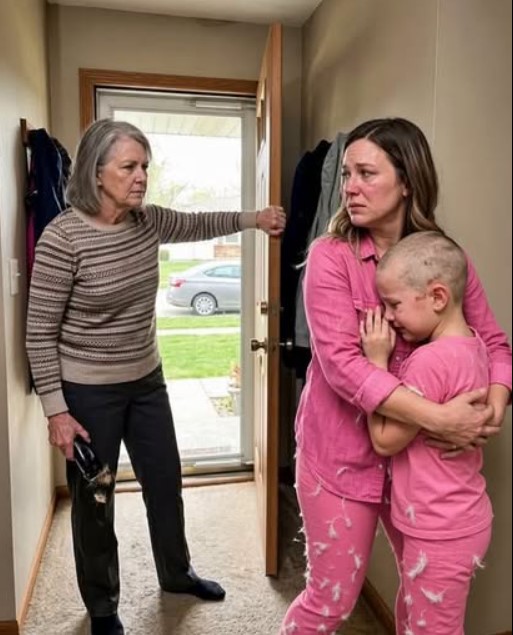
My mother-in-law shaved my eight-year-old daughter bald and blocked the door when I tried to leave.
“Hair grows back,” she said, while my husband called it discipline.
I took Meadow straight to the doctor. Then I filed for custody.
I never imagined that a haircut could expose the darkest secrets in my husband’s family. I thought I was fighting to protect my little girl from a cruel grandmother and a father who refused to stand up for her.
I had no idea that what happened to Meadow was connected to a secret that had been buried for twelve years.
The Day I Found My Daughter
When I picked Meadow up that Tuesday afternoon, I expected to find her with a sticky face, a handful of sweets, and another lecture from Judith about how children needed more structure.
My mother-in-law had always believed that children should obey adults without questioning them. She called herself old-fashioned, but I had begun to suspect that she simply enjoyed being in control.
Still, I had never imagined she would do something so terrible.
I walked into the guest room and stopped.
Meadow was sitting on the floor with her knees pulled tightly against her chest.
Her golden hair, which she had been growing since preschool, covered the carpet around her. Long strands clung to her shirt and bare feet. Her scalp was covered in uneven stubble, and the skin near one ear was red where the clippers had caught her.
For several seconds, I couldn’t move.
My daughter looked up at me. She tried to speak, but no sound came out. Then she pressed both hands against her head and began to shake.
Judith stood behind me holding a pair of electric clippers.
She didn’t look ashamed.
She looked satisfied, as if she had finally corrected a problem that everyone else had been too weak to address.
“She was getting vain,” Judith explained. “Girls who spend too much time looking in mirrors need to learn humility.”
I dropped to my knees and pulled Meadow into my arms. Her hair stuck to my palms as I gathered her against my chest.
Her whole body trembled so violently that her teeth clicked together.
“What did you do to my daughter?” I asked.
Judith sighed.
“Don’t start making a scene. I did what needed to be done.”
“She’s eight years old!”
“And she needs discipline.”
I looked at the clippers in Judith’s hand, then at the frightened little girl hiding against me.
“Who gave you permission to do this?”
Judith lifted her chin.
“I spoke to Dustin. He agreed that I could handle her behavior.”
My husband, Dustin, was at work. I couldn’t understand how he could possibly have agreed to anything like this.
Then Meadow whispered something that made my heart break.
“Daddy said Grandma knows best.”
I held her tighter.
In that moment, I understood that the problem was bigger than Judith’s cruelty. My own husband had allowed our daughter to believe that she deserved whatever punishment his mother chose to give her.
I stood up, lifted Meadow into my arms, and headed for the front door.
Judith followed us into the hallway.
“Where do you think you’re going?”
“To get my daughter help.”
“You’re overreacting.”
I kept walking.
When I reached the doorway, Judith stepped in front of it and crossed her arms.
“You are not taking her anywhere while you’re acting like this.”
Meadow buried her face against my shoulder. I felt her tears soaking through my shirt.
“Move,” I said.
Judith gave me a dismissive smile.
“Hair grows back.”
“Move.”
Something in my voice finally made her hesitate. She stepped aside, still gripping the clippers, and I carried Meadow past her into the driveway.
I didn’t look back.
The First Signs of What Had Happened
Meadow barely spoke for the next two days.
Even though it was May, she slept wearing a winter hat and refused to remove it at breakfast. I made her favorite strawberry pancakes, but she pushed the plate away without taking a bite.
At the kitchen table, she kept drawing the same picture: a small girl with no hair crying beside a woman with enormous arms.
Every time I asked whether she wanted to talk, she shook her head.
I decided to take her to her pediatrician.
The doctor examined the cuts and redness around Meadow’s scalp. She photographed the injuries, documented what she observed, and asked gentle questions about how the haircut had happened.
Meadow answered only a few of them.
Afterward, the doctor spoke with me privately.
She explained that Meadow’s physical injuries needed attention, but her fear and withdrawal were equally concerning. She also explained that the situation warranted a report to the appropriate child-protection authorities.
Then she used words I had been struggling to say aloud.
Abuse. Trauma response. Mandatory report.
Hearing those words made everything feel frighteningly real.
That afternoon, I called my sister Francine, who worked for a family law firm.
I told her about the clippers, the blocked doorway, Dustin’s approval, and Meadow’s drawings.
Francine didn’t tell me to calm down or wait until my husband came home.
Instead, she told me to photograph every injury, preserve every message, save the medical records, and write down everything I could remember.
Then she asked me one question.
“What are you willing to lose?”
I looked across the room at Meadow.
She wore a soft pink hat pulled low over her ears and held her purple elephant against her chest. She had carried that toy since she was three, but now she gripped it so tightly that its fabric bent beneath her fingers.
I knew my answer.
Everything except my child.
By the time Dustin came home, Meadow and I were gone.
He called repeatedly. His first messages were angry. Then he sounded offended. Finally, he began worrying about what other people would think.
He never asked whether the cuts on Meadow’s scalp hurt.
He never asked why she had stopped talking.
He kept repeating the same sentence.
“Mom was trying to help.”
That was when I realized how alone I had been in my marriage.
The Courtroom Question
By Friday morning, I was sitting in family court with a folder on my lap.
Inside were photographs of Meadow’s scalp, the pediatrician’s notes, copies of Dustin’s messages, and our request for temporary protective arrangements while the authorities investigated.
Meadow sat beside me in her pink hat, holding her purple elephant beneath the table.
Dustin entered the courtroom with Judith.
There were empty seats near Meadow. There was room beside his attorney. There was even an empty chair between the two sides.
Dustin walked past all of them and sat beside his mother.
Then he rested one hand on Judith’s shoulder, as if she were the person who needed protection.
The judge opened our file and studied the photographs. Her expression remained controlled, but she stopped turning the pages when she reached the picture showing the red marks near Meadow’s ear.
She looked directly at my husband.
“Mr. Hale, did you authorize your mother to shave your eight-year-old daughter’s head?”
Dustin swallowed.
“I didn’t know she was going to shave it completely.”
Judith turned toward him.
“You knew she needed consequences.”
“I didn’t say shave her head.”
“You said I could handle it.”
“I said discipline her.”
The judge raised one hand, and both of them fell silent.
Then she asked, “Why was this child being disciplined?”
Judith answered immediately.
“She was becoming disrespectful.”
“To whom?” the judge asked.
“To me.”
“What exactly did she do?”
Judith opened her mouth, but nothing came out.
Finally, she said, “She refused to apologize. She embarrassed me.”
I felt Meadow’s fingers tighten around her toy.
The judge noticed.
She leaned forward and softened her voice.
“Meadow, you don’t have to speak if you don’t want to. But if you feel comfortable telling me what happened, I will listen.”
My daughter stared at the floor.
For a moment, I thought she would remain silent.
Then she whispered, “Grandma told me I had to cut my hair.”
Judith stiffened.
The judge asked, “And what happened?”
Meadow’s lower lip trembled.
“She said Mommy let me become spoiled.”
I closed my eyes.
Meadow continued, her voice barely audible.
“She said pretty girls become bad girls.”
Dustin finally turned toward his daughter.
“Meadow…”
My little girl flinched.
It was a small movement, but everyone saw it.
Dustin’s expression changed as he realized that his daughter was afraid of him.
The judge ordered Meadow to remain temporarily in my care while the court reviewed the medical report and the child-protection investigation. Judith was prohibited from contacting Meadow, and Dustin’s contact with his daughter was restricted to supervised visits pending further assessment.
Outside the courtroom, Dustin followed me into the hallway.
“Please,” he said. “I didn’t think she’d actually do that.”
I turned to face him.
“That doesn’t make it better.”
“I was angry. Mom told me Meadow had been lying and disrespectful.”
“About what?”
He looked toward the courtroom doors.
“I don’t know.”
I stared at him.
“Dustin, what was she supposedly lying about?”
He had no answer.
And that frightened me more than anything else.
If he didn’t know what his mother was accusing our daughter of, why had he trusted her enough to authorize punishment?
And why had Judith been so determined to make Meadow feel ashamed of herself?
The Photograph That Changed Everything
That night, after Meadow finally fell asleep, I opened the folder Francine had helped me prepare.
I reviewed the photographs again, looking carefully at every detail.
Then I noticed something in a picture showing the back of Meadow’s neck.
There was a faint red line that didn’t appear to be related to the clippers. Beneath the hairline were two small bruises.
I enlarged the photograph and felt my heart begin to pound.
I called Francine.
“I found another injury.”
She asked me to send her the photograph. A minute later, she called back.
“Don’t confront Dustin about this yet,” she said. “We need to find out exactly what happened before you arrived.”
I looked toward Meadow’s bedroom. The door was slightly open, and my daughter was asleep beneath her blankets, still wearing her pink hat.
Then my phone buzzed.
A message had arrived from an unknown number.
You don’t know what your daughter told Judith.
A second message followed.
Ask Meadow what happened in the garden.
I stared at the screen.
What garden?
What had happened there?
And why was someone contacting me anonymously?
I barely slept that night.
By morning, I had convinced myself that the messages might be a cruel attempt to frighten me. But when Meadow woke up, she refused to eat.
She sat at the kitchen table with her purple elephant tucked beneath one arm while I placed toast in front of her.
“Sweetheart, can I ask you something?”
She nodded.
“Did something happen in Grandma’s garden?”
Her entire body froze.
The toast slipped from her fingers.
After several seconds, she whispered, “She told me not to tell you.”
My heart sank.
“What did she tell you not to tell me?”
Meadow’s eyes filled with tears.
“She said Daddy would be mad.”
I took her hand.
“You are not in trouble, sweetheart. You can tell me what happened whenever you’re ready.”
She looked down at her lap.
“Grandma made me dig a hole.”
“Why?”
“She said I had to bury something.”
Meadow reached into the pocket of her pajamas and pulled out a tiny plastic bag.
Inside was a small silver bracelet.
I recognized it immediately.
It was Meadow’s bracelet, the one she had lost two weeks earlier.
“Where did you find this?”
“Grandma made me bury it.”
“Why would she ask you to do that?”
Meadow began crying.
“She said it was proof that I stole it.”
I couldn’t understand.
“Did you take it?”
She shook her head violently.
“No, Mommy! I didn’t steal it!”
“I believe you.”
“Grandma found it in the laundry. She said I was lying. She said she knew what kind of girl I was becoming.”
The words made my stomach tighten.
What kind of girl.
It was the same phrase Judith had used to justify shaving Meadow’s head.
As Meadow slowly explained more, I learned that Judith had been asking her strange questions for weeks. She had asked whether I was angry with Dustin, whether I kept secrets, whether I cried when I was alone, and whether I ever told Meadow not to tell her father something.
Meadow had always answered no.
Apparently, Judith hadn’t liked those answers.
Francine arrived that afternoon and listened carefully while I explained everything.
“This isn’t just about the haircut anymore,” she said.
“What do you mean?”
“There may be something much bigger behind it.”
She opened her laptop and showed me records of repeated calls between Judith and Dustin in the days leading up to the incident.
There had been seventeen calls over ten days.
Then she showed me a bank transfer.
Three days before the haircut, Dustin had sent his mother a substantial amount of money from an account connected to our household finances.
I stared at the screen.
“Why would he do that?”
“We don’t know yet,” Francine replied. “But we need answers.”
I called Dustin.
He didn’t answer.
I called again.
Nothing.
Two hours later, a message appeared on my phone.
We need to talk. Alone.
I agreed to meet him at a coffee shop the following afternoon.
When he arrived, he looked exhausted. He sat across from me without ordering anything and rubbed his hands over his face.
Then he said, “My mother has been blackmailing me.”
I could hardly breathe.
“About what?”
“The money.”
“What money?”
He stared at the table.
“Money I took from the family account.”
“Why?”
“Because I was trying to pay a debt.”
“Whose debt?”
He finally looked at me.
“My mother’s.”
I leaned back in my chair.
Judith had apparently owed someone a substantial amount of money, and Dustin had tried to protect her by paying it.
But that still didn’t explain why my daughter had been punished.
“What does any of this have to do with Meadow?”
Dustin didn’t answer immediately.
Instead, he reached into his jacket and placed a small envelope on the table.
Inside was a photograph.
It showed Judith standing in her garden beside Meadow. A freshly dug hole was visible between them.
My hands began to shake.
“When was this taken?”
“The day before she shaved Meadow’s head.”
“Who took it?”
“I don’t know.”
I studied the photograph more carefully.
There was a reflection in the glass door behind them.
A woman was standing inside the house, watching.
I looked at Dustin.
“Who is she?”
His face went pale.
“I don’t know.”
But I knew he was lying.
His eyes had given him away before he even finished speaking.
When I asked again, he finally whispered a name.
“Claire.”
“Who is Claire?”
Dustin closed his eyes.
“My sister.”
I stared at him.
“You told me you didn’t have a sister.”
“I did.”
“What happened to her?”
He swallowed hard.
“She disappeared twelve years ago.”
I felt the room tilt around me.
“And your mother knows where she is?”
Dustin didn’t answer.
His silence was enough to tell me that the secret was far more serious than he had admitted.
The Secret Buried in the Garden
That evening, I returned home and found an envelope beneath my front door.
There was no stamp and no name.
Inside was a handwritten note.
Judith didn’t shave Meadow because she was vain.
Beneath it was another sentence.
She shaved her because Meadow saw something she was never supposed to see.
The final line read:
Ask your husband what happened twelve years ago.
I stood in the hallway holding the note.
Behind me, I heard a small voice.
“Mommy?”
I turned.
Meadow stood at the end of the hall. For the first time since the haircut, she had taken off her pink hat.
Her scalp was covered with uneven stubble. She looked frightened, but there was something else in her expression now: determination.
“Mommy,” she whispered, “I remembered something.”
I walked toward her.
“What is it, sweetheart?”
She looked at the photograph in my hand.
“Grandma wasn’t alone when she cut my hair.”
My blood ran cold.
“Who was with her?”
Meadow pointed at the woman reflected in the glass.
“The woman in the house.”
I studied the photograph again.
Then I remembered where I had seen that face.
At my wedding, years earlier, there had been an old photograph Dustin once asked me to forget. A woman stood behind Judith, holding a newborn baby.
When I had asked about it, Dustin had taken the photograph away and told me that it belonged to a painful period in his family’s history.
I had never questioned him further.
Now I understood that the woman in the reflection wasn’t Claire.
She was someone else.
Someone I had seen before.
I searched through the old wedding photographs stored in a box in the closet. After several minutes, I found the picture.
The woman stood behind Judith, holding a baby wrapped in a pale blanket.
On the back, in faded handwriting, were four words.
Meadow was not the first.
I felt as though the floor had disappeared beneath my feet.
What did those words mean?
Was there another child?
Had something happened to that baby?
And why had Dustin wanted me to forget the photograph?
The next morning, I contacted Francine and gave her copies of everything: the anonymous messages, the photograph from the garden, the bank transfer, and the old wedding picture.
She urged me not to investigate alone or confront Judith without a plan. The evidence needed to be preserved, and any claims about what had happened twelve years earlier needed to be verified.
For the first time, I realized that protecting Meadow meant more than keeping her away from Judith.
It meant discovering the truth without allowing the adults around her to frighten her into silence again.
Dustin Finally Tells the Truth
When I met Dustin again, I placed the old photograph on the table between us.
“Tell me who that woman is.”
He stared at it for a long time.
“Her name is Claire’s friend, Vanessa,” he finally said. “She was around when my sister disappeared.”
“Why was she holding a newborn at our wedding?”
He looked away.
“Because that baby was connected to what happened to Claire.”
I waited.
Tears gathered in his eyes, but I couldn’t bring myself to comfort him.
For twelve years, his family had carried a secret that had affected every decision they made. Now our daughter had been caught in the middle of it.
Dustin explained that Claire had disappeared after a serious argument with Judith. The family had been told that Claire had left voluntarily, and Judith insisted that nobody should ask questions.
But Dustin had never believed the story completely.
He had spent years avoiding the subject, afraid of what he might discover and ashamed that he had never pushed for answers.
Recently, Judith had begun asking him for money. She claimed that someone from the past had resurfaced and was threatening to expose the family’s secrets.
Dustin had paid her because he wanted the problem to disappear.
Then Meadow found the silver bracelet.
According to Dustin, Judith believed it was connected to something hidden in the garden. She accused Meadow of stealing it and demanded that she bury it so nobody would discover it.
When Meadow refused to remain silent, Judith decided to punish her.
The haircut, he admitted, had been intended to humiliate Meadow and make her afraid to speak.
I listened without interrupting.
When he finished, I asked the question that mattered most.
“Did you know your mother was planning to shave our daughter’s head?”
“No,” he said quickly. “I swear I didn’t.”
“But you gave her permission to discipline Meadow without asking what had happened.”
He lowered his head.
“Yes.”
“And when I told you what she had done, you defended her.”
His eyes filled with tears.
“Yes.”
“You chose your mother’s version of events over your own child’s pain.”
He had no answer.
I stood up.
“I’m not going to make promises about our marriage today. Meadow needs safety, stability, and time to recover. Nothing you say can change what happened.”
“Please,” he whispered. “I want to fix this.”
“Then start by telling the truth. All of it. And stop expecting Meadow to carry the consequences of the adults’ choices.”
For once, he didn’t argue.
The Investigation
Over the following weeks, the child-protection investigation continued, and the court maintained the temporary arrangements that kept Meadow away from Judith.
Francine helped me organize the evidence, while the authorities looked into the injuries, the repeated calls, the money, and the photographs.
The garden photograph eventually led investigators to examine the property more closely.
They found an old metal box buried near the place where Meadow had been told to dig.
Inside were documents, several photographs, and letters connected to Claire’s disappearance.
The contents did not immediately answer every question, but they contradicted parts of Judith’s account of what had happened twelve years earlier.
The documents suggested that Claire had tried to leave the family after discovering financial wrongdoing. They also indicated that Vanessa had helped Claire before she disappeared.
The newborn in the old photograph was not evidence of a crime by itself, but it gave investigators another lead to follow.
For the first time, people outside Judith’s family were asking questions she could not simply silence.
When Judith learned that the box had been found, she contacted Dustin and demanded that he persuade me to withdraw my statements.
He refused.
That was the first time he had ever directly defied her.
But his refusal did not erase what he had done to Meadow.
The court continued to assess whether he could safely rebuild a relationship with his daughter. Any contact had to be supervised, and Meadow’s feelings and needs remained central to the process.
During one of those early visits, Dustin brought Meadow a new purple elephant because the old one had become worn from being held so tightly.
Meadow accepted the gift politely but kept her distance.
“I miss when you used to read to me,” she told him quietly.
Dustin’s face crumpled.
“I miss that too.”
“Why did you believe Grandma instead of me?”
He opened his mouth, but no answer came.
Finally, he said, “I was wrong. You didn’t deserve what happened. It was my job to protect you, and I didn’t do that.”
Meadow looked at him for a long moment.
“I was scared of you.”
“I know,” he whispered. “I’m sorry.”
She didn’t rush into his arms. She didn’t tell him everything was forgiven.
She simply returned to her chair and continued coloring.
It was a small moment, but it was an honest one.
For the first time, Dustin seemed to understand that being a father meant accepting responsibility, even when the truth was painful.
What Happened to Claire?
The investigation into Claire’s disappearance continued for several months.
Eventually, investigators located Vanessa, the woman from the photographs.
She confirmed that Claire had tried to leave the family years earlier. She also provided information that helped authorities reconstruct the events surrounding Claire’s disappearance.
The evidence showed that Judith had concealed important information from her family. She had used fear, money, and loyalty to keep people from asking questions.
The investigation did not establish that every rumor about the past was true, and some questions remained unanswered. But it did uncover enough information to challenge Judith’s version of events and explain why she had become so desperate to control what Meadow said.
Meadow had seen Vanessa at the house. She had noticed the old photographs and heard adults arguing about the garden. She had asked questions that Judith did not want an eight-year-old child repeating to anyone.
The silver bracelet had become an excuse to frighten her into silence.
Judith’s decision to shave Meadow’s head was not discipline. It was an attempt to make a child feel powerless.
That truth was painful, but it also made one thing clear: Meadow had not done anything to deserve what happened.
She had been a child who saw something confusing and tried to make sense of it.
The adults had failed her.
And the responsibility for that failure belonged to them, not to her.
Rebuilding Meadow’s Confidence
The months after the haircut were difficult.
Meadow began working with a child therapist who helped her express her fear through drawing, storytelling, and gentle conversations. She gradually stopped hiding beneath her hat, although there were days when she still wanted to wear it.
I learned not to pressure her.
If she wanted to cover her head, I let her. If she wanted to take the hat off, I reminded her that she was beautiful either way.
One Saturday morning, I found her standing in front of the bathroom mirror.
Her hair had begun to grow, leaving a soft layer of golden fuzz across her scalp.
She touched it carefully.
“Mommy?”
“Yes, sweetheart?”
“Will it look like my old hair again?”
“It may take time, but it will keep growing.”
She looked at herself for a moment.
“Do you think I’ll be pretty again?”
My heart broke.
I knelt beside her so we were at the same height.
“You were pretty before, and you’re pretty now. But being pretty isn’t what makes you special. You’re kind, curious, funny, and brave. Nobody gets to take those things away from you.”
She studied my face, as though trying to decide whether to believe me.
Then she leaned into my arms.
That day, we went to a shop and chose a few soft headbands and colorful hats. Meadow picked a yellow one with tiny flowers and wore it proudly all afternoon.
It was the first time in weeks that I heard her laugh without looking over her shoulder.
I held on to that sound.
It reminded me that healing was not a single dramatic moment. It was a series of small steps, taken at her pace, with the reassurance that she was safe.
The Final Court Decision
When the court reviewed the case again, the judge considered the medical records, the investigation, the accounts of what had happened, and the effect the incident had on Meadow.
Judith was not permitted to resume contact with Meadow simply because she was family. Any future contact would require the appropriate professional assessment and court approval.
Dustin’s relationship with Meadow was handled separately. The court considered his failure to protect his daughter, his willingness to accept responsibility, and whether supervised contact could safely continue.
I did not ask the judge to punish Dustin out of anger.
I asked for a plan that protected Meadow and put her needs first.
The court’s arrangements gave Meadow stability while the investigation continued. Dustin was required to demonstrate that he could respect boundaries and prioritize his daughter’s well-being before any expansion of contact could be considered.
After the hearing, he approached me outside the courtroom.
“I know you may never forgive me,” he said.
I looked at him carefully.
“Forgiveness isn’t the first thing Meadow needs from me. She needs to know that the people who love her will protect her.”
He nodded.
“I understand.”
“Then prove it through your actions. Don’t ask her to keep secrets. Don’t tell her to trust someone who frightens her. And don’t make her responsible for your mother’s choices.”
He promised he would try.
I didn’t make any promises in return.
Trust would have to be rebuilt over time, if it could be rebuilt at all.
For now, Meadow had a safe home, a mother who believed her, and adults whose responsibility was to protect her rather than silence her.
That was enough to begin with.
A Different Kind of Family
By the following spring, Meadow’s hair had grown several inches.
It wasn’t exactly as long as it had been before, but it was soft and golden again. One morning, she asked if I would help her put a small clip in it.
I sat behind her and gently brushed the new growth.
“Does it hurt?” she asked.
“Not at all.”
She watched us in the mirror.
“Grandma said hair makes girls vain.”
I put down the brush and met her eyes in the reflection.
“Hair is just hair, sweetheart. Long, short, curly, straight, or completely shaved, it doesn’t tell anyone what kind of person you are.”
She thought about that.
“Then why did she do it?”
I took a breath.
“Sometimes adults make harmful choices because they want to control other people. But that doesn’t make those choices right, and it doesn’t mean you caused them.”
Meadow nodded slowly.
Then she smiled.
“Can we go get ice cream?”
I laughed.
“Absolutely.”
We went to her favorite shop, where she ordered strawberry ice cream with rainbow sprinkles. She sat across from me, talking about school, her friends, and a book she wanted me to read with her.
For the first time in a long while, our conversation was about ordinary childhood things.
There were still difficult days. She sometimes woke from nightmares. She occasionally asked whether Judith knew where we lived. Her therapist continued helping her work through those fears.
But Meadow was no longer silent.
She was learning that she could ask questions, express anger, say no, and tell the truth without being punished for it.
And I was learning that protecting my child sometimes meant making decisions I had never imagined making.
It meant leaving a marriage that had stopped feeling safe, setting boundaries with people who believed family loyalty mattered more than a child’s well-being, and refusing to pretend that cruelty was harmless simply because someone called it discipline.
Dustin and I did not return to our old relationship. Whatever the future held, it would have to be built on honesty, accountability, and Meadow’s safety—not on the expectation that I would overlook what had happened.
As for Judith, she could no longer use family gatherings, guilt, or tradition to force her way back into our lives.
The door she had blocked that Tuesday afternoon had become a symbol of something I finally understood.
I had the right to walk away from anyone who threatened my daughter’s safety.
And Meadow had the right to grow up without being made to feel ashamed of herself.
Conclusion
I once believed that keeping a family together meant being patient, avoiding conflict, and giving people another chance whenever they hurt us.
What happened to Meadow taught me that family ties do not excuse abuse, and love is not proven by how much pain someone is willing to tolerate.
Judith shaved my eight-year-old daughter’s head and tried to prevent me from leaving. Dustin defended his mother before he understood what his own child had experienced. Behind those actions lay years of secrecy, fear, and decisions that adults had tried to hide from one another.
But Meadow was not responsible for any of it.
She deserved to feel safe in her grandmother’s home. She deserved a father who listened to her. She deserved to know that her body belonged to her and that nobody had the right to humiliate her to prove a point.
Taking her to the doctor, documenting what happened, seeking legal help, and following the court’s protective arrangements were not acts of revenge. They were steps toward giving her the safety and stability she needed.
The investigation into Dustin’s family revealed painful truths, but it also showed why silence can be so dangerous. When people use fear to keep secrets, children can end up carrying burdens that were never theirs to bear.
Meadow is still healing. Her hair is growing, her confidence is returning, and she is learning to trust her own voice again. There is no perfect timeline for recovery, and there are no guarantees that every relationship can be repaired.
What matters is that she no longer has to face those fears alone.
If there is one thing I want my daughter to remember when she grows up, it is this: her worth was never measured by her hair, her obedience, or anyone else’s approval.
She was worthy of respect before the clippers touched her head, and she remained worthy of respect afterward.
Hair grows back. Trust takes longer. And some choices change a family forever.
But a child should never have to sacrifice her safety to preserve the appearance of a happy family.
I chose Meadow.
I would choose her again, every single time.