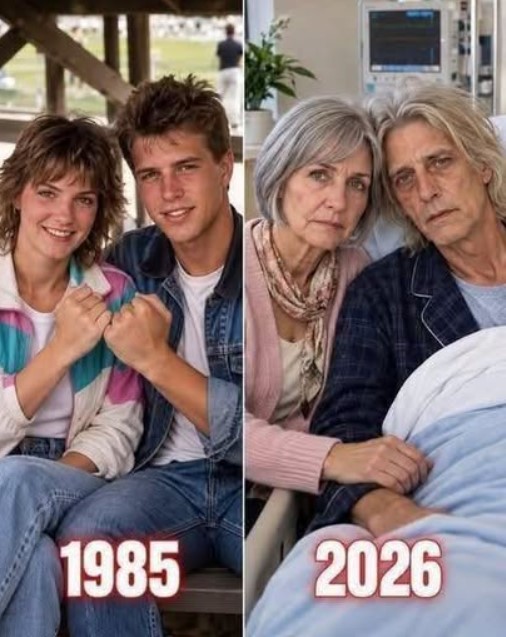
When we were nineteen, my best friend and I made a promise: if we were both still single at sixty, we would find each other again.
I turned sixty last Tuesday.
That night, the old landline in my childhood home rang.
Almost nobody called that number anymore, so I nearly ignored it. I was sitting in the living room with a cup of tea, looking through birthday cards and wondering how sixty years could possibly have passed so quickly.
Then the phone rang again.
Something made me get up and answer it.
I’m glad I did.
Because the voice on the other end belonged to the one person I had never truly forgotten.
The Promise We Made at Nineteen
Jeffrey and I had been best friends since we were seventeen.
We were never officially boyfriend and girlfriend. We were simply Jeffrey and Ruth, two teenagers who seemed to understand each other better than anyone else could.
He dated other girls. I went out with other boys. Our friends constantly teased us, insisting that we would eventually fall in love and get married.
We always laughed at them.
The truth was that our friendship meant too much to risk. Jeffrey was the person I called when something went wrong and the first person I wanted to tell when something wonderful happened.
He knew when I was pretending to be happy. I knew when he was worried, even when he tried to hide it behind a joke.
We could spend hours talking about nothing, yet somehow those conversations always became the most important part of our day.
I was afraid that admitting my feelings might destroy the one relationship I couldn’t imagine living without.
Perhaps Jeffrey felt the same way. Neither of us was brave enough to find out.
Then came the summer night that changed everything.
We had both endured terrible dates. Mine had spent most of the evening talking about himself, while Jeffrey’s date had apparently spent the entire dinner criticizing his clothes.
By the time we met outside our old high school, we were ready to declare romance a complete disaster.
We slipped beneath the football bleachers and sat on the grass, laughing until our stomachs hurt.
Then Jeffrey grew quiet.
“What if we never get this right?” he asked.
I glanced at him. “Get what right?”
“Dating. Relationships. Finding somebody to spend our lives with.”
“We’ll survive.”
He picked at a blade of grass.
“What if we’re both single forever?”
I turned toward him, ready to make another joke, but something in his expression stopped me.
He held out his little finger.
“If we’re both still single at sixty, we stop being idiots and find each other.”
I burst out laughing.
“Sixty? We’ll be ancient!”
“You’ll still be bossy.”
“And you’ll probably be bald.”
“I’ll buy a hat.”
I laughed again, but Jeffrey kept his finger extended.
Then he looked directly into my eyes.
“If we reach sixty and neither of us has found the right person,” he said softly, “maybe it means we already did.”
My heart began pounding.
There were so many things I wanted to say. I wanted to ask whether he had ever imagined kissing me. I wanted to know whether he had ever felt jealous when I talked about another boy.
Most of all, I wanted to tell him that he was already the most important person in my life.
Instead, I wrapped my pinky around his.
“Deal.”
We sealed our promise beneath those old bleachers, believing that sixty was so far away that we would surely have forgotten the whole thing by then.
We were wrong.
The Letters That Kept Us Close
Two months later, Jeffrey left for college three states away.
At first, the distance changed almost nothing.
We wrote letters constantly. They arrived in my mailbox every week, sometimes so long that I needed an entire evening to read them.
He told me about his roommates, his classes, the terrible food in the cafeteria, and the people he met. I wrote about my family, my part-time job, the girls at school, and the ridiculous boys who kept asking me out.
We shared the smallest details because they mattered when they came from each other.
His handwriting was messy, especially when he was excited. Mine was neat at the beginning of every letter and increasingly chaotic toward the end.
Sometimes he sent photographs. Sometimes I tucked a pressed flower into an envelope.
I kept every letter he sent.
I assumed he kept mine, too.
But as the months passed, something began to change.
The weekly letters became less frequent. A week turned into two, then three.
Eventually, Jeffrey mentioned a girl he had met at college.
He wrote about her casually, describing her as intelligent, funny, and beautiful. He wondered whether she might become someone important in his life.
I read that paragraph several times.
Then I sat on my bed and cried.
That was the night I finally admitted the truth to myself.
I loved Jeffrey.
Perhaps I always had.
I loved the way he remembered things I had mentioned only once. I loved that he could make me laugh when I was convinced the world had ended. I loved that he never made me feel foolish for being afraid.
I had been so terrified of losing our friendship that I had never considered what it would feel like to lose the possibility of something more.
That evening, I wrote him a letter.
I told him everything.
I told him I had fallen in love with him long before either of us had understood what love meant. I told him that every boy I dated seemed to be missing something, and that I had finally realized what that something was.
It was Jeffrey.
I wrote until my hand hurt.
When I finished, I folded the pages and placed them inside an envelope.
Then I became frightened.
What if he didn’t feel the same way? What if he had already fallen in love with someone else? What if my confession destroyed the friendship we had protected for years?
I put the envelope away.
I convinced myself that if Jeffrey was happy, I had no right to complicate his life.
I believed I had made the sensible choice.
I would spend the next forty-one years wondering whether it had been the wrong one.
The Letter That Never Reached Him
In the summer of 1986, a letter arrived from Jeffrey.
I recognized his handwriting immediately.
I opened it with trembling fingers, hoping he might have decided to come home for a visit.
Instead, I learned that he was getting married.
He had met someone, and they had decided to build a life together.
I read the letter twice before the words made sense.
Then I reached the final paragraph.
Jeffrey asked me not to contact him again.
He explained that he needed to move forward with his new life and believed it would be better if we stopped writing.
I felt as though someone had taken the air from my lungs.
I cried for weeks.
But I respected his request.
I never called him. I never wrote again. I never tried to find out where he lived.
I told myself that love sometimes meant letting someone go, even when it broke your heart.
I didn’t know that Jeffrey’s decision had been shaped by a lie.
I didn’t know that the letter I had written, the one I believed I had never sent, would become the center of a secret that lasted more than four decades.
I only knew that my best friend had disappeared from my life.
And I had no idea why.
The Life I Built Without Him
Life continued, as life always does.
I dated. I traveled. I built a career and made friends. I had relationships that mattered, and there were moments when I genuinely believed I had found someone with whom I could spend the rest of my life.
Once, I came close to getting married.
But something always felt unfinished.
Whenever someone asked why I had never settled down, I gave the simplest answer.
“I just never met the right man.”
It wasn’t entirely true.
I had met him when I was seventeen.
But I couldn’t spend the rest of my life waiting for someone who had explicitly asked me to leave him alone.
So I learned to live without Jeffrey.
I stopped checking the mailbox for his handwriting. I stopped expecting to see him whenever I visited our old hometown. Eventually, I stopped mentioning his name in conversations.
Yet I never threw away the few things I still had from our friendship.
A photograph from graduation. An old birthday card. A note he had passed me during mathematics class.
They remained tucked away in a box, reminders of a time when the future had seemed full of possibilities.
I sometimes wondered whether Jeffrey was happy.
I wondered whether his wife knew how funny he could be, or whether she understood how quiet he became when something troubled him.
I wondered whether he ever thought about the promise beneath the bleachers.
But I never asked anyone.
Forty-one years passed.
Then I turned sixty.
And at 9:17 p.m. on my birthday, the old landline rang.
The Call I Never Expected
“Hello?” I answered.
A young man’s voice came through the receiver.
“Is this Ruth?”
“Yes.”
“My name is Peter. Jeffrey is my father.”
I sat down so quickly that the chair scraped against the floor.
For a moment, I couldn’t speak.
“What happened?” I finally asked.
Peter paused.
“My dad asked me to call you. He’s in the hospital, and he doesn’t have much time.”
My hand began to shake.
Before I could respond, I heard movement on the other end.
Then a voice came through the receiver.
Older. Weaker. Almost unrecognizable.
But unmistakably his.
“Ruthie.”
My eyes filled with tears.
“Jeffrey?”
A faint laugh escaped him.
“You remembered.”
“How could I forget?”
Silence settled between us.
Then he said something that made my heart ache.
“I remembered every birthday.”
I covered my mouth.
Forty-one years disappeared in those four words.
“Jeffrey, why didn’t you ever call me?”
“I will explain,” he whispered. “But I need you to come to the hospital.”
“Why?”
“There are things about what happened between us that you never knew.”
I gripped the receiver.
“Then tell me.”
“I can’t explain all of it over the phone. Please, Ruth. There’s something here you need to see.”
His breathing sounded strained.
I closed my eyes.
“All right. I’m coming.”
Forty minutes later, I stood outside his hospital room, terrified of what I was about to find.
When I opened the door, I saw Jeffrey lying in bed.
He was thinner than the boy I remembered. His hair had turned white, and illness had changed his face.
But when he looked at me, I recognized his eyes.
My Jeffrey.
“Hey, Ruthie,” he whispered.
I tried to smile.
“Hey, stranger.”
Then I noticed the chair beside his bed.
A small wooden box sat on it.
The sight of that box made me stop breathing.
I knew it.
I knew it better than I knew almost anything from those distant years.
“Where did you get that?” I asked.
Jeffrey smiled weakly.
“You remember.”
I stepped closer.
“I remember everything about that box.”
The Box He Kept for Forty-One Years
We had found the box in the trash behind my father’s workshop when we were seventeen. Its lid was broken, and one corner was missing.
Jeffrey had insisted that we could repair it.
I painted our initials on the top, with a tiny blue heart between them.
R + J.
We used it to store the little things that seemed important to us: a movie ticket, a dried flower, a photograph from graduation, and a note Jeffrey had written during class.
At nineteen, I had forgotten about the box.
Or so I thought.
Now it sat beside Jeffrey’s hospital bed, its wooden corners scratched and its brass latch dulled with age.
“What is inside?” I whispered.
Jeffrey nodded toward it.
“Open it.”
My fingers trembled as I lifted the lid.
Inside were photographs, old ticket stubs, a faded birthday card, a pressed yellow flower, and a newspaper clipping.
Beneath them lay dozens of letters tied together with a faded blue ribbon.
My letters.
I picked up the first one and recognized my teenage handwriting.
The paper had yellowed, but I could still remember writing every word.
“You kept these?”
“Every one.”
“Why?”
Jeffrey looked directly at me.
“Because you were the most important person in my life.”
My throat tightened.
“Then why did you leave?”
The question escaped before I could stop it.
He lowered his eyes.
“I didn’t leave because I wanted to.”
I stared at him.
“What do you mean?”
He lifted the letters from the box and placed them on the blanket.
Then he pulled out an envelope that looked different from the others.
It had never been opened.
My handwriting was on the front.
My name was written in the corner, and the letter was addressed to Jeffrey.
I felt dizzy.
“That was the letter I never sent.”
Jeffrey shook his head.
“You did send it.”
“No. I wrote it, but I never mailed it.”
“You did, Ruthie. It arrived three days after I left for college.”
I stared at the envelope.
I remembered writing those pages. I remembered being afraid and putting them away.
I had always believed I had destroyed that letter.
“Why didn’t you answer it?” I whispered.
“Because I never got to read it.”
My stomach tightened.
“But you just said it arrived.”
“It arrived,” he repeated. “My father intercepted it. He opened it, read everything, and told me you had changed your mind.”
I felt cold all over.
“What?”
“He said you regretted writing it. He told me you wanted me to leave you alone.”
“That isn’t true!”
“I know that now.”
I covered my face with my hands.
For forty-one years, I had believed Jeffrey had stopped loving me.
For forty-one years, he had believed I had rejected him.
We had both spent our lives grieving something that neither of us had understood.
“What happened after that?” I asked.
Jeffrey explained that he had called my house, desperate to hear the truth from me directly.
My father had answered.
According to Jeffrey, my father told him I was embarrassed by my letter and had begun seeing someone else. He said I wanted Jeffrey to move on.
“My father never told me you called,” I whispered.
“I know.”
“Why would he do that?”
Jeffrey looked exhausted.
“I don’t know what your father believed. I only know what happened.”
I felt tears running down my face.
“I never stopped loving you.”
Jeffrey squeezed my hand.
“I know that now.”
Then he reached into the box again.
This time, he pulled out a photograph of me at nineteen, standing outside my house with an envelope in my hand.
Behind me was a parked car.
A man stood beside it.
My uncle Daniel.
I stared at the photograph.
“Why was he there?”
Jeffrey’s face became serious.
“That’s what I’ve spent the last six months trying to understand.”
“Six months?”
He nodded.
“After my father died, I found an old folder in his desk. It contained your letter and some other things. I started looking into what had happened.”
“What else did you find?”
Jeffrey reached into the box and produced an old cassette tape.
My name was written across it.
RUTH.
I stared at the tape.
“What is that?”
“My father’s voice.”
“Have you listened to it?”
He shook his head.
“No.”
“Why not?”
His eyes filled with tears.
“Because I was waiting for you.”
I looked at him, unable to speak.
He took my hand.
“Whatever is on that tape changes everything.”
I stared at the little cassette, thinking about all the years that had passed, all the words that had never been spoken, and all the choices we had made without knowing the truth.
Then I nodded.
“Play it.”
The Confession That Changed Everything
The recording began with static.
Then an old man’s voice filled the room.
Jeffrey’s father.
“Jeffrey, if you’re hearing this, then I’m probably gone. I need to tell you what I did.”
Jeffrey’s fingers tightened around mine.
The recording continued.
“I lied to you about Ruth. I told you she didn’t love you. That wasn’t true. She loved you more than you ever knew.”
I stopped breathing.
The voice crackled before continuing.
“And I was the reason she let you go.”
Then the tape clicked.
Silence.
Jeffrey stared at the machine.
“What happened?” I whispered.
He shook his head.
“I don’t know.”
Beneath the cassette was another envelope.
On the front, in faded handwriting, were the words:
For Ruth, when she turns sixty.
I looked at Jeffrey.
He looked as shocked as I felt.
“Open it,” he whispered.
I carefully unfolded the letter.
The first sentence made my entire body go numb.
Ruth, if you’re reading this, then my son finally found the courage to bring you home.
I read the letter aloud, my voice trembling.
Jeffrey’s father admitted that he had been a proud and controlling man. When Jeffrey left for college, he worried that his son would abandon his plans if he fell in love too young.
He had seen how much Jeffrey cared about me.
He had heard Jeffrey talk about our friendship and watched him eagerly open my letters.
When he discovered my confession, he became afraid that our relationship would change the future he had imagined for his son.
So he intercepted my letter.
He lied to Jeffrey, telling him I had regretted my feelings and wanted no further contact.
When Jeffrey called my house, his father had already prepared another lie. He told Jeffrey that I was seeing someone else and had moved on.
The letter continued.
Jeffrey’s father confessed that he had repeated the lies for years, even when his son questioned him.
He had convinced himself that he was protecting Jeffrey from a mistake.
In reality, he had taken away our chance to make our own decisions.
I looked at Jeffrey.
“You believed him?”
He closed his eyes.
“I did.”
“Why didn’t you try harder to reach me?”
He looked down.
“I was young. I thought I had to respect what I believed was your choice. Then I met Margaret, and life moved forward.”
I understood that answer, even though it hurt.
He had believed I had rejected him. I had believed he had rejected me.
Two young people had trusted the wrong information and spent decades living with the consequences.
I continued reading.
The letter revealed that Jeffrey’s father had regretted his actions for years. He had wanted to confess, but pride and fear had kept him silent.
He admitted that he had mistaken control for protection and had convinced himself that he knew what was best for everyone.
At the bottom of the page was another confession.
If I could undo one thing in my life, it would be this. I would let my son make his own choices. I would let two nineteen-year-olds decide whether their love was foolish or forever.
I could barely see through my tears.
Forty-one years.
Forty-one years believing I had been foolish enough to love someone who didn’t love me back.
Forty-one years believing Jeffrey had forgotten the promise we made beneath the bleachers.
I folded the letter and looked at him.
“Why didn’t you call me when you discovered the truth?”
He turned away.
“Because I was ashamed.”
“You could have written.”
“I know.”
“You could have called.”
“I know.”
“Jeffrey, you could have given me the truth.”
He nodded.
“I know that now.”
He explained that he had discovered the letters after his father died, but by then he was married and had children. He didn’t know whether contacting me would reopen old wounds or disrupt the life I had built.
He had waited, hoping for the right moment.
Then his wife, Margaret, died.
Only after her death did he finally begin to consider whether our promise might still mean something.
I wiped my eyes.
“What was Margaret like?”
Jeffrey smiled sadly.
“She was a good woman. She eventually found the letters. She knew I had loved you, and she told me I had been a coward for never finding out the truth.”
Despite my tears, I almost laughed.
“She sounds like someone I would have liked.”
“You would have.”
He looked down at his hands.
“I loved Margaret. Our life together mattered. But she knew there was a part of my heart that belonged to a time before we met.”
I squeezed his hand.
“That doesn’t make the life you shared any less real.”
He looked at me with gratitude.
For the first time that evening, I understood that the truth wasn’t as simple as imagining the life we might have had together.
We had both lived entire lives without each other. There had been love, loss, responsibilities, and people who mattered deeply.
We couldn’t erase those lives.
But we could finally understand what had happened between us.
The Photograph at the Hospital
I returned to the letter.
Near the bottom, Jeffrey’s father mentioned that he had seen me again twelve years after our separation.
He claimed I had been standing outside the hospital where Margaret gave birth to her first granddaughter, carrying flowers.
I stared at the page.
“That wasn’t me.”
Jeffrey looked confused.
“What?”
“I never had a granddaughter.”
For a moment, neither of us spoke.
Then I read the final lines.
His father admitted that he must have mistaken me for another woman.
After everything we had uncovered, the mistake was almost absurd.
I began laughing.
Not because any of it was funny, but because the truth had become so strange that crying seemed insufficient.
Jeffrey laughed, too.
For the first time in forty-one years, we were laughing together again.
It sounded exactly as I remembered.
Then he reached into the box and pulled out one more photograph.
It showed a wooden bench beside a lake, with a brass plaque attached to the back.
“What is this?” I asked.
“A place I visit every year.”
“Why?”
He looked embarrassed.
“Because it’s where I planned to take you when we turned sixty.”
I stared at him.
“You remembered the promise.”
“I never forgot it.”
“But you were married.”
“Yes.”
“So why did you keep thinking about it?”
He took a breath.
“Because I always believed that if life ever gave us another chance, I would take it.”
He explained that he had waited until after Margaret’s death to consider reaching out. He didn’t know whether I had married, whether I was happy, or whether I wanted to hear from him.
Then, as his health declined, he decided he could no longer let fear make the decision for him.
He had asked his son Peter to find my number.
He had wanted to keep the promise before it was too late.
I looked at the photograph of the bench.
“I had a good life,” I told him. “I had friends, family, work, and memories. I was happy.”
He smiled gently.
“But?”
I touched his hand.
“But there was always something missing.”
A tear slipped down his cheek.
“I know.”
The Last Promise
For several minutes, neither of us spoke.
Then Jeffrey turned toward me.
“Ruthie, I’m not asking you to forgive forty-one years. I’m not asking you to pretend we can get them back.”
He paused to catch his breath.
“I just wanted one honest conversation before I die.”
I shook my head.
“Don’t talk like that.”
“I have to.”
“No.”
“Ruth—”
“You don’t get to disappear again.”
A weak smile appeared on his face.
“You’re still bossy.”
“And you’re still impossible.”
“I missed that.”
I leaned closer.
“I missed you.”
He closed his eyes.
“I missed you, too.”
Then he asked the question I had been waiting forty-one years to hear.
“Do you remember our deal?”
I smiled through my tears.
“The ridiculous sixty-year-old deal?”
“Yes.”
“We said we’d find each other.”
“We did.”
I shook my head.
“No. You called me.”
He smiled faintly.
“That counts.”
I squeezed his hand.
“No, Jeffrey. We found each other.”
For the first time that evening, his face looked peaceful.
A nurse entered to check his monitors. When she saw us holding hands, she smiled gently.
“Family?” she asked.
Jeffrey looked at me.
For forty-one years, I had imagined what it might feel like to hear him call me something other than his best friend.
I had imagined a grand declaration, a confession of love, or a promise that we would finally spend the rest of our lives together.
Instead, he smiled at the nurse.
“My oldest friend.”
I raised an eyebrow.
“Oldest friend?”
He grinned weakly.
“You’ll always be bossy.”
“And you’ll always be bald.”
“I have a hat.”
I laughed.
He laughed, too.
For a moment, we were nineteen again, sitting beneath the football bleachers after two terrible dates, believing we had all the time in the world.
Then his breathing changed.
The monitor beside him began to beep more slowly.
I squeezed his hand.
“Jeffrey?”
His eyes opened.
“I’m here.”
“I know.”
He looked at me.
“Ruthie?”
“Yes?”
“I’m sorry.”
I pressed his hand against my cheek.
“No more apologies.”
“But—”
“You came back.”
His eyes filled with tears.
“I promised I would.”
“You kept your promise.”
He smiled.
Then, almost too quietly to hear, he whispered, “Worth the wait.”
His hand became still.
For a few seconds, I didn’t understand what was happening. I held on to him, waiting for him to squeeze my fingers or make another joke.
Then the monitor changed.
A nurse hurried into the room.
I knew what had happened, even before anyone said the words.
But I couldn’t let go.
Not yet.
I stayed beside him until the room became quiet, until the nurse gently drew the curtain, and until the first light of morning appeared through the window.
The man I had loved since I was seventeen was gone.
But he hadn’t left me wondering anymore.
He had given me the truth.
And he had come back.
The Letter I Found After His Death
I took the little wooden box home with me.
Inside were forty-one years of memories: letters, photographs, a dried flower, the cassette tape, and pieces of two young lives that had once seemed inseparable.
I carried it carefully, as though the memories inside might break.
When I arrived home, I placed the box on my kitchen table and began looking through everything again.
That was when I discovered a folded piece of paper hidden beneath the lining.
It was written in Jeffrey’s handwriting.
There was only one sentence.
Ruth, if we’re both still single at sixty, I’ll find you. But if I don’t make it that far, promise me you’ll finally stop waiting.
I sat in my car for a long time, holding that note.
Then I cried.
Not only because Jeffrey was gone, but because I finally understood something he had been trying to tell me.
He had never wanted me to spend my life waiting for him.
He had wanted me to live.
I had spent so many years believing our story had ended because I had failed to say the right words, or because he had chosen someone else, or because fate had decided we weren’t meant to be together.
Now I knew the truth.
We had loved each other. We had been separated by lies, fear, and decisions made by people who thought they knew what was best for us.
But we had also lived.
Jeffrey had loved Margaret. He had raised his children. I had built my own life. Neither of us could reclaim the years that had passed.
What we could do was stop allowing the past to remain an unanswered question.
I folded the note and placed it back inside the box.
Then I made a promise to myself.
I would remember Jeffrey.
I would treasure what we had shared.
But I would stop waiting for a life that could never happen.
Returning to the Place Where It Began
The following spring, I returned to our old high school.
The football field had changed. The bleachers had been replaced, and the school building had been renovated.
Almost everything looked different.
But I knew exactly where we had sat that summer night.
I carried the wooden box to a quiet place beneath a tree beside the old field.
Then I opened it.
Inside was our first photograph together, taken when we were seventeen.
We looked impossibly young, with our whole lives ahead of us and no understanding of how complicated the future could become.
I smiled at the picture.
“Hey, Jeffrey.”
The wind moved gently through the branches.
“I kept my promise.”
I placed the photograph back inside and closed the lid.
For the first time in forty-one years, I no longer felt as though I was carrying an unfinished story.
I was carrying a completed one.
It wasn’t the story I had imagined at nineteen. We hadn’t married, grown old together, or spent our lives sitting on a porch telling the same jokes.
But we had found our way back to each other.
We had spoken honestly.
We had forgiven what we could and acknowledged what could never be changed.
And, in the end, that was enough.
I stood up and began walking toward the school gates.
I wasn’t forgetting Jeffrey.
I was finally allowing myself to move forward.
Then my phone rang.
For one impossible second, my heart believed it was him.
But it wasn’t.
It was Peter, Jeffrey’s son.
“Hello?” I answered.
“Ruth?”
“Yes?”
“I found something else in Dad’s house.”
I stopped walking.
“What did you find?”
“A letter.”
“To me?”
“No,” Peter said. “To you and me.”
I glanced back at the old football field.
“What does it say?”
Peter was quiet for a moment.
“Dad wrote that if you ever came back to the school, I should give you the letter.”
My heart began to ache again.
“Peter, what did your father write?”
His voice softened.
“He wrote, ‘Tell Ruth that the promise was never supposed to end at sixty.’”
I closed my eyes.
Then I smiled.
Because suddenly I understood.
Our promise had never truly been about getting married at sixty. It had been about remembering who we had been to each other, no matter how much time passed or how far life carried us apart.
It had been about leaving a door open, even when neither of us knew whether we would ever find the courage to walk through it.
We had made that promise as teenagers because we were afraid of the future.
We kept it as adults because we had never entirely forgotten the past.
And when we finally found each other again, we discovered that love had survived, even though life had taken us in different directions.
Conclusion: Some Promises Never Really End
I used to believe that a love story had to end with two people together.
I thought the happiest ending was marriage, a shared home, and a lifetime of ordinary mornings spent beside the person you loved.
But Jeffrey taught me something different.
Sometimes love doesn’t arrive when you expect it. Sometimes it becomes part of another person’s life, another family, and another story. Sometimes the years pass before you have the courage to ask the questions that matter most.
And sometimes, after decades of silence, you are given one last opportunity to tell the truth.
Jeffrey and I never got back the forty-one years we lost. We couldn’t return to the summer night beneath the bleachers or undo the lies that separated us. We couldn’t become nineteen again or discover what our lives might have looked like if someone had allowed us to make our own choices.
But we could finally understand what had happened.
We could acknowledge that our feelings had been real, that neither of us had deliberately abandoned the other, and that the silence between us had been built on a lie.
Most importantly, we could say what we had never managed to say when we were young.
I loved you.
I never forgot you.
I’m glad I found you again.
I still keep the wooden box. Sometimes I open it and look at our old photograph, the one where we are seventeen and laughing as though the world belongs to us.
I think about the girl I was then, frightened of losing her best friend.
I wish I could tell her that life would be complicated, that some people would make choices for her, and that she would carry unanswered questions for longer than she could imagine.
But I would also tell her something else.
I would tell her that the friendship was worth having, that the love was real, and that even though their story would not unfold the way she dreamed, it would still matter.
Because love is not measured only by the number of years two people spend together.
Sometimes it is measured by the honesty they finally find, the kindness they leave behind, and the courage it takes to return after a lifetime apart.
Jeffrey kept his promise.
He found me when we were sixty.
And although I lost him the same night I found him again, I will always be grateful that the old landline rang at 9:17 p.m.
For forty-one years, I had wondered whether he remembered.
Now I knew.
He had remembered the letters, the laughter, the terrible dates, the promise beneath the bleachers, and the girl who had once painted their initials on a little wooden box.
He had remembered me.
And I had remembered him.
Some promises do not end when the years pass. They simply change shape, becoming memories, lessons, and reminders of the people who helped us become who we are.
Our promise was never really about finding each other at sixty.
It was about making sure that, no matter what happened, we never forgot what we had meant to each other.
And in the end, we didn’t.
We found each other.
We told the truth.
We said goodbye.
And somehow, after everything, that was enough.