At Sunday dinner, I watched my husband tear open a tiny white packet and empty its contents into my bowl of chicken soup. He stirred the mixture carefully, then carried it into the dining room and placed it in front of me with a smile.
“Eat, Diane,” Mark said. “You’ve been claiming you don’t feel well for months. Maybe it’s time you stopped pretending to be sick for attention.”
His mother, Judith, laughed dismissively.
“She has always worried too much about her health,” she remarked. “Every little thing becomes a crisis with her.”
I stared at the soup without saying a word.
I didn’t ask Mark what he had added. I didn’t accuse him of anything, and I certainly didn’t let him see how frightened I was.
Instead, I waited for everyone at the table to become distracted. When an argument broke out between Mark’s father, Harold, and his brother Steve, I quietly exchanged my bowl with another one.
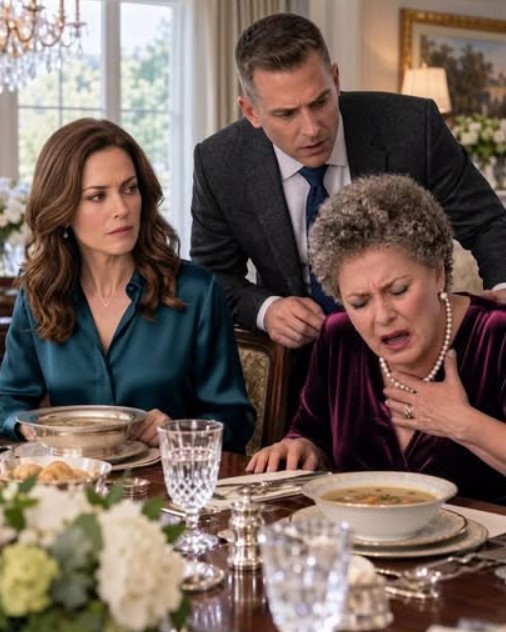
A few minutes later, someone began feeling terribly unwell.
Everyone panicked. Chairs scraped across the floor, voices rose, and someone reached for a phone to call emergency services.
But I wasn’t watching the person who had fallen ill.
I was watching my husband.
Mark’s face had turned pale. His eyes were fixed on me, searching for something—confusion, weakness, dizziness, anything that would tell him his plan had worked.
I was sitting perfectly upright, thinking more clearly than I had in months.
And the fear in his expression revealed something I had never imagined about the man I had loved for twenty-six years.
Suddenly, six months of unexplained symptoms began to make horrifying sense.
Twenty-Six Years of Marriage
My name is Diane Foster. I was fifty years old when my life changed during what should have been an ordinary family dinner.
Mark and I had been married for twenty-six years. We lived in a modest brick house in Carmel, Indiana, the same home we had purchased when we were younger and full of plans for the future.
Our marriage wasn’t particularly exciting, but I had always believed it was dependable. We had our routines, our familiar disagreements, and our shared memories. We never had children, so our lives revolved around our careers, friends, occasional weekend trips, and family gatherings.
The most important family tradition was Sunday dinner at Mark’s parents’ house.
Every Sunday at exactly 5:30 p.m., we gathered at Judith and Harold’s home near Geist Reservoir. Judith considered punctuality a sign of respect, and arriving late was enough to earn a lecture before we had even removed our coats.
Mark had spent his entire life trying to avoid disagreements with his mother. If Judith made a cutting remark, he usually laughed awkwardly or changed the subject. If she criticized me, he would tell me afterward that she hadn’t meant anything by it.
Over the years, I had learned to tolerate her behavior.
I never imagined that the same woman who criticized my cooking, questioned my medical concerns, and commented on my appearance might one day become involved in something far more sinister.
That Sunday, however, something felt wrong from the moment Mark and I got into the car.
He barely spoke during the drive. His hands were unusually tight around the steering wheel, and he checked the clock repeatedly.
“Is something bothering you?” I asked.
“No. I’m tired.”
He answered too quickly.
I knew that tone. It was the voice he used whenever he wanted me to stop asking questions.
When we arrived at his parents’ house, Judith opened the door and immediately complained that we were three minutes late.
“Traffic,” Mark explained.
“There wasn’t any traffic,” Harold called from his recliner, where he was watching a fishing program.
Judith gave him a sharp look, and Harold shrugged.
Normally, I would have laughed at the exchange. It was a familiar scene, one that had played out countless times over the years.
But I couldn’t shake the uneasy feeling in my stomach.
Mark’s brother Steve and his wife, Karen, arrived shortly afterward with a blueberry pie. Karen slipped into the kitchen with me while the others settled into the living room.
“Judith still insists that everything must be homemade,” Karen whispered.
“I know,” I replied.
“So I took the pie out of the store packaging before we left.”
I laughed quietly.
“I did the same thing last Thanksgiving.”
For a few minutes, we chatted about ordinary things. Nothing seemed unusual, and I almost convinced myself that I was being unnecessarily suspicious.
Then Judith called everyone to the table.
Chicken soup was served first, followed by roast beef, potatoes, carrots, rolls, and dessert. Six bowls of soup were placed around the table, filling the room with the familiar smell of rosemary, thyme, and chicken stock.
Judith suddenly announced that she had forgotten the crackers.
“I’ll get them,” Mark said immediately.
He stood up, picked up my bowl, and carried it toward the kitchen.
“Why are you taking mine?” I asked.
“You like extra pepper,” he replied with a smile.
I watched him leave the room.
Something about his expression bothered me, although I couldn’t explain why.
A moment later, I excused myself to wash my hands.
Instead of walking directly to the bathroom, I slowed as I passed the kitchen doorway.
That was when I saw him.
The Tiny White Packet
Mark stood at the kitchen counter with my bowl in front of him.
He reached into his pocket and removed a small white packet. It was folded tightly, and I couldn’t see a label or identify what it contained.
He tore it open.
Then he tipped a fine white substance into my soup and stirred it thoroughly.
My heart began pounding so hard that I could hear it in my ears.
For several seconds, I remained frozen in the hallway.
I wanted to rush into the kitchen and demand an explanation. I wanted to grab the bowl from him and ask why my own husband was secretly putting something into my food.
But then he glanced over his shoulder.
He was checking whether anyone had seen him.
I stepped backward before he could notice me and continued toward the bathroom.
Once inside, I closed the door and stared at my reflection in the mirror.
My face looked pale. My eyes were wide, and my hands were trembling.
I barely recognized the frightened woman staring back at me.
Then the previous six months began replaying in my mind.
The dizziness that came without warning.
The headaches that left me struggling to concentrate.
The exhaustion that made me fall asleep unusually early.
The moments when I walked into a room and completely forgot why I had gone there.
Sometimes I lost words halfway through a sentence. On other occasions, I felt unsteady on my feet or struggled to remember familiar details.
I had visited my doctor, but the initial tests hadn’t provided a clear explanation.
I blamed stress, work, and the possibility that I was simply getting older.
Mark encouraged me to think the same way.
“You don’t eat properly,” he would say.
“You’re working too hard.”
“Everyone gets forgetful sometimes, Diane.”
Once, I became confused while driving to a grocery store I had visited for years. I had to pull into a parking lot and sit there until I felt calm enough to continue.
When I told Mark about it, he smiled sympathetically.
“Welcome to getting older.”
I had trusted him because I believed he wanted to help me.
Now I wondered whether he had been watching my symptoms for a reason.
When I returned to the dining room, Mark was already seated beside me. He had placed the soup in front of my chair.
“There you go,” he said. “Extra pepper, just how you like it.”
“Thank you.”
I looked into the bowl, then at his face.
His smile appeared perfectly normal, but beneath the table his knee was bouncing nervously.
Everyone else continued talking. Judith discussed Thanksgiving plans, Harold told a story he had repeated many times, and Steve interrupted him to correct a detail.
The scene was so ordinary that it felt unreal.
Mark kept glancing at me, then at my soup, then back at me.
He was waiting for me to eat.
I considered confronting him, but I didn’t know what had been in the packet. If I accused him without evidence, he could deny everything. Judith would undoubtedly defend her son, and both of them could insist that my recent confusion had caused me to misunderstand what I had witnessed.
I needed to think carefully.
When an argument distracted everyone at the table, I quietly exchanged my bowl with Judith’s. The bowls looked identical, and nobody noticed the change.
I knew the situation was dangerous, but I had no way of identifying the substance or predicting what it might do. I couldn’t safely determine what was happening simply by watching the table.
Still, I was desperate to understand why Mark had behaved that way.
Judith returned to her seat and lifted her spoon.
She took a mouthful of soup, then another.
Across the table, Mark looked at me.
“You haven’t eaten anything.”
“It’s too hot,” I replied.
“Give it a minute.”
There was something unsettling about the way he encouraged me to eat.
I kept my expression calm and watched him.
Several minutes later, Judith stopped speaking.
She blinked repeatedly and looked down at her hands.
“Something feels strange,” she murmured.
Her spoon slipped from her fingers and struck the table.
Harold turned toward her.
“What is it?”
“My hands feel funny. I don’t feel right.”
Judith attempted to stand, but she immediately became unsteady.
Steve reached for her arm while Karen pulled out her phone.
“Mom, sit down,” Steve urged.
“Should we call an ambulance?” Karen asked.
Within seconds, the dining room descended into chaos.
Everyone was talking at once. Harold looked frightened, Steve tried to support his mother, and Karen contacted emergency services.
I remained seated, watching Mark.
He wasn’t looking at Judith with the concern I expected from a son watching his mother become ill.
He was staring directly at me.
His face had lost its color.
His expression was one of pure disbelief.
I was sitting upright, alert and fully aware of what was happening.
For the first time in months, I understood that my instincts might have been right all along.
The Evidence I Could No Longer Ignore
The paramedics arrived quickly and took Judith to the hospital. Steve and Harold followed them, while Karen offered to bring clothes and other necessities later.
Outside the house, Mark stood beside me in the cool evening air.
“You should probably get checked out, too,” he said.
I turned toward him.
“Why?”
“You’ve been feeling tired lately.”
For months, he had dismissed my concerns and suggested that I was exaggerating my symptoms. Now, suddenly, he appeared worried about my health.
“I feel fine,” I replied.
His jaw tightened.
We drove home in almost complete silence.
Later that evening, Mark went upstairs to shower. As soon as I heard the bathroom door close, I collected a few clean bags, gloves, and my keys.
I returned to Judith’s house.
The dining room looked almost exactly as it had when everyone rushed outside. Chairs stood at odd angles, napkins lay on the floor, and half-filled glasses remained on the table.
The bowls of soup were still there.
I carefully secured the bowl Judith had eaten from and the spoon she had used. Beneath the table, I noticed a small white wrapper that appeared to match the packet I had seen Mark open.
I kept the items separate and preserved them as carefully as I could.
I didn’t know whether they would provide useful evidence, but I understood that whatever answers existed might disappear if the room was cleaned before anyone examined it.
When I returned home, Mark was waiting.
“Where have you been?”
“I went back to your parents’ house.”
“Why?”
“I thought I had left something.”
He studied my face.
“You weren’t carrying anything when we left.”
I held his gaze.
“It has been a long evening, Mark.”
For several seconds, neither of us moved.
Then he looked away.
We barely slept that night.
The next morning, Karen called to tell me that doctors didn’t believe Judith had suffered a stroke. They were conducting further tests to determine what had caused her sudden symptoms.
I thanked her and ended the call.
Across the kitchen, Mark held a newspaper without turning a single page.
He had heard every word.
That afternoon, I made an appointment with my longtime doctor, Dr. Emily Lawson.
After I explained what had happened at dinner, she closed the examination-room door and asked me a question I hadn’t expected.
“Diane, has anyone had regular access to your food or medication?”
My stomach tightened.
“Why are you asking me that?”
Dr. Lawson turned her computer screen toward me.
She explained that an earlier blood test had revealed traces of a prescription sedative. At the time, the amount had been low, and there had been no obvious way to determine whether it was connected to my symptoms.
A follow-up test had been recommended, but I had canceled the appointment after reporting that I felt better.
I could barely remember making that decision.
“Have you knowingly taken any sedatives?” she asked.
“No.”
“Does Mark prepare food or drinks for you?”
I thought about the coffee he had started bringing me in the mornings. I remembered the smoothies he occasionally made and the dinners he had recently insisted on cooking.
“Yes,” I answered.
Dr. Lawson ordered additional testing and advised me to avoid any suspected source of exposure while the situation was investigated.
After leaving her office, I arranged for an independent laboratory to analyze the items I had preserved from Sunday dinner.
The cost was substantial, but I paid it anyway.
For the first time, I had a reason to believe my symptoms might have an explanation that had nothing to do with stress or aging.
A few days later, the laboratory contacted me.
The technician asked me to come in to discuss the results.
Once we were seated in a private office, she explained that testing had identified a prescription medication in the soup.
The substance could cause dizziness, drowsiness, confusion, impaired coordination, memory difficulties, and changes in judgment, depending on the medication and the amount involved.
I felt as though the floor had shifted beneath me.
Those were the same problems I had experienced for months.
I asked whether repeated exposure to a medication could produce an ongoing pattern of symptoms.
She explained that the effects would depend on the substance, dose, frequency, and individual circumstances, but repeated exposure could potentially cause persistent problems.
The possibility was terrifying.
My symptoms might not have been random incidents at all.
The laboratory also reported findings suggesting that the packet or its contents might have been handled by more than one person.
Until then, I had imagined that Mark might have been acting alone.
Now I began to wonder about Judith.
She had been unusually dismissive whenever I mentioned my health. She had repeatedly told me I was anxious, dramatic, or too sensitive.
Could she have known more than she had admitted?
I needed answers.
A Financial Motive Emerges
The following morning, I contacted Tom Reynolds, a retired Indianapolis detective whom Harold had once recommended to us.
Tom listened carefully while I explained the packet, the laboratory findings, my medical symptoms, and Mark’s strange behavior during the dinner.
When I finished, he remained quiet for a moment.
“Are you prepared for the possibility that your marriage may be very different from what you believed?” he asked.
I stared at my coffee.
“I think I’m already there.”
Tom advised me not to confront Mark impulsively. Instead, he encouraged me to preserve the evidence, work with qualified professionals, and report the suspected poisoning through the appropriate authorities.
He also helped me understand that the situation might involve more than my health.
We began examining the financial circumstances surrounding my marriage.
The first document that caught our attention was a life-insurance policy.
My name appeared beside a benefit of two million dollars.
“When was this amount increased?” I asked.
“About eight months ago,” Tom replied.
I examined the signature on the paperwork.
It resembled mine, but I had never knowingly signed an agreement authorizing that change.
Tom also discovered that Mark’s insurance business was experiencing serious financial difficulties. Poor investments and lost clients had left him facing a significant shortfall.
The information gave us a possible financial motive, although it did not establish who had altered the policy or why.
I felt sick thinking about it.
I had shared a home, a bed, and twenty-six years of memories with a man who might have been hiding enormous financial problems from me.
But I still needed to understand Judith’s possible involvement.
I visited her at the hospital.
She looked tired and much smaller than she usually did. For once, she wasn’t issuing instructions or criticizing the people around her.
“Diane,” she said, “I’m glad you came.”
“How are you feeling?”
“Embarrassed.”
I sat beside her bed.
“What do you remember about Sunday dinner?”
She frowned.
“I remember making the soup.”
My chest tightened.
“You made it?”
“Of course. Mark helped me.”
Before I could ask another question, Harold entered the room. Judith immediately changed the subject, and I decided not to press her while she was recovering.
But her answer stayed with me.
She had made the soup.
Mark had helped.
And I had seen him add something to my bowl.
Several days later, Harold called and asked me to meet him alone.
I found him sitting on the back porch of his house, staring toward the yard.
“I suppose you know about Mark,” he said quietly.
“I know some things. I need to know more.”
Harold explained that after almost fifty years of marriage, he had become accustomed to Judith’s controlling behavior.
She kept documents, private notes, copies of financial records, and information about people that they hadn’t necessarily agreed to share.
“Why would she do that?” I asked.
He looked away.
“Leverage.”
The word hung between us.
Then he told me that Steve had discovered small cameras installed around parts of the house. Judith had placed them there because she liked knowing what was happening even when she wasn’t present.
Some of the recordings were harmless and even absurd. One showed Judith secretly eating several pieces of pie after complaining that the dessert was too sweet.
For the first time in days, Steve and I managed a brief laugh.
Then he opened another recording.
The laughter disappeared.
Mark and Judith were sitting together, talking about me.
They discussed the inheritance my aunt had left me. It was money that had been kept separate from our marital finances, and Judith spoke about it as though she believed the family should eventually control it.
Then Mark mentioned my memory problems.
Judith suggested documenting more incidents.
They discussed the possibility of guardianship.
I stared at the screen, barely able to breathe.
The plan, if that was what it was, became clearer.
They might have been trying to create the appearance that I was losing my ability to manage my own life. If enough people believed that I was becoming confused and unreliable, someone might attempt to challenge my financial independence.
My inheritance could be placed under someone else’s control.
My decisions could be questioned.
My freedom could be taken away under the claim that I needed protection.
And the person who might be helping to create that situation was my own husband.
As Steve and I continued watching the recordings, my phone vibrated.
The message came from an unknown number.
Stop looking for answers.
For the first time, my anger gave way to genuine fear.
I showed Tom the message.
“Don’t respond,” he advised. “Keep the message. Let the authorities investigate it.”
From that moment on, I was careful about everything.
I stopped drinking coffee Mark brought me and avoided food he had prepared. I made arrangements to stay with people I trusted when necessary, and I followed the advice of my doctor and legal counsel.
Meanwhile, Mark continued pretending that nothing was wrong.
Every morning, he asked whether I had slept well.
Every evening, he asked whether I was tired.
Sometimes he brought coffee into the bedroom and watched me expectantly.
I refused it politely.
He began offering to cook more often, but I found reasons to eat elsewhere.
Then one evening, he suggested selling our house.
“Why would we do that?” I asked.
“A fresh start,” he said.
“For both of us?”
“Of course.”
His answer came too quickly.
The house had substantial equity. It was another valuable asset, another possible source of money, and another reason to be cautious.
“Maybe,” I replied.
Relief spread across his face.
He believed I was considering his suggestion.
He didn’t understand that I was buying time.
Judith’s Secret Files
Tom continued investigating the financial documents and the information we had collected.
He discovered that Judith had researched adult guardianship procedures. Harold also found a way into one of her locked cabinets.
Inside were copies of my medical information, financial records, inheritance documents, and handwritten notes about my daily routine.
The pages recorded when I left home, when I was usually alone, and the occasions when I appeared forgetful or confused.
I stared at those notes with trembling hands.
For years, Judith had sat across from me at Sunday dinner, smiling and making conversation, while apparently collecting details about my life.
I couldn’t understand how someone could treat another person’s vulnerability as an opportunity.
An attorney named Melissa Grant joined our efforts. She reviewed the available evidence, including the medical findings, financial paperwork, messages, and recordings.
“The evidence raises serious concerns,” she told me. “We need to preserve it properly and make sure the appropriate authorities can review it.”
She also explained that a recording or suspicious document had to be assessed in context. We couldn’t assume that every detail would prove what we suspected, but together the evidence could help establish what had happened.
Then Mark gave us an unexpected opportunity.
He suggested another Sunday dinner at his parents’ house now that Judith had returned home.
“A family dinner might help everyone get back to normal,” he said.
I almost laughed.
“That’s a good idea,” I replied.
He smiled, apparently satisfied that I had accepted his suggestion.
I knew what I had to do.
I would not go there to argue or make accusations without evidence. I would go prepared to reveal what we had discovered and let the facts speak for themselves.
The Sunday Dinner That Exposed Everything
The following Sunday, the same six people gathered around Judith’s dining table.
Judith sat at one end. Harold sat beside her, while Steve and Karen took their usual places.
Mark sat next to me.
For the first ten minutes, everyone behaved as though the previous week had never happened.
Judith asked about the weather. Harold mentioned a neighbor’s new car. Steve talked about work, and Karen asked whether anyone wanted more water.
Mark seemed increasingly relaxed.
Then I placed a folder on the table.
He stopped talking.
“What’s that?” he asked.
“Answers,” I replied.
I opened the folder and removed the insurance policy, the laboratory report, and the documents relating to the guardianship research.
Judith’s hand began to tremble.
“Diane, I don’t think you understand—”
“Please,” I said quietly. “Let me finish.”
For once, she stopped speaking.
I connected my laptop to the television and opened the first recording.
Judith’s voice filled the room.
She discussed my memory problems and spoke about the importance of documenting incidents. Mark responded by talking about getting doctors to record my confusion.
The conversation moved to my inheritance, the house, and the possibility of guardianship.
Karen covered her mouth.
Steve stared at his brother as though he had never seen him before.
Mark’s expression hardened.
“Where did you get that?” he demanded.
I played another recording.
Then another.
Each one revealed more of the conversations that had taken place when the people involved believed nobody else was listening.
Mark finally struck his palm against the table.
“This is ridiculous!”
Harold turned toward his son.
“No,” he said quietly. “It isn’t.”
Mark stared at him.
Harold’s voice trembled, but he continued.
“It’s true.”
Judith tried to interrupt.
“You don’t understand what was happening.”
“Then explain it,” I replied.
She opened her mouth, but no explanation came.
For years, Judith had controlled conversations by speaking louder, dismissing objections, or making other people feel foolish for questioning her.
This time, her usual tactics weren’t enough.
The documents were there. The recordings were playing. The medical findings had been documented, and the suspected poisoning was being investigated.
Then Tom entered the room.
He had been waiting nearby because we had arranged for him to be available if needed.
Mark looked at him suspiciously.
“Who are you?”
“I’m someone who has been helping Diane understand what happened,” Tom answered.
He played another recording.
In it, Mark and Judith discussed how long their plan was taking. They talked about my increasing alertness, my inheritance, the house, Mark’s financial difficulties, and the insurance policy.
The discussion repeatedly returned to guardianship.
There was no dramatic confession, no single sentence that explained everything.
Instead, the recordings revealed a pattern of conversations that, taken together with the other evidence, painted a deeply disturbing picture.
Harold slowly stood.
He looked at Judith with an expression I had never seen on his face before.
For nearly fifty years, he explained, he had told himself that remaining quiet kept his family together.
He had ignored Judith’s controlling behavior because challenging her always seemed to create more trouble than accepting it.
“I told myself you were strong,” he said, his eyes filling with tears.
“But this isn’t strength.”
He looked directly at his wife.
“It’s cruelty.”
Nobody shouted after that.
Nobody needed to.
The truth could no longer be dismissed as a misunderstanding or another one of my supposed health anxieties.
When the Authorities Became Involved
In the weeks that followed, the evidence was reviewed through official channels.
Hospital toxicology testing confirmed that Judith had been exposed to the same medication found in the soup. My own medical results were consistent with repeated exposure over time, although the full circumstances had to be established through the investigation.
Investigators examined the laboratory findings, financial documents, disputed signatures, insurance changes, messages, recordings, and the research concerning guardianship.
The picture that emerged was frightening.
Mark’s financial problems had become severe. Judith believed that the family should retain control over assets she considered part of the family’s future, including the inheritance my aunt had left me.
The evidence suggested that the two of them had been trying to create the appearance that my memory and judgment were declining.
Repeated exposure to medication appeared to have contributed to the symptoms that others had noticed.
If people around me came to believe that I was becoming incapable of managing my affairs, the situation could potentially be used to challenge my independence.
The larger amount found in the soup that Sunday had brought the suspected pattern into the open.
What began as a frightening incident at a family dinner had revealed questions about my health, my marriage, and my financial security that I had never imagined I would have to face.
Before Mark left that evening, he stopped near the door.
For a brief moment, I saw the younger man I had married.
I remembered the way he had danced with me in our first apartment. I remembered him holding my hand at my father’s funeral and driving through a snowstorm because I was afraid to drive home alone.
Those memories were real.
So was the evidence before me.
“I’m sorry,” Mark said.
Strangely, I believed that he felt some kind of regret.
Perhaps he was sorry that he had been discovered. Perhaps he regretted the damage to his life, the consequences facing his family, or the fact that everything he had tried to conceal was now exposed.
Maybe part of him was genuinely sorry for what he had done to me.
But regret could not erase his choices.
“I’m sorry, too,” I replied.
A flicker of hope appeared in his eyes.
“For what?” he asked.
“For believing I knew you.”
Then I walked away.
The legal process continued for months. There were medical reports, financial reviews, interviews, and court hearings. My marriage ended through paperwork and legal decisions rather than one dramatic final argument.
Harold eventually ended his marriage to Judith as well.
Mark accepted responsibility for several offenses connected to the financial documents and the medication incident. Judith’s legal representatives raised questions about her age and health, and the courts considered the relevant circumstances before consequences followed.
I learned that justice rarely resembles the dramatic scenes people see on television.
There wasn’t always a powerful speech or a moment when everyone applauded.
Sometimes justice meant preserving evidence, sitting through long meetings with attorneys, answering difficult questions, and waiting for decisions to be made.
It was exhausting, but I kept going.
I had spent months being told that I was confused, forgetful, or too anxious to trust my own judgment.
I was determined not to let those accusations define the rest of my life.
Learning to Trust Myself Again
Physically, I began to improve more quickly than I expected.
Once the suspected exposure stopped, the dizziness gradually faded. My memory became clearer, and the exhaustion that had weighed on me for months began to lift.
I no longer felt as though my body were failing me.
That realization brought relief, but it also brought grief.
For months, I had blamed myself.
I had questioned my age, my work habits, my health, and my ability to manage ordinary tasks. Every time I struggled to remember something, I wondered whether I was losing control of my mind.
Meanwhile, people I trusted had encouraged me to doubt what I was experiencing.
The medical problems were frightening, but the emotional damage went deeper.
The worst thing Mark and Judith had threatened to take from me wasn’t simply my money or my independence.
It was my confidence in my own perception.
I began seeing a counselor to work through what had happened.
At first, I found the sessions frustrating. My counselor repeatedly asked questions that seemed obvious.
“Do you trust your memories?”
“Do you trust your judgment?”
“Do you trust people?”
Eventually, I understood why she kept asking.
For months, every time something felt wrong, someone had given me another explanation. When I forgot something, the incident was treated as evidence that I was becoming incapable. When I questioned what I was told, I was made to feel overly emotional.
I had gradually learned to silence my own doubts.
Recovery meant learning that I could take my concerns seriously without assuming that every fear was automatically correct. It meant listening to my instincts while also seeking medical advice, asking questions, and looking for reliable evidence.
Most importantly, it meant understanding that I deserved to be treated with respect.
Harold struggled with his own feelings of guilt.
Several months later, we walked together beside Geist Reservoir.
“I should have spoken up years ago,” he told me.
“You couldn’t have known this would happen.”
“I knew Judith liked controlling people.”
“That isn’t the same as knowing she would do something like this.”
He looked toward the water.
“I thought staying quiet kept the peace.”
I stopped walking and turned toward him.
“Sometimes silence only protects the person causing the problem.”
He gave a tired smile.
“Seems like we’re learning things late.”
“Better late than never,” I replied.
Steve and Karen remained close to me throughout the ordeal.
Karen brought food when the legal proceedings left me exhausted. Steve called so frequently that I eventually had to remind him that I was allowed to spend an evening alone without someone checking whether I was all right.
He laughed.
“Fine. I’ll call every other evening.”
It was irritating, but it was also a reminder that genuine care feels different from control.
People who care about you don’t need you to become weaker so they can feel more powerful. They don’t deliberately undermine your confidence or treat your independence as a threat.
Real support helps you become stronger.
A New Home and a Different Kind of Peace
About a year after that Sunday dinner, I sold the house in Carmel.
Leaving was harder than I expected.
I had lived there for more than twenty years. Every room held memories: Christmas mornings, rainy breakfasts, friends gathered on the patio, and evenings when Mark and I laughed over something that seemed important at the time.
I remembered him painting a bedroom the wrong shade of blue and insisting that it would look different once the paint dried.
Some of those memories were genuinely happy.
That was one of the most difficult lessons I had to accept.
Someone can betray you terribly without making every moment of the past a lie.
I didn’t need to erase every good year to acknowledge what had happened later. I could remember the happiness I had experienced while also accepting that my marriage had become unsafe.
But I also didn’t need to remain in a house where every cup, cabinet, and familiar routine reminded me of what I had endured.
I bought a small cottage in Brown County.
It wasn’t impressive. The kitchen needed repairs, the porch leaned slightly, and the garden had been neglected.
I loved it immediately.
On my first evening there, I sat outside with a cup of tea and listened to the crickets.
There was no television playing inside. No footsteps behind me. No one asking whether I felt tired or insisting that I needed help with something I could do myself.
For the first time in years, silence felt safe.
That spring, I planted flowers in the garden.
Some grew beautifully. Others didn’t survive.
I volunteered at the local library and joined a walking group. I began cooking meals for one person without feeling sad whenever I looked at the chair across from me.
Eventually, I stopped thinking of it as an empty chair.
It was simply a chair.
My life no longer needed to be organized around the absence of my husband.
I could make plans because I wanted to make them. I could spend an afternoon reading, take a walk when the weather was pleasant, or invite a friend over without worrying about whether my choices would be criticized.
Slowly, the world became larger again.
Almost two years after the dinner that changed everything, Harold, Steve, and Karen came to visit.
Karen arrived carrying a blueberry pie.
“Homemade?” I asked with a smile.
She looked offended.
“Obviously.”
Steve laughed.
“She threw away the store box before we got here.”
For the first time in a long while, we ate together without fear or tension.
We sat on the porch and talked about ordinary things. Nobody checked the clock, and nobody insisted that dinner had to begin at precisely 5:30.
At one point, Harold lifted his glass.
“To new traditions,” he said.
We raised ours.
And I thought about the old Foster dining room, where tradition had once seemed more important than honesty, kindness, or respect.
For years, I had believed that family traditions were what kept people together.
Judith believed that too.
But we had misunderstood something fundamental.
A table does not make a family.
A schedule does not make a family.
Sharing a last name does not automatically make people trustworthy.
Trust matters. Respect matters. Safety matters.
Without those things, tradition is nothing more than repetition.
Conclusion: The Day I Finally Trusted Myself
People have asked whether I regret what happened with the bowls that Sunday evening.
The answer has never been simple.
Judith became seriously ill, and I carried guilt about that for a long time. I have had to live with the knowledge that my decision during a frightening moment had consequences I could not fully predict.
But I also know what I witnessed.
I saw something being added to a bowl of soup intended for me. I had experienced unexplained symptoms for months. The subsequent medical and laboratory findings gave serious reason to investigate whether those symptoms were connected to repeated exposure to medication.
The evidence eventually revealed a much larger problem involving people I had trusted with my life.
That Sunday, I had only moments to decide how to respond to what I had seen. I was frightened, confused, and unsure of what the substance might do. I could not have known how everything would unfold.
What I do know is that the incident forced me to stop dismissing my own concerns.
For most of my marriage, I believed strength meant patience. I thought being a good wife meant giving someone another opportunity to explain their behavior. I believed maturity meant avoiding conflict whenever possible.
Those qualities can be valuable.
But they become dangerous when someone uses them to silence you.
There is a difference between patience and ignoring warning signs. There is a difference between forgiveness and surrender. And there is a difference between peace and silence.
I understand those differences now.
Sometimes I still remember that Sunday dinner: the steam rising from the soup, Mark watching me from across the table, the tiny white packet, and my frightened reflection in the bathroom mirror.
I remember how much I wanted to believe there was an innocent explanation.
I also remember the moment I realized that I could no longer ignore what I had seen.
Underneath my fear was a voice I had silenced for far too long.
It reminded me that my experiences mattered. My questions mattered. My health mattered. And I mattered.
I had spent months allowing other people to convince me that I couldn’t trust my own mind. Rebuilding that confidence took time, patience, and support, but it was possible.
Today, I no longer measure a successful life by how long a marriage lasts, how perfectly a family follows its traditions, or how much discomfort a person is willing to tolerate to keep everyone else happy.
I measure it by something much simpler.
Can I feel safe in my own home?
Can I speak honestly without being humiliated?
Can I make decisions about my life without someone deliberately undermining my confidence?
Can I trust the people who claim to love me?
Those questions matter more than appearances.
Mark and I once shared twenty-six years of marriage. We had routines, memories, and moments of genuine happiness. Losing that life was painful, but staying in it would have meant ignoring the truth that had finally come to light.
I did not get my old life back.
Instead, I built a new one.
It is quieter now, and sometimes it is lonely. But it belongs to me.
I can drink my morning tea without wondering what someone might have put into it. I can listen to my body without being told that I am imagining things. I can make a mistake without fearing that someone will use it as proof that I am incapable.
Most of all, I can trust myself to ask questions when something doesn’t feel right.
That tiny white packet changed the course of my life, but it did not get to determine how my story ended.
I did.
And if there is one lesson I carry with me from that terrible Sunday, it is this: love should never require you to surrender your independence, your dignity, or your ability to trust your own judgment.
A person who truly loves you does not need to make you feel helpless.
A family that truly cares about you does not need you to remain silent.
And a peaceful life is not one in which nobody ever disagrees with you. It is one in which you can speak, question, and live without being afraid.
For months, I had been taught to doubt myself.
That Sunday evening, I finally listened to the voice telling me that something was wrong.
And by listening to it, I gave myself the chance to begin again.