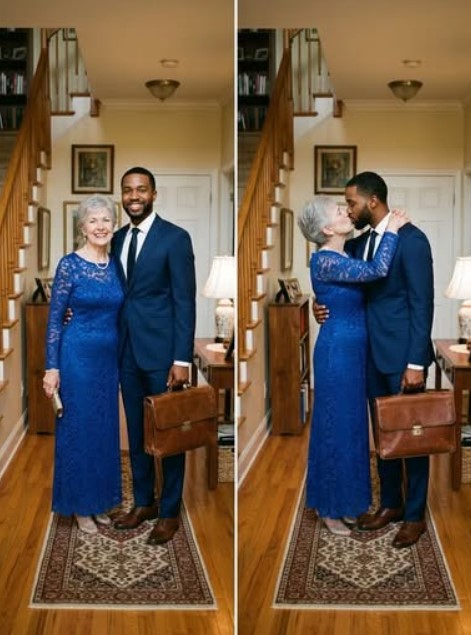
The Secret Behind Eight Thousand Nights
After my brother Tony hung up the phone, I remained seated in my kitchen, staring at nothing in particular.
His words kept replaying in my mind. He believed Richard was taking advantage of our mother. He thought a man who had declared bankruptcy, rented a small apartment, and owned almost nothing had entered her life because she had a paid-off house and savings.
For a moment, I understood why Tony was suspicious. We had spent months wondering why Richard disappeared before dessert every Sunday. We had invented explanations that seemed increasingly convincing, even though none of us had any real evidence.
But then I thought about what Chloe had witnessed that evening.
She had followed Richard because she suspected he was hiding another woman. Instead, she had discovered a truth that none of us had imagined.
Richard wasn’t driving south to meet a secret girlfriend. He was visiting his son.
And every night, at the same time, he was keeping a promise that had shaped his entire life.
I began thinking about the numbers.
My father had been gone for eleven years. For the first five of those years, Mom had almost disappeared into her grief. She rarely went anywhere unless I encouraged her. She stopped tending to her garden, stopped meeting friends, and often ate dinner alone in front of the television.
I visited her twice a week whenever I could. I brought groceries, helped with household repairs, and tried to persuade her to do things she once enjoyed.
But grief can make even familiar places feel empty. Sometimes, all I could do was sit beside her and hope that time would soften the loneliness.
Then she joined the community gardening club.
At first, she went only because one of her neighbors encouraged her. Eventually, she began talking about the people she met there. She started planting flowers again and spending more time outdoors.
And then Richard came into her life.
I remembered the day she told me about him. She had sounded almost embarrassed by her own happiness. She described a funny man who knew how to grow tomatoes, who brought her flowers, and who listened carefully whenever she spoke.
A few weeks later, she bought a red dress.
She started wearing perfume again. She smiled at messages on her phone and occasionally caught herself humming while preparing dinner.
I had been so relieved to see her happy that I never considered how easily our suspicion might hurt her.
Then I thought about Richard’s life.
Twenty-two years earlier, his nine-year-old son, Sam, had fallen from a tree house in their backyard. The accident had caused a serious brain injury. Sam survived, but he was left unable to walk and unable to communicate in full sentences.
Richard and his wife tried to rebuild their lives around their son’s needs. For four years, Richard cared for Sam at home. He lifted him, bathed him, fed him, and learned how to recognize his needs even when Sam couldn’t explain them.
Then Richard’s wife left.
She had reached a point where she couldn’t continue living that life, and the marriage eventually ended. Richard was left to navigate the financial and emotional responsibilities of caring for a child with complex needs.
When Sam’s insurance coverage ran out, the bills became overwhelming. Richard eventually lost his house and declared bankruptcy. He sold what he could and moved into a small rented apartment near Willow Creek Residential Care, where Sam had lived for the past eighteen years.
He chose the apartment because it allowed him to visit his son every evening without worrying about a long journey.
Every night, at 7:45, Richard read Sam a bedtime story.
He had done it for more than eight thousand nights.
Not only when life was easy. Not only when he felt strong. Not only when he had money in the bank.
He did it through financial hardship, loneliness, disappointment, and years in which his own needs had probably come last.
Sam knew the routine. If Richard was late, he became frightened. The familiar story, the sound of his father’s voice, and the small ritual of being tucked into bed helped him feel safe.
Richard had never missed a night.
Not for holidays. Not for birthdays. Not even for my mother’s special chocolate pie.
Suddenly, his constant glances at the clock no longer seemed suspicious. They seemed heartbreaking.
I had been so busy trying to uncover what Richard was hiding that I hadn’t considered what he might be protecting.
That Sunday, Mom decided we would have dinner together again. She set the table for six instead of five and prepared a pot roast. She even baked another chocolate pie.
I knew she wanted Richard to feel welcome, but I suspected she was also trying to show him that she understood why he had to leave.
At four o’clock, the doorbell rang.
Tony stood on the porch in a neatly pressed suit. Beside him was a woman wearing a navy blazer and carrying a professional-looking briefcase.
He introduced her as Ms. Bradley, an estate attorney.
My stomach tightened.
Tony had come prepared to discuss Mom’s will.
Part 4: My Brother’s Accusations
Richard was already seated at the dining table when Tony arrived. He stood politely and extended his hand.
Tony ignored it.
Instead, he pulled out a chair and began explaining why he believed our mother needed legal protection.
He said he loved her. He said he was worried about her future. He reminded us that she was seventy-two and had spent eleven years alone after our father’s death.
Then he turned toward Richard.
According to Tony, Richard had appeared in Mom’s life at a convenient moment. He had no house, limited savings, and a history of bankruptcy. Meanwhile, Mom owned her home outright and had accumulated money over many years.
Tony didn’t accuse Richard of stealing anything outright. Instead, he suggested that we needed to be realistic.
“People who are lonely sometimes make decisions they wouldn’t otherwise make,” he said. “I don’t want Mom to discover too late that she’s been taken advantage of.”
Richard sat quietly, his expression difficult to read.
I wanted to defend him, but part of me was afraid of making the situation worse. We had only recently learned the truth about Sam. We didn’t know Richard well enough to understand every detail of his past, and Tony’s concerns about Mom’s finances were not entirely unreasonable.
Still, there was a difference between protecting someone and treating them as if they had lost the ability to make their own decisions.
Tony finally looked directly at Mom.
“Dad worked his whole life for this house,” he said. “Would he really want a stranger to end up with it?”
The room went silent.
Mom placed her napkin beside her plate. She folded her hands and looked at my brother with a calmness that surprised me.
“Tony, I love you,” she said. “And I know you believe you’re protecting me. But I am seventy-two years old, not seven.”
Tony opened his mouth, but Mom continued.
“My home and my savings are mine. I understand what I own, and I understand what a will is. If I decide to make changes to my estate, I’ll do so because I want to, not because someone is frightened by the person I’m dating.”
Ms. Bradley remained silent.
Mom turned toward Richard.
“This man has never asked me for money. Not once. He brings me flowers, helps me with little things around the house, and makes me laugh. He has never suggested that I sell my home or change my will.”
She paused, her eyes growing moist.
“His money went toward caring for his son. I don’t see a con man when I look at Richard. I see a father who has spent years doing everything he can for his child.”
Tony looked uncomfortable.
Richard lowered his eyes. He didn’t argue, demand an apology, or offer a dramatic speech in his defense.
Instead, he quietly said, “I understand why you would worry about your mother. If I had a mother in this situation, I would want to protect her too.”
His response seemed to take some of the anger out of the room.
Then he glanced at his watch.
It was 7:20.
He reached for his leather briefcase and began gathering his things. For months, that simple movement had irritated us. We had interpreted it as another sign that he wanted to escape our family.
This time, nobody complained.
Richard stood, but before leaving, he looked around the table.
“There’s something I’d like to ask,” he said.
He hesitated, as though the words were difficult to say.
“Sam would like to meet you all. If you’re willing, I’d be grateful if you came with me tonight.”
Mom’s eyes filled with tears.
Tony looked startled. I felt a lump rise in my throat.
Richard had spent months protecting this part of his life from our questions. Now he was offering to let us into it.
“Of course we’ll come,” Mom said immediately.
Chloe nodded.
I agreed, and after a long silence, Tony did too.
For the first time since Richard had entered our lives, we weren’t going to watch him leave.
We were going to follow him.
Part 5: The Boy Beneath the Moon Lamp
We drove to Willow Creek Residential Care in two cars.
The building was modest, with a low brick exterior, a small garden, and warm light glowing through several windows. It looked peaceful, but I couldn’t stop thinking about the years Richard had spent making this journey every evening.
How many times had he driven here exhausted?
How many evenings had he arrived carrying worries he couldn’t share with anyone?
And how many times had he sat beside his son, setting aside his own sadness because Sam needed him to be present?
Richard led us down a quiet corridor to a small room.
Inside, a moon-shaped lamp glowed on the nightstand. Children’s picture books were stacked neatly beside the bed, and drawings covered the walls. A wheelchair stood near the window.
A grown man sat in it.
Sam was thirty-one years old, but there was something gentle and childlike in his expression. His dark eyes were remarkably similar to Richard’s.
When Richard appeared in the doorway, Sam’s face brightened immediately.
It was a transformation so complete that I felt tears gathering in my eyes before I even understood why.
Richard crossed the room and knelt beside his son.
“Hello, buddy,” he said softly.
Sam made a small sound of recognition and smiled.
Then he noticed the rest of us standing behind his father. His expression changed. He looked confused and a little shy.
Richard didn’t rush him.
“It’s all right, Sam,” he said. “These are friends I told you about.”
He gestured toward Mom.
“This is Margaret. She’s the lady who makes chocolate pie.”
Sam studied her for several seconds. Then he slowly reached out and patted her hand.
Mom covered his hand with hers.
“Oh, sweetheart,” she whispered.
Her tears began falling.
She had spent eleven years missing my father and wondering whether happiness would ever return to her life. Now she was sitting beside a man whose father had devoted more than two decades to caring for him.
She understood something about love in that moment that none of us had fully understood at the dinner table.
Love wasn’t always grand gestures or romantic promises. Sometimes, it was the same quiet act repeated night after night, even when nobody was watching.
At 7:45, Richard took a familiar book from the nightstand.
Goodnight Moon.
He sat beside Sam’s bed and began reading.
His voice was steady and gentle. Sam watched him closely, responding to familiar phrases with small movements and smiles.
Halfway through the story, Richard paused.
He looked toward Mom and held the book out to her.
“Would you like to read the rest?” he asked.
Mom looked surprised.
“Are you sure?”
Richard nodded.
She sat on the edge of Sam’s bed and began reading. Her voice trembled at first, but gradually she settled into the rhythm of the story.
Sam listened intently.
When she reached the final pages, Richard tucked him in and kissed his forehead.
“Goodnight, buddy,” he whispered.
Sam smiled.
At eight o’clock, Richard took a small harmonica from his pocket and played a simple melody. Sam clapped his hands, delighted by the familiar sound.
Then Chloe stepped forward.
“I know the song you like,” she said.
She took out her phone and played Sam’s favorite tune. Richard had told her about it when she found him outside the facility.
Sam’s face lit up. He laughed, and the sound filled the little room.
It was an ordinary laugh, perhaps, but to us it felt extraordinary. We had come expecting to uncover a scandal. Instead, we had been welcomed into a place where love had survived years of hardship.
Tony stood near the doorway, saying nothing.
I glanced at him and noticed that his eyes were wet.
For the first time that evening, he seemed to understand that Richard’s financial situation told only a small part of his story.
After Sam was settled, we made our way into the hallway.
Tony stopped Richard before we reached the exit.
“Richard,” he said quietly.
Richard turned.
Tony swallowed hard.
“I owe you an apology. I assumed the worst about you without knowing what you’d been through.”
Richard looked at him for a moment.
Then he shook his head.
“You were trying to look after your mother,” he replied. “I understand that. If I were in your position, I’d want to make sure she was safe too.”
Tony extended his hand.
This time, Richard took it.
They shook hands for several seconds, and something between them finally began to soften.
It wasn’t that all their doubts disappeared in one night. Trust doesn’t work that way. But Tony had seen the truth with his own eyes, and he no longer had to imagine a secret hidden behind Richard’s briefcase.
He had met Sam.
And he had seen the father who visited him every night.
Part 6: A Family That Grew Around a Promise
Things changed after that Sunday.
Mom moved our family dinner to five o’clock so Richard could enjoy the meal without watching the clock every few minutes. We made sure everyone was ready to leave by 7:15.
Then, whenever possible, we drove to Willow Creek together.
The visits became part of our family routine.
Sometimes Mom brought a homemade dessert. Sometimes I brought flowers for Sam’s room. Chloe began making playlists of songs she thought he might enjoy.
Tony, who had initially treated Richard with such suspicion, surprised us all by discovering that he was remarkably good at reading children’s books aloud. He gave the characters different voices and dramatic expressions, and Sam seemed to enjoy every minute of it.
We began taking turns reading the bedtime story.
Mom read on Sundays when she could. Chloe chose stories and songs. I sometimes sat beside Sam and talked about our week, even when he couldn’t answer in the way most people would expect.
Tony eventually joined us regularly, too.
He never became careless about Mom’s finances, and neither did I. We still believed she deserved clear information and independent control over her affairs. But we stopped treating Richard’s poverty as proof of dishonesty.
We learned to ask questions without assuming the answers.
More importantly, we learned that protecting someone doesn’t mean deciding their life for them.
Mom continued seeing Richard. Their relationship grew slowly, without pressure or grand promises. They enjoyed gardening together, sharing simple meals, and talking about the lives they had lived before meeting one another.
Richard never asked Mom to rescue him from his financial difficulties. He never asked her to change her will or provide money for Sam’s care.
He simply allowed her to know him.
And Mom, in turn, allowed herself to love again.
One day, I noticed a new drawing taped above Sam’s bed.
It showed seven stick figures holding hands in a long, uneven row. Some figures were taller than others. One had what looked like a bright red dress. Another had a dark scribble for hair.
Beneath the drawing, in shaky letters, were two words:
My family.
I stood looking at it for a long time.
Sam might never be able to express everything he felt, but he had found a way to tell us that we belonged there.
We had entered his room as strangers, uncertain of what to say or how to behave. Now it felt like a place where all of us could put down our worries for a little while and simply be together.
The greatest change was in Mom.
For years, she had believed that the happiest part of her life was behind her. She had loved my father deeply, and nothing would ever erase that love. But she was beginning to understand that loving someone new didn’t mean betraying the person she had lost.
She could remember Dad and still laugh with Richard.
She could miss the past and still look forward to Sunday evenings.
She could be seventy-two and still experience the excitement of a new relationship.
And Richard, who had spent so many years believing that revealing his circumstances would make a woman leave, began to discover that the truth could also bring people closer.
Conclusion: The Night He Finally Stayed for Dessert
Last month, we celebrated Richard’s birthday.
Mom baked a chocolate pie, the same dessert he had been forced to leave behind on her birthday because he needed to visit Sam.
But this time, she didn’t place the pie on our dining table.
She carried it to Willow Creek.
We gathered in Sam’s room at 7:30, just before Richard’s usual bedtime routine. The moon-shaped lamp glowed beside the bed, and the walls were covered with drawings, photographs, and little reminders of the people who had become part of Sam’s life.
We sang happy birthday.
Sam clapped louder than anyone.
Richard laughed, looking around the room at the people who had once suspected him of leading a double life. His eyes shone with emotion as Mom placed a slice of chocolate pie in front of him.
For the first time in the eight months they had been together, he stayed for dessert.
He looked at Mom across the little room, with Sam smiling nearby and the rest of us gathered around them.
“I never thought I’d have this,” he said quietly.
Mom reached for his hand.
“Neither did I,” she answered.
And I understood what he meant.
Richard hadn’t simply found a woman who accepted him. He had found people willing to see beyond his circumstances, to recognize the devotion behind his routines, and to welcome his son into their lives without treating him as a burden.
We had assumed that a man who disappeared at 7:26 every Sunday must be hiding something shameful.
We had been wrong.
He was keeping a promise.
For twenty-two years, Richard had carried the weight of an accident that changed his son’s life. For more than eight thousand nights, he had returned to Sam with a familiar story, a gentle voice, and the reassurance that his father was still there.
He hadn’t missed those evenings because he didn’t care about Mom.
He left because someone who depended on him was waiting.
And once we understood that, we stopped asking him to choose between his son and the possibility of love.
We made room for both.
Sometimes, I still think about Chloe coming through our front door that night, crying and clutching Richard’s briefcase. She had followed him expecting to expose a betrayal. Instead, she discovered the truth about a man whose greatest secret was also his greatest act of devotion.
Her discovery changed our family.
It taught us that appearances can conceal sacrifices we know nothing about, that financial hardship does not define a person’s character, and that loneliness can make us fearful of things we have not yet understood.
Most of all, it reminded us that love is not always measured by how long someone stays at a dinner table.
Sometimes, love is measured by the promise someone keeps when everyone else has gone home.
And sometimes, the family we think we already have is only the beginning of the family we are meant to find.