Old houses have a special way of preserving little pieces of the past. While cleaning out a drawer, opening an old toolbox, or sorting through a box of belongings left behind by grandparents, it is not unusual to discover an object that seems to have no obvious purpose. Some of these items look familiar at first glance, yet their unusual shapes leave us wondering what they were actually designed to do.
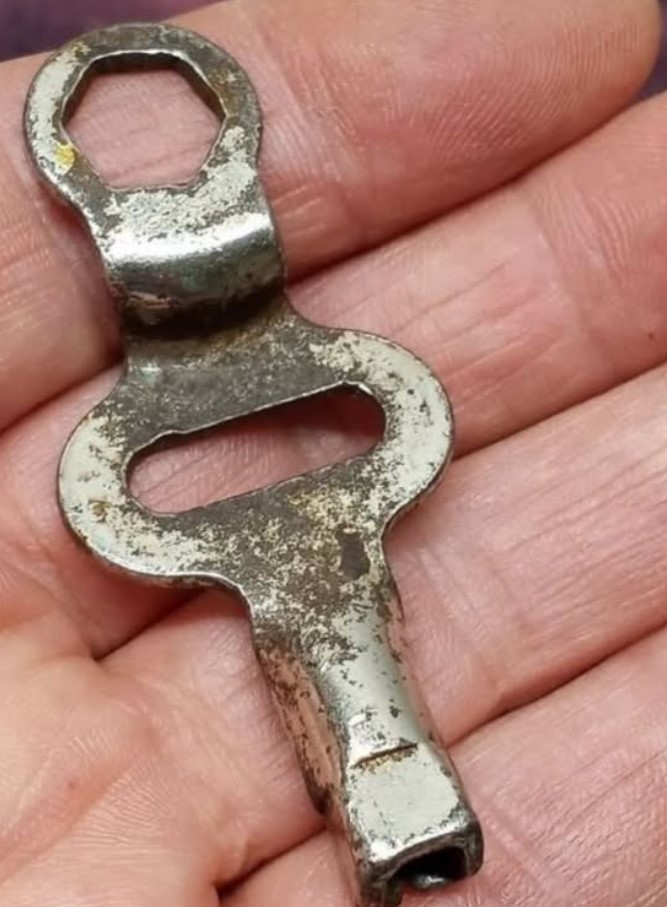
That is exactly what happened when my husband discovered a small, weathered metal object in his grandparents’ house. At first, it looked like an old-fashioned key. However, when he examined it more closely, he noticed that it had several unusual openings instead of the familiar teeth or ridges found on ordinary keys.
He tried to imagine which door it might open, but nothing in the house seemed to match its shape. The object appeared to have been made from metal, with a worn, silvery surface, dark patches, and signs of age. Its distinctive design made it look more like a specialized tool than something intended to unlock a traditional door.
So, what exactly could it be?
The photograph provides a few useful clues. Although its precise identity cannot be confirmed from the image alone, the object’s unusual openings and shaped metal end suggest that it may be an old mechanical tool or a specialized key designed for a particular piece of equipment.
What Does the Mysterious Metal Object Look Like?
Before trying to identify an unfamiliar antique, it helps to examine its physical features carefully. Small details that might initially seem decorative can actually reveal how an object was intended to be used.
In the photograph, the item has a flat metal body with several distinctive features.
A hexagonal opening at one end: The upper part contains a roughly six-sided opening. This shape is commonly associated with tools designed to fit over a nut, bolt, or similarly shaped fitting. Unlike a conventional door key, this opening appears intended to fit around a component rather than operate a lock directly.
An elongated opening in the middle: The central section has a long, narrow slot. Openings like this can serve different purposes depending on the tool’s design. They may accommodate a tab, provide clearance for a fitting, or help reduce the amount of material used in a tool.
A shaped end at the bottom: The lower end appears to have a small, hollow or square-shaped opening. This is another important clue because square and rectangular sockets are frequently found on tools used to turn mechanical components.
A worn, silvery surface: The metal has a mottled appearance, with darker areas and patches where the surface finish seems to have worn away. This may reflect years of handling, storage, corrosion, or exposure to moisture. However, appearance alone cannot establish the object’s age or the type of metal from which it was made.
Taken together, these features suggest that the object deserves to be investigated as a possible mechanical tool rather than assumed to be an ordinary house key.
Could It Be an Old Specialized Key?
One possibility is that the object is a specialized key made for equipment that no longer exists in the house.
Not every key was designed to unlock a door. Over the years, people have used keys to operate clocks, machinery, cabinets, heating equipment, utility fittings, and various household devices. Some were made for one particular model or mechanism, which explains why they can be difficult to identify today.
For example, a winding key for a mechanical clock fits onto a specific winding arbor. Its opening must match the mechanism’s dimensions. If the clock has disappeared or the key belongs to another model, the key may seem completely useless.
Other specialized keys were made for equipment that required a particular shape or size. They might have been stored in a workshop, utility cupboard, or toolbox rather than with the family’s ordinary keys.
The object in the photograph, however, does not look like a typical long-stemmed clock-winding key. Its combination of a hexagonal opening, an elongated slot, and a shaped lower end makes a more general mechanical-tool identification worth considering.
Without measurements, markings, or a view of the reverse side, it would be premature to identify it as a particular type of key.
Could It Be a Small Multi-Purpose Tool?
Another possibility is that the object was designed to perform more than one task.
Older tools were often made to solve practical problems with simple, durable pieces of metal. Before compact tool kits and specialized equipment became commonplace, a single item might have included several differently shaped working ends.
The hexagonal opening could potentially fit a nut or fitting of a particular size. The lower opening might engage a different component, while the central slot could serve a separate purpose or provide clearance for a part of the mechanism.
This does not mean the object definitely is a multi-purpose tool. Its openings must be compared with the fittings it was designed to operate before that conclusion can be reached.
Still, the possibility explains why it may resemble a key without functioning like one. A tool can have a key-like outline while being intended to turn, adjust, or release a mechanical component.
The object’s original purpose may also have become less obvious because the equipment it belonged to was discarded years ago.
Could It Be an Old Can-Opening Key?
Some older household tools used a small metal key to open cans with a rolled metal strip. The user would insert the strip into a slot and rotate the key, winding the strip around the tool as it separated from the can.
These tools were once familiar in kitchens, particularly before easy-open packaging became widespread. Their simple construction allowed them to be reused many times.
At first glance, a small metal object with openings and a key-like shape might bring this possibility to mind. However, a traditional can-opening key generally has a slot or winding feature specifically suited to gripping and rolling a thin strip of metal.
The object shown here has a distinctive hexagonal opening and a shaped end that make its identification as a can-opening key uncertain. The central slot alone is not enough to establish that purpose.
If the family remembers using old tins that required a separate winding key, this possibility could be investigated. Otherwise, it should remain only one of several possibilities rather than the assumed answer.
Why Doesn’t It Open Any Door?
The simplest explanation may be that the object was never intended to open a door.
When we find an unfamiliar metal object, we often compare it with things we already know. If it resembles a key, we naturally search for a lock that might accept it. But the resemblance can be misleading.
A tool designed to operate a valve, adjust a fitting, or turn a mechanical part may have openings that look unusual precisely because it performs a different job.
There are several reasons the object might not match anything in the house today:
- The original equipment is gone. A previous owner may have thrown away an old appliance, clock, machine, or other item while keeping its tool.
- The object belonged to a workshop. It may have been used outside the home, perhaps for repairs, maintenance, or work on equipment.
- It was made for a specific fitting. The opening may match a component of a particular size or design that is no longer present.
- It came from another location. Grandparents often collected tools over many years, inherited belongings, or brought items home from work.
- Its purpose has been forgotten. If the person who originally used it is no longer around to explain it, the object’s history may be lost.
An object does not need to unlock anything to have a useful history. Sometimes, its purpose only becomes clear after someone recognizes the equipment it was designed to fit.
What Can Its Age Tell Us?
The worn finish gives the object an old appearance, but determining its actual age requires more evidence.
Metal objects can develop dark patches, discoloration, and surface corrosion after years in a damp drawer, garage, basement, or shed. A relatively ordinary tool can look much older than it is if it has been stored in poor conditions.
Likewise, an item made decades ago may remain in surprisingly good condition if it was kept dry and handled carefully.
To estimate its age, it would help to examine several details.
The manufacturing method: Look at whether the object appears stamped from a flat sheet of metal, cast into a shape, or formed through another manufacturing process. These details can help narrow down its likely production period, although none is conclusive on its own.
The maker’s mark: Some manufacturers stamped their names, initials, model numbers, or patent information onto tools. Even a faint marking can provide a valuable starting point for research.
The dimensions: The length, width, thickness, and measurements of each opening can help distinguish one tool from another.
The material: The metal’s composition and surface finish may offer further clues. A specialist can sometimes identify these characteristics more reliably than a photograph can.
The family history: Knowing where the grandparents lived, what kind of work they did, and which equipment they owned may be just as helpful as examining the metal itself.
The safest conclusion is that the object appears worn and may be old, but its exact age cannot be established from its appearance alone.
How to Identify the Object More Accurately
If the goal is to discover what the object actually does, a few careful steps can make the investigation much more productive.
1. Photograph Both Sides
The current photograph shows the front of the object clearly, but the reverse side may contain important details. A second photograph could reveal a maker’s name, stamped number, groove, notch, or other feature that helps identify its function.
Take pictures of both sides and the ends, using natural light. A close-up of each opening can also make its shape easier to compare with reference images.
2. Measure Every Opening
Use a ruler or caliper to record the overall length, width, and thickness. Measure the hexagonal opening across its flat sides and note the dimensions of the lower opening.
These measurements may help match the object to a particular fitting or a known tool design.
3. Examine the Grandparents’ Other Belongings
Look for old clocks, machinery, gardening equipment, workshop tools, heating appliances, or other objects that may have been kept in the same area.
If the item was stored beside a particular machine or collection of tools, that location could provide a useful clue. Even a broken or incomplete piece of equipment might reveal what the mysterious object was designed to operate.
4. Search for Similar Examples
Once the measurements and markings are known, compare the object with photographs in antique tool references, museum collections, and specialist collector communities.
Searching for a combination of its unusual openings and overall shape may be more effective than searching for an “old key” alone.
For example, an antique-tool reference collection such as Alloy Artifacts can be useful when investigating older hand tools and their manufacturers.
5. Ask an Experienced Tool Collector
If the object remains unidentified, an antique-tool collector, locksmith familiar with older mechanisms, or specialist in vintage hardware may be able to recognize it.
Providing clear photographs, dimensions, and information about where it was found will make identification much easier.
Until the object’s purpose is established, avoid forcing it into a lock or fitting. Doing so could damage either the object or the mechanism.
Should You Clean or Restore It?
It can be tempting to polish an old metal object until it looks new. However, cleaning it too aggressively may remove useful evidence.
The surface finish, small scratches, manufacturing marks, and remaining patina may help a specialist understand how the item was made and used.
Start by examining it without altering the surface. If there is loose dust, gentle handling and a soft, dry brush may be enough to make its features easier to see.
Avoid wire brushes, sanding, strong chemicals, or abrasive polishing until you know what the object is and whether it has any collectible value.
If the item turns out to be a common tool, careful cleaning may eventually be appropriate. If it is a rare or historically significant piece, preserving its existing condition may be preferable.
The priority should be identification first and restoration second.
Why Small Antique Objects Are Worth Investigating
Even when an old tool has little monetary value, discovering its purpose can reveal something about the people who owned it.
Grandparents’ houses often contain objects that once played a practical role in everyday life. A small key might have belonged to a clock that stood in the living room for decades. A specialized wrench might have been used to repair equipment at work. A simple metal implement might have helped maintain a household appliance that no longer exists.
These items can connect us to routines and experiences that would otherwise be forgotten.
Identifying them can also help families preserve their history. A photograph accompanied by the object’s name, approximate age, and known background is far more informative than an unidentified item placed back into a drawer.
If your husband discovers more tools or related equipment in the same box, keeping the pieces together may help establish their original purpose.
Sometimes, the most important discovery is not the object itself but the story behind it.
Conclusion :
The mysterious metal object found in the grandparents’ house certainly has an unusual design. Its hexagonal opening, elongated central slot, shaped lower end, and worn silver-colored surface suggest that it may be a specialized key or a small mechanical tool rather than an ordinary door key.
Several explanations are possible, including a tool made for a particular fitting, a component associated with old equipment, or a specialized household implement. However, the photograph does not provide enough evidence to identify one specific use with confidence.
The most useful next steps are to photograph the reverse side, measure the openings, check for maker’s marks, and examine the other objects stored nearby. Those details may reveal whether it belonged to a clock, an appliance, a workshop tool kit, or a completely different type of equipment.
For now, the object remains a small mystery from the past—and that is part of what makes it interesting. Rather than forcing it into the category of an ordinary key, looking carefully at its construction may lead to a much more accurate answer.
Sometimes, an object that appears useless is simply waiting for someone to rediscover the tool, machine, or everyday task for which it was originally made.