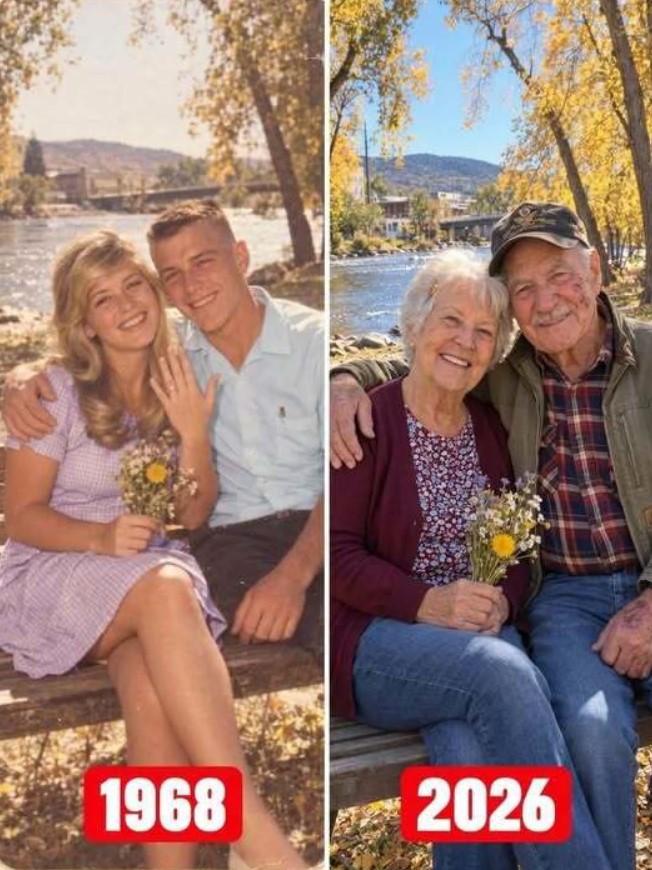
I was eighteen when Danny Wirth asked me to dance in a yellow dress. That was the beginning of a love story I believed would last forever. Nine days after he slipped a ring onto my finger, he left for the Army. A few months later, his mother sent me a letter saying he had died.
For fifty-eight years, I believed her.
I married another man, raised a family, and built a life filled with ordinary happiness. I kept Danny’s letters hidden in a candy box, never imagining that one day someone would knock on my door with wildflowers and a message written in the same crooked handwriting I had spent a lifetime remembering.
I was seventy-seven years old when the past finally found me.
The Boy Who Called Me Dandylion
Everyone in Reno knew me as Sukey. My real name was Susan, but people had called me Sukey since I was little.
Danny was different. He called me Dandylion.
It began the night he asked me to dance. I was wearing a yellow dress, and he said I reminded him of a dandelion growing in a field. When he wrote the nickname, he always spelled it incorrectly, adding an extra letter where it didn’t belong.
I never corrected him. I loved that little mistake because it belonged to us.
In October 1968, Danny proposed to me on a bench beside the river downtown. The ring he gave me had a tiny diamond and a cheap band that eventually turned my finger green. It wasn’t expensive, but I treasured it as if it were the most beautiful ring in the world.
Nine days later, he left for the Army.
Before he shipped out, he promised to write. He kept that promise, sending me thirty-one letters. I read them over and over, learning the shape of his handwriting and the way his capital D leaned forward as though it were tired.
I saved every letter in a Whitman’s candy box. Over the years, the box moved from beneath my bed to my closet and finally into my cedar chest, where it remained long after I believed Danny was gone.
In the spring of 1969, the letters stopped.
At first, I thought he was busy or unable to write. Then June arrived, and a letter came from his mother instead.
She explained that she had traveled to Texas to be near Danny. He had been badly burned overseas and taken to a hospital in San Antonio.
According to her letter, he had not survived.
She told me that he had been buried in her family’s cemetery in Ohio. She also instructed me not to come.
“There’s nothing left to see,” she wrote. “Remember him how he was.”
I was nineteen years old. I didn’t have enough money to travel to Ohio, and I was too devastated to ask the questions I should have asked.
I lay in my mother’s house for a week, barely able to get out of bed.
The boy who had promised to write to me every week was gone, and I had no way to say goodbye.
The Life I Built After Losing Him
Two years later, I married Ted Haldane.
Ted was a good man, and I want to make that clear. He sold insurance, and eventually I joined him in the business. We worked together for thirty years, raised two children, and welcomed four grandchildren.
We bought a house near the freeway. We had familiar routines, family dinners, bills to pay, and a lemon tree in the yard that stubbornly refused to produce a single lemon.
It wasn’t a glamorous life, but it was a good one.
Still, a small part of me carried guilt. I sometimes felt guilty for marrying so soon after Danny’s supposed death. I felt guilty when I laughed, when I enjoyed my family, and when I realized that happiness had returned to my life.
The box of letters remained in my cedar chest throughout my marriage.
Ted knew about Danny. In time, he learned about the letters and the ring, and he never demanded that I throw them away. He understood that the grief I carried from my youth did not diminish the love I had for him.
I came to understand that a heart could hold more than one kind of love. Danny belonged to my youth, while Ted was the man who shared the life I actually lived.
When Ted died three years ago, I thought the most important chapters of my life were already behind me.
I was seventy-seven. I had my pension, my memories, and a casserole in the freezer for emergencies. I kept a pencil behind my ear out of habit after decades of filling out insurance policies.
My life had become quiet.
Then, last Saturday, someone rang my doorbell.
The Wildflowers on My Doorstep
A teenage boy stood outside holding a mason jar filled with wildflowers.
There were black-eyed Susans, tiny blue flowers, and a single dandelion in the middle.
“Ma’am, these are for Susan.”
A small white card was tied to the ribbon.
The moment I saw the handwriting, my heart seemed to stop.
That capital D.
That crooked, familiar shape.
And beneath it, the nickname I had not heard in fifty-eight years.
Dandylion.
I had to sit down on the front step.
My first thought was that someone was playing a cruel joke on an old woman. My second was that nobody alive knew that name except Danny and me.
I called the florist, dialing the wrong number twice because my hands were shaking.
The woman who answered was kind. She remembered an older gentleman who had come into the shop on Thursday, paid cash, and struggled to hold his pen.
“He left the name D. Wirth,” she explained. “There was a phone number, too.”
The area code was from California.
I called the number.
A woman answered, but when I introduced myself as Susan Haldane and explained that I was looking for someone, she hung up.
I sat there staring at the phone.
My grandson found the address in just a couple of minutes. The house was in Susanville, California, about two hours away.
That evening, I told my daughter what had happened.
She looked at me as though I had lost my mind.
“Mom, you’re seventy-seven. You’re going to drive two hours to chase a ghost?”
“He isn’t a ghost if he can buy flowers,” I replied.
She worried that someone was trying to scam me. She begged me not to embarrass myself by believing a stranger’s story.
But I couldn’t sleep.
I took the Whitman’s candy box from my cedar chest and spread Danny’s letters across the kitchen table. I read them late into the night, remembering the boy who had once promised me a future.
The following morning, I got into my car.
On the way out of town, I stopped at a Raley’s for gas. I sat in the parking lot for a long time, wondering whether my daughter was right. Perhaps I was a lonely old woman chasing a memory that should have remained in the past.
Then I put the car in drive.
I had already spent fifty-eight years wondering what had happened to Danny. I wasn’t going to spend another day refusing to find out.
The Daughter Who Tried to Close the Door
The address led me to a small green house on a quiet street. A wooden ramp led to the porch, and a pair of old men’s work boots sat neatly beside the door.
I knocked.
A woman about fifty years old answered. She had gray at her temples and was still wearing the scrubs from her night shift.
She looked at me, and something in her expression told me that she knew exactly who I was.
“You’re her,” she said. “The Dandelion. I’m his daughter.”
For a moment, I couldn’t make myself speak.
“Is he here?” I finally asked. “Is Danny here?”
Her eyes filled with tears. She gripped the door with both hands.
“He wanted you to have the flowers. He never meant for you to come.”
Then she said the words I had dreaded hearing.
“He doesn’t want you to see him like this. Please go.”
She began to close the door.
But from inside the house, a man’s voice called out.
“Selena. Wait.”
I would have recognized that voice anywhere. It was older now, roughened by time, but it was unmistakably his.
Selena stopped.
The door slowly swung open.
The Man Who Came Back
The man sitting in the wheelchair beside the window had Danny’s eyes.
Everything else had changed.
His hair was thin and white. His face was narrow, and a pale scar ran from beneath his left ear down his neck. His right hand rested on a blanket, his fingers curled inward by the lasting effects of his injuries.
But his eyes were the same blue I remembered from the riverbank in October.
He looked at me, and I looked at him.
Fifty-eight years stood between us.
Then he smiled.
“Hello, Dandylion.”
My knees nearly gave way. Selena caught my elbow and helped me into a chair.
“Danny?” I whispered.
He nodded.
I began to cry. It wasn’t the quiet kind of crying people do when they are trying to remain composed. It was the kind of crying that comes after holding pain inside for so long that the body no longer knows how to contain it.
Danny cried, too.
For a long time, neither of us could speak.
Then I asked the question that had lived inside me for nearly six decades.
“Why?”
Danny explained that he had not died in Vietnam. In March 1969, his convoy had been attacked, leaving him severely burned. He was transferred between hospitals and eventually taken to San Antonio.
His injuries were so serious that, for months, he struggled to remember even basic details about himself. His recovery was long and painful. He had to relearn how to walk and adjust to a body that no longer looked or worked as it once had.
But even when his memory was badly affected, he remembered me.
He remembered my name.
And he remembered Dandylion.
His mother had visited him in the hospital. When he began recovering, she told him that I would be better off believing he was dead. She thought I deserved a husband who could give me children, a home, and an ordinary life.
Danny admitted that he had agreed with her.
He was young, frightened, and ashamed of his injuries. He couldn’t bear the thought of me seeing him in a hospital bed, unable to walk properly and struggling with the nightmares left by the war.
“You don’t get to decide what I can bear,” I told him.
He lowered his eyes.
I asked whether he had stopped loving me.
“No. Never.”
Then he told me something that hurt almost as much as the lie about his death.
After leaving the hospital, he had written me a letter. He explained that he was alive and hoped to come home when he was well enough. He wanted me to know the truth, even if I no longer wanted to marry him.
But his mother found the letter before he could mail it.
She burned it.
Then she told him that she had sent it and that it must have been lost.
Danny waited for an answer that never came. Eventually, he convinced himself that I had moved on and no longer wanted him.
I had spent fifty-eight years believing he was dead.
He had spent those same years believing I had forgotten him.
Neither of us had known that one woman’s decision had separated us so completely.
The Years We Could Never Get Back
Danny eventually recovered enough to work in a small factory in Ohio. He met a woman named Elaine at a church supper, and before marrying her, he told her about me.
Elaine understood that the past was part of his life, but she did not demand that he erase it. She became his wife and companion for forty-one years, helping him through his injuries, nightmares, and medical difficulties.
They had a daughter, Selena.
Elaine died of cancer six years before I found Danny again. After her death, he moved to California, hoping the milder climate would help with his arthritis. His health continued to decline, and Selena cared for him.
When I asked whether he had ever tried to find me, he admitted that he had made a few attempts. He wrote to my old address and called directory assistance, but he did not know my married name.
He could have tried harder.
He knew that.
“I was a coward, Susan,” he told me. “Not about the war. About you.”
I listened as he told me about the life I had missed: the years in the factory, his marriage to Elaine, the birth of Selena, and the ordinary days that had gradually become a lifetime.
Two weeks before sending the flowers, he had been hospitalized with pneumonia. His doctor warned Selena that his heart was weakening and that he might not survive another winter.
That was why he had sent the wildflowers.
He wanted me to know he was alive before he died for real.
He hadn’t expected me to come.
I reached for his hand. It was thin, wrinkled, and crooked with age, but it was warm.
“Danny, I wasn’t coming to see a handsome young soldier,” I told him. “I was coming to see you.”
For a while, we sat together without trying to repair the years.
Before I left, he asked whether I would visit again.
I smiled through my tears.
“Do you think you can put up with me?”
He gave me the crooked smile I remembered.
“I’ve been waiting fifty-eight years to find out.”
I drove home that evening with shaking hands. When my daughter called, I finally answered.
“Was it really him?” she asked.
I looked at the wildflowers Selena had insisted I take home.
“Yes,” I said. “It was really him.”
That night, I opened the candy box again. But for the first time in fifty-eight years, I wasn’t opening it to mourn a dead man.
I was opening it to prepare for another visit.
The Ring, the Letters, and the Life We Had Lived
The following Sunday, I returned to Danny’s house with a lemon cake. My lemon tree had finally produced fruit after years of stubbornly refusing to do so, and bringing a cake seemed like the proper way to celebrate an unexpected reunion.
Danny was waiting beside the window.
“You came,” he said.
“I told you I would.”
He looked like a schoolboy who had been promised a trip to the fair.
I began visiting every Sunday. Sometimes I brought food, sometimes a newspaper or a book, and sometimes I brought nothing except myself.
One afternoon, I brought the old ring.
The diamond had become dull, and the band was scratched. A green stain remained on the inside, a reminder of the cheap piece of jewelry that had once meant everything to an eighteen-year-old girl.
Danny stared at it in my palm.
“You kept it.”
“Of course I kept it.”
I told him that I had once considered throwing it away on the day I married Ted. But I hadn’t done it.
Danny wanted to know whether Ted had known about him.
I told him the truth. Ted had found the letters by accident while searching for our car insurance papers. When I explained who Danny was, Ted had listened without anger.
He understood that grief was not a rival.
He had told me that a person could love someone who was gone and still love the person sitting beside them at breakfast.
I looked at Danny and made sure he understood something important.
“I loved Ted. He gave me a beautiful life.”
Danny nodded.
“I hoped you had that.”
I was relieved that he never asked me to diminish my marriage to make room for our memories. He had loved Elaine, just as I had loved Ted. We were not two people who had spent fifty-eight years waiting for our lives to begin again. We were two people who had lived full lives separately and had been given the unexpected chance to tell each other the truth.
We couldn’t undo the past.
But we could stop hiding from it.
The Secret Behind the Empty Grave
In November, Danny told me something else he had kept to himself.
After leaving the hospital, his mother had taken him to a cemetery in Ohio. She had purchased a grave marker bearing his name and told the family he had died overseas.
There had been no body in the grave.
It was empty.
His mother had allowed everyone to mourn a son who was still alive. Danny had gone along with the lie because he was ashamed of his injuries and afraid of what I would think if I saw him.
I felt sorry for his mother for a moment. Perhaps she had been frightened, too. Perhaps she thought she was protecting both of us from a future she couldn’t imagine.
But I remembered the nineteen-year-old girl who had read her letter and believed the boy she loved was gone forever.
“She wasn’t the one who had to live with it,” I said quietly.
Danny bowed his head.
He wanted to go back to Ohio before he died. He wanted to tell his family what had happened, put the truth on the record, and visit the empty grave.
It was a difficult journey for a man whose health was failing, but I told him I would go with him if Selena and his doctor agreed it was safe.
“You’re not doing this alone,” I said.
Selena was worried about the trip. Her father had only recently been in the hospital, and she knew how difficult long journeys could be for him. But after speaking with his doctor, she began planning accessible accommodation, regular stops, and everything he would need.
Then she revealed that she had known about me for years.
After Elaine died, Selena had found Danny’s old letters and a photograph of a girl wearing a yellow dress. She had wondered about the woman her father had loved as a young man.
When Danny became seriously ill, Selena decided she could no longer stand by and allow him to die without knowing what had happened to me.
She found my name and called my number. She was the woman who had hung up when I introduced myself.
“I was scared,” she admitted. “I thought you might tell me to leave him alone.”
I reached for her hand.
“I was seventy-seven years old and had been waiting fifty-eight years to open that door.”
She laughed through her tears.
And in that moment, I understood that I had not simply found the boy I had lost. I had also found the family who had loved him after me.
They made room for me, too.
Returning to Ohio
In early December, we traveled to Ohio.
Danny’s doctor had approved the trip with precautions. Selena drove, and I sat in the back beside Danny so I could help when he needed something. We stopped frequently and stayed overnight along the way.
I brought the Whitman’s candy box with me. I wasn’t sure why, but I wanted those thirty-one letters to be part of the journey that had begun with them.
The trip was difficult. Danny struggled with pain and exhaustion, and there were moments when I wondered whether we had asked too much of him.
But he was determined.
He wanted to face the place where his family had buried his name beneath a stone, even though his body had never been there. He wanted to end the lie that had shaped so much of his life.
And I wanted him to have that chance.
We had spent decades allowing fear and silence to make decisions for us. I wasn’t going to let either one decide how our story ended.
Conclusion: Some Goodbyes Come Too Soon
Susan and Danny could never recover the fifty-eight years they had lost. They could not return to the riverbank where he had given her the ring, erase the lies that separated them, or become the young couple they once imagined they would be.
But they could share what remained.
Their reunion was not about pretending that their lives had stood still. Susan had loved Ted and raised a family. Danny had loved Elaine and raised Selena. Both had experienced happiness, grief, and the ordinary moments that turn years into a lifetime.
Their past love did not make those later relationships less meaningful.
Instead, their reunion gave them a chance to acknowledge the truth, forgive what they could, and stop allowing an old lie to define them.
Sometimes, life offers us a second chance not to repeat the past, but to understand it differently. Sometimes, the people we lose remain part of our stories even when we build new lives.
And sometimes, all it takes to open a door that has been closed for decades is a jar of wildflowers, a familiar crooked letter, and a name that only one person in the world ever spelled wrong.
After fifty-eight years, Danny finally came home—not to the life he and Susan had once planned, but to the truth they had both deserved all along.