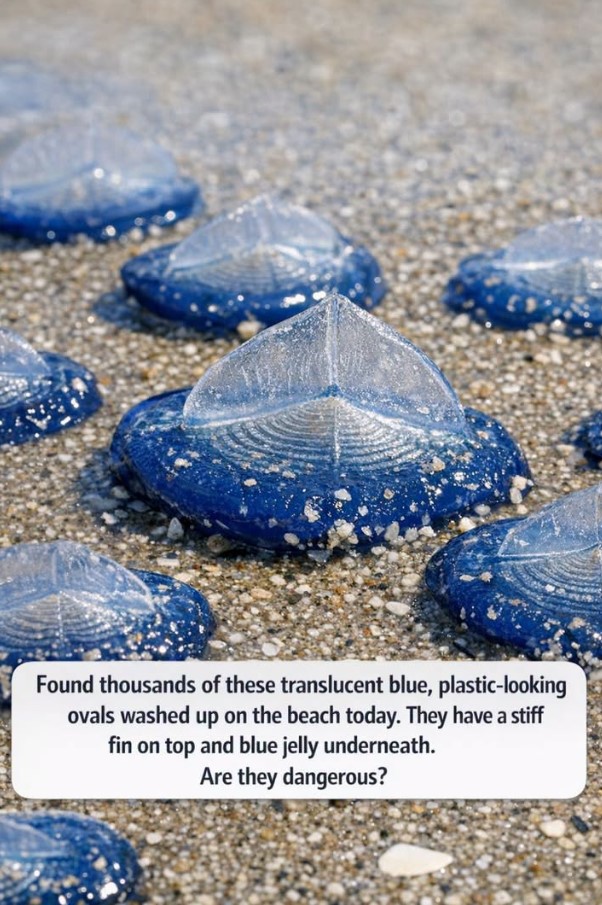
Imagine walking along the beach and suddenly noticing thousands of small, bright blue objects scattered across the sand. At first glance, they might look like pieces of plastic, unusual shells, or even something left behind by human activity. But when you look more closely, you discover that each one has a translucent, oval-shaped body, a stiff little fin on top, and a soft, jelly-like underside.
These mysterious ocean visitors are not plastic waste. They are living marine organisms known as Velella velella, commonly called by-the-wind sailors. Their unusual appearance often surprises beachgoers, especially when thousands wash ashore at the same time.
Although they are related to jellyfish, these creatures have a distinctive structure and a fascinating way of traveling across the ocean. But are they dangerous to people, children, or pets? And why do so many appear on beaches all at once?
Understanding what these blue creatures are can help you appreciate this natural phenomenon while knowing how to behave safely around unfamiliar marine life.
1. What You Found: Meet the By-The-Wind Sailor
The small blue organisms covering the sand are most likely Velella velella, a marine animal commonly known as the by-the-wind sailor. These creatures belong to a group of animals called hydrozoans, which are related to jellyfish, sea anemones, and corals.
Most are only a few centimeters long, although their size can vary. Their most recognizable feature is a flat, oval-shaped body with a raised, translucent triangular sail attached to the upper surface. The body is usually bright blue or blue-purple, making it easy to spot against pale sand.
Unlike many familiar marine animals, by-the-wind sailors do not swim actively from place to place. Instead, they float near the ocean’s surface and use their small sails to catch the wind. Ocean currents also influence their movement, carrying them across large areas of water.
Each visible animal is actually a colony made up of specialized polyps that work together. The soft, gelatinous underside contains structures involved in feeding and reproduction, while the sail helps the colony move with the wind.
When thousands are carried toward the shoreline, they can create an extraordinary sight. What looks like a beach covered in blue plastic may actually be a natural gathering of marine life.
2. How to Tell Velella Velella From Other Jellyfish
At first, it is easy to mistake these creatures for ordinary jellyfish. However, their shape is quite different.
A typical jellyfish has a rounded, umbrella-shaped bell and may have long tentacles hanging beneath it. A by-the-wind sailor has a flatter, oval body with a stiff, raised sail that crosses the top at an angle.
Its bright blue color is another useful clue. Freshly stranded specimens may appear vivid blue, turquoise, or purple, while older ones can become pale as they dry out in the sun.
The sail is especially important because it acts like a tiny boat sail. It catches the wind and allows the organism to drift across the water’s surface. Depending on the direction and strength of the wind, large numbers may be pushed toward land together.
These animals are also sometimes confused with the Portuguese man o’ war, another blue marine organism. However, the two should not be treated as equally harmless. The Portuguese man o’ war has long, trailing tentacles capable of delivering painful stings, while by-the-wind sailors are generally considered much less hazardous to people.
Because unfamiliar marine animals can be difficult to identify with certainty, it is best not to touch them simply because they resemble a known, relatively harmless species.
3. Are They Dangerous to Touch?
The good news is that by-the-wind sailors are generally considered harmless to humans. They possess microscopic stinging structures called nematocysts, which they use to capture small prey. These structures are usually not powerful enough to cause the kind of serious sting associated with more dangerous jellyfish relatives.
Nevertheless, that does not mean you should handle them freely. Individual reactions can vary, and contact with unfamiliar marine organisms may cause mild skin irritation in some people.
The safest approach is to observe them without touching them. Their unusual shape and vivid coloring make them interesting subjects for photographs, so there is little reason to pick them up.
If you accidentally touch one, avoid rubbing your eyes or touching your mouth afterward. Wash your hands thoroughly with soap and fresh water. If your skin becomes irritated, rinse the affected area and monitor how it feels.
Seek medical advice if you develop persistent or worsening pain, significant swelling, a spreading rash, or other unusual symptoms. Difficulty breathing, faintness, or swelling of the face or throat requires emergency medical attention.
The main point is simple: these creatures are not usually a major threat to people, but treating unfamiliar sea life with care is always sensible.
4. Risks for Children, Pets, and People With Sensitive Skin
Children are naturally curious, and a beach covered in bright blue creatures may tempt them to pick the animals up. Parents should explain that these are living marine organisms, not toys or pieces of plastic.
Encourage children to look closely without touching. This is a useful opportunity to teach them about ocean wildlife and why it is important to respect animals even when they appear harmless.
The same advice applies to pets. Dogs may sniff, lick, or eat unfamiliar objects washed ashore, especially when they are scattered across a large area. Although by-the-wind sailors are generally considered low-risk for humans, swallowing marine organisms or large amounts of unfamiliar beach material could upset a pet’s stomach.
Keep dogs from eating them, and contact a veterinarian if your pet consumes a large quantity or develops vomiting, diarrhea, unusual drooling, or other concerning symptoms.
People with sensitive skin or a history of allergic reactions should be particularly cautious. Even if a species is usually harmless, individual sensitivity can differ.
Rather than assuming every blue organism on the beach is safe, keep a respectful distance and supervise children and pets until you are confident about what you are seeing.
5. What Happens If You Experience Irritation?
Most people who encounter by-the-wind sailors will not experience a serious reaction. Still, it is helpful to know what to do if you develop discomfort after accidental contact.
First, stop handling the organism and avoid rubbing the affected skin. Rubbing can worsen irritation and may spread material across the area.
Rinse the skin gently with clean water and wash your hands with soap. If discomfort continues, seek advice from a healthcare professional rather than experimenting with unverified home remedies.
Do not assume that advice for one type of jellyfish applies to every marine animal. Different species can cause different reactions, so the appropriate response depends on the organism involved.
If you are unsure whether the animal was a by-the-wind sailor or a more hazardous species, explain what happened to a medical professional and describe any symptoms you notice.
Mild irritation may settle without further treatment, but persistent pain, worsening swelling, or signs of an allergic reaction should not be ignored.
6. Why Do Thousands Wash Up on Beaches at Once?
One of the most surprising things about by-the-wind sailors is how many can appear on a beach in a short period.
These organisms spend much of their lives floating on the surface of the ocean. Their small sails allow them to catch the wind, but they have limited control over where they travel. Ocean currents and changing weather conditions can carry entire groups in the same direction.
When winds blow toward the coast, large numbers may be pushed into shallow water and eventually onto the sand. Once stranded, they cannot simply sail themselves back into deeper water.
Mass strandings are a natural phenomenon and have been observed in different coastal regions over many years. Depending on local conditions, a beach may be covered with hundreds, thousands, or even far more individuals.
The timing and location of these events vary. Wind direction, current patterns, seasonal changes, and conditions in the open ocean all influence where the animals end up.
Although a large stranding can look alarming, it does not automatically indicate pollution, an environmental disaster, or a dangerous change in the water. Sometimes, it is simply the result of wind and currents moving floating marine life toward shore.
7. What to Do—and What Not to Do—If You See Them
If you discover a beach covered in blue, sail-shaped organisms, the best response is to observe them carefully and leave them undisturbed.
Here are a few sensible precautions:
- Keep your hands away from unfamiliar marine life. Even relatively harmless organisms may cause irritation in sensitive individuals.
- Supervise children. Encourage them to observe the animals rather than pick them up.
- Keep pets from eating them. Dogs should not be allowed to chew or swallow unknown sea creatures.
- Take photographs from a safe distance. Photos can help you identify the animals later without unnecessary contact.
- Follow local beach guidance. If warning signs or instructions from lifeguards are present, follow them.
You generally do not need to return stranded by-the-wind sailors to the ocean. Many may already be dead or drying out, and moving them is unnecessary. Leaving them undisturbed also allows birds and other scavengers to use them as a natural food source.
If you believe the organisms may be a more dangerous species, avoid contact and notify a lifeguard or local wildlife authority if appropriate.
A beach covered in unusual marine life can be fascinating, but watching without disturbing the animals is usually the best choice.
8. Are They Bad for the Environment or the Ocean?
Despite their strange appearance, by-the-wind sailors are a natural part of the marine food web.
They feed on small organisms, including plankton and other tiny marine animals. In turn, they can become food for fish, seabirds, and other predators. Their presence helps connect different parts of the ocean ecosystem.
When large numbers wash ashore, they may also provide food for coastal scavengers. As the organisms decompose, their nutrients return to the surrounding environment.
For these reasons, a mass stranding does not automatically mean that the beach or ocean has been harmed. It can simply reflect the normal movement of marine organisms under particular weather conditions.
However, the effects of any large wildlife event depend on its location and circumstances. If a stranding is accompanied by unusual pollution, widespread fish deaths, or other concerning signs, local environmental authorities may need to investigate.
Scientists can also learn from observing where and when these organisms appear. Recording strandings may help researchers understand the influence of winds, currents, and changing ocean conditions on floating marine life.
Rather than viewing every large gathering as a threat, it is more useful to consider the wider ecological context.
9. The Strange Life Cycle of These Drifting Colonies
By-the-wind sailors have a life cycle that is more complex than their simple appearance suggests.
The floating colony consists of specialized polyps that perform different functions. Some help capture food, while others contribute to reproduction. Together, these structures allow the colony to survive while drifting on the ocean’s surface.
Their reproductive cycle includes tiny jellyfish-like stages known as medusae. These forms take part in sexual reproduction, releasing reproductive cells into the water. After fertilization and further development, new individuals can eventually form floating colonies.
This combination of colony growth and reproductive stages helps the species persist across large areas of ocean.
Their dependence on wind and currents also explains why they sometimes arrive in enormous numbers. They may spend long periods offshore before weather conditions suddenly carry them toward the coast.
When you see thousands of blue sails scattered across the sand, you are witnessing one visible part of a much larger marine life cycle.
10. When to Worry: Look-Alike Species With Stronger Stings
Although by-the-wind sailors are generally considered low-risk, it is important to distinguish them from other blue marine organisms.
The Portuguese man o’ war is a particularly important example. It has a prominent, gas-filled float and long, trailing tentacles that can deliver painful stings. Its appearance can vary, and it may also wash ashore, where its tentacles can remain hazardous.
The blue color alone is not enough to identify an organism. Look at the overall shape, the presence of long tentacles, and the structure of its float or sail—but do not approach closely to investigate.
If you cannot confidently identify what has washed up, keep your distance. Do not pick it up, even if it appears dead or dried out.
Follow any local warnings and ask a lifeguard or wildlife specialist for guidance if you are concerned. When a potentially dangerous marine animal is present, caution is more important than getting a closer look.
11. How Climate and Ocean Currents May Influence Mass Strandings
Weather and ocean conditions play a major role in where by-the-wind sailors travel. Their movement depends heavily on surface winds and currents, so changes in these conditions can affect the timing and location of beach strandings.
Researchers are interested in whether longer-term changes in sea temperatures, wind patterns, and ocean circulation may influence these events. However, the causes of an individual stranding cannot be determined from the number of animals on the beach alone.
A large gathering may result from ordinary weather patterns rather than climate change. Understanding any long-term trend requires observations collected over time and careful scientific analysis.
Monitoring these events can help researchers study the relationship between marine life and changing environmental conditions. It can also provide information about the distribution of floating organisms along coastlines.
For beachgoers, the practical lesson remains the same: a sudden appearance of thousands of blue organisms is often a natural event, but unfamiliar wildlife should always be approached cautiously.
Conclusion :
Thousands of translucent blue ovals with stiff little sails may look like discarded plastic, but they are most likely by-the-wind sailors, scientifically known as Velella velella. These unusual marine organisms drift across the ocean’s surface, using their sails to catch the wind and their specialized structures to feed and reproduce.
They are generally considered harmless to humans, and their appearance on beaches is often the result of wind and ocean currents carrying them ashore in large groups. They also play a role in the marine food web, providing food for other animals and contributing to the natural movement of nutrients through coastal ecosystems.
Still, it is best to avoid touching unfamiliar sea creatures, keep children and pets from handling or eating them, and seek local guidance if you suspect a more dangerous species is present.
The next time you encounter a beach covered in bright blue, jelly-like shapes, take a moment to observe this remarkable natural phenomenon from a safe distance. What first appears to be plastic debris may actually be a fascinating reminder of how closely marine life is connected to the wind, the currents, and the changing ocean.