The Mystery of Room 214
On a rainy Tuesday morning, Daniel drives his 79-year-old grandmother, Evelyn Walker, to St. Andrew’s Medical Center. She carries an old photograph and a yellow envelope but refuses to explain why she needs to visit someone before eight o’clock.
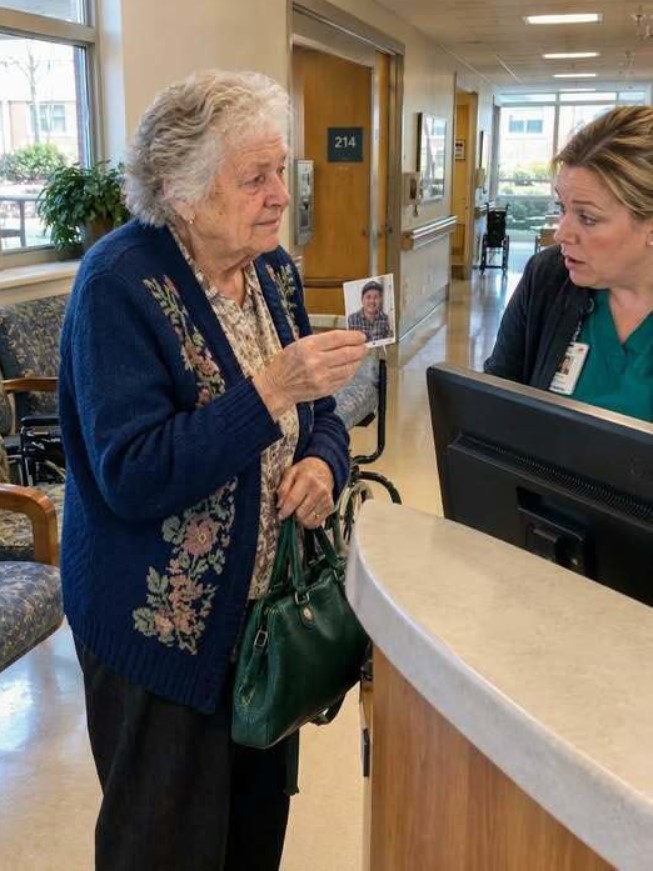
At the hospital, a receptionist named Kayla tells Evelyn she cannot sit in the family waiting room because she is not on the authorized visitor list. Evelyn accepts the decision calmly, but before leaving, she asks whether Room 214 still has its small window overlooking the courtyard.
When Kayla asks how she knows about the window, Evelyn reveals that she paid to have it installed decades earlier. She shows the receptionist an old photograph of a young woman holding a newborn beside that very window.
An elderly doctor, Dr. Thomas Hale, arrives after seeing the photograph. He recognizes Evelyn immediately and becomes alarmed when he notices the envelope. He orders the staff to prevent the patient in Room 214 from being transferred.
Daniel is confused when Dr. Hale tells him that his family has been hiding an important truth from him.
A Secret About Daniel’s Father
In a private consultation room, Evelyn finally explains that Daniel’s late father, Michael, was adopted.
Michael had known the truth since he was eighteen, but he had planned to tell Daniel when his son was older. His sudden death in a car accident prevented him from doing so.
The woman in the photograph is Ruth Calloway, Michael’s biological mother. Ruth is now gravely ill with pancreatic cancer and has been asking to remain in Room 214, where she once held her newborn son.
Evelyn explains that she worked as a nurse at St. Andrew’s in the early 1970s. After losing her own baby girl, Grace, during a premature birth, she was left grieving in a windowless room. She and her husband, Frank, used the money they had saved for their daughter’s nursery to pay for a small window in Room 214, hoping other grieving mothers would have something beautiful to look at.
Frank also planted the cherry tree outside the window.
Years later, Evelyn cared for Ruth, a nineteen-year-old student whose wealthy father, Harold Calloway, had arranged for her baby to be adopted in secret. Ruth’s father wanted to protect the family’s reputation and controlled the adoption arrangements.
When Ruth gave birth to a healthy boy on April 19, 1975, Evelyn broke hospital rules and allowed her to hold him for three precious hours. Dr. Hale, then a young resident, took a photograph so Ruth would have proof of that moment.
When Ruth’s father tried to take the baby away, Ruth asked for him to be placed with Evelyn and Frank. They agreed to adopt him under a strict secrecy agreement. That baby grew up to become Michael Walker, Daniel’s father.
The Truth About Dr. Hale
Evelyn then reveals another shocking secret: Dr. Thomas Hale is Michael’s biological father and Daniel’s grandfather.
Thomas and Ruth had fallen in love when they were young, but Ruth’s powerful father threatened to destroy Thomas’s medical career if he continued their relationship. Thomas was frightened and allowed the adoption to happen, a decision that haunted him for the rest of his life.
He remained at St. Andrew’s for fifty-one years because it was the last place he had seen his son. Evelyn secretly sent him photographs of Michael every Christmas, allowing Thomas to watch his son grow up from a distance. Thomas also shared those photographs with Ruth during private meetings.
Ruth even attended Michael’s funeral from across the street, unable to approach the family. She sent white lilies with a card reading, “From the window.”
Daniel is devastated that so much of his family’s history was kept from him. Evelyn admits that she feared he would stop loving her if he learned they were not related by blood. After losing her daughter, husband, and son, she was terrified of losing Daniel too.
Daniel embraces her and reassures her that she will always be his grandmother. Her love, sacrifices, and years of raising him matter far more than genetics.
A Family Reunited
Ruth’s daughter, Catherine, arrives at the hospital angry that the planned transfer to a hospice facility has been stopped. She initially believes Evelyn is a stranger who might upset her dying mother.
Dr. Hale explains the truth about Ruth’s first child and reveals that he is the baby’s biological father. Catherine is stunned to discover that she had an older brother she never knew existed and that Daniel is her nephew.
Eventually, Catherine agrees to let everyone visit Ruth in Room 214.
When Evelyn enters, Ruth recognizes her immediately. They hold hands, remembering the night of Michael’s birth and the little window that gave Ruth comfort during one of the hardest moments of her life.
Daniel introduces himself to Ruth. She recognizes his resemblance to Michael and gently touches his face, something she never had the chance to do with her grown son.
Daniel tells her stories about his father: how Michael worked as an electrician, loved baseball, made Mickey Mouse pancakes, and whistled “Here Comes the Sun” while working. Ruth reveals that she sang that same song to Michael when he was a newborn. Somehow, the melody had remained part of his life.
Evelyn gives Ruth the original birth certificate she has protected for fifty-one years. The document names Ruth as Michael’s mother and Thomas as his father. Ruth thanks Evelyn for giving her son a loving home and tells Daniel that he deserves to know the truth about his origins.
Catherine also reconciles with her mother. Ruth admits she hid the past because she felt ashamed that she had not fought harder to keep Michael. Catherine takes her hand, and the family begins healing together.
Ruth’s Final Days
Ruth remains in Room 214 rather than transferring to Chicago. Catherine stays nearby, and Evelyn and Daniel visit every day. Kayla apologizes for turning Evelyn away and adds her name to the authorized visitor list, identifying her relationship to the patient as “Family.”
Daniel’s pregnant wife, Sarah, visits too. When Ruth feels the baby kick, she is delighted to learn that the child is a girl.
As Ruth grows weaker, the cherry tree outside the window begins to show new buds. On Ruth’s final afternoon, she asks someone to sing. Daniel begins whistling “Here Comes the Sun,” the song his father loved. Thomas, Catherine, and Evelyn join him softly.
Ruth dies peacefully a little after four o’clock, with sunlight falling through the window onto her hands.
At her funeral, Evelyn places a white lily on the grave of her own daughter, Grace. She quietly says that Grace and Ruth have now met.
Dr. Hale retires two months later, finally feeling that he no longer needs to remain at the hospital. He gives Daniel a shoebox containing fifty-one years of Christmas cards and photographs of Michael. The notes on the backs reveal a father who had watched his son grow up from afar and regretted never telling him the truth.
The Window’s Lasting Legacy
In the spring, the hospital installs a small brass plaque beneath the window in Room 214. Evelyn chooses words honoring Grace, Ruth, and every mother who needed something to look at besides a wall.
On April 19, exactly fifty-two years after Michael’s birth, Daniel and Sarah welcome their daughter into the world. They name her Grace Ruth Walker, honoring Evelyn’s lost daughter and Daniel’s biological grandmother.
After the birth, Daniel takes Evelyn to the now-empty Room 214. The cherry tree outside is covered in pink and white blossoms, its branches reaching toward the window Frank planted it beside decades earlier.
Evelyn reflects that family is not simply a list of names or a set of rules determining who belongs in a waiting room. Family is the person who makes a place for you, cares for you, and gives you hope—even when they may never benefit from that kindness themselves.
As they leave, Evelyn picks up her handbag and walks through the hospital’s family waiting room toward the maternity wing, where her great-granddaughter is waiting.
This time, she walks through the door marked FAMILY without anyone questioning whether she belongs.
The story ends with the idea that love creates family through sacrifice, loyalty, compassion, and the courage to welcome people home.
The Ending: What Grandma Had Been Keeping for Fifty-One Years
Dr. Hale led us down a quiet hallway, away from the crowded waiting room. Grandma walked beside him with the envelope pressed against her chest. For the first time that morning, I noticed her hands trembling.
“Grandma,” I whispered, “what’s in that envelope?”
She looked at me, her eyes shining.
“The truth, Daniel. Something I should have told your father years ago, and something you deserve to know now.”
Dr. Hale stopped outside Room 214. Through the small window in the door, I could see an elderly woman lying beneath a white blanket. Her silver hair rested against the pillow, and a vase of fresh flowers stood on the bedside table.
“Her name is Margaret,” the doctor explained. “She’s been asking for Evelyn for several days. We didn’t understand why until this morning.”
Grandma closed her eyes for a moment.
“Is she awake?”
“Yes. But she’s very weak.”
Before we entered, Dr. Hale turned to me.
“Daniel, what you’re about to hear may change how you understand your family. But please remember something: the people who raise us, love us, and stand beside us are every bit as important as the people who gave us life.”
I didn’t understand what he meant until Grandma opened the door.
The woman in the bed slowly turned her head. When she saw Grandma, her lips parted, and tears gathered in her eyes.
“Evelyn?”
Grandma crossed the room and took her hand.
“I’m here, Margaret. I’m sorry it took me so long.”
Margaret shook her head weakly.
“You came. That’s what matters.”
I stood near the doorway, afraid to interrupt a reunion that had clearly been waiting decades to happen.
Grandma pulled the envelope from her handbag and placed it on the bedside table. Inside was an old photograph, a handwritten letter, and a document protected by a sheet of yellowed tissue paper.
Margaret stared at the photograph.
“You kept it.”
“Of course I kept it,” Grandma replied. “You asked me to remember that day for both of us.”
I stepped closer.
“Grandma, who is she?”
Grandma looked up at me. Her voice was gentle, but every word seemed to cost her something.
“Margaret was your father’s birth mother, Daniel.”
The room became completely silent.
My father had died six years earlier. As far as I knew, he had been an only child, raised by Grandma and Grandpa in the little house where I had spent so many childhood weekends. I had never questioned the story of his childhood. I had never imagined there was another woman somewhere who had spent her life wondering about him.
“Your grandfather and I adopted your father when he was a baby,” Grandma continued. “We loved him as our own. We never wanted him to feel unwanted, so we promised to protect his story until he was old enough to understand it.”
“Did Dad know?” I asked.
Grandma nodded slowly.
“He learned the truth when he was an adult. He wanted to meet Margaret, but life kept getting in the way. Then he became ill, and everything happened so quickly. He asked me to find her after he was gone.”
She looked down at her hands.
“I promised him I would. But I was afraid. I kept telling myself there would be another day, another visit, another chance to explain everything.”
Margaret squeezed her fingers.
“You don’t have to apologize for loving him,” she whispered. “You gave him the childhood I could not give him. You were his mother in every way that mattered.”
Grandma finally began to cry.
For years, I had seen her as the strongest person in our family. She was the woman who fixed broken buttons, baked bread for neighbors, and showed up whenever someone needed help. I had never considered how many private sorrows she might have carried while making everyone else feel safe.
I pulled a chair beside her.
“Why didn’t you tell me?”
“Because I wanted you to remember your father for the man he was, not become distracted by the secrets surrounding his birth. And because I was frightened that you might think our family was somehow less real.”
I took her hand.
“Grandma, nothing could make you less my grandmother.”
She smiled through her tears.
“Your grandfather used to say that family isn’t measured by blood. It’s measured by who stays when staying becomes difficult.”
Margaret asked me to sit beside her. She wanted to hear about my father, so I told her everything I could remember: his terrible singing, his habit of falling asleep during old movies, and how he always brought home flowers for Grandma on Friday evenings.
Margaret laughed softly.
“He hated being late,” she said. “Even as a little boy, he would become upset if he thought someone was waiting for him.”
Then she looked toward the window.
“Is the courtyard still there?”
Grandma nodded.
“And the old maple tree?”
“Yes. It’s taller than the building now.”
Margaret smiled.
“Then some things survived.”
She asked Grandma to open the window curtain. Pale morning light spread across the bed, illuminating the photograph they had placed beside her.
For a while, nobody spoke. There was nothing left to explain that mattered more than the simple fact that two women who had loved the same child were finally sitting together.
Before we left that afternoon, Margaret asked me to promise something.
“When you have children of your own, tell them the whole story. Not just the painful parts. Tell them about the people who tried their best, the people who made mistakes, and the people who loved your father before you ever knew him.”
“I promise,” I said.
She squeezed my hand.
“Then he won’t be forgotten.”
Margaret passed away peacefully three days later.
Grandma attended the small memorial service, holding the same handbag she had carried into the hospital that rainy Tuesday. She placed the old photograph beside Margaret’s flowers and stayed until everyone else had gone.
On our way home, I asked Grandma why she had insisted on visiting that particular morning.
She looked out at the passing trees.
“Margaret had written to me several weeks ago. She told me she was running out of time. I kept the letter in my drawer because I didn’t know how to face what it asked of me.”
“What did it ask?”
Grandma opened her handbag and handed me the letter.
The final sentence was written in a shaky hand:
Please don’t let me leave this world believing that the woman who raised my son never forgave me for giving him away.
I looked at Grandma.
“Did you forgive her?”
Grandma’s eyes filled again.
“There was never anything to forgive. We both loved the same little boy. We simply loved him from different places.”
The following month, I returned to St. Andrew’s with Grandma. We brought a small framed photograph of my father as a child and asked the hospital administrator whether it could be displayed near Room 214.
The receptionist who had turned Grandma away that morning happened to be working at the front desk. When she recognized us, she stood up immediately.
“Mrs. Walker,” she said quietly. “I’ve wanted to apologize.”
Grandma gave her a kind smile.
“You were doing your job, dear. But sometimes, before we decide who belongs somewhere, we should give ourselves a moment to discover why they came.”
The receptionist lowered her eyes, then nodded.
A small plaque was eventually placed beside the window in Room 214. It carried no grand title or elaborate inscription. Just one sentence:
For everyone who has ever needed a place to belong.
Whenever I visit Grandma now, she still reminds me to check the oil in my car. She still bakes bread on Sunday mornings, and she still keeps an old photograph in the top drawer of her bedroom dresser.
Sometimes, she takes it out and tells me another story about my father.
I used to believe that the most important parts of a person’s life were the things everyone could see: their achievements, their family name, and the years they spent beside us.
Now I understand that some of the greatest acts of love happen quietly. They happen in hospital rooms, in difficult conversations, in promises kept long after everyone else has forgotten them.
And sometimes, they happen when a seventy-nine-year-old woman walks into a hospital carrying nothing but an old photograph and the courage to make one last visit.
Grandma had not gone to Room 214 to claim a place among strangers.
She had gone to give someone peace.
And in doing so, she taught me that family is not simply who sits beside you when life is easy. Family is the love that remains, the truth we finally find the courage to share, and the kindness that opens a door when the world tells someone they do not belong.
Even now, whenever I pass a hospital window overlooking a courtyard, I think of Grandma Walker.
I think of the envelope she carried, the secret she had guarded, and the woman who had waited so long to hear that she was forgiven.
Most of all, I remember what Grandma said as we drove home that rainy afternoon.
“Never assume you know someone’s whole story, sweetheart. Sometimes, the person standing outside the door is the very reason it was built.”