When towing a trailer behind a car, knowing how to distribute the weight properly is just as important as choosing the right vehicle or trailer. A load that appears secure may still create a serious problem if it is placed in the wrong position.
Even a single heavy object can change the balance of a trailer. Too much weight near the front can place excessive pressure on the vehicle’s hitch, while too much weight at the back can make the trailer unstable and increase the risk of dangerous swaying.
This is why understanding trailer weight distribution is essential for anyone who transports furniture, equipment, luggage, or other heavy items.
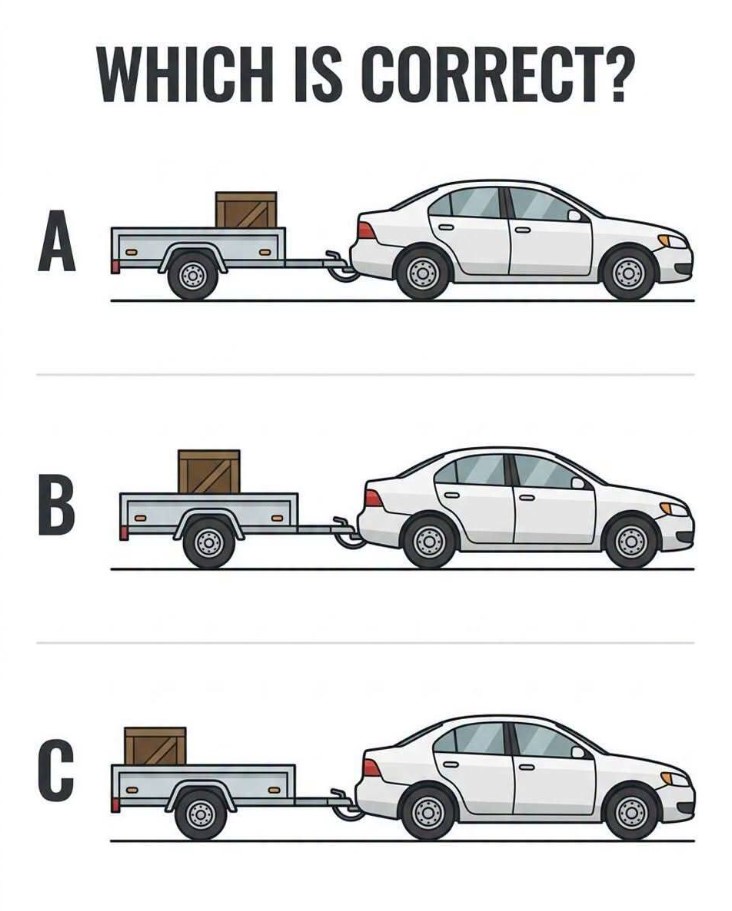
In this visual challenge, three different trailer-loading arrangements are presented. At first glance, they may look quite similar, but the position of the heavy box changes how the trailer behaves when connected to the car.
The question is simple: Which option shows the correct way to distribute the load?
The answer given in the original challenge is Option B. Let’s look at why this arrangement is considered the best choice and what every driver should understand before towing a loaded trailer.
Understanding Trailer Weight Distribution
A trailer does not behave independently when it is attached to a vehicle. The weight it carries affects the hitch, the towing vehicle’s suspension, and the way the entire combination handles on the road.
One of the most important measurements is called tongue weight.
Tongue weight is the downward force that the front of the trailer places on the towing vehicle through the hitch. It plays an important role in keeping the trailer stable while driving.
When the load is distributed correctly, the trailer should remain balanced, and the towing vehicle should maintain good steering and braking control.
However, when the weight is placed too far forward or too far backward, the balance changes. This can affect the height of the vehicle, the pressure on its tires, and the trailer’s ability to follow safely behind it.
That is why drivers should never load a trailer without considering where the heaviest objects are positioned.
The Correct Answer: Option B
According to the original challenge, Option B is the correct answer.
This option represents a more balanced arrangement, with the heavy box positioned around the central axle area rather than placed at the extreme front or rear of the trailer.
The axle is an important reference point because it supports the trailer’s weight through its wheels. Keeping heavy cargo low and close to the axle helps avoid extreme weight distribution.
However, there is an important detail: placing every heavy object exactly over the axle is not automatically the safest arrangement. A conventional trailer normally needs some downward force on its hitch to remain stable.
The goal is to achieve the correct tongue weight while keeping the load balanced from side to side. For many conventional trailers, the recommended tongue weight is approximately 10 to 15 percent of the fully loaded trailer’s total weight. The exact requirement depends on the trailer, vehicle, and hitch manufacturer’s instructions.
Therefore, Option B represents the intended balanced choice in this quiz, but actual trailer loading should always be checked against the manufacturer’s recommendations.
Why Option A Is Incorrect
In Option A, the heavy box is positioned close to the front of the trailer.
This placement can create excessive tongue weight because too much of the load is pressing down on the hitch.
When the tongue weight becomes too high, the rear suspension of the towing vehicle may be pushed down while its front end rises.
This change in vehicle position can reduce the amount of weight carried by the front tires. Since those tires are responsible for much of the vehicle’s steering control, losing some of their grip can make driving more difficult.
Excessive tongue weight can also:
- Put too much pressure on the rear suspension.
- Increase the load carried by the rear tires.
- Reduce steering stability.
- Affect braking performance and vehicle handling.
- Exceed the permitted limits of the hitch or towing vehicle.
This does not mean that heavy objects should never be placed toward the front of a trailer. In fact, some forward weight is necessary for proper tongue weight. The problem occurs when too much weight is concentrated at the front.
The correct approach is to distribute the load carefully and measure the resulting tongue weight rather than guessing.
Why Option C Is Incorrect
Option C places the heavy box near the very back of the trailer.
This arrangement can be particularly dangerous because it may reduce the downward force on the hitch too much.
When a large amount of weight sits behind the axle, it can act like a seesaw. The rear of the trailer becomes heavier, while the front may lift and place less pressure on the hitch.
If the tongue weight becomes too low, the trailer can begin swaying from side to side while the vehicle is moving.
This movement is often called trailer sway or fishtailing. It can become difficult to control, particularly at higher speeds, in strong winds, or when another vehicle passes nearby.
A trailer that sways excessively can pull the towing vehicle from side to side and create a dangerous situation for everyone on the road.
For this reason, placing the heaviest cargo at the very back of a trailer should be avoided unless the manufacturer’s loading instructions specifically require a different arrangement.
Why Tongue Weight Matters So Much
Tongue weight may sound like a technical term, but the idea is straightforward: the trailer needs to place the correct amount of downward pressure on the hitch.
If the downward pressure is too high, the towing vehicle’s rear may become overloaded and its front tires may lose some of their grip.
If the downward pressure is too low, the trailer may become unstable and start swaying.
Both situations can affect safe driving.
For many conventional ball-hitch trailers, a tongue weight of approximately 10 to 15 percent of the loaded trailer weight is a common guideline. For example, if a conventional trailer weighs 2,000 pounds after being loaded, its recommended tongue weight may be around 200 to 300 pounds.
This is only a general example. Different trailer designs can have different requirements, so drivers should always follow the instructions provided by the trailer and vehicle manufacturers.
Practical Tips for Loading a Trailer Safely
Understanding the correct answer to the quiz is useful, but applying these principles in real life is even more important.
Here are some simple precautions that can help make towing safer.
1. Keep heavy objects low.
Place heavier items close to the trailer floor rather than stacking them high. A lower center of gravity helps improve stability and reduces the risk of the load shifting during turns.
2. Distribute the weight evenly from side to side.
Avoid placing all the heavy cargo on one side of the trailer. Uneven weight can put extra pressure on certain tires and affect handling.
3. Avoid concentrating all the weight at the rear.
A rear-heavy trailer may have insufficient tongue weight, increasing the risk of dangerous swaying.
4. Do not overload the front.
Too much weight near the hitch can overload the towing vehicle’s rear suspension and reduce the grip of its front tires.
5. Secure every item properly.
Use suitable straps, tie-downs, or other approved equipment to prevent cargo from moving while driving. A load that shifts during a journey can suddenly change the trailer’s balance.
6. Check the trailer and vehicle weight limits.
Never assume that a vehicle can tow a particular trailer simply because it has a hitch. Check the vehicle’s towing capacity, hitch rating, axle limits, and the trailer’s maximum permitted weight.
7. Make sure the trailer sits correctly when connected.
Follow the manufacturer’s instructions for hitch height and trailer position. An incorrectly positioned trailer can affect stability and handling.
8. Check everything before leaving.
Inspect the hitch connection, safety chains, tires, lights, and braking system. Make sure the load is secure and that the trailer is properly balanced before starting the journey.
What Happens When a Trailer Is Poorly Loaded?
Incorrect weight distribution can create several problems, even when the trailer appears perfectly normal while parked.
A trailer with excessive tongue weight can push down the rear of the towing vehicle. This may affect steering, tire loading, suspension performance, and braking.
A trailer with insufficient tongue weight can become unstable and begin moving from side to side. At higher speeds, this movement may become more difficult to control.
Cargo that is not properly secured can also shift suddenly when the vehicle accelerates, brakes, or turns. Even a small movement can change the balance of the trailer.
These risks show why proper loading should never be treated as a minor detail. A few minutes spent checking the weight distribution can help prevent serious problems later.
Frequently Asked Questions
Is Option B the correct answer?
Yes. The original visual challenge identifies Option B as the correct choice because it represents the more balanced arrangement compared with placing the heavy box at the extreme front or rear.
Should the heaviest object always be placed directly over the axle?
Not necessarily. Heavy objects should generally be kept low and near the axle area, often slightly forward, but the final arrangement must provide the correct tongue weight. Always follow the trailer manufacturer’s loading instructions.
What is the ideal tongue weight for a conventional trailer?
A common guideline is approximately 10 to 15 percent of the fully loaded trailer weight. However, the correct figure can vary depending on the trailer design and towing equipment.
Why is too much weight at the back dangerous?
A rear-heavy load can reduce the downward force on the hitch. This can make the trailer unstable and increase the risk of swaying or fishtailing.
Can too much weight at the front affect the car?
Yes. Excessive tongue weight can push down the rear of the vehicle and reduce the load on its front tires. This can negatively affect steering, braking, and overall handling.
Does a balanced trailer guarantee a safe journey?
No. Correct weight distribution is only one part of safe towing. Drivers must also respect towing limits, secure the cargo, check the tires and brakes, use the correct hitch, and follow the manufacturer’s recommendations.
Conclusion
The correct answer in this visual challenge is Option B. It represents the intended balanced arrangement and highlights an important lesson about the way weight should be distributed when towing a trailer.
Options A and C demonstrate why placing a heavy object too far forward or too far backward can create problems. Too much weight at the front may overload the hitch and affect the towing vehicle’s steering, while too much weight at the rear can reduce tongue weight and increase the risk of dangerous trailer sway.
The most important lesson is that safe towing depends on more than simply making a trailer look level. Drivers need to consider the total loaded weight, the position of heavy objects, the recommended tongue weight, and the limits of their vehicle and towing equipment.
A properly loaded trailer is easier to control and helps reduce unnecessary stress on the vehicle, tires, suspension, and hitch. Taking the time to check these details before every journey is a simple habit that can make a meaningful difference.
Sometimes, a small adjustment in the position of a heavy box can have a major effect on road safety. That is why understanding weight distribution is so important for every driver who tows a trailer.