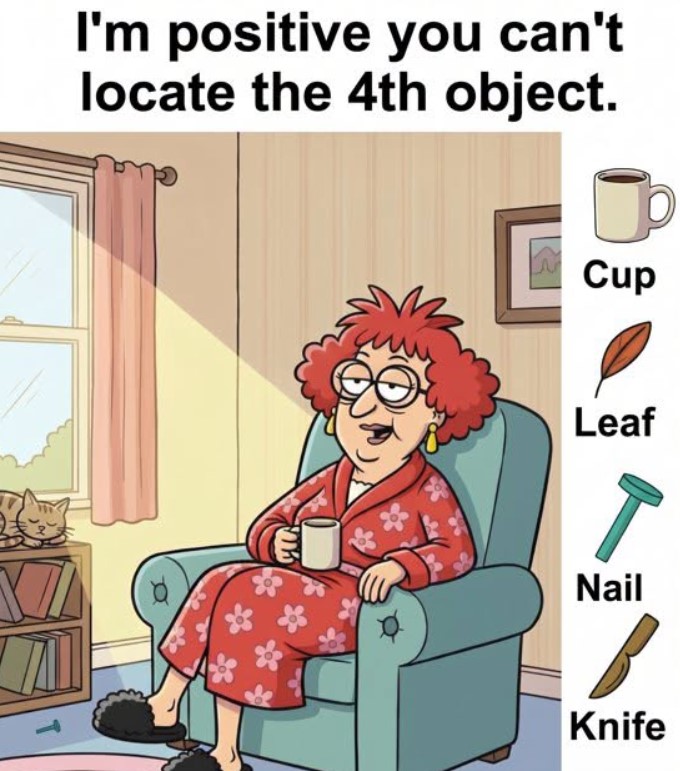
At first glance, this living-room puzzle looks like a simple picture of a woman relaxing in her favorite chair with a cup of coffee or tea. A cat is resting nearby, sunlight is coming through the window, and the room seems peaceful and ordinary.
But there is a challenge hidden in the illustration!
You are asked to find four objects: a cup, a leaf, a nail, and a knife. The cup is easy to spot, but the remaining objects are much harder to recognize because they blend into the details of the room.
The real trick is to stop looking at the picture as a whole and start examining its smaller details. An object may be hiding in an unexpected place, disguised by a shape, a line, or part of the furniture.
The First Object: The Cup
The cup is probably the easiest object to find.
Look at the woman sitting in the large blue armchair. She is holding a light-colored cup in one hand, resting it comfortably near her lap.
Its handle and rounded shape make it fairly easy to recognize. The cup is clearly visible, so most people will probably find this one almost immediately.
The Second Object: The Nail
The nail is hidden near the bottom-left part of the illustration.
Look at the floor beside the small bookshelf. You can see a tiny green object lying on the blue floor. It has a long, narrow body and a wider head, making it look like a small nail.
Because it is close to the edge of the picture and much smaller than the furniture, it is easy to overlook.
The Third Object: The Leaf
The leaf is another object that requires careful observation.
Instead of searching only among the obvious objects, examine the decorative details and shapes throughout the room. The leaf is represented by a narrow, pointed shape with a form similar to the example shown beside the puzzle.
This is the kind of detail that can easily disappear among the illustration’s colors and patterns.
The Fourth Object: The Knife
The knife is the most challenging object in the puzzle.
Look carefully at the smaller details rather than focusing only on the woman, the chair, and the cat. The knife is represented by a shape resembling a blade, with a pointed end and a handle.
Its unusual placement makes it harder to recognize than an ordinary knife lying openly on a table.
Why Is This Picture So Difficult?
This type of visual puzzle works by using the way our brains recognize familiar objects.
When we look at a living room, we naturally focus on the largest and most recognizable details. We notice the person sitting in the chair, the cat near the window, the bookshelf, and the furniture.
Small objects receive much less attention.
The puzzle also uses several visual distractions:
- Different sizes: Some objects are much smaller than the main elements of the room.
- Unexpected locations: The hidden items are not necessarily placed where we would normally expect to find them.
- Similar shapes: Some details can resemble ordinary decorative elements rather than separate objects.
- Busy surroundings: The patterns, furniture, and other details make it harder to concentrate on one small area at a time.
A useful strategy is to divide the illustration into sections. Examine the floor, bookshelf, chair, clothing, window, and wall decorations separately. This makes it easier to notice details that you might otherwise miss.
A Simple Trick for Solving Hidden-Object Puzzles
If you enjoy challenges like this, try following a few simple steps:
- Study the examples first. Pay attention to the shape of each object you need to find.
- Look at the edges. Small hidden objects are often placed near the borders of an illustration.
- Examine unusual shapes. A leaf may look like a decoration, while a nail may resemble a small mark on the floor.
- Ignore the main character for a moment. The most interesting details are often hidden in the background.
- Take your time. Looking too quickly can cause your eyes to skip over small objects.
Conclusion :
This living-room puzzle is a fun reminder that the smallest details can sometimes be the hardest to notice. The cup is easy to identify because the woman is holding it, but the other objects require a much closer look.
The nail near the bookshelf is a good example of how an object can hide in plain sight. A tiny detail on the floor can be overlooked simply because our attention is drawn toward the larger furniture and the person in the picture. The leaf and knife are also intended to challenge the way we recognize familiar shapes when they appear in unexpected places.
What makes these puzzles enjoyable is that they encourage us to slow down, observe carefully, and look beyond the obvious. You may feel certain that you have examined every corner of the room, only to notice a hidden detail when you look again.
So, did you manage to spot all four objects without help? If you found the cup, leaf, nail, and knife, congratulations! You have a sharp eye for visual details. And if one of them escaped your attention, don’t worry. That is exactly what makes a good hidden-object challenge so entertaining.