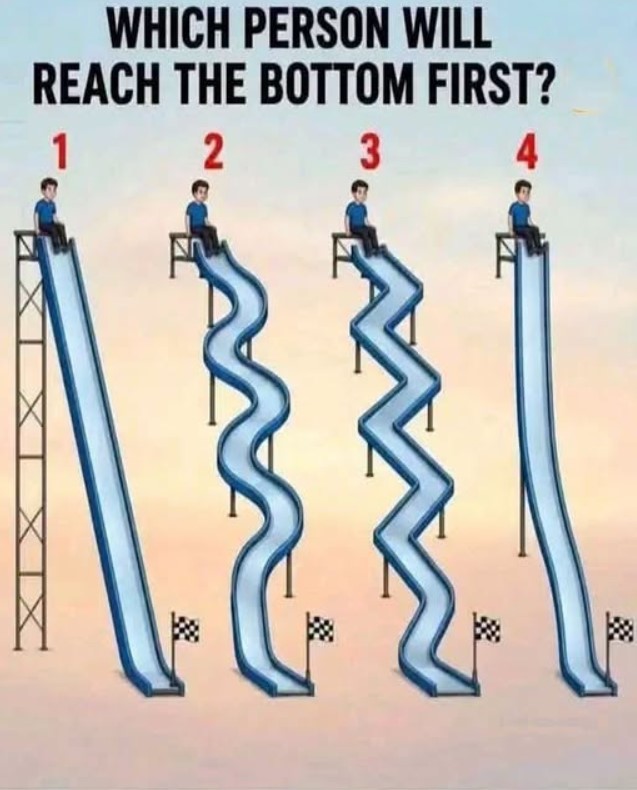
Imagine standing at the top of a playground and looking down at four different slides. Each one has a completely different shape, and four people are getting ready to race to the bottom.
At first, the challenge seems easy. You might think the person using the straightest slide will win. After all, a direct path should mean a faster journey, right?
But there is an interesting twist. The shape of a slide can make a surprising difference in how quickly someone reaches the bottom. Sometimes, the route that looks longer or less straightforward can actually offer an advantage.
This visual puzzle challenges you to look beyond appearances and think about gravity, acceleration, and the way movement changes along different paths.
Take a Look at the Four Slides
In the picture, four people are sitting at the top of four different slides. Each person is identified by a number: 1, 2, 3, and 4.
A finish flag is waiting at the bottom of each slide. The goal is simple: decide which person will reach the finish line first.
Before reading the explanation, take a moment to examine the four paths.
- Slide 1 follows a relatively straight, steep route.
- Slide 2 has several waves and curves.
- Slide 3 contains sharp zigzags and tight turns.
- Slide 4 begins with a very steep drop before gradually curving toward the bottom.
Which design do you think gives its rider the greatest advantage?
Do not rush to choose. The answer depends on more than the apparent length of the route.
Why the Shape of Each Slide Matters
To understand the puzzle, it helps to think about how gravity affects a person moving down a slope.
Gravity pulls objects downward, and the component of that force acting along a slope helps accelerate them. A steeper slope generally produces greater acceleration along the direction of movement.
However, the shape of the path also matters. Changes in direction, friction, and the speed a rider gains along the way can all influence the final time.
Let’s look at each slide more closely.
Slide Number 3: The Sharp Zigzag Path
Slide number 3 has a very unusual design. Instead of providing a smooth route toward the bottom, it contains several sharp changes in direction.
At first glance, this might look like an exciting ride, but it is not necessarily a fast one.
Every turn changes the direction of movement. In a real slide, the rider may also experience additional contact forces and friction, depending on the surface and the way the turns are designed.
These features can make the journey less efficient and may reduce the rider’s speed.
For that reason, slide number 3 does not appear to be the strongest candidate for winning the race.
Slide Number 2: The Wavy Route
Slide number 2 has a series of curves and ups and downs.
Unlike the sharp zigzags of slide number 3, its path looks smoother. Nevertheless, the rider must continually follow a changing direction.
The shape of the route affects how the rider accelerates and moves along the slide. Depending on the exact design, some sections may help the rider gain speed, while others may slow the journey.
It is therefore difficult to determine its exact travel time simply by looking at the picture.
Still, the puzzle encourages us to compare this winding path with the two more direct-looking slides.
Slide Number 1: The Straight and Steep Route
Slide number 1 looks like a strong contender.
Its path is relatively straight and steep, providing a direct route from the starting point to the finish.
A straight incline can be advantageous because the rider does not need to follow a series of tight turns. Gravity also accelerates the rider along the slope.
However, there is another important question: how quickly does the rider gain speed at the beginning?
A slide that starts with a particularly steep section may allow the rider to accelerate rapidly before reaching a gentler part of the route.
That brings us to the final competitor.
Slide Number 4: The Surprising Favorite
Slide number 4 begins with a very steep drop before gradually curving toward the bottom.
This design gives the rider a significant early acceleration. As the rider descends the steep opening section, gravity helps build speed quickly.
The rider can then carry that gained speed into the gentler lower portion of the slide.
This idea is connected to an interesting concept in physics called the brachistochrone problem.
The brachistochrone problem asks a famous question: What shape of path allows an object to travel between two points in the shortest possible time under gravity, assuming ideal conditions and no friction?
The surprising result is that the fastest path is not necessarily a straight line. The ideal curve is a special shape called a cycloid.
The important lesson is that the shortest-looking route is not always the fastest route. How quickly an object gains speed can matter just as much as the distance it travels.
The Correct Answer: Person Number 4
According to the original puzzle, the intended answer is person number 4.
The explanation is that slide number 4 begins with a steep drop, allowing the rider to accelerate rapidly near the start. The rider then continues along the lower curve with the speed gained during that initial descent.
This makes slide number 4 the expected winner of the visual challenge.
However, there is an important scientific detail worth remembering: the brachistochrone principle does not mean that every slide with a steep beginning will automatically be the fastest. The exact shape, height, total distance, friction, and other conditions all matter.
Without precise measurements and a clearly defined model, we cannot prove the winner from the general description alone. Person number 4 is the intended answer to the puzzle, rather than a guaranteed result for every real-world slide.
What Makes This Puzzle Interesting?
This challenge is a great example of how physics can surprise us.
Many people naturally assume that a straight path must always be the fastest. It seems logical because a straight route often looks shorter and more direct.
But movement is not determined by distance alone. Acceleration plays a major role.
A path that allows an object to gain speed earlier may sometimes produce a shorter travel time, even if the route itself is not the shortest.
This is why scientists and mathematicians have studied problems involving falling objects, curved paths, and the effects of gravity for centuries.
The brachistochrone problem is especially interesting because its answer goes against what many people would initially expect.
Conclusion :
So, who will reach the bottom first?
According to the original visual puzzle, the answer is person number 4. The steep beginning of the fourth slide gives the rider an opportunity to gain speed quickly before continuing along the gentler curve.
What makes this challenge so interesting is that the obvious answer is not always the best one. Slide number 1 may look like the most direct route, but the fourth slide demonstrates why the way a journey begins can make a difference to the overall result.
The puzzle also introduces an important idea from physics: the fastest path between two points is not always the straightest or shortest path. The famous brachistochrone problem shows that a specially shaped curve can allow an object to reach its destination in less time under ideal conditions.
Of course, real playground slides involve additional factors such as friction, surface materials, rider position, and the exact dimensions of the slide. That is why the picture should be treated as a fun physics-inspired challenge rather than a complete scientific experiment.
Now it is your turn to share the puzzle. Show the four slides to your friends or family members and ask them to choose a winner before revealing the answer.
Did you pick person number 4, or did you think one of the other riders would reach the bottom first? Sometimes, the most interesting part of a puzzle is discovering why our first instinct can be wrong.