Have you ever looked at a simple math problem and felt confident that you knew the answer, only to discover that you had missed an important detail? Some puzzles are designed to test more than basic arithmetic. They challenge our attention, patience, and understanding of the rules we learned in school.
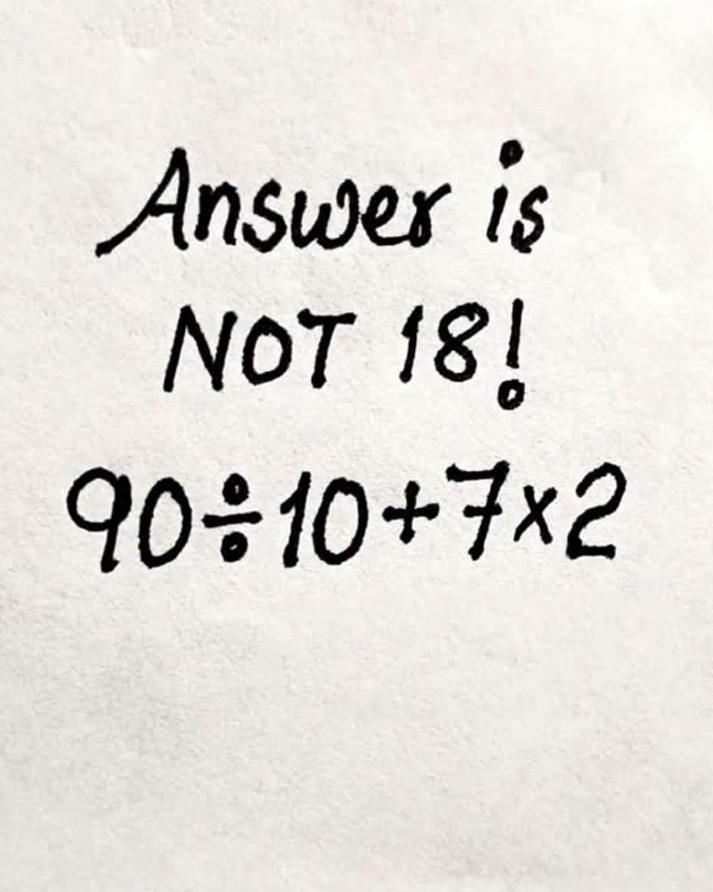
Today’s math challenge is a perfect example. At first glance, the equation looks incredibly easy. It contains only a few numbers and three familiar mathematical operations. However, the message written above it makes the challenge even more interesting: “Answer is NOT 18!”
That statement immediately raises a question. If the answer is not 18, then what is the correct result?
Before looking at the solution, take a moment to solve the equation yourself:
90 ÷ 10 + 7 × 2 = ?
Try not to rush. Many people make mistakes with expressions like this because they perform the calculations in the wrong order.
Let’s examine the equation carefully and discover the correct answer.
The Math Puzzle
The expression we need to solve is:
90 ÷ 10 + 7 × 2
There are three different operations involved:
- Division (÷)
- Addition (+)
- Multiplication (×)
The most important thing to remember is that mathematical expressions must follow a specific order of operations.
You cannot simply choose whichever calculation looks easiest or work through every symbol from left to right. Doing so can lead to an incorrect result.
Understanding the Order of Operations
In mathematics, the standard order of operations is commonly remembered using the acronym PEMDAS.
Each letter represents a particular step:
- P – Parentheses: Solve calculations inside parentheses first.
- E – Exponents: Calculate powers and roots.
- MD – Multiplication and Division: Perform multiplication and division from left to right.
- AS – Addition and Subtraction: Perform addition and subtraction from left to right.
One important detail often causes confusion: multiplication does not automatically come before division, and addition does not automatically come before subtraction.
Operations at the same level are handled from left to right.
For our particular puzzle, there are no parentheses or exponents. We only need to deal with division, multiplication, and addition.
That means we must complete the division and multiplication before adding the results together.
Step-by-Step Solution
Let’s solve the equation carefully.
Step 1: Calculate the division.
Start with the first operation:
90 ÷ 10 = 9
Now our original equation becomes:
9 + 7 × 2
Step 2: Calculate the multiplication.
Before performing the addition, we must multiply 7 by 2.
7 × 2 = 14
Our expression now becomes:
9 + 14
Step 3: Complete the addition.
We have finished the multiplication and division, so we can now add the remaining numbers.
9 + 14 = 23
The correct answer is 23!
This is the result obtained by following the standard mathematical order of operations.
Why Is the Answer Not 18?
The statement written above the puzzle says that the answer is not 18. But why would someone think that 18 might be the correct result?
The answer is that expressions containing several mathematical symbols can sometimes confuse people, especially when they try to solve them too quickly.
Some people may remember the order of operations incorrectly or assume that all calculations should be performed in a particular sequence without checking which operations have priority.
However, it is important to notice something interesting about this specific equation: even calculating strictly from left to right does not produce 18.
Let’s see what happens.
90 ÷ 10 = 9
9 + 7 = 16
16 × 2 = 32
This incorrect approach produces 32, not 18.
The important lesson is that we should not simply accept a suggested answer or assume that a puzzle contains a hidden trick. We should examine the actual equation and apply the correct rules.
Common Mistakes to Avoid
Even a short equation can lead to confusion when the order of operations is misunderstood.
Here are some common mistakes to watch out for.
1. Solving everything from left to right
This is one of the most frequent errors. Although multiplication and division at the same level are handled from left to right, addition must wait until those operations are completed.
2. Thinking multiplication always comes before division
PEMDAS can sometimes make people believe that multiplication must always be performed before division. That is not correct.
Multiplication and division have equal priority, so they are evaluated from left to right.
3. Adding before multiplying
In this puzzle, adding 9 and 7 before calculating 7 × 2 would ignore the standard order of operations.
4. Rushing through the equation
Because the numbers look simple, people sometimes answer without carefully examining the symbols. Taking a few extra seconds can prevent an unnecessary mistake.
How to Get Better at Math Puzzles
Math puzzles are a fun way to practice logical thinking and improve your confidence with numbers.
You do not need to solve complicated equations every day to become better at arithmetic. Even short challenges can help reinforce important mathematical concepts.
Here are a few simple habits that can make a difference:
- Read the entire equation before starting.
- Identify every mathematical operation.
- Remember the standard order of operations.
- Work through the calculations one step at a time.
- Double-check your result before choosing an answer.
- Avoid letting a suggested answer influence your calculations.
The most important habit is to understand why an answer is correct rather than simply memorizing the final number.
Conclusion :
This tricky math puzzle is a great reminder that even the simplest-looking equations deserve a little attention. At first, the expression 90 ÷ 10 + 7 × 2 may seem like something anyone could solve in just a few seconds. However, the different mathematical operations make it important to follow the correct order of operations.
The key is remembering that multiplication and division must be completed before addition and subtraction. Once you apply that rule, the calculation becomes straightforward. First, 90 divided by 10 gives you 9. Next, 7 multiplied by 2 gives you 14. Finally, adding 9 and 14 produces the correct result: 23.
What makes this puzzle interesting is the statement claiming that the answer is not 18. It encourages people to question the result, look more closely at the equation, and think about the mathematical rules involved. And that is exactly what a good brain teaser should do: make you pause, reconsider your approach, and understand the reasoning behind the solution.
Remember, getting the correct answer is not always about calculating faster. It is about knowing which steps to follow and taking the time to apply them properly. A small misunderstanding of the order of operations can change the result completely.
So, the next time you come across a viral math puzzle on social media, resist the temptation to answer immediately. Read the equation carefully, work through each operation, and trust the mathematical rules rather than the opinions in the comments.
Final answer: 23.