Do you enjoy solving tricky math riddles that look simple at first but make you stop and think twice? Here is a fun little brain teaser that will put your observation skills and basic arithmetic knowledge to the test.
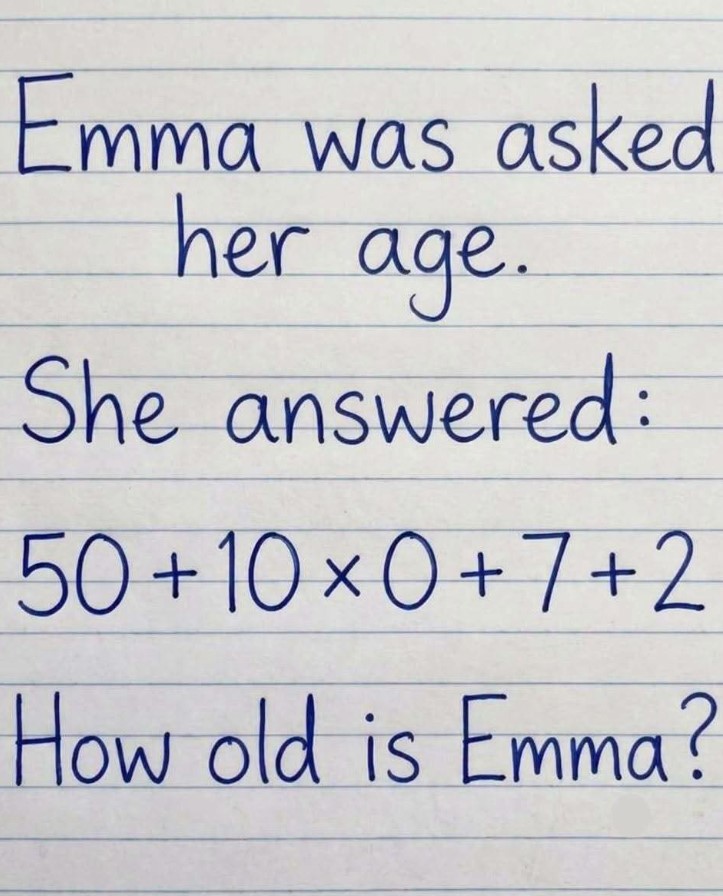
The puzzle is built around a girl named Emma. When someone asks her how old she is, she doesn’t give a straightforward answer. Instead, she writes a mathematical expression on a piece of paper:
50 + 10 × 0 + 7 + 2
At first glance, this equation may seem easy to solve. You might be tempted to calculate everything from left to right, adding and multiplying as you go. However, doing that without paying attention to the mathematical rules could lead you to the wrong answer.
So, the question is simple:
How old is Emma?
Before looking at the solution, take a moment to work it out yourself. You may be surprised by how easily a small mathematical detail can change the result.
Take a Moment to Solve the Puzzle
Look carefully at the expression:
50 + 10 × 0 + 7 + 2
The numbers are not particularly complicated, and the operations are familiar. There are no fractions, complicated equations, or difficult calculations.
The real challenge is knowing which operation must be performed first.
Many people make the mistake of starting with the first number and working their way across the expression from left to right. Although this approach may seem natural, it is not always correct when multiplication and addition appear together.
Before calculating, remember that mathematics follows a specific set of rules called the order of operations.
The Important Rule: Order of Operations
The order of operations tells us which mathematical operations should be completed first when an expression contains several different signs.
One popular way to remember these rules is through the acronym PEMDAS:
- P – Parentheses: Complete calculations inside parentheses first.
- E – Exponents: Calculate powers and roots.
- M – Multiplication: Perform multiplication.
- D – Division: Perform division.
- A – Addition: Perform addition.
- S – Subtraction: Perform subtraction.
Multiplication and division are performed before addition and subtraction. When multiplication and division appear together, they are handled from left to right. The same principle applies to addition and subtraction.
In Emma’s puzzle, there are no parentheses or exponents, and the only multiplication operation is easy to identify.
That is where we should begin.
Step-by-Step Solution :
Let’s solve the expression carefully so there is no confusion.
Step 1: Identify the multiplication.
The original expression is:
50 + 10 × 0 + 7 + 2
According to the order of operations, multiplication must be completed before addition.
Therefore, we start with:
10 × 0
Any number multiplied by zero equals zero.
So:
10 × 0 = 0
Step 2: Replace the multiplication with its result.
Once we calculate 10 × 0, the original expression becomes:
50 + 0 + 7 + 2
Now there are no multiplication operations remaining. We only need to complete the additions.
Step 3: Add the numbers.
Start with:
50 + 0 = 50
Then:
50 + 7 = 57
Finally:
57 + 2 = 59
We have reached the final result.
The Correct Answer: Emma Is 59 Years Old!
The answer is 59.
The complete calculation is:
50 + 10 × 0 + 7 + 2
= 50 + 0 + 7 + 2
= 50 + 7 + 2
= 57 + 2
= 59
Therefore, based on the mathematical expression Emma provided, she is 59 years old.
The trick was not hidden in a complicated calculation. It was simply a matter of remembering that multiplication must be performed before addition.
Why Do So Many People Get This Puzzle Wrong?
The reason this puzzle catches people off guard is that our eyes naturally encourage us to read an equation from left to right.
When we see a series of numbers and mathematical signs, it is tempting to start calculating immediately without checking whether a particular operation has priority.
For example, someone might begin by adding 50 and 10, then continue with the remaining numbers. But that would ignore the multiplication sign and produce an incorrect result.
Another reason is that the expression contains multiplication by zero. Some people overlook this small detail because they are concentrating on the larger numbers.
However, zero plays an important role in mathematics. Multiplying any number by zero always gives zero, regardless of how large the original number is.
This is why slowing down and checking the mathematical signs can make such a big difference.
Try Another Math Challenge!
Now that you have solved Emma’s age puzzle, why not test yourself with another expression?
Try this one without using a calculator:
20 + 5 × 4 − 10 ÷ 2
Remember to follow the order of operations. Complete multiplication and division before addition and subtraction.
If you want to check your answer, the correct result is 35.
These small challenges are an enjoyable way to practise mental arithmetic, improve concentration, and become more comfortable with mathematical rules.
Conclusion :
The How Old Is Emma? challenge proves that even a short mathematical expression can be surprisingly tricky when we forget the basic rules of arithmetic.
At first, the equation looks like a simple collection of numbers that can be calculated in just a few seconds. But the secret is knowing that not every operation has the same priority. Multiplication must come before addition, and overlooking that rule can completely change the result.
Once we take the time to examine the expression carefully, the solution becomes much easier. Multiplying 10 by zero gives us zero, leaving only a straightforward addition problem. The final answer is 59, meaning Emma is 59 years old.
The most valuable lesson from this puzzle is that getting the correct answer is not always about calculating quickly. It is about understanding the rules, paying attention to the details, and taking a moment to think before jumping to a conclusion.
Did you manage to discover Emma’s age without looking at the explanation? If you got 59 on your first attempt, well done! And if you made a different calculation, don’t worry. That is exactly what makes these brain teasers so enjoyable.
Share this puzzle with your friends and family and see who can solve it correctly. You might discover that the person who answers the fastest isn’t always the one who gets it right!