
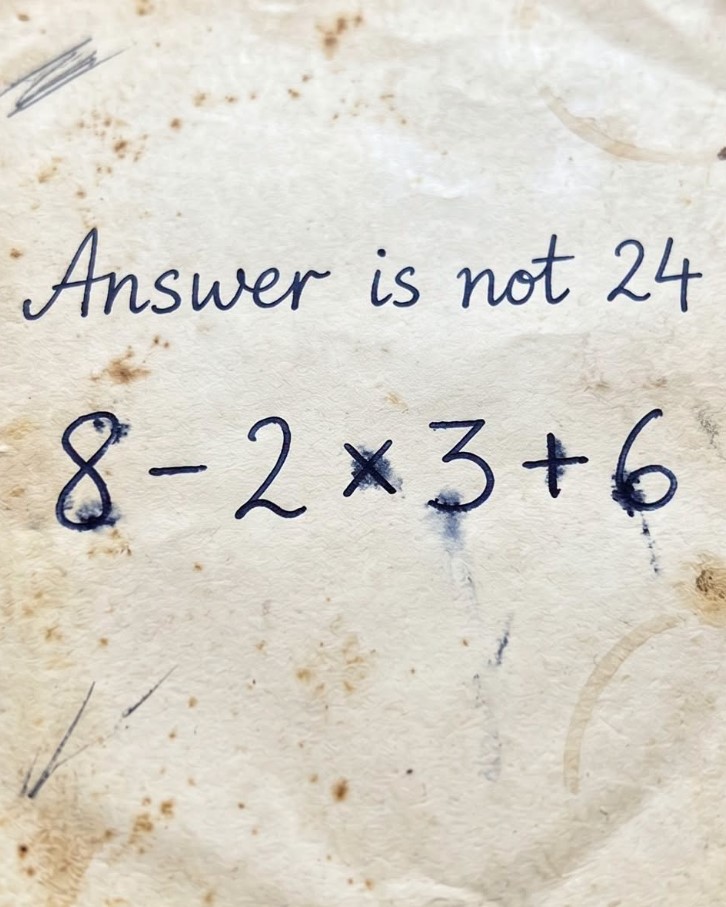
Sometimes, the simplest math puzzles are the ones that cause the most confusion. A short equation containing only a few numbers and familiar mathematical symbols can easily trick people into giving the wrong answer.
That is exactly what happens with this viral vintage math puzzle.
The challenge features a handwritten equation on a piece of aged-looking paper. At first glance, it seems like an ordinary arithmetic problem. However, a small handwritten warning above the equation makes the challenge more interesting:
“Answer is not 24.”
The equation itself is:
8 − 2 × 3 + 6
Many people look at the expression and immediately begin calculating from left to right. That approach produces 24, which is precisely the answer the handwritten note tells us to avoid.
But why is 24 incorrect? And what is the correct solution?
The secret is understanding one important mathematical rule: the order of operations.
Before reading the explanation, take a moment to solve the puzzle yourself. You might discover that the answer is much simpler than you initially thought.
Can You Solve the Equation?
Here is the complete expression:
8 − 2 × 3 + 6
There are only four numbers and three mathematical operations:
- Subtraction
- Multiplication
- Addition
Nothing looks particularly difficult, and most people can perform these calculations mentally.
The problem is that we cannot simply solve every operation in the order it appears from left to right.
Mathematics has specific rules that tell us which operations must be completed first.
If you remember those rules, finding the correct answer becomes straightforward.
Why Do Some People Get 24?
Let’s look at the common mistake.
Someone who calculates strictly from left to right might solve the equation this way:
First:
8 − 2 = 6
Then:
6 × 3 = 18
Finally:
18 + 6 = 24
This calculation explains why some people arrive at 24.
The individual arithmetic operations are correct, but the order in which they were performed is wrong.
Multiplication should have been completed before subtraction.
This is an important distinction because mathematical expressions must follow the standard order of operations. Simply moving from left to right without considering the different operations can lead to an incorrect result.
The Important Rule: PEMDAS and BODMAS
To solve this puzzle correctly, we need to remember the order of operations.
Two popular ways of remembering these rules are PEMDAS and BODMAS.
PEMDAS stands for:
- P – Parentheses: Complete calculations inside parentheses first.
- E – Exponents: Calculate powers and roots.
- M – Multiplication: Perform multiplication.
- D – Division: Perform division.
- A – Addition: Perform addition.
- S – Subtraction: Perform subtraction.
BODMAS follows the same general principle:
- B – Brackets
- O – Orders
- D – Division
- M – Multiplication
- A – Addition
- S – Subtraction
One detail is particularly important: multiplication and division have equal priority, as do addition and subtraction.
When multiplication and division appear together, calculate from left to right. The same rule applies when addition and subtraction appear together.
For our puzzle, this means we must complete the multiplication before dealing with the subtraction and addition.
Step-by-Step Solution
Now let’s solve the equation carefully.
Original expression:
8 − 2 × 3 + 6
Step 1: Perform the multiplication first
Look at the middle of the equation.
We have:
2 × 3
Multiplying 2 by 3 gives us:
2 × 3 = 6
This is the first operation we need to complete because multiplication takes priority over addition and subtraction.
Step 2: Replace the multiplication with its answer
Now substitute 6 into the original expression.
We get:
8 − 6 + 6
Notice that the equation has become much easier. We no longer have multiplication, so only subtraction and addition remain.
Step 3: Calculate from left to right
When addition and subtraction appear together, they have equal priority.
Therefore, we work from left to right.
First:
8 − 6 = 2
The expression now becomes:
2 + 6
Step 4: Complete the final addition
All that remains is:
2 + 6 = 8
And we have our answer!
<escape>The correct answer is 8.</escape>
Why Is 8 the Correct Answer Instead of 24?
The difference between the two answers comes entirely from the order in which the operations are performed.
The incorrect approach begins with subtraction, even though multiplication appears later in the expression.
The correct approach follows the mathematical order of operations:
- Multiply 2 by 3.
- Subtract the result from 8.
- Add 6.
Here is the complete calculation in one place:
8 − 2 × 3 + 6
= 8 − 6 + 6
= 2 + 6
= 8
The number 24 comes from ignoring the priority of multiplication and calculating strictly from left to right.
This is why the handwritten warning on the vintage paper is so important. It encourages readers to question their first instinct and reconsider the equation before choosing an answer.
Why Do Simple Math Puzzles Confuse So Many People?
There are several reasons why a short equation like this can catch people off guard.
1. We naturally read from left to right.
When reading a sentence or a series of numbers, our eyes usually move from left to right. It is therefore tempting to apply the same habit to mathematical expressions.
However, arithmetic has additional rules that determine the correct sequence of calculations.
2. The equation looks too easy.
Because the numbers are small and familiar, people may assume they can solve the problem immediately.
They sometimes rush through the calculation without stopping to identify which operation should come first.
3. Multiplication is easy to overlook.
In this particular puzzle, multiplication appears between subtraction and addition. Someone concentrating on the first two numbers may begin subtracting before noticing that multiplication has priority.
4. People confuse the order of operations.
Some remember that multiplication comes before addition but forget that it also comes before subtraction.
Others misunderstand PEMDAS and assume that addition must always come before subtraction. In reality, addition and subtraction have equal priority and are performed from left to right.
Understanding these small details makes a big difference.
Try Another Quick Math Challenge
Now that you have solved the vintage puzzle, why not test your understanding with another short equation?
Try this one:
12 + 4 × 3 − 6
Take a moment to work it out before checking the solution.
Remember to perform multiplication first.
4 × 3 = 12
Now the equation becomes:
12 + 12 − 6
Continue from left to right:
12 + 12 = 24
24 − 6 = 18
The correct answer is 18.
If you reached 18 without looking at the explanation, congratulations! You have correctly applied the order of operations.
How to Avoid Making the Same Mistake
The best way to solve these puzzles is to develop a simple habit: pause before calculating.
Instead of immediately working from left to right, scan the entire expression and identify the operations it contains.
Ask yourself:
- Are there parentheses or brackets?
- Are there exponents?
- Is there multiplication or division?
- Are there only addition and subtraction remaining?
Once you identify the operations, follow the correct sequence.
It also helps to write down each step instead of trying to complete the entire equation mentally. This reduces the chance of skipping an operation or accidentally changing the order.
With a little practice, these rules become much easier to remember.
Conclusion
The viral vintage math puzzle is a perfect example of how a simple-looking equation can challenge our thinking. At first glance, the expression 8 − 2 × 3 + 6 appears easy enough to solve in just a few seconds. Yet many people arrive at 24 because they instinctively calculate from left to right without considering the order of operations.
The handwritten warning, “Answer is not 24,” gives us an important clue. It encourages us to slow down, examine the mathematical signs, and remember that multiplication must be completed before addition and subtraction.
Once we apply the correct rules, the solution becomes clear. First, multiply 2 by 3 to get 6. Then subtract 6 from 8, leaving 2. Finally, add the remaining 6 to reach the correct answer: 8.
The interesting part of this challenge is that the difficulty does not come from complicated numbers or advanced mathematics. It comes from a small detail that is easy to overlook when we rush.
That is also what makes these puzzles so enjoyable. They remind us that getting the right answer is not always about being fast or performing difficult calculations. Sometimes, the most important skill is knowing when to pause, think carefully, and follow the rules.
Did you get 8 on your first attempt, or did you initially think the answer was 24? Either way, this puzzle is a useful reminder of why understanding the order of operations matters.
Share the challenge with your friends and family and see who can solve it correctly without looking at the explanation. You may be surprised by how many people fall for the same little mathematical trap!