
Finding a large, hairy spider suddenly racing across the living room floor is enough to frighten almost anyone. The surprise can be even worse when you have a dog or cat at home. Your first thought may be whether the spider is poisonous, whether it could bite your pets, and whether you should be worried about finding more of them inside the house.
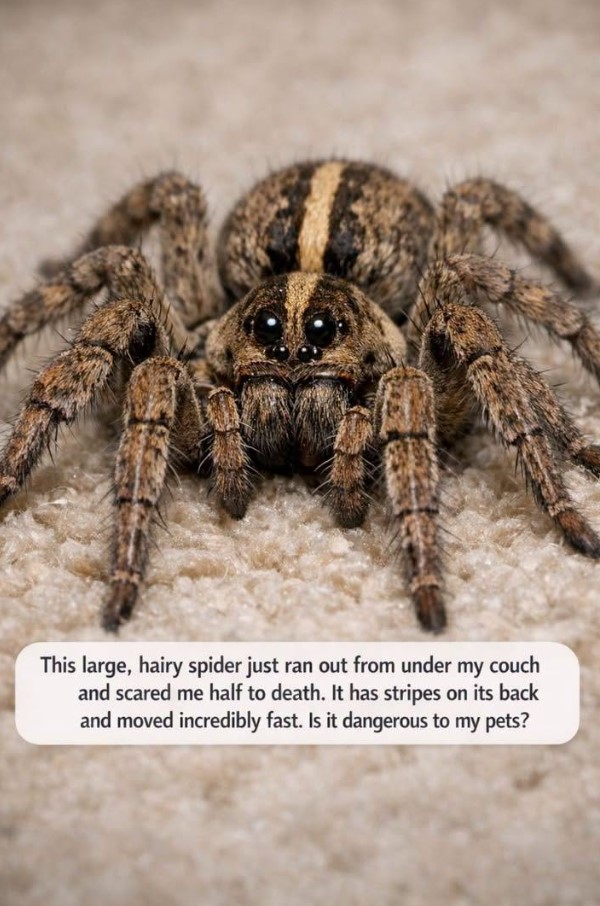
A spider with a hairy body, noticeable stripes, and incredibly fast movements may be a wolf spider. These spiders are active hunters rather than web-builders. They usually spend their time outdoors searching for insects, but they can occasionally wander into homes.
Although their appearance can be intimidating, wolf spiders are generally not considered dangerous to people or pets. However, it is still important to avoid handling an unfamiliar spider and to watch your animals if they have been playing with it.
Understanding what this spider might be, how it behaves, and what to do if your pet encounters one can help you handle the situation calmly and safely.
1. First Things First: Stay Calm When a Large Spider Runs Across the Floor
A fast-moving spider can make an ordinary moment at home feel like an emergency. You might instinctively reach for a shoe or try to chase it, but taking a moment to stay calm is a better first step.
Keep your distance and prevent pets and children from approaching the spider. Dogs may try to sniff it, while curious cats might attempt to catch it with their paws. This can put both the animal and the spider in a defensive situation.
If possible, observe the spider without touching it. Take note of its body shape, color, approximate size, leg length, and markings. A clear photograph taken from a safe distance can also be useful if you later need help identifying it.
Remember that running away is a common defensive response among spiders. A spider that suddenly darts under furniture is usually trying to find somewhere to hide, not chasing you or your pets.
2. Could It Be a Wolf Spider?
One possible explanation is a wolf spider, a member of the Lycosidae family. Wolf spiders are known for their relatively large, hairy bodies and their ability to move quickly while hunting.
Unlike spiders that build webs to catch flying insects, wolf spiders actively search for food. They hunt small insects and other tiny creatures, often moving across the ground rather than waiting in a web.
Their appearance varies depending on the species. Many are brown, gray, or dark-colored, with stripes or other markings along their bodies. Their strong legs and hairy appearance can make them look much larger than people expect.
Wolf spiders are generally solitary. Seeing one does not automatically mean there is an infestation or that a nest is hiding somewhere in your living room.
It is important to remember that appearance alone cannot confirm the species. Several different spiders can look hairy, striped, and fast-moving. A photograph and information about where the spider was found can help an experienced identifier make a more reliable assessment.
3. How to Recognize a Wolf Spider
There are several features that may help distinguish a wolf spider from other common spiders.
A hairy, sturdy body: Wolf spiders usually have a relatively robust body covered in short hairs. Their appearance is often less delicate than that of spiders with thin bodies and long, narrow legs.
Brown or gray coloring: Many species have shades of brown, gray, or black, sometimes with lighter and darker patterns that help them blend into their surroundings.
Stripes and markings: Some wolf spiders have noticeable lines running along the length of their bodies. These markings can make them look striped from above.
Quick movements: Wolf spiders are active hunters. They can move rapidly across floors, soil, and other surfaces while searching for prey or escaping danger.
No prey-catching web: Unlike many familiar house spiders, wolf spiders do not rely on a web to catch insects. They hunt directly.
Wolf spiders can vary considerably in size. Some are relatively small, while others have a body length of several centimeters and a much larger appearance when their legs are included.
If you see a large spider with these characteristics, a wolf spider is one possibility, but it should not be treated as a confirmed identification without a closer examination.
4. Are Wolf Spiders Dangerous to Dogs and Cats?
This is probably the most important question for pet owners. The reassuring news is that wolf spiders are generally not considered medically dangerous to dogs and cats.
They do possess venom, as many spiders do, but they use it mainly to subdue small prey. They are not known for seeking out pets or attacking larger animals.
Most wolf spiders would rather escape than confront a dog or cat. However, a spider may bite defensively if it is trapped, squeezed, or repeatedly disturbed.
A curious pet could also try to catch or eat the spider. This is why it is sensible to separate your animals from an unfamiliar spider rather than allowing them to investigate.
The risk depends on the actual spider species and the circumstances of the encounter. Since not every large, striped spider is a wolf spider, it is best not to assume that an unidentified spider is harmless.
5. What Happens If a Wolf Spider Bites Your Pet?
A bite from a wolf spider is not usually expected to cause serious problems, but any suspected spider bite deserves attention if your pet develops unusual symptoms.
Possible local signs include:
- Mild redness around the affected area.
- Slight swelling.
- Tenderness or discomfort.
- Licking, scratching, or paying unusual attention to one spot.
The severity of a reaction can vary. Some animals may show little or no noticeable reaction, while others may be more sensitive.
It is also important not to assume that every unexplained swollen area or skin irritation is a spider bite. Other insects, skin conditions, injuries, and allergic reactions can produce similar signs.
If you believe your pet has been bitten, contact a veterinarian for advice. Do not apply household chemicals, human creams, or medication unless a veterinary professional recommends them.
6. Warning Signs That Mean Your Pet Needs Veterinary Attention
Although serious reactions are not expected from an ordinary wolf spider encounter, certain symptoms should never be ignored.
Contact a veterinarian promptly if your pet develops:
Difficulty breathing: Breathing problems can indicate a serious reaction and require immediate veterinary attention.
Severe or rapidly increasing swelling: Swelling around the face, mouth, or throat is particularly concerning.
Repeated vomiting: Vomiting after a suspected bite or exposure should be discussed with a veterinarian.
Unusual weakness or lethargy: If your pet becomes unusually tired, weak, or difficult to engage, seek professional advice.
Severe pain or distress: Persistent crying, limping, restlessness, or sensitivity around an area may indicate a problem that needs examination.
If your pet collapses, struggles to breathe, or shows signs of a severe reaction, seek emergency veterinary care immediately.
Do not wait for symptoms to become worse if your animal appears seriously unwell. A veterinarian can assess the situation and decide whether treatment is needed.
7. Why Wolf Spiders Can Actually Be Helpful Around Your Home
Even though many people would prefer not to see a spider in their living room, wolf spiders can play a useful role in the environment.
They are natural predators of insects and help keep certain small pest populations under control. Their diet may include flies, crickets, and other insects they can catch.
Because they hunt rather than build large webs in corners, they may not be as noticeable as other spiders. They generally spend their time searching for food in outdoor areas such as gardens, lawns, and spaces beneath rocks or leaves.
Finding one indoors does not necessarily mean your home is dirty. It may simply have wandered inside while looking for shelter or following potential prey.
If you find a wolf spider outside, leaving it alone is usually a reasonable choice. It can continue its natural role without creating a problem inside your home.
8. How to Remove a Spider Safely Without Harming Your Pets
If the spider has entered your living room, you may prefer to remove it rather than leave it hiding under the couch.
First, move your pets into another room and close the door. This prevents them from approaching while you deal with the spider.
If you feel comfortable doing so, you can use a clear glass or sturdy container and a piece of stiff paper or cardboard.
- Place the container carefully over the spider without touching it.
- Slide the cardboard slowly underneath until the spider is contained.
- Keep the cardboard firmly against the opening.
- Carry the container outside while keeping it level.
- Release the spider in a suitable outdoor area away from your home’s entrance.
Do not attempt this method if the spider looks unfamiliar, you cannot identify it, or you are uncomfortable getting close to it. A professional pest-control service can help with removal when necessary.
Avoid crushing the spider with bare hands or trying to pick it up. Even a species that is usually harmless may bite if it feels trapped.
Also be careful with insect sprays. Many pest-control products can be harmful to pets if they come into contact with treated surfaces or inhale the chemicals. Always follow product instructions and keep animals away from treated areas.
9. Simple Ways to Reduce Spiders Inside Your Home
You cannot completely prevent every spider from entering a house, but a few practical habits can make indoor encounters less likely.
Seal small openings: Check around doors, windows, pipes, and other openings. Repair gaps where spiders and insects might enter.
Install or repair window screens: Damaged screens can provide an easy route indoors for insects and spiders.
Keep areas under furniture clean: Dust, clutter, and undisturbed corners can provide hiding places. Regularly cleaning beneath couches, beds, and cabinets helps make these areas less attractive.
Reduce clutter: Cardboard boxes, unused items, and piles of belongings can create sheltered spaces where spiders may hide.
Control insects: Since spiders feed on insects, reducing the number of insects inside your home can make it less attractive to hunting spiders.
Store pet food properly: Keep food in sealed containers and clean up leftover food to avoid attracting insects.
Check doors and windows: Make sure weather stripping and door sweeps fit properly, especially around exterior entrances.
These simple measures can help reduce unwanted visitors without relying on unnecessary chemical treatments.
10. Common Myths About Wolf Spiders
Wolf spiders have a frightening reputation, partly because of their size, hair, and quick movements. However, several common beliefs about them are misleading.
Myth: Wolf spiders chase people and pets.
They are active hunters, but that does not mean they deliberately pursue humans or household animals. Their quick movements are generally related to hunting or escaping.
Myth: Every large, hairy spider is dangerous.
Size and hairiness do not automatically indicate danger. Many large spiders are not considered medically significant. Identification depends on several physical features, not appearance alone.
Myth: Finding one spider means there are hundreds nearby.
A single wandering spider does not prove that an infestation exists. Wolf spiders are generally solitary hunters, and one may simply have entered by accident.
Myth: Wolf spiders catch insects with large webs.
They are active hunters and do not depend on prey-catching webs in the same way as many other spider species.
Myth: You should always kill a spider as soon as you see it.
If a spider can be safely identified and relocated, there is often no need to kill it. Keeping a safe distance and removing it carefully can protect both your household and the spider.
11. When Should You Call Pest Control?
Finding one spider under the couch usually does not require professional pest control. In many cases, it is simply an accidental visitor that can be removed safely.
However, professional help may be useful if you repeatedly find large spiders indoors, discover many spiders in different rooms, or cannot identify a spider that concerns you.
It is particularly important to seek expert identification if you suspect a species that may be medically significant in your region.
A pest-control professional can inspect possible entry points, identify conditions that attract insects and spiders, and recommend appropriate measures. If you have pets, tell the professional so that any treatment can be selected and applied with their safety in mind.
You do not need to panic because of one unexpected encounter, but repeated sightings are a good reason to investigate further.
Conclusion
Finding a large, hairy spider racing out from under your couch can certainly be frightening, especially when your dog or cat is nearby. Its stripes, sturdy body, and incredible speed may make it look dangerous, but these characteristics can also fit a wolf spider, a type of active hunter that generally avoids people and larger animals.
Wolf spiders are not usually considered a serious threat to household pets. They prefer to hunt small insects and escape when disturbed rather than confront dogs or cats. Still, an unfamiliar spider should never be handled carelessly, and pets should be kept away until it has been safely removed.
If your animal has been in contact with the spider, watch for unusual symptoms and contact a veterinarian if you suspect a bite or notice swelling, vomiting, breathing difficulties, weakness, or significant discomfort.
A few simple household habits can also reduce the chances of another surprise visitor. Seal gaps around doors and windows, clean beneath furniture, reduce clutter, and keep insects under control.
Most importantly, remember that a frightening appearance does not automatically mean a dangerous animal. A calm approach, careful identification, and a little prevention can help keep your home comfortable while protecting the pets who share it with you.