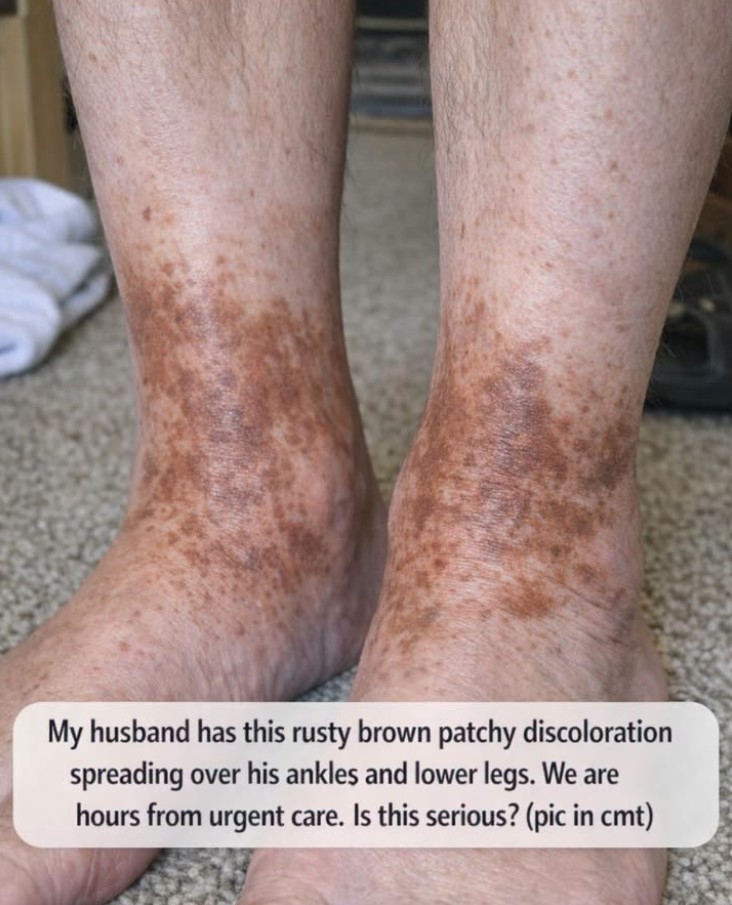
Noticing an unusual change in your husband’s skin can be frightening, especially when the discoloration seems to be spreading and the nearest urgent care facility is hours away. A rusty brown or reddish-brown color around the ankles and lower legs may look alarming, but what does it actually mean?
One possible explanation is a circulation condition called chronic venous insufficiency. It occurs when the veins in the legs have difficulty moving blood back toward the heart. Over time, this can cause blood to collect in the lower legs, leading to swelling, skin irritation, and brownish discoloration.
However, not every brown patch on the legs has the same cause. Some skin changes may be related to circulation problems, while others can indicate infection, a blood clot, or reduced arterial blood flow.
The important thing is knowing which symptoms can wait for a medical appointment and which ones require immediate attention.
Let’s look at what may cause this rusty brown discoloration, what warning signs to watch for, and what steps can be taken safely while arranging medical care.
1. What Could Cause Rusty Brown Discoloration Around the Ankles?
One common possibility is chronic venous insufficiency, a condition that affects the veins responsible for returning blood from the legs to the heart.
Healthy leg veins contain small one-way valves that help blood travel upward. When these valves become weak or damaged, blood can begin collecting in the lower legs instead of circulating efficiently.
This creates increased pressure inside the veins. Eventually, fluid can leak into nearby tissues, causing swelling around the ankles and lower legs.
Tiny blood vessels may also leak small amounts of blood into the surrounding skin. As the blood cells break down, an iron-containing pigment called hemosiderin can remain in the skin.
This pigment may create a rusty, reddish-brown, or tea-stained appearance.
The discoloration can develop gradually and may become more noticeable over time.
It is important to remember that this is only one possible explanation. A healthcare professional needs to examine the skin and consider the person’s medical history before identifying the actual cause.
2. Why Does the Discoloration Often Begin Around the Ankles?
The ankles are particularly vulnerable to circulation-related skin changes because gravity makes it harder for blood to travel back toward the heart.
When someone spends many hours standing or sitting with their legs hanging down, pressure can build up in the veins of the lower legs.
This is why chronic venous insufficiency often affects the area around the ankles first.
The discoloration may gradually extend toward the lower calves. It can appear as irregular brown patches rather than one clearly defined spot.
Other changes may develop alongside the discoloration, including:
- Swelling around the ankles, especially later in the day.
- Skin that feels tight or stretched.
- Dryness and persistent itching.
- Reddish-brown or purplish areas.
- Skin that becomes thicker or firmer.
- Visible varicose veins.
Both legs may be affected, although one side can look worse than the other.
If these symptoms are present, it is worth arranging a medical evaluation rather than assuming the discoloration is simply an ordinary skin change.
3. Who Is More Likely to Develop Chronic Venous Insufficiency?
Chronic venous insufficiency can develop for several reasons. It is more common as people get older, but it can affect younger adults too.
Some factors that may increase the risk include:
Older age: The valves inside the veins can become weaker over time, making circulation less efficient.
Long periods of standing: People whose jobs require them to stand for many hours may experience increased pressure in the veins of their lower legs.
Prolonged sitting: Spending long periods sitting without moving can also reduce the effectiveness of the calf muscles that help push blood upward.
Varicose veins: Enlarged, twisted veins may be associated with damaged valves and poor venous circulation.
Previous blood clots: A history of deep vein thrombosis can damage the valves inside the affected veins.
Excess body weight: Carrying additional weight can increase pressure on the veins in the legs.
Having one or more of these risk factors does not automatically mean someone has chronic venous insufficiency. It simply makes a proper assessment more important.
4. Signs That May Suggest a Circulation Problem
Brown discoloration is only one possible symptom. Other changes can provide additional clues about what is happening in the legs.
For example, swelling that becomes worse toward the evening and improves after a night’s rest can occur with venous insufficiency.
Some people also describe their legs as feeling unusually heavy, tired, or achy after standing or walking for extended periods.
Other possible signs include:
- Deep marks left by socks around the ankles.
- Itchy or dry skin near the lower legs.
- Visible enlarged veins.
- Swelling that returns regularly.
- Brown staining around the inner ankle.
- Areas of skin that feel unusually firm.
In more advanced cases, the skin may become fragile and develop open sores, particularly around the inner ankle.
These changes deserve medical attention because untreated venous problems can gradually lead to more serious skin damage.
5. When Is It Probably Not an Immediate Emergency?
Not every case of slowly developing brown discoloration requires an ambulance or an immediate trip to the emergency department.
If the skin changes have developed gradually over several weeks or months, and the person otherwise feels well, chronic venous insufficiency may be one possible explanation.
However, the absence of severe symptoms does not mean the condition should be ignored.
A medical appointment should still be arranged to identify the cause and determine whether treatment is needed.
If there is noticeable swelling, increasing itching, tenderness, skin cracking, or fluid leaking from the affected area, the evaluation should happen sooner.
The most important distinction is between a gradual skin change and a sudden change accompanied by other concerning symptoms.
When symptoms develop rapidly or the person’s general condition worsens, waiting simply because the discoloration looks brown rather than red is not safe.
6. Warning Signs That Mean You Should Not Wait
This is the most important section for anyone living far from urgent care.
Certain symptoms alongside leg discoloration can indicate conditions that need immediate medical attention.
Sudden swelling in one leg
If one leg suddenly becomes much more swollen than the other, especially when the calf is painful, warm, or tender, a deep vein thrombosis (DVT) is a possibility.
A DVT is a blood clot that forms in a deep vein, usually in the leg. It requires urgent medical assessment.
Chest pain or sudden shortness of breath
A blood clot can sometimes travel to the lungs, causing a potentially life-threatening condition called pulmonary embolism.
Sudden difficulty breathing, chest pain, coughing up blood, or fainting requires emergency medical help immediately.
Red, hot, painful skin with fever
If the affected area becomes increasingly red, warm, swollen, and painful, particularly when accompanied by fever or chills, a skin infection such as cellulitis may be responsible.
This needs prompt medical evaluation.
Blackened skin or severe foot pain
Black or dying-looking skin, severe foot pain, unusually cold toes, or signs of poor blood flow should never be ignored.
An infected-looking open wound
A new ulcer, spreading redness around a wound, pus, or rapidly worsening skin damage also requires prompt medical attention.
If any of these warning signs appear, do not wait for a routine appointment. Contact emergency services or seek emergency care, even if the nearest facility is far away.
7. How Can You Tell the Difference Between Venous Problems, Cellulitis, and a Blood Clot?
Several conditions can affect the appearance of the lower legs, but they do not always develop in the same way.
Understanding some of the differences can help you recognize when a medical assessment is particularly urgent.
Chronic venous insufficiency
This condition often develops gradually. It may cause brown discoloration around the ankles, swelling, itching, heaviness, and visible varicose veins.
It can affect both legs, although one may be more noticeable.
Cellulitis
Cellulitis is a bacterial skin infection. It often develops more quickly and causes an area of skin to become red, warm, swollen, and painful.
Fever, chills, and feeling generally unwell may also occur.
Deep vein thrombosis
A DVT may cause sudden swelling, pain, tenderness, and warmth, usually affecting one leg.
It cannot be reliably diagnosed or excluded by looking at the skin. Medical assessment and ultrasound testing may be necessary.
Poor arterial circulation
Arterial circulation problems are different from venous insufficiency. They can cause cold feet, pale or bluish toes, weak pulses, and pain when walking that improves with rest.
Because compression can be unsafe for some people with significant arterial disease, circulation should be assessed before starting compression treatment.
These conditions can sometimes share symptoms, so an online description cannot replace a medical examination.
8. What Can You Safely Do at Home While Waiting for Medical Care?
If your husband is otherwise stable and has none of the emergency warning signs described above, a few simple measures may help him remain comfortable while arranging an appointment.
These steps do not treat the underlying cause or replace medical care.
Elevate the legs
When resting, encourage him to lie down and place pillows beneath his calves so his legs are comfortably raised above heart level.
Elevating the legs for around 20 to 30 minutes may help reduce swelling associated with venous circulation problems.
If this causes pain or discomfort, stop and seek medical advice.
Encourage gentle movement
Avoid remaining seated in the same position for hours.
If he feels well enough to walk, short, gentle walks around the house can encourage the calf muscles to help move blood through the veins.
Gentle ankle movements, such as pointing the toes downward and then pulling them upward, may also help.
However, sudden painful swelling in one leg requires urgent assessment rather than trying to manage it with exercise.
Keep the skin clean and moisturized
Dry or itchy skin can become irritated and fragile.
A plain, fragrance-free moisturizer may help protect intact skin. Avoid scratching the affected areas because small breaks in the skin can increase the risk of infection.
If there are open wounds, leaking areas, or signs of infection, ask a healthcare professional how to care for them.
Avoid prolonged standing or sitting
When possible, change positions regularly.
If he normally spends long periods standing, sitting down for short breaks may help. If he spends most of the day sitting, gentle movement can be beneficial when it is safe to do so.
9. Should He Start Wearing Compression Stockings?
Compression stockings are commonly used to help manage swelling associated with chronic venous insufficiency.
They apply controlled pressure to the legs, helping support venous blood flow and reduce fluid buildup.
However, they are not suitable for everyone.
Before starting compression stockings, it is important to establish whether the person has adequate arterial circulation.
This is particularly important for someone with diabetes, a history of smoking, known peripheral artery disease, cold feet, weak foot pulses, or pain when walking.
A clinician may recommend an ankle-brachial index test to assess blood flow in the legs before prescribing compression.
The strength and type of compression also matter.
For these reasons, it is better not to start tight compression stockings or wrap the legs firmly without professional guidance.
Simple leg elevation and gentle movement are generally safer temporary measures when there are no emergency symptoms.
10. Home Treatments That Should Be Avoided
When medical facilities are far away, it can be tempting to try different home remedies.
However, some treatments may irritate the skin or make an existing problem worse.
Avoid the following:
Tight elastic bandages: Wrapping the legs too tightly or unevenly can create pressure problems and potentially worsen circulation.
Harsh cleaning products: Hydrogen peroxide, bleach, alcohol, and other harsh substances should not be applied to irritated skin or open wounds without medical instructions.
Heating pads: Heat can cause burns, particularly when skin is damaged, numb, or has reduced sensation.
Aggressive scrubbing: Brown discoloration caused by hemosiderin is pigment within the skin. It is not dirt and cannot simply be scrubbed away.
Unprescribed steroid creams: Using strong steroid creams without knowing the cause of the skin changes can hide symptoms or worsen certain skin conditions.
The safest approach is to protect the skin, avoid unnecessary treatments, and arrange an appropriate medical assessment.
11. When Should He See a Doctor?
If the discoloration has developed slowly and there are no emergency symptoms, he should still arrange a medical appointment.
The appropriate timing depends on the symptoms.
If the skin changes are stable and there is no significant swelling, pain, or skin damage, a routine appointment within the next one to two weeks may be reasonable.
If there is substantial swelling, increasing itching, inflammation, cracking, or fluid leaking from the skin, he should be assessed sooner, ideally within a few days.
If any emergency warning signs develop, do not wait for a routine appointment.
A primary care clinician can begin the evaluation and refer him to a vascular specialist or dermatologist if needed.
Before the appointment, it may help to write down:
- When the discoloration first appeared.
- Whether one leg or both legs are affected.
- Whether the patches are spreading.
- Whether swelling is worse in the evening.
- Whether he experiences pain, itching, or heaviness.
- Whether he has a history of blood clots or varicose veins.
- Any existing medical conditions.
- All medications and supplements he takes.
Taking photographs of the affected areas over several days can also help document changes, provided doing so does not delay medical care.
12. What Tests Might the Doctor Recommend?
A healthcare professional will usually begin with a physical examination.
They may compare both legs, check for swelling, warmth, tenderness, varicose veins, and changes in the skin.
They may also examine the feet to assess pulses, temperature, and signs of reduced arterial circulation.
Depending on the findings, several tests may be considered.
Venous duplex ultrasound
This test uses sound waves to examine blood flow through the veins. It can help identify problems with the vein valves and assess whether a blood clot is present.
Ankle-brachial index
This test compares blood pressure measured at the ankle with blood pressure measured in the arm. It helps evaluate arterial circulation in the legs.
Blood tests
Depending on the person’s medical history and other symptoms, the doctor may recommend tests to assess kidney function, liver function, or other possible causes of swelling.
The exact tests depend on the examination and the suspected underlying condition.
13. How Is Chronic Venous Insufficiency Usually Treated?
If chronic venous insufficiency is confirmed, treatment usually focuses on improving circulation, controlling swelling, and protecting the skin.
The treatment plan may include several approaches.
Compression therapy
When appropriate and medically safe, compression stockings can help reduce swelling and support blood flow toward the heart.
Regular movement
Walking and exercises that activate the calf muscles can help support venous circulation.
Leg elevation
Raising the legs while resting may help reduce fluid buildup around the ankles.
Skin care
Moisturizers and appropriate treatment for inflammation can help prevent dryness, itching, and skin damage.
Weight management
For people carrying excess weight, gradual weight management may help reduce pressure on the veins.
Specialist treatment
If an ultrasound reveals significant vein valve problems or enlarged veins, a vascular specialist may discuss procedures such as endovenous ablation or sclerotherapy.
These treatments aim to address problematic veins and improve circulation.
The appropriate approach depends on the severity of the condition and the person’s overall health.
14. What Happens If the Condition Is Ignored?
Chronic venous insufficiency is not usually an immediate emergency, but that does not mean it should be ignored.
Without appropriate care, the skin changes can gradually become worse.
The brown discoloration may darken or spread, while the skin becomes increasingly dry, itchy, thick, and fragile.
Some people develop a condition called stasis dermatitis, which causes inflammation and irritation of the skin around the lower legs.
In more advanced cases, the tissue beneath the skin can become hardened, a condition known as lipodermatosclerosis.
Open sores called venous ulcers may also develop, particularly around the inner ankle.
These wounds can be difficult to heal and may remain open for long periods without appropriate treatment.
Early assessment is important because managing circulation problems and protecting the skin may help reduce the risk of further complications.
15. The Most Important Thing to Remember If You Live Far From Urgent Care
If your husband has slowly developing rusty brown discoloration around his ankles and lower legs, chronic venous insufficiency is one possible explanation, particularly if he also experiences swelling, heaviness, or visible varicose veins.
However, the color alone cannot establish the diagnosis.
If he is otherwise feeling well and has no warning signs, arrange a medical evaluation soon rather than assuming the discoloration is harmless.
While waiting, gentle movement, comfortable leg elevation, and basic skin care may help.
But if he develops sudden swelling in one leg, severe pain, a hot and rapidly reddening area, fever, chest pain, shortness of breath, blackened skin, or an infected-looking wound, seek urgent medical help.
Living far from medical facilities makes it especially important to recognize the difference between symptoms that can be assessed through a scheduled appointment and those that should never be ignored.
Conclusion: Should You Be Worried About Rusty Brown Patches on the Lower Legs?
Seeing brown patches spreading around your husband’s ankles can naturally cause concern, especially when getting medical attention involves a long journey.
The good news is that chronic venous insufficiency is a possible explanation for this type of gradual discoloration. It is a condition that can often be managed with appropriate medical care, lifestyle changes, and skin protection.
However, it is important not to assume that every brown or reddish patch is caused by poor venous circulation. Skin infections, blood clots, arterial circulation problems, and other conditions can produce changes in the legs that require different treatments.
Pay attention to how quickly the discoloration develops, whether one or both legs are affected, and whether there is swelling, pain, warmth, or skin damage.
Most importantly, do not allow the distance to urgent care to delay emergency treatment if serious warning signs appear.
A medical examination is the best way to understand what is happening and decide which treatment is appropriate. Taking action early can help protect the skin, reduce discomfort, and prevent certain circulation-related complications from becoming more difficult to manage.
A final reminder: This article is for general educational purposes only. It cannot diagnose a medical condition or replace advice from a qualified healthcare professional. If symptoms are sudden, severe, or worsening, seek medical attention promptly.