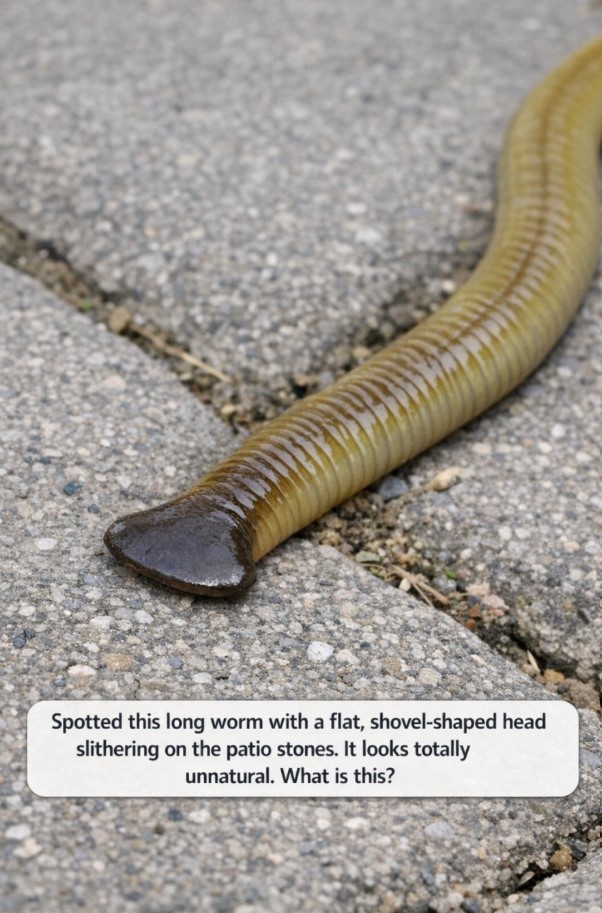
Finding an unusual creature moving across your patio can be surprising, especially when it looks unlike the typical worms or insects you’re used to seeing. A long, slender, worm-like animal with a flattened, shovel-shaped head can look almost “unnatural” at first glance. But many such sightings are common, natural animals that have adapted to life in gardens and yards.
Creatures like this are often overlooked or misunderstood because their appearance is different from what we normally expect. Instead of being a cause for alarm, these animals generally play a role in the ecosystem — whether by helping soil stay healthy or eating unwanted pests.
In this article, we’ll explore the most likely explanations for what this creature could be, how to identify it safely, and what to do if you encounter it on your patio or in your yard.
What the Creature Might Be
A long, worm-like animal with a flattened, shovel-shaped head is usually one of the following:
1. A Flatworm or Planarian
Flatworms are soft-bodied invertebrates that often appear in moist environments. They can be long, thin, and smooth, and some species have a head that looks slightly broader or flatter than the rest of the body.
- These animals are not harmful to people.
- They feed on tiny organisms and help break down decaying matter.
- Flatworms are more common in damp areas and under stones or leaf litter.
2. A Larval Insect Stage (Beetle or Fly Larva)
Some insect larvae, especially those of ground beetles or certain types of flies, can appear long and worm-like. They may have a slightly flattened head or body adapted for crawling under surfaces.
- These larvae often stay close to soil or decaying plant material.
- They may be present after rain or in shaded, moist areas.
3. A Species of Worm
There are also true worms that don’t look like the typical round earthworm. Some soil-dwelling worms can have flattened heads used for burrowing more efficiently.
- These are usually beneficial for soil health.
- They help aerate the ground and assist in breaking down organic material.
How to Identify It :
To understand what you’ve found, look at these details:
Body Shape and Texture
- Does it have a smooth, soft body?
- Is it segmented like an earthworm, or uniform like a ribbon?
Planarians and flatworms have a uniform body, while insect larvae may show slight segment breaks.
Head Shape
- A flattened or shovel-like head often suggests an animal adapted for moving through soil or tight spaces.
- True worms usually have a rounded front rather than a broad, flat head.
Movement
- Slow, gliding motion on moist surfaces may point toward flatworms.
- Wriggling with defined muscle contractions may suggest earthworms or larvae.
Environment where it was found
- Was it near damp stone, mulch, or plant beds? Moist or shaded areas are common homes for these creatures.
- Dry, sunny spots are less likely to host soft-bodied animals for extended periods.
These clues can help narrow down which type of animal it is without needing close inspection.
Safety and Handling Advice
Most animals that fit this description are harmless and play a role in the outdoor environment. Still, it’s good to follow simple precautions:
1. Avoid Touching Directly
Even harmless animals may secrete substances or attract dirt. Use a stick or leaf to gently move it aside if necessary.
2. Watch Where You Step
Soft-bodied creatures can be fragile. If you want to clear them from a patio or walkway, encourage them to move rather than squashing them.
3. Wear Gloves if Needed
When moving stones or working in moist soil, gloves protect your hands from dirt and minimize contact with unseen creatures.
4. Leave It in the Yard
Most of these animals help the environment by feeding on decaying matter, controlling pests, or improving soil structure. Unless it’s a pest species, letting it continue its role in the ecosystem is beneficial.
Conclusion :
Seeing a long, worm-like creature with a flat, shovel-shaped head on your patio may look unusual at first, but in most cases it’s a harmless and natural part of your outdoor environment. Common possibilities include flatworms, invertebrate larvae, or soil-dwelling worms — all of which are adapted to moist, shaded places and contribute to the balance of your yard’s ecosystem.
Identifying the creature can be as simple as observing its head shape, body form, and movement. Most of the time, these animals do not pose any danger to people or pets. Handling them gently, if necessary, and leaving them in a suitable outdoor spot supports the natural processes in your garden.
Understanding these small but interesting parts of nature gives you a deeper appreciation for the variety of life in your backyard and helps remove the surprise factor when unexpected visitors turn up on your patio.