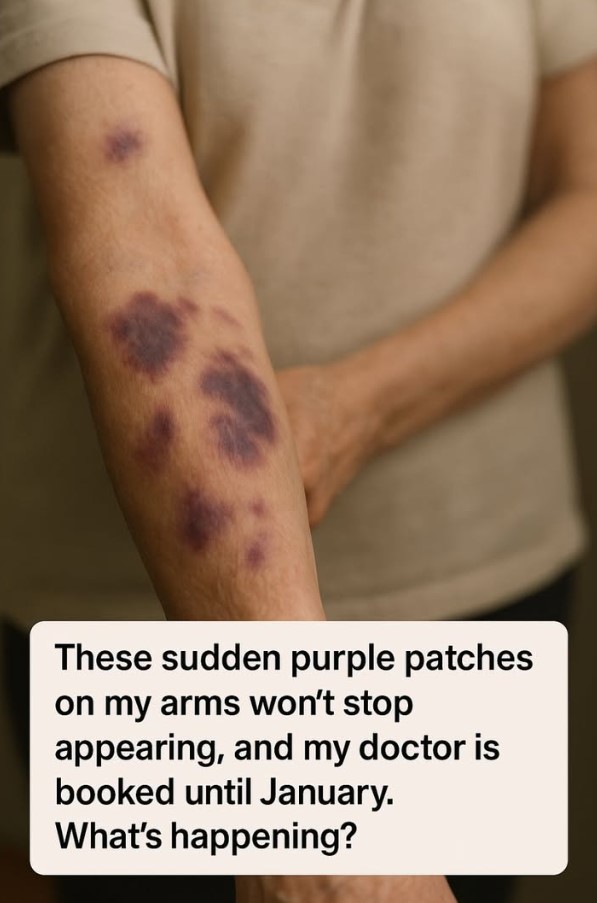
You look down at your arms and notice something that wasn’t there before — purple patches, almost like bruises, but you don’t remember bumping into anything. At first, you shrug it off. Then another one appears. And another. Suddenly, it feels like they won’t stop showing up. To make matters worse, your doctor can’t see you for weeks.
If this sounds familiar, you’re not alone. This exact situation worries a lot of people, especially when changes appear on the skin without an obvious explanation. The good news is that many causes of sudden purple patches on the arms are common, non-serious, and related to natural changes in the skin, particularly with age or sensitivity. Still, it’s completely understandable to feel uneasy while waiting for answers.
Let’s talk calmly and clearly about what may be going on
Why purple patches appear on the skin at all
Purple patches on the skin usually have one simple explanation: blood beneath the surface.
Under your skin is a network of tiny blood vessels. When very small vessels break or leak, blood can pool just under the skin, creating purple, reddish, or bluish areas. These marks often look like bruises, even if no clear injury occurred.
What surprises many people is that this can happen without pain, swelling, or memory of trauma. Everyday activities — leaning on a counter, carrying groceries, brushing against furniture — can sometimes be enough, especially if the skin has become more delicate.
Why the arms are such a common place for these patches
People often ask, “Why my arms?” And there’s a very practical reason.
The skin on the arms:
- Is thinner than skin on many other parts of the body
- Has less cushioning fat underneath
- Is exposed to sunlight more than most areas
- Experiences frequent minor bumps during daily life
Over time, all of this adds up. The blood vessels under the skin become easier to damage, and the skin itself doesn’t “bounce back” the way it used to. This makes the arms a prime location for purple patches to appear.
Aging skin plays a major role (even if you feel healthy)
One of the most common and least talked-about reasons for sudden purple patches is normal skin aging.
As the years go by:
- Skin becomes thinner
- Elasticity decreases
- The supportive tissue around blood vessels weakens
When this happens, blood vessels break more easily, even from very light pressure. The result can be purple patches that look dramatic but are often harmless.
Many people first notice these changes in midlife or later and are surprised because they otherwise feel perfectly healthy. Skin changes often appear before we expect them to.
Why the patches may keep appearing
It can be especially stressful when the marks don’t seem like a one-time thing. One fades… then another shows up.
This usually happens because:
- The underlying skin fragility is still present
- Daily activities continue to place mild stress on the arms
- Healing may take longer than it used to
So while older patches fade, new ones can appear, making it feel like the problem never stops — even though each individual patch is resolving on its own timeline.
Medications can make bruising more visible
Another common contributor is medication. Some medications don’t cause purple patches directly but can make them more noticeable when tiny blood vessels leak.
This can happen because certain medications:
- Affect how blood clots
- Reduce inflammation in ways that thin the skin
- Change how the body responds to minor vessel damage
If you take regular medications, this is something a healthcare provider will usually consider when evaluating skin changes.
What these purple patches usually feel like
One reason these patches cause anxiety is that they often:
- Don’t hurt
- Aren’t itchy
- Appear suddenly
- Look darker than expected
Because there’s no pain or clear injury, the brain fills in the gaps — and worry grows. But in many cases, the lack of pain or other symptoms is actually reassuring.
What they usually are NOT
It’s easy to jump to worst-case scenarios, especially when waiting weeks for an appointment. But in many cases, these patches are not:
- A sign of infection
- A sign of something contagious
- Caused by something you did wrong
- An emergency
They are often related to skin fragility, circulation at the surface level, or minor vessel leakage, not a dangerous internal problem.
When it’s reasonable to be more alert
While many purple patches are harmless, it’s still important to pay attention to your body.
It’s a good idea to make note of things like:
- How often new patches appear
- Whether they fade over time
- If they are painless or tender
- Whether they stay mostly on the arms
You should be especially mindful if patches:
- Appear rapidly all over the body
- Are accompanied by pain, warmth, or swelling
- Come with other unusual symptoms
Keeping simple notes or photos can be helpful when you finally see your doctor.
Why waiting for a doctor can feel so stressful
The hardest part for many people isn’t the patches themselves — it’s the waiting.
Uncertainty triggers anxiety. When something visible appears on your body and you can’t get immediate reassurance, your mind naturally searches for answers. This is completely human.
Understanding that many people experience these same symptoms — and that they often turn out to be manageable or benign — can help reduce that stress while you wait.
Gentle, everyday habits that support skin health
Without offering treatment or medical advice, there are general habits that support skin comfort and resilience:
- Being gentle with your arms during daily activities
- Keeping skin moisturized to reduce dryness and fragility
- Protecting arms from excessive sun exposure
- Staying hydrated
These steps don’t “fix” purple patches instantly, but they support overall skin health and comfort.
A calm perspective while you wait
Seeing unexplained changes on your skin can be unsettling, especially when you feel stuck waiting for answers. But in many cases, sudden purple patches on the arms are a visible sign of skin sensitivity or aging, not a sign that something is seriously wrong.
You’re doing the right thing by planning to see a doctor. In the meantime, understanding what’s likely happening can ease worry and help you feel more grounded.
Final thoughts
Our skin tells a story about our lives — time, movement, sun exposure, and change. Sometimes it does so in ways that catch us off guard. Sudden purple patches can look alarming, but they’re often part of how skin changes and adapts over time.
Until your appointment arrives, remember this: you’re not alone, you’re not imagining things, and in many cases, there is a simple explanation. Awareness, patience, and professional guidance — when it becomes available — are the best path forward.