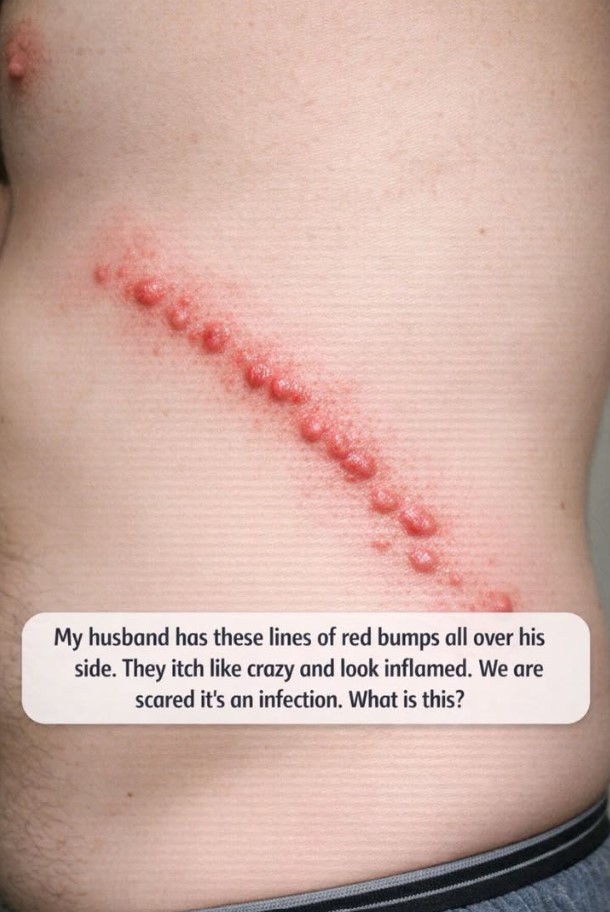
Noticing a sudden outbreak of red bumps on the skin—especially when they appear in lines or clusters and itch intensely—can be alarming. When the rash looks inflamed and keeps spreading, it’s natural to worry that it might be an infection or something serious.
Rashes like this are actually quite common, but the pattern (lines), the location (side of the body), and the intense itching can point to a few specific causes. Some are harmless and temporary, while others may need medical attention.
Let’s break down what this could be and how to tell the difference.
What does a rash in “lines” usually mean?
When bumps appear in lines or streaks, it often suggests something touched or irritated the skin directly.
This pattern is a key clue doctors use.
It usually points to:
- Contact with a plant or chemical
- An allergic skin reaction
- Something brushing or dragging across the skin
1. Most likely cause: contact dermatitis (skin reaction)
The most common explanation is contact dermatitis.
This happens when the skin reacts to:
- Plants (like poison ivy-type reactions)
- Soaps, detergents, or chemicals
- Fabrics, fragrances, or metals
Symptoms include:
- Red bumps or patches
- Intense itching
- Sometimes blisters or swelling
And importantly:
The rash often appears exactly where the skin touched the irritant, sometimes forming lines or streaks.
This is why people often see linear patterns—for example, from brushing against something.
2. Another possibility: insect bites (especially in lines)
Some insect bites appear in clusters or lines.
Common examples:
- Bedbugs
- Fleas
These bites can:
- Be very itchy
- Appear in rows or groups
- Show up overnight
If the bumps appeared suddenly (especially after sleeping), this is worth considering.
3. Could it be shingles? (important to rule out)
Because the rash is on the side of the body, some people worry about shingles.
Shingles typically:
- Appears on one side of the body
- Follows a band or line along nerves
- Starts with tingling or pain before the rash
However, key difference:
- Shingles is usually painful or burning, not just itchy
From real-world discussions, people often note that shingles causes deep nerve pain, not just surface itching.
If it’s mainly itchy (not painful), shingles is less likely—but still possible.
4. Allergic or irritant reaction from clothing or products
Sometimes the cause is surprisingly simple:
- New laundry detergent
- Tight clothing rubbing the skin
- Sweat + friction
These can trigger a rash that:
- Appears in specific areas (like the side)
- Forms patterns where fabric touches
- Itches intensely
5. Less common causes
Other possibilities include:
- Heat rash (especially in warm, sweaty areas)
- Eczema flare-ups
- Mild skin infections
These are usually less patterned but can still cause clusters of bumps.
🚨 When should you be concerned?
Most itchy rashes are not dangerous—but you should seek medical advice if:
- The rash is spreading quickly
- It becomes painful instead of itchy
- Blisters form or ooze
- There is fever or fatigue
- It doesn’t improve within a few days
Also, if it clearly follows a band on one side with pain, shingles should be checked early.
What you can do right now
✔️ Avoid scratching
Scratching can worsen irritation and lead to infection
✔️ Wash the area gently
Use mild soap and lukewarm water
✔️ Try soothing options
- Cool compress
- Anti-itch creams (like hydrocortisone)
✔️ Think about recent exposures
- New soap, clothes, plants, or environments
Identifying the trigger is key to stopping the rash.
The bottom line
A rash with itchy red bumps in lines is most commonly caused by a skin reaction (contact dermatitis) or possibly insect bites—not necessarily a serious infection.
The pattern itself is an important clue: it often means something touched the skin rather than something spreading internally.
Still, it’s important to watch how it evolves. If it becomes painful, spreads rapidly, or doesn’t improve, it’s best to have it checked by a healthcare professional.
Conclusion :
While a sudden, itchy rash like this can look alarming, the good news is that most causes are treatable and not dangerous. The key is paying attention to the pattern, symptoms, and how the rash changes over time.
In many cases, the body is simply reacting to something external—like a plant, fabric, or chemical—and once that trigger is removed, the skin begins to heal.
However, because some conditions can look similar at first, it’s always better to stay cautious. If anything feels unusual or worsens, getting medical advice early can provide peace of mind and faster relief.