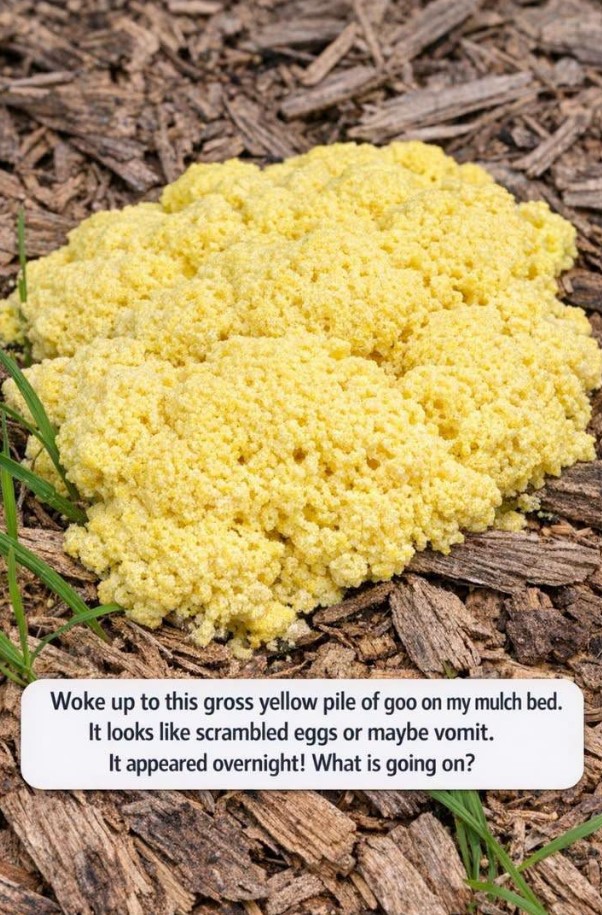
You step outside in the morning, coffee in hand, ready to admire your garden—only to discover what looks like a bright yellow pile of scrambled eggs sitting in your mulch. It seems to have appeared out of nowhere overnight, and its strange, foamy texture makes it look more like spilled food or animal vomit than anything natural.
While this mysterious blob may look alarming, there’s no need to panic. What you’re seeing is almost certainly a fascinating organism known as dog vomit slime mold. Despite its unpleasant nickname and bizarre appearance, this unusual growth is generally harmless and actually plays an important role in the natural ecosystem of your garden.
If you’ve ever wondered what this strange yellow mass is, why it suddenly appears after rain, and whether you should remove it, here’s everything you need to know.
The Mystery Behind the Bright Yellow Blob
One of the most surprising things about this yellow growth is how quickly it appears. Many gardeners report going to bed with perfectly normal mulch only to wake up and find a softball-sized mound of bright yellow foam.
Its rapid appearance often causes concern because it seems almost impossible that something this large could develop overnight.
In reality, slime molds spend most of their lives hidden within decaying organic matter. Under the right environmental conditions, they suddenly emerge into their visible reproductive stage, creating the eye-catching mass that surprises homeowners.
The transformation can happen in just a matter of hours.
Meet Dog Vomit Slime Mold
The scientific name for this organism is Fuligo septica, although most gardeners know it by its unforgettable common name: dog vomit slime mold.
Despite its appearance, it is neither a fungus nor an animal.
Instead, slime molds belong to a unique group of organisms that behave differently from plants, fungi, and animals. During one stage of their life cycle, they exist as a giant single cell containing millions of nuclei. This unusual structure allows them to slowly move across surfaces while searching for food.
Although movement is extremely slow—often only a few millimeters per hour—it is enough to allow the organism to explore mulch, leaf litter, and decaying wood.
Why Does It Suddenly Appear?
Several environmental conditions encourage slime mold to emerge.
These include:
- Warm temperatures
- High humidity
- Recent rainfall
- Heavy watering
- Thick layers of mulch
- Decaying organic material
Fresh wood mulch provides an especially attractive habitat because it retains moisture while offering plenty of microorganisms for the slime mold to feed upon.
This explains why many homeowners notice the yellow blob shortly after adding new mulch or following several rainy days.
Is It Dangerous?
Fortunately, the answer is no.
Dog vomit slime mold is considered harmless to:
- People
- Pets
- Trees
- Flowers
- Shrubs
- Vegetable gardens
- Lawns
It doesn’t infect living plants or steal nutrients from their roots.
Instead, it feeds on bacteria, fungi, and microscopic organisms living within decaying organic matter.
Unlike plant diseases, slime mold isn’t attacking your garden—it’s simply helping recycle natural materials already breaking down.
Can It Hurt Your Plants?
This is one of the biggest misconceptions surrounding slime mold.
Many gardeners assume the yellow mass is suffocating their flowers or causing nearby plants to wilt.
In reality, healthy plants are usually unaffected.
The slime mold sits on the surface of mulch rather than invading plant tissues. Occasionally, if it covers very small seedlings completely, it might temporarily block sunlight until removed, but established plants rarely experience any problems.
Once the slime mold disappears, the plants continue growing normally.
Why Does It Look So Strange?
Dog vomit slime mold goes through several fascinating stages.
When it first appears, it usually looks:
- Bright yellow
- Puffy
- Moist
- Foamy
- Soft like scrambled eggs
Over the next several days, it begins changing color and texture.
It may become:
- Pale yellow
- Tan
- Brown
- Gray
- Powdery
- Dry and crusty
Eventually, it releases microscopic spores into the air before breaking apart naturally.
After this process, it often disappears almost as mysteriously as it arrived.
How Long Will It Stay?
The good news is that slime mold rarely sticks around for very long.
Depending on weather conditions, most patches disappear within several days to about two weeks.
Dry weather speeds up the process considerably.
Rainy, humid conditions may allow it to persist a bit longer before eventually drying out.
In many cases, nature handles the cleanup without any intervention from the homeowner.
Should You Remove It?
Removal is entirely optional.
If the appearance bothers you, you can simply:
- Scoop it up with a shovel
- Use a rake to break it apart
- Dispose of it in yard waste
- Turn over the mulch to expose it to air
There’s usually no need for chemical sprays or fungicides.
Since slime molds aren’t true fungi, fungicides generally provide little benefit and are unnecessary for managing the problem.
Many gardening experts recommend simply letting nature take its course.
Can It Come Back?
Yes.
If your garden continues providing favorable conditions—warm temperatures, moisture, and organic mulch—you may see slime mold return from time to time.
However, each appearance is temporary.
Seeing it once doesn’t necessarily mean you’ll have recurring outbreaks every season, although some gardens experience it periodically after wet weather.
How to Reduce Future Appearances
While eliminating slime mold completely isn’t practical, you can reduce the chances of seeing it by making your garden slightly less inviting.
Helpful strategies include:
Avoid Overwatering
Water only as much as your plants need.
Constantly saturated mulch creates ideal conditions for slime mold development.
Improve Airflow
Trim overcrowded shrubs and plants to increase air circulation around mulch beds.
Faster drying discourages prolonged moisture buildup.
Turn the Mulch Occasionally
Raking or fluffing mulch helps it dry more evenly and reduces consistently damp pockets.
Use Mulch in Moderate Depths
A mulch layer of about two to three inches is generally sufficient for moisture retention while reducing excessive dampness.
Surprisingly Helpful for Your Garden
Although most people want to remove slime mold immediately, it actually contributes to a healthier garden ecosystem.
By feeding on bacteria and helping break down organic matter, it supports the natural decomposition process that eventually enriches soil.
It also serves as part of the complex web of organisms that keep garden environments functioning properly.
Rather than being an invader, it’s simply another participant in nature’s recycling system.
Other Strange Things You Might Find in Mulch
Mulch creates an environment where many unusual organisms thrive.
Besides slime molds, gardeners sometimes encounter:
- Bird’s nest fungi
- Mushrooms
- Puffballs
- Tiny cup fungi
- Moss
- Lichens
Most are harmless and simply indicate that the organic material is naturally decomposing.
Their appearance is often a sign that the mulch is biologically active rather than unhealthy.
When Should You Be Concerned?
Although slime mold itself isn’t dangerous, there are a few situations where further investigation may be worthwhile.
If you notice nearby plants showing symptoms such as severe wilting, blackened stems, root rot, or widespread leaf discoloration, the problem is likely unrelated to the slime mold and may involve watering issues, pests, or plant diseases.
Similarly, if a mysterious substance has a strong chemical odor, appears oily, or is accompanied by signs of contamination, it could be something other than slime mold and should be examined more closely.
Otherwise, the classic yellow, foamy mass found on mulch after warm, wet weather is almost always harmless.
Conclusion :
Finding a bright yellow pile of goo in your mulch bed can certainly be startling. At first glance, it resembles scrambled eggs, expanding foam, or even animal vomit, making many homeowners worry that something harmful has invaded their garden. Fortunately, this strange-looking growth is usually nothing more than dog vomit slime mold—a harmless organism that thrives in moist, mulch-rich environments.
Although its appearance is dramatic, it poses no threat to people, pets, or healthy plants. In fact, it quietly contributes to your garden by helping break down organic material and recycling nutrients back into the soil. Within a few days, it will typically dry out, change color, release its spores, and disappear on its own with little or no intervention.
The next time you discover this unusual yellow visitor, there’s no need to panic or reach for harsh chemicals. Whether you choose to leave it alone or simply rake it away for cosmetic reasons, you can feel confident knowing it’s a natural part of a healthy garden ecosystem. Sometimes the strangest sights in nature are also the most fascinating, reminding us that our gardens are full of hidden life working behind the scenes—even if it occasionally looks a little bizarre at first glance.