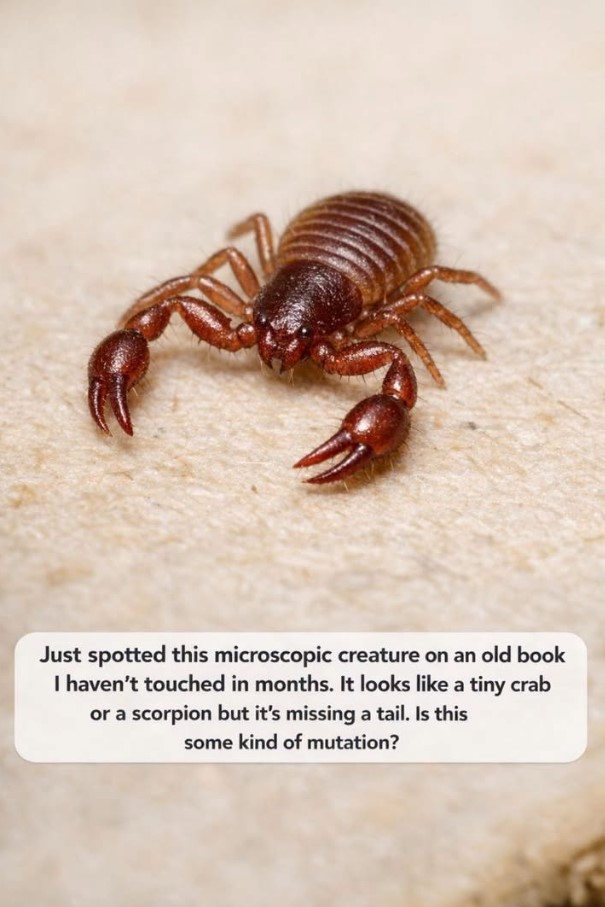
Finding an unfamiliar creature crawling across an old book, dusty shelf, or forgotten storage box can be enough to make anyone pause. When that creature resembles a miniature scorpion or tiny crab—complete with large pincers but no tail—it can seem even more mysterious. At first glance, many people assume they’ve discovered a dangerous pest or a strange mutation. Fortunately, the reality is much less alarming. This fascinating little arachnid is most likely a pseudoscorpion, one of nature’s smallest and most beneficial predators. Despite its intimidating appearance, it’s harmless to people and pets and can actually help keep your home free of unwanted pests.
Meet the Pseudoscorpion
The tiny creature in the photo is commonly known as a pseudoscorpion, sometimes called a book scorpion or false scorpion.
Although it resembles a scorpion, it lacks the long tail and venomous stinger that most people associate with its larger relatives. Instead, it belongs to its own unique group of arachnids, sharing ancestry with spiders, ticks, mites, and true scorpions.
Most pseudoscorpions measure only 2 to 5 millimetres long, making them so small that they’re often overlooked unless they happen to crawl across a light-colored surface.
Why Does It Look Like a Tiny Scorpion?
The resemblance is no coincidence.
Like true scorpions, pseudoscorpions have:
- Eight legs
- Large claw-like pincers (called pedipalps)
- A segmented body
- Strong hunting instincts
However, unlike true scorpions, they have: - No tail
- No stinger
- No ability to sting humans
Their oversized pincers help them capture prey rather than defend themselves from people.
Why Was It on an Old Book?
Old books provide an ideal hiding place.
Bookshelves, storage boxes, and paper collections often attract tiny insects such as:
- Booklice
- Dust mites
- Small insect larvae
- Tiny beetles
Pseudoscorpions hunt these creatures, making libraries and bookshelves an excellent feeding ground.
Finding one on a neglected book usually means it was searching for food—not damaging the book itself.
Are They Dangerous?
Not at all.
Despite their fierce appearance, pseudoscorpions are completely harmless to humans.
They:
- Cannot sting
- Rarely bite
- Do not spread diseases
- Do not infest homes like cockroaches or termites
- Do not damage furniture or fabrics
Even if one were handled, its tiny claws are generally too small to break human skin.
Nature’s Tiny Pest Controller
One reason scientists and entomologists appreciate pseudoscorpions is their appetite for household pests.
They commonly feed on:
Dust Mites
One of the most common microscopic creatures found in homes.
Booklice
Tiny insects that feed on mould growing on paper and cardboard.
Carpet Beetle Larvae
Young beetles capable of damaging natural fibres.
Small Flies and Gnats
Whenever they can catch them.
Mite Species
Including some that may become household nuisances.
By eating these organisms, pseudoscorpions help maintain a healthier indoor environment naturally.
How Do They Hunt?
Despite their tiny size, they’re surprisingly effective predators.
They wait patiently until prey comes close before quickly grabbing it with their powerful pincers.
Their pedipalps contain small venom glands used to immobilize tiny insects.
This venom is harmless to humans but highly effective against prey only a fraction of their size.
After capturing food, they inject digestive enzymes before consuming the liquefied contents.
Can They Live Inside Homes?
Yes.
They commonly live in:
- Basements
- Attics
- Bookshelves
- Closets
- Storage rooms
- Garages
- Under bark outdoors
- Leaf litter
- Bird nests
- Tree hollows
They prefer dark, quiet places where humidity is slightly higher than average.
How Do They Get Inside?
Because they’re incredibly small, they can enter through:
- Open windows
- Tiny wall cracks
- Firewood
- Cardboard boxes
- Potted plants
- Books
- Packages
Some even hitch rides on larger insects through a behaviour called phoresy.
They grab onto flies or beetles using their pincers and travel to entirely new locations before letting go.
Are They Rare?
Not at all.
Pseudoscorpions are found on every continent except Antarctica.
Scientists have identified more than 3,500 species, with many more still being discovered.
Because they’re so tiny and secretive, most people simply never notice them.
Should You Remove One?
In most situations, there’s no need.
If you find one:
- Gently relocate it outside if you prefer.
- Avoid crushing it.
- Leave it alone if it’s in a quiet corner.
It won’t damage your belongings and may actually reduce populations of unwanted insects.
When Should You Be Concerned?
The presence of a single pseudoscorpion usually isn’t a problem.
However, if you’re seeing many of them, it may indicate that their food source is abundant.
That could mean:
- High humidity
- Mould growth
- Large numbers of booklice
- Dust mite populations
- Other tiny insects
Addressing moisture issues often reduces these prey populations naturally.
Keeping Your Home Less Attractive to Tiny Pests
If you’d like to discourage both household pests and the predators that feed on them, good home maintenance is key.
Helpful habits include:
Reduce Humidity
Use a dehumidifier in damp rooms and repair any water leaks promptly.
Keep Shelves Clean
Dust bookshelves and storage areas regularly to reduce food sources for booklice and mites.
Store Books Properly
Keep books in dry, well-ventilated spaces rather than damp basements or garages.
Improve Ventilation
Allow fresh air to circulate, especially in rooms prone to moisture buildup.
Inspect Stored Boxes
Cardboard boxes stored for years can attract insects that become prey for pseudoscorpions.
Fascinating Facts About Pseudoscorpions
- Some species can live for several years.
- Mothers carry eggs in a special brood pouch until they hatch.
- Young pseudoscorpions remain with their mother briefly after birth.
- Some species produce silk from glands in their jaws to build tiny protective shelters for moulting or overwintering.
- They have existed for hundreds of millions of years, surviving alongside dinosaurs and countless other ancient creatures.
Why They’re Often Mistaken for Something Dangerous
Their appearance is undeniably dramatic. Large pincers, a segmented body, and quick movements make them look intimidating despite their tiny size. Because most people are unfamiliar with pseudoscorpions, they often assume they’re baby scorpions, venomous spiders, or even mutated insects. In reality, these harmless arachnids are simply one of nature’s lesser-known helpers, quietly hunting pests without causing any trouble for humans.
Conclusion
Discovering a tiny creature that looks like a miniature scorpion can certainly be startling, especially when it appears unexpectedly on an old book or inside your home. However, in most cases, there’s no reason to panic. A pseudoscorpion is not a dangerous invader or a bizarre mutation—it’s a fascinating arachnid that has been part of Earth’s ecosystems for millions of years. Despite its fierce appearance, it poses no threat to people, pets, or property and instead spends its time hunting tiny pests that many homeowners would rather not have around.
Rather than viewing these tiny hunters as unwelcome guests, it’s worth appreciating the important role they play in nature. They help keep populations of booklice, mites, and other microscopic insects under control, acting as a natural form of pest management without the need for chemicals. Their presence can even be a reminder to check for excess moisture or hidden insect activity, making them more of an indicator than a problem.
The next time you spot one of these unusual creatures, take a closer look before reaching for a tissue or insect spray. You may be looking at one of the smallest and most efficient predators in the natural world—a remarkable little arachnid that quietly helps maintain balance in its environment. Sometimes the strangest-looking visitors turn out to be the most beneficial, proving once again that appearances can be wonderfully deceiving.