The Doctor Refused to Let Them Hide the Truth
Dr. Mercer waited until the door closed behind Graham.
Then he pulled his stool closer to my bed.
“You have three fractured ribs on the left side,” he said. “One of them is displaced. The CT also shows bruising around your lung. You need to remain here for observation.”
For a moment, I couldn’t speak.
The pain had been real from the second I hit the bottom of those stairs, but hearing the injuries described aloud made everything suddenly more concrete.
Three fractured ribs.
A bruised lung.
The marks on my back.
This wasn’t something I could simply shake off the next morning and pretend had never happened.
Dr. Mercer pointed toward the long red pressure mark across my upper back.
“I also want this documented exactly as you described it,” he said carefully. “I can’t tell you who caused it based on the injury alone, but your account needs to be recorded accurately.”
I swallowed.
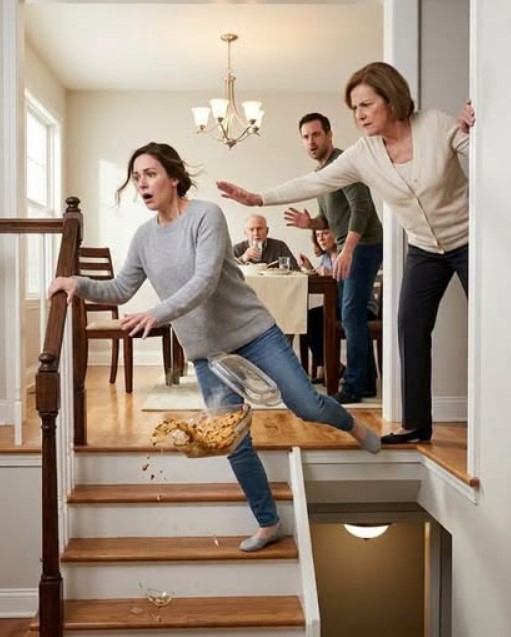
“My mother-in-law pushed me.”
He nodded.
The nurse then asked me a question I hadn’t expected.
“Do you want your husband to remain in the room?”
I looked toward the closed door.
I could hear Graham speaking quietly in the hallway.
He was talking to someone on his phone.
“She’s upset,” he said. “She’s confused right now. I think everyone just needs to calm down.”
My stomach tightened.
Even now, he was trying to soften the truth.
I closed my eyes.
“No,” I said. “Please keep him outside.”
It was a small sentence.
But it was the first decision I’d made that night without looking at Graham first.
Then I Saw the Message
The nurse brought me my purse.
My phone was inside.
I had seven missed calls from Judith.
There were also dozens of messages in the family group chat.
Most were asking what had happened.
Some were already defending Judith.
I opened the conversation and froze.
Graham had sent a message while I was inside the CT scanner.
Mom didn’t mean to push Nora. Please don’t make this bigger than it is.
I stared at the screen.
He had just told the entire family that his mother had pushed me.
Yet minutes earlier, he had told hospital staff that I had slipped.
He knew the truth.
He had known from the beginning.
Before I could say anything, raised voices came from the hallway.
The door opened.
Judith walked into the room.
She was still wearing the cream cardigan she’d had on during dinner. There was a dark stain near the bottom of it from the casserole that had shattered when I fell.
She stopped when she saw me.
Her eyes moved from my cut sweater to the medical equipment beside the bed.
Then she looked at Dr. Mercer.
Her face suddenly lost its color.
“Tell them I never touched you,” she said.
I didn’t answer.
Instead, I held up my phone.
Graham’s message was still glowing on the screen.
Judith looked at it.
Then she looked at her son.
For the first time that night, the story she had been trying to control had slipped beyond her reach.
“Graham,” she said sharply.
He stood in the doorway.
His mouth opened.
Nothing came out.
Judith stared at him.
“Graham.”
He looked at the message again.
Then he looked at me.
Finally, in a voice so quiet I almost didn’t hear it, he said:
“She pushed you.”
The room went completely still.
Graham Finally Told the Truth
Judith stared at him as though he had betrayed her.
“You weren’t even downstairs.”
“I was at the doorway,” Graham said.
His voice was shaking.
“I saw your hand on her back.”
My heart sank.
He hadn’t merely suspected what happened.
He had seen it.
He had watched his mother put her hands on me.
He had heard me fall.
And afterward, instead of protecting me, he’d tried to turn what happened into an accident.
All those hours in the emergency room suddenly made sense.
His panic hadn’t been because he didn’t know what happened.
It was because he knew exactly what happened and was afraid of what would happen to his mother.
Dr. Mercer remained calm.
He didn’t lecture anyone.
He simply told Graham and Judith that they needed to leave so the medical staff could continue treating me.
Judith refused.
She accused me of trying to destroy her family.
She said I had always been dramatic.
Then she pointed toward my back.
“That mark could have come from anything.”
The nurse stepped between her and my bed.
“You need to leave the room.”
Judith looked at Graham.
He reached toward her arm.
She pulled away immediately.
Before she walked out, she looked directly at me.
“You will regret this.”
I believed her.
That frightened me.
Because some part of me had spent years believing that keeping Judith happy was safer than confronting her.
But another thought was stronger.
I knew I would regret lying even more.
I Chose to Make a Report
The nurse asked whether I wanted to speak with someone about making an official report.
My first instinct was still to look toward Graham.
That habit had become automatic.
Whenever something went wrong, I looked at him.
Whenever Judith became angry, I waited for him to explain.
Whenever I questioned myself, I searched his face for reassurance.
But this time, I didn’t.
“Yes,” I said.
The process wasn’t dramatic.
There was no shouting.
No dramatic confrontation.
Just questions.
Lots of them.
Where had I been standing?
What had Judith said?
Where had her hand made contact?
Which step had I missed?
What happened when I reached the bottom?
I answered every question as accurately as I could.
I didn’t exaggerate.
I didn’t need to.
My injuries were already telling part of the story.
The medical staff photographed the visible bruising with my permission and recorded the pressure mark on my back.
I also showed them Graham’s message.
The words were simple, but they mattered.
Mom didn’t mean to push Nora. Please don’t make this bigger than it is.
He had admitted what happened while simultaneously trying to minimize it.
Graham Came Back Alone
It was close to midnight when Graham was allowed back into my room.
Judith had already left.
He didn’t approach my bed.
He stood near the wall instead.
For years, that had been where Graham seemed to position himself whenever his mother hurt someone.
Close enough to know.
Far enough to claim he couldn’t do anything.
“I panicked,” he said.
“So you lied.”
He looked down.
“I was trying to keep everyone calm.”
“I was lying at the bottom of a staircase.”
His eyes filled with tears.
“She is still my mother.”
I looked at him.
“And I am still your wife.”
He had no answer.
For years, I had mistaken his quietness for stability.
I remembered the ordinary things he did.
He packed my lunch when I worked late.
He kept jumper cables in my car.
He remembered how I liked my coffee.
He checked the weather before long drives.
Those things had made me believe he was dependable.
But I finally understood something.
Being dependable when life was easy wasn’t enough.
The real test came when everything went wrong.
And when his mother pushed me down those stairs, Graham had chosen the version of peace that required me to stay silent.
He Told Me Why He Was Afraid
Graham eventually told me about growing up with Judith.
He said she could punish him with silence for weeks whenever he disagreed with her.
She could cry suddenly, become ill, accuse him of abandoning her, or make him feel responsible for her emotions.
His father had taught him to apologize before anyone even decided what had happened.
I had seen pieces of that behavior over the years.
I had watched Judith make Graham feel guilty whenever he established a boundary.
But understanding where his fear came from didn’t make what happened to me acceptable.
“You saw her push me,” I said.
He nodded.
“And then you told the nurse I slipped.”
He started crying.
I didn’t.
The pain medication had dulled some of the physical pain, but nothing could dull the fact between us.
“Are you going to tell the truth if they ask you again?”
He stared at the floor.
“Yes.”
“Even if your mother cuts you off?”
His face tightened.
“Yes.”
I wanted to believe him.
But trust didn’t return just because someone finally said the right thing.
The Night Changed Everything
Around two in the morning, my oxygen level dropped.
The nurse adjusted my position and checked me again.
Every movement hurt.
Graham stood up to help.
“Don’t touch me.”
He immediately sat back down.
That was the first boundary I had ever set with him that he respected without arguing.
By morning, the bruising on my side had spread.
Dr. Mercer explained that the lung bruising appeared stable, but I needed another night of observation.
He warned me not to rush my recovery.
Graham asked if he could take me home after discharge.
“No,” I said.
I called a coworker instead.
I asked if I could stay in her spare room.
She didn’t ask me to explain everything.
She simply said:
“I’ll be there.”
Graham heard the conversation.
He looked like he wanted to object.
But he said nothing.
The Family Could No Longer Pretend
Later that morning, messages began appearing in the family group.
One relative admitted she had seen Judith follow me toward the basement.
Another said she had heard Judith accuse me of turning Graham against her before I went downstairs.
Neither person had helped me when I was lying on the concrete.
Now they were apologizing from the safety of their homes.
Their messages didn’t erase what happened.
But they mattered.
For years, everyone had behaved as though Judith’s version of events was the only version that could survive.
That was finally changing.
Then Graham wrote another message.
I saw my mother put her hand on Nora’s back. Nora did not slip.
Judith responded almost immediately.
She called him ungrateful.
Then she accused me of controlling him.
A few minutes later, she left the family group.
For once, the truth remained after Judith walked away.
I Left the Hospital Without Graham
I spent another night in the hospital.
Graham slept in a chair in the hallway because I didn’t want him in my room.
At one point, he told me he had nowhere else to go.
I looked at him.
“I can’t solve that for you while I’m still struggling to breathe.”
He nodded.
When I was finally discharged, my coworker came to pick me up.
She brought a clean sweatshirt, a cup of coffee, and a pillow to put between my body and the seat belt.
Graham was waiting near the exit with my overnight bag.
He handed it to my coworker rather than trying to put it in his own car.
“I’m sorry,” he said.
“I know.”
It wasn’t forgiveness.
It was simply an acknowledgment that I’d heard him.
I left with my coworker.
I didn’t go back to Judith’s house.
I didn’t go home with Graham.
I went somewhere I could finally breathe without wondering who might be waiting behind me.
Recovery Changed More Than My Ribs
The next six weeks were difficult.
Medication.
Follow-up appointments.
Short walks.
Sleeping upright because lying flat was too painful.
Even ordinary movements became reminders of the staircase.
Sometimes footsteps behind me made me freeze.
Sometimes the sound of something falling in the kitchen sent my heart racing.
My coworker never demanded explanations.
She simply helped.
Graham moved into a short-term rental.
He continued sending messages, but I responded only when something practical needed to be discussed.
He paid the medical expenses that insurance didn’t cover.
More importantly, he gave a formal statement confirming what he had eventually admitted.
Judith continued trying to reach me through relatives.
First, she called the incident an accident.
Then it became a misunderstanding.
Then it was described as a private family matter.
Every version had the same purpose.
I was supposed to protect her from the consequences of what she had done.
I stopped answering.
The Evidence Spoke for Itself
The case moved slowly.
There wasn’t one dramatic courtroom scene where everyone suddenly understood everything.
There were interviews.
Medical records.
Statements.
Messages.
My medical chart documented the fractured ribs, the lung bruising, and the pressure mark on my back.
It also contained the account I had given before anyone had time to coordinate another version.
Graham’s message showed that he knew his mother had pushed me.
His later statement confirmed what he had witnessed.
The relatives’ accounts supported what had happened before the fall.
Eventually, Judith’s attorney advised her to stop insisting that nobody had touched me.
Months later, the matter was resolved with probation, counseling, restitution toward my medical expenses, and an order preventing Judith from contacting me.
She never apologized directly.
Her written statement described the incident as a family disagreement that had become physical.
Even then, she couldn’t simply say:
I pushed her.
She still tried to make the staircase part of the story.
Graham and I Were Finished
Graham and I separated permanently.
He asked me to attend counseling with him.
I told him he needed counseling whether I ever returned to the marriage or not.
For once, he didn’t make his personal growth something I had to promise to reward.
He began talking honestly about the way he had spent his life managing his mother’s emotions.
Then he admitted something else.
He remembered smaller incidents that had happened before the staircase.
A time when Judith had held my wrist too tightly during Thanksgiving.
A moment when she had blocked a doorway during an argument.
A disturbing joke about accidents happening to women who didn’t respect their elders.
Graham had treated each incident as something separate.
Because if he admitted they were connected, he would have had to make a choice.
That realization hurt almost as much as his lie at the hospital.
I filed for divorce.
This time, Graham didn’t fight me.
One Year Later
Almost a year after the fall, the final divorce paperwork arrived.
My ribs had healed.
One spot still ached whenever the weather changed, but the worst of the physical pain was gone.
I had moved into a small apartment.
There were stairs.
At first, I hated them.
I gripped the railing so tightly that my fingers went numb.
Whenever someone walked behind me, my body would tense.
But slowly, the stairs became ordinary again.
One Sunday, the coworker who had taken me from the hospital came over with two friends.
She brought a casserole in a simple glass dish.
We sat around my kitchen table and ate together.
Nobody watched what I said.
Nobody corrected my memory.
Nobody asked me to stay quiet to protect someone else’s feelings.
When dinner was over, my friend picked up the casserole dish.
“Where do you want this?”
I looked toward the refrigerator.
“Right there.”
She placed it safely on the middle shelf.
It was such a small thing.
A dish being carried from one room to another without fear.
A Sunday dinner ending without someone getting hurt.
For the first time in a long time, I realized how much ordinary safety had meant to me.
What “Keep It in the Family” Means to Me Now
For months, Graham’s words had stayed in my head.
Let’s keep it in the family.
I understand them differently now.
Keeping something in the family can sound like loyalty.
Sometimes it is used to make silence feel noble.
But silence had protected Judith.
It had protected Graham from confronting his fear.
It had protected everyone at that dinner from having to admit what they had witnessed.
It had not protected me.
The truth did something different.
The truth forced Graham to finally face what he had seen.
It allowed the medical staff to document what happened.
It gave other relatives permission to stop pretending.
And most importantly, it allowed me to stop carrying responsibility for someone else’s actions.
I used to think family meant protecting one another from consequences.
Now I believe something different.
Family should be the place where you don’t have to beg someone to tell the truth.
It should be the place where your pain isn’t minimized because acknowledging it makes someone uncomfortable.
And it should never be the place where violence is hidden simply because admitting it would embarrass everyone else.
My ribs healed.
My marriage ended.
The stairs became ordinary again.
And eventually, that Sunday dinner stopped being the day my life fell apart.
It became the day I finally understood that keeping the peace is not the same thing as being safe.
Sometimes, telling the truth is the first real step toward getting your life back.