Sometimes the scariest moments begin with something completely ordinary. A strange object discovered beneath a bed, hidden in the shadows of a forgotten corner, can instantly send the imagination racing. Is it an insect? A cocoon? A strange fungus? Something left behind by a rodent? Before long, your brain has created a dozen alarming possibilities—all before you’ve had a chance to look closely.
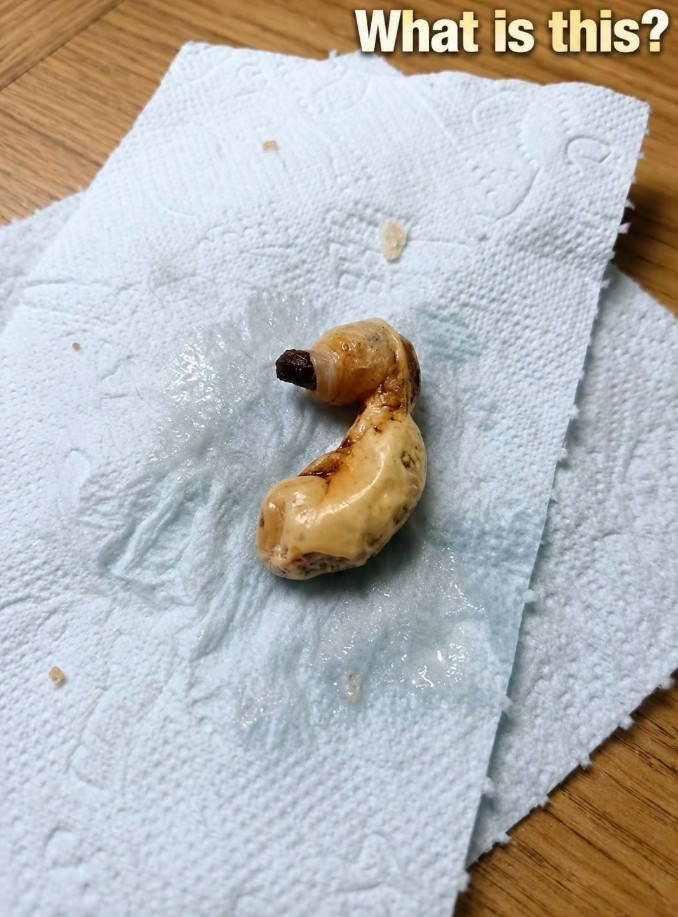
That is exactly what happened in this case. At first glance, the object in the photo appears unsettling. Curved, pale, and oddly organic, it resembles some kind of mysterious creature curled up on a paper towel. Social media users have guessed everything from an alien egg to a giant grub. Yet the truth is far less dramatic—and surprisingly funny.
As it turns out, this “monster” is simply a pistachio shell that has absorbed moisture, softened, and become coated with dust, debris, and natural oils over time. While it may look unrecognizable after spending weeks or months under furniture, it serves as a perfect reminder of how easily our minds can mistake everyday objects for something much more frightening.
Why Does It Look So Strange?
Fresh pistachio shells are hard, dry, and light beige in color. Most people recognize them instantly. However, once a shell ends up under a bed, couch, or other piece of furniture, it begins to change.
Over time, several things happen:
- Dust sticks to the shell.
- Household humidity softens its surface.
- Oils from the nut may darken portions of the shell.
- Dirt and fibers collect in its grooves.
- The shell may curl or stain unevenly.
These changes can transform a familiar snack into something that looks surprisingly biological.
The dark tip visible in the photo is often just a remaining piece of the nut or a stain that has collected dirt over time, making it appear even more mysterious.
Why Our Brains Immediately Think “Creature”
Humans evolved to notice potential dangers quickly.
Psychologists call this pattern recognition—our brains constantly compare unfamiliar shapes to things we’ve seen before.
When we encounter an object that is:
- Curved
- Pale
- Slightly shiny
- Organic-looking
our minds may instantly associate it with:
- Larvae
- Worms
- Insects
- Animal remains
- Mold
- Parasites
This rapid judgment once helped our ancestors avoid poisonous animals and dangerous environments. Today, it mostly causes us to panic over harmless objects hiding beneath the furniture.
The Power of Pareidolia
Another fascinating psychological effect is known as pareidolia.
This occurs when people perceive meaningful patterns in random objects.
Examples include:
- Seeing faces in clouds.
- Finding shapes in tree bark.
- Believing a stain resembles an animal.
- Mistaking food for living creatures.
The pistachio shell in the picture is a classic example. Its unusual curves and discoloration encourage the brain to interpret it as something alive, even though it’s simply food waste that has changed appearance over time.
Why Forgotten Food Changes Appearance
Any food left around the house begins interacting with its environment.
Depending on humidity and temperature, foods can:
- Dry out completely.
- Become soft.
- Absorb moisture.
- Change color.
- Collect dust.
- Develop harmless surface staining.
Nut shells are particularly interesting because their rough texture traps tiny particles that make them look much older than they really are.
Could It Actually Be Dangerous?
In this case, the object itself is harmless.
However, any food left hidden for extended periods can potentially:
- Attract ants.
- Encourage cockroaches.
- Draw rodents if enough food accumulates.
- Develop mold under very damp conditions.
That’s why regular cleaning beneath furniture is always a good household habit.
The shell itself isn’t dangerous—but forgotten food can sometimes invite unwanted guests.
Why Social Media Loves Photos Like This
Pictures of mysterious household discoveries spread rapidly online because they trigger curiosity.
People naturally enjoy trying to solve puzzles.
Comment sections often include guesses such as:
- Alien egg
- Giant grub
- Snake skin
- Mouse remains
- Cocoon
- Fungus
- Unknown parasite
Hours later, someone finally recognizes the object, and thousands of readers laugh at how something so ordinary caused so much confusion.
These harmless mysteries remind us how powerful first impressions can be.
Cleaning Tips When You Find Mystery Objects
If you discover an unfamiliar object while cleaning:
1. Don’t panic.
Take a closer look before assuming it’s something dangerous.
2. Use gloves if necessary.
Especially if the object has been sitting for a long time.
3. Check for nearby signs.
Look for:
- Additional food debris
- Insect droppings
- Rodent evidence
- Moisture damage
Finding only a single object usually points to an accidental spill rather than a larger problem.
4. Vacuum thoroughly.
Removing dust and crumbs helps prevent insects from becoming interested in the area.
5. Sanitize the surface.
A simple household cleaner is usually sufficient after removing old food debris.
Why We Often Fear the Unknown
One of the most fascinating aspects of this story isn’t the pistachio shell—it’s our reaction to it.
When information is incomplete, our brains often fill in the missing details with imagination.
Scientists believe this happens because our ancestors benefited from assuming an unfamiliar shape might be dangerous rather than harmless.
In other words, mistaking a pistachio shell for a grub costs nothing.
Mistaking a venomous creature for a harmless object could have been much more serious.
Our brains still use that ancient survival strategy today.
Everyday Objects That Commonly Fool People
This isn’t the only household item that regularly causes confusion.
People frequently mistake these ordinary objects for something alarming:
- Burned popcorn kernels mistaken for insects.
- Onion skins mistaken for snake skin.
- Dryer lint mistaken for mold.
- Seeds mistaken for eggs.
- Earwigs mistaken for scorpions.
- Mushroom spores mistaken for animal nests.
- Potato sprouts mistaken for strange roots.
The internet is full of photos proving that even common household items can become surprisingly mysterious under the right conditions.
Frequently Asked Questions
Is this an insect?
No. The object shown is consistent with an old pistachio shell that has changed appearance after spending time under furniture.
Why is it soft and yellow?
Exposure to humidity, oils, dirt, and dust can alter both the texture and color of natural food materials.
Should I worry if I find one?
Not usually. Simply remove it, clean the area, and check for any additional food debris.
Can old nuts attract pests?
Yes. Food scraps can attract insects or rodents if left for long periods, especially in large quantities.
How can I prevent this?
Vacuum beneath furniture regularly and avoid leaving snacks where crumbs or shells can fall into hard-to-reach places.
Conclusion :
Sometimes the biggest household mysteries turn out to have the simplest explanations. What first appeared to be a strange creature hiding beneath the bed was, in reality, nothing more than a forgotten pistachio shell that had been transformed by time, dust, and moisture. Its unusual appearance was enough to fool the eye and spark countless imaginative theories, proving just how easily ordinary objects can become unrecognizable when viewed out of context.
This story is also a fascinating reminder of how the human brain works. Our minds are wired to recognize patterns and react quickly to anything that looks unfamiliar or potentially threatening. While this instinct once helped our ancestors survive in the wild, today it often leads us to mistake harmless items for insects, parasites, or other frightening discoveries. Fortunately, taking a closer look usually reveals a far less dramatic explanation.
The next time you come across something odd while cleaning your home, resist the urge to panic. Observe it carefully, consider the most likely possibilities, and remember that everyday objects can change dramatically after weeks or months hidden beneath furniture. A little curiosity, combined with a bit of investigation, often turns a moment of worry into a good laugh—and perhaps even a story you’ll share with friends and family. After all, not every “monster” under the bed is a monster; sometimes, it’s just yesterday’s snack waiting to surprise you.