
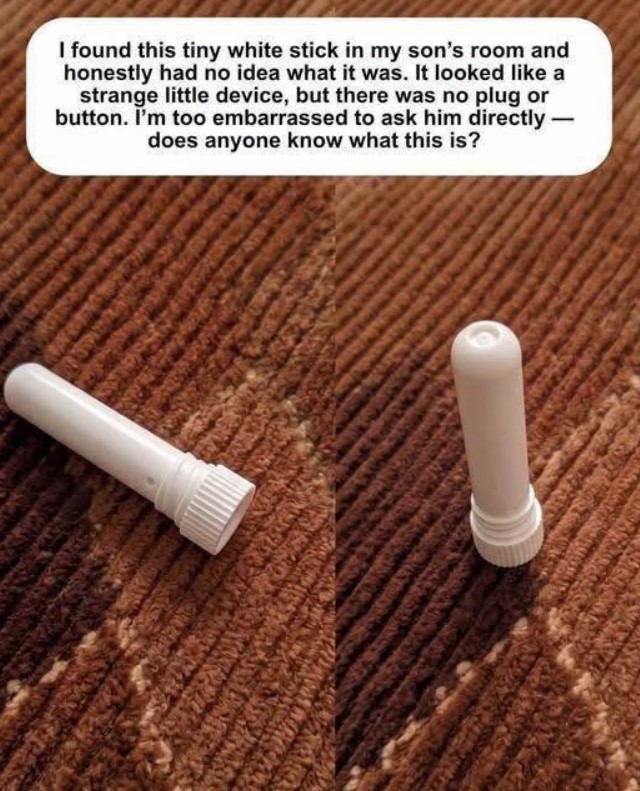
Finding an unfamiliar object in your child’s bedroom can spark all kinds of questions. When the item is small, plastic, and unlike anything you recognize, it’s easy for your imagination to jump to the worst-case scenario. Many parents have discovered mysterious gadgets, accessories, or personal care products while cleaning and have found themselves wondering whether they should ask about them—or quietly investigate first.
The tiny white tube shown in the picture is one of those items that frequently appears in online forums, where thousands of people ask the same question. At first glance, it looks like a miniature electronic device or a piece from an unknown appliance. In reality, its purpose is much more ordinary than many people expect.
Here’s what it is, why it exists, and what you should know before jumping to conclusions.
What Is the Tiny White Stick?
The object in the photo is most commonly a tampon with its plastic applicator. Specifically, it appears to be a compact or travel-sized applicator tampon before use.
When fully assembled, these products look like a small plastic tube with a rounded tip and a textured grip near the bottom. The tampon is stored safely inside the applicator until it’s ready to be used.
People who have never purchased or used menstrual products often mistake them for:
- A USB gadget
- A small medical device
- A battery component
- Lip balm packaging
- A vape accessory
- A pen refill
- A piece from a household appliance
Because they’re designed to be discreet and portable, they’re surprisingly unfamiliar to many people.
How Does It Work?
A tampon is a menstrual hygiene product designed to absorb menstrual flow internally.
The plastic applicator simply helps insert the absorbent tampon comfortably and hygienically. After insertion, the applicator is removed and discarded while the absorbent portion remains in place until it’s time for removal.
Modern applicator tampons are:
- Individually wrapped
- Sterile until opened
- Easy to carry in a purse or backpack
- Designed for single use
After use, both the tampon and applicator should be disposed of properly according to the manufacturer’s instructions.
Why Might Someone Have One?
There are many perfectly normal explanations.
Someone in the household may have:
- Purchased menstrual supplies.
- Left one behind accidentally.
- Carried one in a backpack or purse.
- Shared supplies with a friend.
- Used it for its intended purpose.
Even if the room belongs to a son, the item could easily belong to:
- A visiting relative
- A friend
- A sibling
- A girlfriend
- Someone who accidentally dropped it
Finding one doesn’t automatically reveal anything unusual or concerning.
Why Parents Often Don’t Recognize It
Many fathers—and even some mothers who use different menstrual products—have never seen certain brands or compact applicator designs.
Manufacturers produce dozens of styles, including:
- Cardboard applicators
- Plastic applicators
- Compact applicators
- Digital (applicator-free) tampons
Some modern versions are much shorter than older designs because they expand during use rather than being long from the start.
That means a compact tampon can look surprisingly unfamiliar.
Common Misunderstandings
Pictures like this regularly circulate on social media with captions encouraging people to guess what the object is.
Popular guesses include:
- A vape cartridge
- A secret recording device
- A tracking device
- A battery
- A cosmetic product
- A medical injector
The mystery often attracts thousands of comments before someone correctly identifies it as a tampon applicator.
Is It Safe to Handle?
Yes.
Unused menstrual products are clean and individually packaged before opening.
If the wrapper has already been removed, simply avoid touching any absorbent portion unnecessarily and wash your hands afterward, just as you would after handling any personal hygiene item.
There is no special hazard associated with an unused tampon.
Could It Be Something Else?
While the pictured object closely resembles a compact tampon applicator, some small cosmetic or medical products may have similar shapes.
If you ever find an unfamiliar item and aren’t completely sure what it is:
- Look for printed branding or markings.
- Compare it with images online.
- Ask another household member.
- Avoid assuming the worst without evidence.
In many cases, the simplest explanation turns out to be the correct one.
Why Open Communication Matters
Parents sometimes hesitate to ask questions because they worry about creating an awkward conversation.
However, approaching the situation calmly can prevent misunderstandings.
Instead of making assumptions, consider asking something simple such as:
A relaxed, non-judgmental question often leads to an easy explanation.
Creating an environment where family members can discuss personal health products without embarrassment also helps normalize important conversations about hygiene and health.
Understanding Menstrual Products
Menstrual hygiene products come in several forms, including:
- Pads
- Tampons
- Menstrual cups
- Menstrual discs
- Period underwear
Different people choose different products depending on comfort, lifestyle, and personal preference.
Tampons have been used safely for decades when used according to the manufacturer’s directions, including changing them at recommended intervals to reduce the risk of complications such as Toxic Shock Syndrome (TSS), a rare but serious condition associated with prolonged tampon use.
Frequently Asked Questions
Is this an electronic device?
No. It is a personal hygiene product, not an electronic gadget.
Is it dangerous?
An unused tampon is not dangerous when handled normally. Like any hygiene product, it should be used only as directed.
Why is it so small?
Many brands make compact applicator tampons that expand during use and are designed to fit easily into a purse or pocket.
Could a boy have one?
Yes. A tampon found in a boy’s room could belong to a visitor, friend, sibling, partner, or someone who simply left it behind. By itself, it doesn’t provide meaningful information about the situation.
Should I be worried?
Not necessarily. Finding a menstrual product is generally not a cause for concern. If you’re curious about why it’s there, a respectful conversation is usually the best approach.
Conclusion :
Finding an unfamiliar object in your child’s room can easily trigger concern, especially when you have no idea what you’re looking at. The internet is filled with stories of parents discovering mysterious items and immediately fearing the worst, only to learn that the explanation is surprisingly ordinary. The tiny white stick shown in this photo is a perfect example. While it may look like a small electronic device or some kind of unusual accessory, it is actually a common personal hygiene product that millions of people use every day.
Before drawing conclusions, it’s always worth taking a moment to identify the object and consider all the possible explanations. A compact tampon applicator can belong to a family member, a visitor, a friend, or someone who simply forgot it. Its presence alone doesn’t reveal anything unusual or alarming. In fact, many people who have never used menstrual products are genuinely surprised to discover what these compact designs look like.
Situations like this also highlight the importance of open, respectful communication within families. If you’re unsure about something you’ve found, approaching the conversation with curiosity instead of suspicion can prevent unnecessary misunderstandings and encourage trust. Honest discussions about health, hygiene, and personal care products help create an environment where family members feel comfortable asking questions and sharing information without embarrassment.
Ultimately, not every mystery has a dramatic answer. Many everyday items appear strange simply because they’re unfamiliar to us. Taking a few minutes to research an object or ask a calm question can replace anxiety with understanding and turn what seemed like a worrying discovery into an opportunity to learn something new. Sometimes, the simplest explanation really is the correct one, and a little knowledge goes a long way toward easing unnecessary concern.