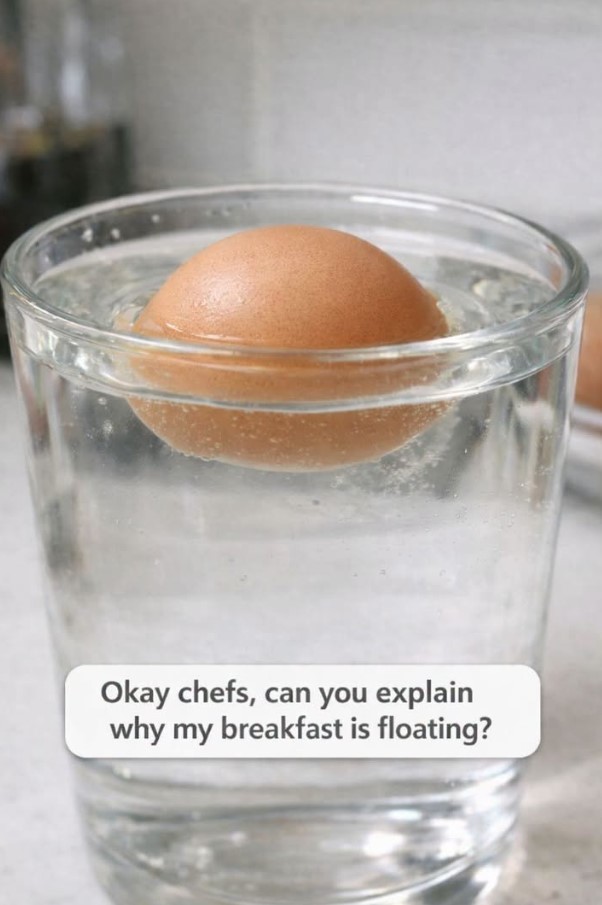
Have you ever dropped an egg into a glass of water and watched it do something unexpected? Instead of sinking neatly to the bottom, it may tilt upward, stand almost vertically, or even rise all the way to the surface. If you’ve never seen it before, the sight can be surprisingly strange.
That simple kitchen experiment is commonly known as the egg float test, and it has become one of those old-fashioned food tips that continues to circulate online. Some people use it to decide whether an egg is fresh, while others treat a floating egg as an automatic sign that it has gone bad.
But the reality is a little more complicated.
An egg’s ability to float is closely connected to what happens naturally inside its shell as it ages. Eggs contain a small pocket of air, and that air pocket gradually becomes larger over time. As the egg loses moisture through the tiny pores in its shell, its overall density changes, making it increasingly buoyant.
So if your breakfast is floating, it doesn’t necessarily mean you have discovered a dangerous egg.
It may simply mean that the egg is older.
Understanding the difference between freshness, quality, and food safety is the key to interpreting what the float test can—and cannot—tell you.
What Is the Egg Float Test?
The egg float test is an extremely simple way to observe an egg’s buoyancy.
All you need is a bowl, glass, or container deep enough to completely submerge the egg and enough water to let it move freely.
Place the uncracked egg into the water and observe its position.
Generally, you may see one of three things:
- The egg lies flat on the bottom.
- The egg stands upright or tilts upward.
- The egg floats toward the surface.
Traditionally, these positions have been interpreted as different stages of freshness.
An egg that lies flat is usually considered relatively fresh. An egg that stands upright is older, while a fully floating egg has typically lost enough moisture that its internal air cell has become significantly larger.
The original article describes this same principle and explains that the test works because the air cell inside an egg expands as the egg ages.
But there is an important point to remember: floating is an indicator of age, not a perfect laboratory test for safety.
Why Does an Egg Float?
The answer comes down to basic science.
When a hen lays an egg, there is already a small air cell inside it. This air pocket forms between the inner and outer shell membranes, usually at the wider end of the egg.
As time passes, an egg naturally loses some moisture and carbon dioxide through microscopic pores in its shell.
The air cell gradually becomes larger.
That larger air pocket changes the egg’s overall density.
Eventually, the egg becomes buoyant enough to rise in water.
This is why an older egg is more likely to stand upright or float than a very fresh egg.
It’s not because something mysterious has suddenly filled the egg with gas. It’s a natural consequence of the egg slowly changing during storage.
What Does a Sinking Egg Tell You?
If an egg sinks and rests horizontally on the bottom of the container, it is generally a sign that the egg is relatively fresh.
A younger egg has a smaller internal air cell, so its overall density remains greater than that of the surrounding water.
That causes it to sink.
However, “fresh” should not automatically be interpreted as “guaranteed safe.” Proper refrigeration, handling, shell condition, and the source of the egg still matter.
The float test is best viewed as a rough freshness clue, not a replacement for proper food-safety practices.
What If the Egg Stands Upright?
An egg that sinks but stands on one end is typically older than one that lies completely flat.
As the internal air cell becomes larger, the egg becomes more buoyant. The wider end may rise while the narrower end remains on the bottom.
This is often considered an intermediate stage.
The egg may still be perfectly usable, depending on how it has been stored and whether it shows any signs of spoilage.
This is one reason the traditional “sink equals good, float equals bad” rule can be misleading.
Eggs don’t suddenly change from safe to unsafe simply because their position in water changes.
Aging is gradual.
What Does a Floating Egg Really Mean?
When an egg floats completely, it has generally developed a larger internal air cell.
That usually indicates that the egg is relatively old.
But age and spoilage are not exactly the same thing.
An older egg can still have no obvious signs of spoilage, while an egg that has been mishandled can become unsafe without necessarily giving you a perfect visual warning.
For that reason, don’t rely exclusively on the float test to decide whether an egg is safe to eat.
Instead, consider the egg’s storage history, condition, smell, and appearance.
And if you’re uncertain, the safest choice is to discard it.
The Most Important Test Happens After You Crack It
If you decide to inspect an older egg, don’t crack it directly into a bowl containing the rest of your ingredients.
Instead, crack it into a separate clean bowl.
This simple habit can prevent one questionable egg from contaminating an entire recipe.
Once cracked, look at the egg carefully.
A normal egg may have:
- A yolk that holds its shape reasonably well
- Egg white that varies in thickness
- A mild or almost nonexistent smell
- Normal coloration appropriate to the egg
An older egg may have a flatter yolk and thinner, more watery whites. Those changes can indicate declining quality, but they don’t necessarily mean the egg is spoiled.
The biggest warning sign is often the smell.
A Bad Egg Usually Makes Its Presence Known
Spoiled eggs can produce an unmistakably unpleasant odor.
A strong sulfur-like or rotten smell is a major reason to stop immediately and throw the egg away.
You don’t need to taste it to find out.
In fact, never taste an egg that you suspect has spoiled.
If the smell is clearly wrong, don’t try to rescue it by cooking it longer, adding spices, or mixing it into another ingredient.
Simply discard it.
It may seem wasteful to throw away a single egg, but that’s preferable to taking an unnecessary food-safety risk.
What About Unusual Colors?
Color changes can also be worth paying attention to.
An unusual appearance, unexpected discoloration, mold, or strange texture should make you cautious.
Not every variation in an egg is dangerous, though. For example, some harmless differences in yolk color occur naturally depending on what the hen ate.
That’s why it’s better to consider the entire picture rather than reacting to one characteristic in isolation.
When an egg smells normal, looks normal, has been stored correctly, and is within an appropriate storage period, the float test alone shouldn’t be treated as proof that it is unsafe.
Does a Runny Egg White Mean It’s Bad?
Not necessarily.
One of the natural changes that occurs as eggs age is that the thick white can become thinner and more watery.
A very fresh egg generally has a thicker white that stays closer to the yolk.
Over time, the egg white’s structure weakens, allowing it to spread more easily after cracking.
That can be a sign that the egg is older.
But again, older does not automatically mean spoiled.
This is an important distinction because many kitchen myths turn gradual quality changes into absolute safety rules.
How Your Refrigerator Affects Egg Freshness
Storage plays a major role in how long eggs maintain their quality.
For refrigerated eggs, keeping them consistently cold helps slow down deterioration.
It’s also a good idea to keep eggs in their original carton.
The carton provides physical protection and can help reduce the egg’s exposure to odors from strongly scented foods.
It also makes it easier to keep track of dates and storage information.
Why the Refrigerator Door Isn’t Ideal
Many refrigerators have molded egg holders built directly into the door.
That might seem like the obvious place to store eggs, but the door is exposed to repeated temperature changes every time it opens.
The main refrigerator compartment tends to provide a more stable environment.
For that reason, keeping eggs in their carton on an interior shelf is generally a better storage practice than storing them in the door.
Keep Eggs in Their Carton
The carton isn’t just convenient packaging.
It helps protect the shells from bumps and helps prevent eggs from absorbing odors from nearby foods.
Eggshells are porous, so strong odors can sometimes make their way through the shell over time.
The carton also keeps the eggs organized and helps you monitor their age.
A little organization in the refrigerator can go a long way toward reducing food waste.
What About Cracked Eggs?
A cracked shell deserves special attention.
Once the protective shell has been damaged, bacteria have an easier route into the egg.
If an egg is cracked before you buy it, it’s generally better to choose another carton.
If you accidentally crack an egg at home, don’t leave it sitting around for days.
Follow appropriate food-safety guidance for handling and refrigeration, and when in doubt, discard it.
Don’t Wash Refrigerated Eggs at Home
Egg washing is another subject that often causes confusion.
In some countries, eggs are washed commercially before reaching consumers, while in other places eggs are sold with their natural protective coating intact.
If you’re buying commercially prepared refrigerated eggs, avoid washing them at home immediately before storing them.
Washing can alter the shell’s natural protective barrier and introduce additional moisture around the shell.
Instead, keep them stored according to the handling instructions provided for the eggs you purchased.
How Long Can Eggs Stay Fresh?
Egg storage life depends on several factors, including whether the eggs are refrigerated, how they were handled, and local food-safety practices.
For refrigerated eggs, quality can remain good for weeks when they are stored properly.
That’s why the date printed on the carton shouldn’t be confused with a precise moment when an egg instantly becomes unsafe.
Dates can refer to different things depending on the country and labeling system, including quality or sell-by guidance.
When using eggs, consider the date together with storage conditions and signs of spoilage.
Should You Trust the Date or the Float Test?
Neither one should be treated as the only factor.
The carton date provides useful information about the product’s age and recommended quality period.
The float test provides a rough clue about the egg’s age based on its buoyancy.
Neither test, by itself, can guarantee that an egg is safe.
Food safety is about more than freshness.
An egg that has been improperly stored can pose a risk even if it sinks. Conversely, an older egg that floats may not necessarily have spoiled.
This is why proper refrigeration and careful handling remain more important than relying on viral kitchen tricks.
Can Older Eggs Still Be Useful?
Yes, older eggs that remain suitable for consumption can be especially useful in certain recipes.
As eggs age, some of their characteristics change, and those changes can actually make them convenient for particular cooking tasks.
For example, older eggs are often easier to peel after hard-boiling because the larger air cell can create more separation between the egg and shell.
They can also work well in baked goods where the egg is combined with flour, sugar, fat, and other ingredients.
Cakes, muffins, pancakes, and other baked recipes can be good ways to use eggs that are no longer at their freshest but are still suitable for cooking.
What About Hard-Boiled Eggs?
Older eggs are traditionally favored by many home cooks for hard-boiling because they tend to peel more easily.
The larger air cell can create a little more separation under the shell, making it easier to get underneath the membrane.
That doesn’t mean you should use a questionable egg simply because you’re boiling it.
Cooking doesn’t make spoiled food safe.
Always inspect the egg before using it and discard anything that shows clear signs of spoilage.
Don’t Let a Viral Kitchen Hack Replace Food Safety
The egg float test is popular because it’s cheap, simple, and visually satisfying.
You don’t need special equipment.
Just fill a container with water and watch what happens.
But social media often turns useful kitchen tricks into absolute rules.
An infographic might say:
Sinks = good.
Floats = bad.
Real food science isn’t always that simple.
The float test is useful for understanding egg age, but it shouldn’t be treated as a definitive safety test.
That distinction is especially important when you’re cooking for children, older adults, pregnant people, or anyone with a higher risk of serious foodborne illness.
A Better Way to Check Your Eggs
Instead of depending on one trick, use a simple checklist.
Step 1: Check the shell
Look for cracks, unusual contamination, mold, or other obvious problems.
Step 2: Check storage
Ask yourself whether the eggs have been refrigerated properly and consistently.
Step 3: Check the date
Use the carton information as one part of your decision.
Step 4: Use the float test if you want a freshness clue
A floating egg is usually older because its internal air cell has expanded.
Step 5: Crack questionable eggs separately
Never mix a questionable egg directly into the rest of your ingredients.
Step 6: Check the smell and appearance
A foul smell or clearly abnormal appearance is a strong reason to discard the egg.
Step 7: When uncertain, throw it away
A single egg isn’t worth gambling with your health.
How to Reduce Egg Waste
Being cautious doesn’t mean you need to throw away every egg that isn’t perfectly fresh.
The better approach is to store eggs properly from the beginning.
Keep them refrigerated, leave them in their carton, avoid unnecessary temperature changes, and use older eggs sooner.
You can also organize your refrigerator so the oldest eggs are easy to reach.
That simple “first in, first out” habit can help prevent forgotten cartons from sitting at the back of the refrigerator until you’re no longer sure when you bought them.
What Chefs Know About Older Eggs
Professional cooks often understand that “fresh” and “useful” aren’t always identical concepts.
An egg that’s a little older may behave differently from one that’s only a few days old.
Its white may spread more quickly, the yolk may sit lower, and its air cell may be larger.
Those differences matter depending on the recipe.
For some preparations, very fresh eggs are desirable because the whites hold their shape better.
For other recipes, especially those involving baking or hard-boiling, slightly older eggs can work perfectly well.
The key is knowing whether you’re dealing with an egg that is simply older or one that has actually spoiled.
The Safest Rule of All
If an egg smells rotten, looks clearly abnormal, has been improperly stored, or otherwise makes you uncomfortable, don’t try to convince yourself that it’s fine.
Throw it away.
There is no prize for successfully eating a questionable egg.
And if you’re preparing food for someone particularly vulnerable to foodborne illness, being conservative with questionable ingredients is even more important.
Conclusion :
So, okay chefs—why is your breakfast floating?
Most likely, because your egg has been aging.
As an egg sits in storage, moisture and gases gradually escape through the tiny pores in its shell. The air cell inside becomes larger, reducing the egg’s density and making it increasingly buoyant. That’s why a fresh egg is more likely to sink flat, while an older egg may stand upright or float.
But here’s the important takeaway: the float test tells you more about an egg’s age than its absolute safety.
A floating egg isn’t automatically a guarantee that the egg is rotten, just as a sinking egg isn’t a guarantee that everything is perfectly safe. Storage conditions, shell condition, smell, appearance, and proper handling all matter.
If you decide to inspect an older egg, crack it separately and pay attention to any obvious warning signs. A strong sulfur-like odor, mold, unusual discoloration, or other unmistakable abnormalities are reasons to discard it immediately.
And if you’re ever genuinely unsure, remember the simplest kitchen rule of all: when in doubt, throw it out.
That one egg may cost you a little money, but avoiding a food-safety problem is worth far more.
So the next time you see an egg bobbing around in a bowl of water, don’t panic. Your breakfast isn’t necessarily trying to escape. It’s simply showing you one small example of the fascinating science that happens naturally inside an eggshell.