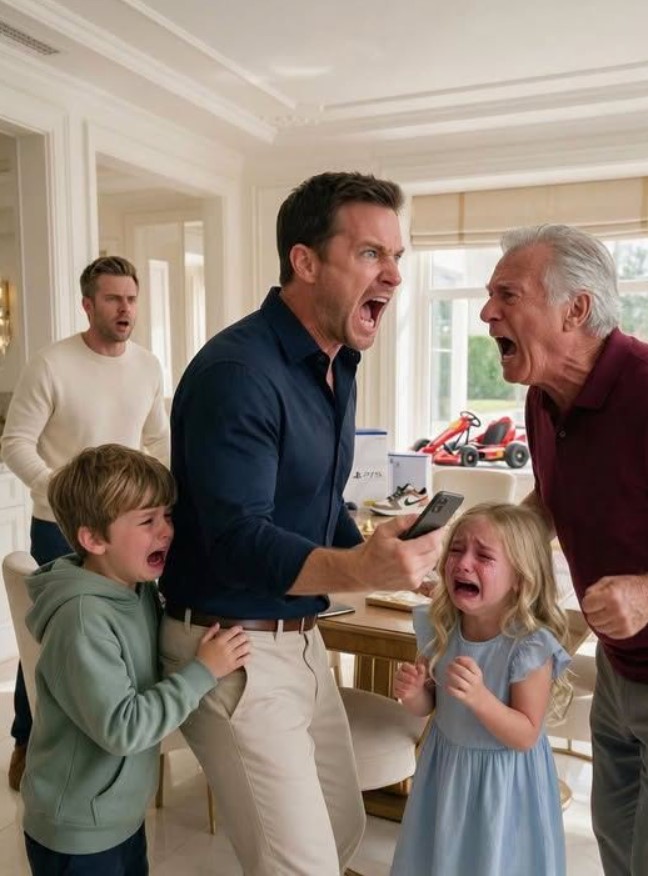
When my father announced that he had sold my children’s birthday presents, he said it casually over Sunday dinner, as though he were telling us he had returned something to a store.
“We sold the bikes and tablets online,” Dad said, cutting into his steak. “We got four thousand six hundred dollars altogether. They don’t need expensive things.”
For several seconds, I sat there trying to understand what I had just heard.
Beside me, my wife, Claire, went completely still. Our nine-year-old son, Ethan, lowered his eyes toward his plate, while his younger sister, Lily, blinked rapidly as she fought back tears.
The presents had been stored in Dad’s garage because Claire and I were renovating our mudroom before Ethan’s birthday. My father had volunteered to keep everything safe until we finished the work.
I had trusted him.
Every item had been purchased with my money. I still had the receipts, and the packages had our family’s name on them. I had never given Dad permission to open them, much less sell them.
Yet there he sat, behaving as though he had done us a favor.
Then my brother Derek’s children came running into the dining room.
Mason was wearing a new pair of designer sneakers, while Tyler proudly carried a PS5 controller. Through the dining-room window, I could see a bright red go-kart parked beside Dad’s fence.
I looked from the children to my father.
“You sold my kids’ presents to pay for all of that?”
Dad shrugged.
“Derek’s boys actually appreciate things. Yours already have enough.”
I wanted to believe I had misunderstood him. Surely, he would realize how cruel those words sounded, especially with my children sitting right there.
But Ethan looked up at his grandfather and asked the question that broke my heart.
“Grandpa, they get fun stuff, but we don’t?”
Dad barely hesitated.
“Yes, buddy. They matter more.”
The room fell silent.
Claire tightened her hand around mine beneath the table. I could feel her trembling, but she managed to keep her voice steady as she told the children to put on their shoes.
Derek leaned toward me and whispered, “Don’t embarrass yourself here.”
I didn’t argue with him. I didn’t shout at my father or demand that he apologize in front of everyone.
I simply stood up, helped Lily put on her coat, and told Ethan to grab his backpack.
Then I turned toward Dad.
“You’re right,” I said quietly. “Some people have too many fun things.”
He smiled as if he had won the argument.
He was still smiling when I opened my banking app.
First, I canceled the remaining payment for the Disney cruise I had arranged for my parents’ anniversary. Then I stopped the automatic transfers that had been covering the mortgage payments on Dad’s beach condo in Gulf Shores.
It was a condo he had proudly claimed to own outright for years.
In reality, I had been helping pay for it for three years.
Dad watched my face change as he realized what I was doing.
“What are you doing?” he demanded.
“Cutting back,” I replied. “You taught me that tonight.”
“You can’t just—”
“I already did.”
Derek pushed back his chair and stood up.
“You’re being petty.”
“No. I’m being consistent.”
Dad began raising his voice. He talked about family loyalty, appreciation, and everything he claimed to have done for me over the years. He insisted that I was making a terrible mistake over a few presents.
I let him finish.
Then I looked him directly in the eyes.
“Sell the go-kart.”
I walked my family outside, helped everyone into the car, and ignored the calls that were already appearing on my phone.
Before pulling away, however, I made one final call.
My father had no idea that the call had nothing to do with the cruise.
The Call My Father Never Expected
I contacted the county sheriff’s office through its non-emergency number.
I wasn’t trying to have my father dragged away in handcuffs. I simply understood that if I did nothing, the story would eventually change.
By the following morning, the sale would become a misunderstanding. Then it would become a family arrangement. Eventually, someone would suggest that I had given Dad permission to sell the items and was now exaggerating the situation because I was angry.
I had seen this pattern before.
The deputy who returned my call asked straightforward questions. Who had purchased the bikes and tablets? Did I have receipts and serial numbers? Had I given my father permission to sell anything? Could anyone confirm that he had admitted selling the items?
I answered every question honestly.
I explained that the presents belonged to my children, that I had kept the receipts, and that my father had openly discussed the sale during dinner in front of several witnesses.
“Save every message,” the deputy advised. “Don’t threaten anyone. We’ll document the complaint and follow up.”
That was the call Dad didn’t know about.
He found out on Monday morning.
At 8:17, my phone rang while I was walking Ethan into school. Dad’s name appeared on the screen, but I silenced the call.
Two minutes later, Derek called.
At 8:23, Mom sent me a message in capital letters.
WHAT DID YOU DO?
I waited until the children were inside the school before reading the rest of the messages.
Apparently, a deputy had visited Dad and asked questions about the online sales. The deputy had also requested information about the buyers.
My father, who had spent the previous evening telling relatives that I had supposedly gifted him the items, suddenly discovered that lying to family members was different from answering questions during an official inquiry.
His first voicemail was furious.
His second sounded nervous.
By the third, he was trying to sound reasonable.
“Ryan, call me. We can fix this. There’s no reason to involve outsiders.”
Outsiders.
That single word told me everything I needed to know.
When Dad accepted my money for the condo, I was family. When he accepted the cruise reservation, I was family. When he needed someone to cover an unexpected expense, I was family.
But when he sold my children’s belongings and used the money to benefit Derek’s household, that was supposedly family business, too.
Only the consequences were outsiders.
Claire found me in the kitchen later that morning, staring at my phone.
“Are you okay?” she asked.
“No,” I admitted. “But I’m done pretending this is normal.”
She nodded.
“Good.”
There was no celebration in her voice. She was hurt, just as I was, but she understood that something had to change.
For years, we had made excuses for my father. We had told ourselves that he was old-fashioned, that he favored Derek because Derek needed more help, or that keeping the peace was worth the occasional disappointment.
But there was a difference between helping one child and deliberately humiliating another.
And there was an even bigger difference between treating adults unequally and telling a nine-year-old boy that he mattered less than his cousins.
I couldn’t erase those words from Ethan’s memory. I could only make sure he didn’t grow up believing they were true.
My Brother Came to My Office
By lunchtime, Derek had shown up at my office.
He didn’t bother sitting down.
“You need to withdraw the complaint,” he announced.
I looked up from my desk.
“I need Dad to return the four thousand six hundred dollars.”
“He spent it.”
“Then he can sell the PS5, the shoes, and the go-kart.”
Derek’s jaw tightened.
“My kids shouldn’t have to lose things because you’re mad.”
I stared at him for a moment, making sure I understood what he was saying.
“You heard Dad tell my son that your children matter more,” I replied. “You told me not to embarrass myself. Don’t come in here now pretending you’re protecting children from adult problems.”
His face turned red.
“That’s not what I meant.”
“It’s exactly what you meant.”
He paced across my office before lowering his voice.
“The condo payment is due Friday. Dad can’t cover it.”
“That sounds like Dad’s problem.”
“You’ve paid it for three years.”
“Voluntarily.”
“He’ll lose the place.”
“Then he owns something he can’t afford.”
Derek looked at me as though I had suddenly become a stranger.
Maybe I had changed. Or perhaps I had finally stopped playing the role my family had assigned to me.
For years, I had been the dependable son. The quiet brother. The person who paid, repaired, booked, covered, and forgave before anyone even had to ask.
Whenever someone needed help, I was expected to provide it. Whenever I needed consideration in return, I was told not to make a big deal out of things.
I had confused being useful with being loved.
That afternoon, I decided I would no longer make that mistake.
As Derek reached the door, I stopped him.
“One more thing.”
He turned around.
“If Dad returns the money, I’ll tell the deputy that he made restitution. But I’m not going to lie for him.”
Derek left without answering.
That evening, Dad finally sent a text instead of another voicemail.
COME TOMORROW. WE’LL SETTLE THIS.
I showed the message to Claire.
She read it twice before looking at me.
“Don’t go alone.”
So I didn’t.
The Go-Kart Was Gone
The next afternoon, Claire came with me when I went to my parents’ house.
The first thing I noticed was the empty space beside the fence.
The red go-kart was gone.
Dad stood near the front door with his arms crossed. Mom was sitting in the living room, looking exhausted. Derek was there, too, sitting on the edge of the sofa with his phone in his hand.
Nobody greeted us warmly.
Dad pointed toward the dining room.
“Let’s get this over with.”
I remained standing.
“Where are my children’s presents?”
He frowned.
“I told you. They’re sold.”
“And the money?”
“It’s gone.”
“Then what exactly are we settling?”
Mom spoke before Dad could answer.
“Your father made a mistake. He shouldn’t have sold the things without asking you, but you didn’t have to involve the sheriff.”
I took a slow breath.
“Mom, he didn’t accidentally sell the presents. He deliberately sold them. Then he spent every dollar on Derek’s children. When Ethan asked why, Dad told him that his cousins mattered more.”
Mom looked down at her hands.
Dad shook his head impatiently.
“I was trying to help Derek. He has two boys, and things are expensive these days.”
“So are things for my children.”
“Your family is doing fine.”
“That doesn’t mean my children deserve less respect.”
Dad opened his mouth, but I continued.
“You could have asked me for money if Derek needed help. You could have spoken to me about it privately. You could even have suggested that we buy something for the boys together. Instead, you took property that wasn’t yours, sold it without permission, and used the money for someone else.”
Derek finally spoke.
“The boys didn’t know where the money came from.”
“I’m not blaming your children,” I said. “They’re innocent in this. But the adults who made these decisions need to take responsibility.”
For the first time, Derek didn’t immediately argue.
Claire stood beside me, her expression calm but firm.
“Ethan and Lily have been asking why their grandfather doesn’t love them as much as their cousins,” she said. “Do you understand what that does to a child?”
Mom’s eyes filled with tears.
Dad looked uncomfortable, but he still seemed more concerned about the investigation than about what he had said to Ethan.
“You’re making me sound like some kind of criminal,” he muttered.
“I’m telling the truth about what happened.”
He pointed toward the empty yard.
“I sold the go-kart. There. Is that what you wanted to hear?”
“Did you sell it to repay the money?”
He hesitated.
“I needed the cash.”
“That wasn’t my question.”
He looked away.
The go-kart had been sold, but Dad wasn’t offering to return the full amount. He was hoping that selling it would be enough to make the matter disappear.
It wasn’t.
I told him that I wanted a written repayment plan for the money he owed me. I also made it clear that the deputy would receive the information about the sale and any repayment arrangements. I wasn’t going to make promises about the investigation or pretend that returning money automatically erased what had happened.
Dad called me cold.
Derek called me unforgiving.
Mom asked whether there was any way we could put the family back together.
I answered her honestly.
“Not by pretending this never happened.”
The Money I Stopped Giving Away
Over the following days, the family pressure intensified.
Relatives called to tell me that parents sometimes made mistakes. Others said I was punishing my mother because of something Dad had done. A few suggested that I should think about how embarrassed my father must feel.
Almost nobody asked how Ethan and Lily were doing.
That told me more than any argument could have.
I kept the receipts, saved the messages, and cooperated with the deputy’s requests. I didn’t post about the situation online or send angry messages to the family group chat. I didn’t need an audience to prove that I was right.
I simply stopped paying for things that weren’t my responsibility.
The condo payments ended. The cruise was canceled, and I reviewed the other recurring expenses I had quietly taken care of over the years.
Some were legitimate arrangements I had chosen to make. Others had gradually become obligations simply because everyone assumed I would continue paying.
I canceled the ones I could no longer justify.
I wasn’t trying to make my parents homeless or leave them without necessities. If a genuine emergency arose, I could decide whether to help based on the circumstances. But I would no longer fund luxuries while my own children were treated as less important.
Dad had always spoken proudly about owning the beach condo. Now he had to decide whether he could afford to keep it without my assistance.
That decision belonged to him.
Meanwhile, Claire and I replaced the birthday presents we could. We didn’t make the children feel responsible for the expense, and we didn’t tell them that their cousins had to lose their belongings to make things fair.
Instead, we explained that Grandpa had made a wrong decision and that adults were responsible for fixing the problems they created.
Ethan listened quietly.
One evening, while we were putting together a small model kit at the kitchen table, he asked me a question I wasn’t prepared for.
“Dad, did Grandpa say that because he doesn’t like me?”
I set the pieces down.
“No, buddy. What Grandpa said was wrong, and you didn’t do anything to deserve it.”
“But he said they matter more.”
“I know. And I’m sorry he said that to you. But your worth doesn’t depend on what Grandpa says or what presents you get. You matter because you’re you. Your sister matters just as much. Nothing about what happened changes that.”
Ethan studied my face, as if he were deciding whether to believe me.
Then he nodded and returned to the model.
It wasn’t a dramatic moment. There was no big speech or instant healing. But I hoped that, little by little, he would understand that the people who loved him should never ask him to compete for basic kindness.
Lily needed reassurance, too. Claire spent extra time with her, listening to her questions and reminding her that she hadn’t done anything wrong.
We couldn’t control what my father had said.
We could control what our children heard at home.
What Happened to the Family?
The sheriff’s office continued handling the complaint according to its procedures. I cooperated and provided the documentation I had. I did not promise Dad that I would make the matter disappear, and I didn’t assume that a repayment agreement would determine the outcome of any official inquiry.
Dad eventually began discussing how he might repay the money. The exact amount and timing would have to be documented rather than settled with another vague promise over dinner.
Our relationship changed permanently.
For a while, Dad insisted that I had betrayed him. He spoke as though the greatest harm in the entire situation was that I had refused to protect him from the consequences of his own choices.
I didn’t argue every time he brought it up.
I had already explained my position.
Derek and I also stopped speaking regularly. He was angry that the condo payments had ended, and he believed I had made life harder for his household. I reminded him that I had never agreed to be permanently responsible for our father’s expenses.
His children weren’t the problem. Neither were mine.
The problem was that the adults had allowed favoritism and entitlement to become normal.
Mom eventually reached out to Claire. She apologized for the way the children had been treated and admitted that she should have spoken up at dinner.
Her apology didn’t repair everything overnight, but it was the first time anyone in my parents’ household acknowledged the harm without immediately asking me to take responsibility for making things comfortable again.
I accepted the apology without pretending that everything was fine.
Trust, I learned, isn’t restored by one conversation. It takes honesty, changed behavior, and time.
Dad still had choices to make about his finances. Derek still had to manage his household without assuming I would cover every shortfall. And I had to learn that setting boundaries with family did not make me cruel.
It made me responsible for my own household.
The Lesson I Never Wanted My Children to Learn This Way
Months later, I thought about that Sunday dinner again.
I remembered the way Ethan had lowered his eyes. I remembered Lily trying not to cry. I remembered Dad’s satisfied smile when he believed he had proved that my children didn’t need the things he had sold.
Most of all, I remembered the words he had spoken without hesitation.
“They matter more.”
I could have shouted at him. I could have turned the dinner into a public confrontation. I could have spent the following weeks trying to convince every relative that I was right.
Instead, I left.
I documented what happened, protected my children, and stopped supporting arrangements that had become one-sided.
That decision wasn’t made because I wanted revenge. It was made because I finally understood that love does not require someone to accept every insult, cover every bill, or forgive every betrayal without accountability.
My father had treated my financial support as though it were his entitlement. He had treated my children’s presents as though they were his property. And he had treated my son’s hurt as though it didn’t matter.
I couldn’t change those choices for him.
I could, however, change mine.
My children didn’t need a grandfather who bought them expensive gifts to prove he loved them. They needed adults who treated them with dignity, protected their feelings, and made it clear that they were never less important than their cousins.
Claire and I could give them that.
The money could be repaid or handled through the proper process. The condo could be kept or sold. The family might eventually find a way to rebuild some of its relationships.
But none of those outcomes would change the boundary I had set.
I would help people when I genuinely chose to help them. I would no longer allow anyone to confuse my generosity with permission to disrespect my family.
And if my father ever wanted a closer relationship with Ethan and Lily, he would have to begin by acknowledging what he had done and showing, through his actions, that his grandchildren mattered.
Because that Sunday night, I didn’t stop loving my father.
I stopped allowing that love to be used against my children.
Sometimes the strongest response to betrayal isn’t a shouting match or a dramatic act of revenge. It’s a quiet decision to stop paying the price for someone else’s behavior.
And sometimes, walking away from the dinner table is the first step toward giving your own family the respect and peace it deserves.
Conclusion :
Family loyalty should never mean accepting dishonesty, favoritism, or financial exploitation. Parents and grandparents can make mistakes, but real reconciliation requires them to acknowledge those mistakes and take responsibility for repairing the harm. In Ryan’s situation, the most important issue was never the bikes, tablets, or the $4,600 alone. It was the message his father delivered to two innocent children—that they mattered less than their cousins. By staying calm, documenting what happened, ending financial arrangements that no longer made sense, and reassuring his children, Ryan chose to protect his household rather than continue a painful pattern. Helping relatives can be an act of love, but it should never come at the expense of your children’s dignity or your own peace of mind. Boundaries do not have to be cruel. Sometimes, they are simply the clearest way to show that love and respect must go hand in hand.