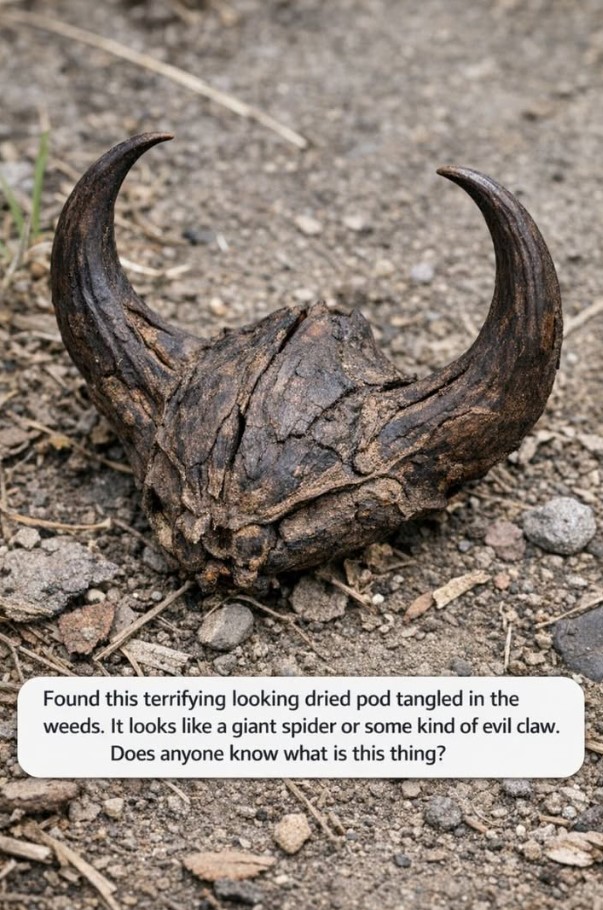
Coming across a strange dried object tangled in weeds can make you stop and stare, especially when it looks less like a plant and more like the remains of some bizarre creature. With its dark, twisted shape and long, curved projections, this particular dried pod can easily be mistaken for a giant spider, an oversized claw, or something straight out of a horror movie.
But despite its frightening appearance, there is a surprisingly ordinary explanation. The object is a dried seed pod from a plant commonly known as Devil’s Claw, associated with the genus Proboscidea. The unusual shape is not accidental. It is part of the plant’s natural strategy for spreading its seeds.
What Is That Strange Dried Pod?
The intimidating object is a mature fruit or seed pod produced by a Devil’s Claw plant. When the fruit is young, it looks considerably less frightening. As it matures and dries, however, its structure becomes hard and develops distinctive hooked projections.
Once completely dried, the pod can look remarkably different from an ordinary fruit.
Those curved extensions are responsible for the “spider” or “evil claw” appearance. When the pod becomes tangled among dry vegetation, it can be especially difficult to recognize as something botanical.
Why Is It Called Devil’s Claw?
The common name makes perfect sense once you see the mature fruit.
The dried pod develops long, curved structures that resemble the fingers or talons of a claw. From certain angles, the entire fruit can look as though it belongs to a strange animal rather than a plant.
The dramatic name is therefore based largely on appearance.
It isn’t evidence that the plant is dangerous or anything supernatural. Nature simply produced a fruit with an unusually memorable shape.
Why Does the Plant Have Those Hooks?
This is the most fascinating part.
The hooks are connected to seed dispersal.
Rather than simply dropping all of its seeds directly beneath the parent plant, the mature fruit can use animals as an unintentional transportation system. The hooked portions can catch onto fur, feathers, clothing, or other surfaces as animals move through vegetation.
The fruit can then be carried away from the original plant.
Eventually, the seeds can be released in another location where they may have an opportunity to grow.
So what looks like an evil claw is actually an ingenious natural adaptation.
How Does a Green Fruit Turn Into Something So Creepy?
The transformation happens gradually.
When the fruit is developing, it is much softer and greener. As it matures, the plant’s fruit becomes increasingly firm and eventually dries out.
The exterior structure becomes more rigid, while the characteristic projections become much more noticeable.
By the time the pod is completely dry, it can look almost nothing like the original fruit.
This is why someone discovering only the dried remains among weeds might have no idea that they’re looking at part of a plant.
Why Does It Look Like a Giant Spider?
Our brains are constantly trying to identify familiar patterns.
When we see a central body surrounded by several long, curved extensions, we naturally compare it to things we already recognize.
That’s why a dried Devil’s Claw pod might remind someone of:
- A giant spider
- A crab
- A scorpion
- An animal claw
- An alien creature
- A strange insect
- A dried sea creature
The resemblance is purely visual, but it can be surprisingly convincing.
The dark color and irregular shape make the illusion even stronger.
Is It Dangerous?
Although the pod may look threatening, its appearance is much more dramatic than its actual danger.
The main reason to handle it carefully is its sharp, hooked structure.
Those projections are designed to catch onto passing animals, so they can also catch on human skin, clothing, gloves, or pet fur.
If you find one, avoid grabbing it bare-handed. A pair of sturdy gardening gloves is a much better option if you need to move or remove it.
Where Might You Find One?
Devil’s Claw and related plants are generally associated with warm and relatively dry environments, particularly parts of the southwestern United States and Mexico.
The plants can appear in disturbed areas, open ground, fields, and places where vegetation has become overgrown.
The dried pods can remain tangled among weeds even after the rest of the plant has become difficult to recognize.
That’s one reason they can seem to appear out of nowhere.
Should You Remove It From Your Yard?
That depends on where you found it and whether you want the plant growing there.
If the pod is simply sitting among weeds and isn’t causing a problem, you don’t necessarily need to do anything.
If you’re trying to prevent the plant from spreading, however, removing mature seed pods before they have a chance to disperse their seeds may be useful.
Wear gloves when handling them because the hooked projections can be surprisingly persistent.
It’s also worth looking around the surrounding area for additional fruits or the parent plant.
What If There Are Several Pods?
Finding one unusual pod is mostly a curiosity.
Finding many of them in the same area suggests that the plant may be growing nearby or has successfully reproduced there.
Look through the surrounding weeds for additional mature fruits or dried stems.
If you’re unsure what plant you’re dealing with, taking a clear photograph of the pod and the surrounding plant can make identification much easier.
Don’t Let the Appearance Fool You
One of the best reminders from discoveries like this is that nature doesn’t always look the way we expect.
Plants can produce fruits that look like animals, flowers that resemble insects, seeds that cling to fur, and structures that appear almost artificial.
Devil’s Claw is a particularly memorable example because its mature fruit looks genuinely strange.
But the frightening appearance serves a practical purpose.
The plant isn’t trying to scare humans. It’s simply using a physical structure that helps move its seeds through the environment.
A Clever Natural Hitchhiker
Think of the dried pod as a tiny natural transportation device.
An animal walking through vegetation brushes against the fruit. The hooks catch onto its fur or feathers. The animal keeps moving, unknowingly carrying the seeds farther away.
Eventually, the fruit becomes detached or breaks apart, allowing the seeds to reach a new location.
From the plant’s perspective, this is an efficient way to expand its range.
What looks terrifying to us is simply an effective evolutionary strategy.
What Should You Do If You Find One?
If you discover one in your yard, don’t panic.
First, observe it without touching it. If you want to identify it, take a photograph from several angles.
If you decide to pick it up, use gloves and handle it carefully.
If you’re trying to remove the plant entirely, look for other mature pods and determine whether additional plants are growing nearby.
And if you’re collecting unusual natural objects, you can certainly keep a dried pod as a botanical curiosity—just store it somewhere secure where its hooks won’t catch on clothing, pets, or children’s hands.
Final Thoughts
That terrifying-looking object tangled in the weeds may initially look like a giant spider, an evil claw, or some mysterious creature, but it’s actually a fascinating example of botanical adaptation.
The dried Devil’s Claw pod gets its bizarre appearance from the hooked structures that develop as the fruit matures. Those hooks have an important purpose: they can attach to passing animals and help transport the plant’s seeds to new locations.
So, the next time you spot one of these strange pods hiding among weeds, take a closer look before assuming you’ve discovered something frightening. Its creepy appearance is simply nature’s way of solving a very practical problem.
Sometimes the strangest-looking “creatures” in the garden aren’t creatures at all—they’re clever little seed pods waiting for their next ride.