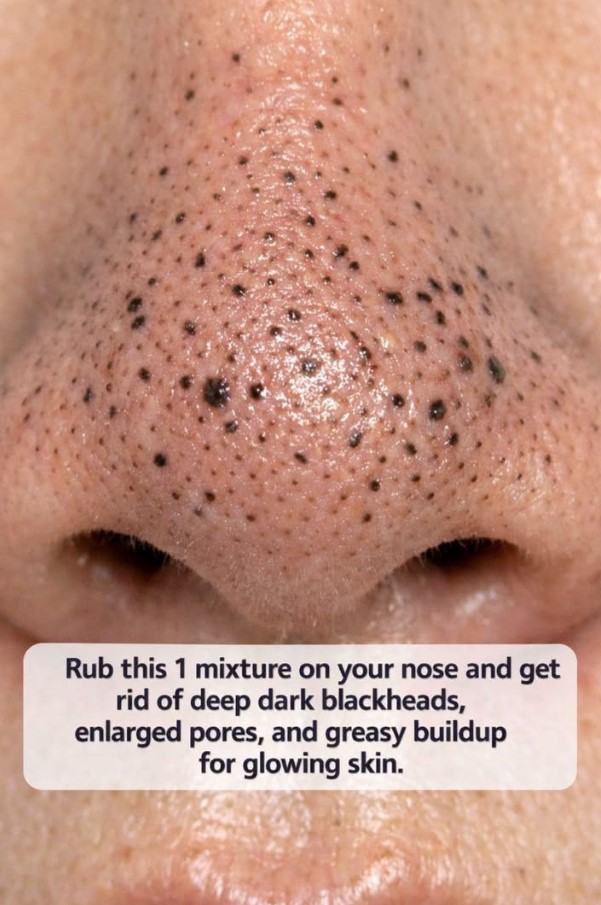
Few things are more frustrating than looking closely in the mirror and noticing that the skin around your nose seems covered with tiny dark dots, visible pores, and a layer of excess oil. You wash your face, try a scrub, and perhaps even use a pore strip, only to find that the problem seems to return a short time later.
The nose is one of the areas of the face most likely to become oily because it contains a high concentration of sebaceous glands. As oil mixes with dead skin cells and other debris, pores can become clogged and more noticeable. What appears to be a collection of stubborn blackheads can also include sebaceous filaments, which are completely normal structures that help move oil through the pores.
That distinction matters because no homemade mixture can permanently erase pores or make them disappear. However, a consistent and gentle skincare routine can help reduce excess oil, improve the appearance of congestion, and leave the skin looking smoother.
The original viral remedy suggests combining baking soda, honey, and water and rubbing the mixture onto the nose. While honey can be a moisturizing ingredient, baking soda is not an ideal facial exfoliant because its alkaline nature can disrupt the skin barrier and cause dryness or irritation.
So instead of treating this as a miracle cure, it is better to understand what actually causes blackheads and how to approach them without damaging your skin.
Why Does the Nose Get So Oily?
The nose tends to produce more sebum than many other areas of the face. Sebum is the natural oil produced by the skin, and it serves an important purpose: it helps protect the skin and prevent excessive moisture loss.
The problem occurs when there is more oil than the skin needs, particularly when oil combines with dead skin cells.
This mixture can collect inside pores and create blockages. When the contents of an open pore are exposed to air, they can oxidize and appear dark. That is what gives a traditional blackhead its characteristic black or gray appearance.
Contrary to a common misconception, the dark color does not simply mean that the pore is filled with dirt.
This is why aggressively scrubbing your nose until it feels completely clean is not necessarily the answer. You can remove some surface oil while simultaneously irritating the skin.
Blackheads Are Not the Only Tiny Dark Dots
Before trying to remove every dot you see, it is worth considering whether they are actually blackheads.
Many people mistake sebaceous filaments for blackheads. Sebaceous filaments are normal and occur naturally inside pores. They are particularly easy to see on the nose because the pores there can be more prominent.
A blackhead is a clogged pore, while a sebaceous filament is part of the skin’s normal oil-transport system.
Sebaceous filaments may become less noticeable when excess oil is controlled, but they naturally refill. This means that squeezing or repeatedly scrubbing them is unlikely to provide a permanent solution.
Understanding this can save you from endlessly attacking your nose in an attempt to achieve completely poreless skin.
The Popular Baking Soda and Honey Mixture
The original remedy calls for baking soda, honey, and water. The suggested preparation uses approximately one tablespoon of baking soda combined with one tablespoon of honey, with a little water added if necessary to create a paste. The article recommends applying the mixture to the nose, leaving it for roughly 10 to 15 minutes, and then rinsing it away.
The attraction is obvious.
The ingredients are inexpensive, easy to find, and probably already sitting in many kitchens.
Honey is also well known for its humectant properties, meaning it can help attract and retain moisture. It has also been studied for various skin-related applications.
Baking soda, however, deserves more caution.
Although it may feel mildly abrasive and can temporarily remove some surface material, facial skin has a naturally acidic environment. Baking soda is alkaline. Applying it repeatedly can potentially interfere with the skin barrier, leading to dryness, irritation, redness, or uncomfortable tightness.
For that reason, baking soda should not be treated as a guaranteed or scientifically established blackhead cure.
A Gentler Alternative for Oily Skin
If your goal is to make the nose look smoother and less greasy, a gentler approach is usually a better choice.
A simple option is to use a mild cleanser followed by a product containing salicylic acid. Salicylic acid is a beta hydroxy acid that is particularly useful for oily and acne-prone skin because it can penetrate into the pore and help loosen accumulated oil and dead skin cells.
Look for a facial product formulated specifically for this purpose rather than attempting to create a stronger concentration at home.
For many people, a product containing a relatively low concentration can be enough to begin improving the appearance of clogged pores.
The key is patience.
A blackhead that has been present for months is unlikely to disappear permanently after one treatment.
How to Clean Your Nose Without Over-Scrubbing
Start with a gentle facial cleanser and lukewarm water.
Avoid extremely hot water. While hot water can feel satisfying when you have oily skin, it can contribute to dryness and irritation.
Massage the cleanser gently over your face for approximately 30 to 60 seconds. Pay particular attention to the sides of your nose, but don’t scrub aggressively.
Rinse thoroughly and pat your face dry with a clean towel.
If you use a salicylic-acid product, apply it according to the product’s instructions. Follow with a lightweight moisturizer.
Yes, even oily skin needs moisturizer.
Removing too much oil and moisture from the skin can leave it feeling tight and uncomfortable. Maintaining the skin barrier is an important part of keeping your routine sustainable.
Why Scrubbing Harder Can Backfire
It can be tempting to attack blackheads with a rough washcloth, sugar scrub, salt, baking soda, or a facial brush.
The logic seems simple: if the pores are clogged, scrub harder to clean them.
Unfortunately, skin doesn’t always respond that way.
Excessive friction can cause irritation and redness. When the protective skin barrier becomes compromised, the area may become dry, flaky, sensitive, or uncomfortable.
You may then find yourself applying more products to fix the irritation you created while trying to solve the original problem.
Gentle, consistent care is usually a better strategy than aggressive treatments.
What About Pore Strips?
Pore strips can be satisfying because they may pull some material from the surface of the nose and create the impression that the pores have been dramatically cleaned.
However, the effect is temporary.
They do not permanently shrink pores, and they do not prevent new oil from entering the pore.
If you enjoy using pore strips occasionally and your skin tolerates them, they may be part of your routine, but they should not be considered a permanent blackhead solution.
For ongoing congestion, a consistent skincare routine is generally more useful.
Don’t Forget Moisturizer
One of the biggest mistakes people with oily skin make is assuming that moisturizer will automatically make their face greasier.
That isn’t necessarily true.
A lightweight, non-comedogenic moisturizer can help support the skin barrier without feeling heavy. Look for a formula that suits your skin type and does not leave you feeling excessively greasy.
After cleansing or exfoliating, moisturizing can help prevent the tight, dry sensation that sometimes follows.
The goal isn’t to eliminate every trace of oil.
Your skin needs some oil to remain healthy.
The goal is balance.
Sunscreen Still Matters
If you’re working on improving the appearance of your skin, sunscreen should not be overlooked.
Use a broad-spectrum sunscreen with an SPF of at least 30 during the day. Sun exposure can contribute to premature skin aging and uneven pigmentation, making texture and discoloration more noticeable over time.
A lightweight sunscreen designed for oily or combination skin may be more comfortable if you dislike heavy products.
Skincare doesn’t stop at treating blackheads. Protecting your skin every day is part of maintaining the results you’re working toward.
Avoid These Common DIY Ingredients
The internet is full of homemade skincare recipes, but “natural” does not automatically mean “gentle.”
Be cautious about applying lemon juice, undiluted vinegar, toothpaste, coarse salt, sugar, or essential oils directly to your face.
These ingredients can cause irritation, especially when applied repeatedly or left on the skin for extended periods.
Baking soda also belongs in the category of ingredients that deserve caution. Although the original article recommends it, its alkaline nature makes it a poor choice for routine facial exfoliation.
When it comes to facial skin, a product specifically formulated and tested for skincare is often a safer choice than experimenting with kitchen ingredients.
How Often Should You Treat Blackheads?
More is not necessarily better.
If you’re using a salicylic-acid product, follow its directions and give your skin time to adjust. Introducing several exfoliating products simultaneously can make it difficult to determine what is helping and what is causing irritation.
A simple routine might include:
A gentle cleanser in the morning and evening.
A lightweight moisturizer.
Daily sunscreen.
A salicylic-acid product several times per week if your skin tolerates it.
The exact frequency depends on the product and your skin’s sensitivity.
If your skin becomes red, painful, unusually dry, or flaky, reduce the frequency or stop the irritating product.
What Results Should You Expect?
One of the biggest problems with viral skincare hacks is unrealistic expectations.
You may see smoother-feeling skin relatively quickly after cleansing or exfoliating, but that doesn’t mean every blackhead has been permanently removed.
The appearance of clogged pores can improve gradually with consistent care.
The source article suggests that noticeable changes may take several weeks of regular treatment. A more realistic way to think about progress is to look for gradual improvements in oiliness, texture, and the number of persistent clogged pores rather than expecting perfectly invisible pores.
Take photographs under similar lighting if you want to compare progress.
You may be surprised by how difficult it is to notice gradual changes when you look at your face every day.
When It Is Time to See a Dermatologist
If blackheads are persistent despite several weeks of consistent skincare, a dermatologist can help determine what you’re actually dealing with.
Sometimes what appears to be simple congestion is part of acne or another skin condition requiring a more targeted treatment.
A dermatologist can also recommend prescription-strength products when appropriate and can perform professional extractions if necessary.
Do not squeeze deep or painful blemishes yourself. Repeated picking can irritate the skin and potentially leave marks.
The Bottom Line on the Viral Mixture
The idea of mixing ingredients from the kitchen and rubbing them onto the nose is appealing because it sounds simple, inexpensive, and convenient.
The original recipe recommends baking soda, honey, and water as a way to address blackheads, oily buildup, and visible pores. However, the claim that this mixture can deeply clean pores, permanently reduce pore size, or eliminate blackheads should be treated cautiously.
Honey can be a pleasant moisturizing ingredient, but baking soda is not something I’d recommend routinely rubbing onto facial skin.
If your goal is clearer-looking, less greasy skin, there are gentler and more predictable approaches available.
Start with a mild cleanser. Avoid harsh scrubbing. Consider a properly formulated salicylic-acid product if it suits your skin. Moisturize afterward and wear sunscreen every day.
Most importantly, remember that pores are a normal part of healthy skin. You don’t need to make them disappear.
The best skincare routine is not necessarily the most aggressive one. It is the routine you can use consistently without leaving your skin irritated.
So, if you look in the mirror and notice those familiar dark dots across your nose, don’t reach immediately for the strongest DIY remedy you can find. Take a gentler approach, give your skin time, and focus on maintaining a healthy barrier.
Clearer-looking skin is a realistic goal. Completely poreless skin is not—and that’s perfectly normal.
Conclusion :
Getting rid of blackheads and excess oil doesn’t have to mean scrubbing your skin aggressively or relying on harsh homemade remedies. While the baking soda and honey mixture may sound like a quick solution, baking soda can be irritating for facial skin, especially when used repeatedly. A gentler approach is usually a better choice for maintaining healthy, balanced skin.
Focus instead on consistent basics: cleanse gently, use a properly formulated salicylic-acid product if your skin tolerates it, moisturize regularly, and protect your face with sunscreen during the day. These simple habits can gradually improve the appearance of clogged pores and excess oil without unnecessarily damaging your skin barrier.
It’s also important to remember that visible pores and sebaceous filaments are completely normal. The goal isn’t to make your nose look perfectly poreless—that isn’t realistic—but to keep the skin clean, comfortable, and healthy.
With patience and the right routine, your skin can look smoother, fresher, and more radiant. Sometimes, the best skincare “hack” isn’t the strongest treatment at all; it’s choosing a gentle routine and sticking with it long enough to let your skin benefit.